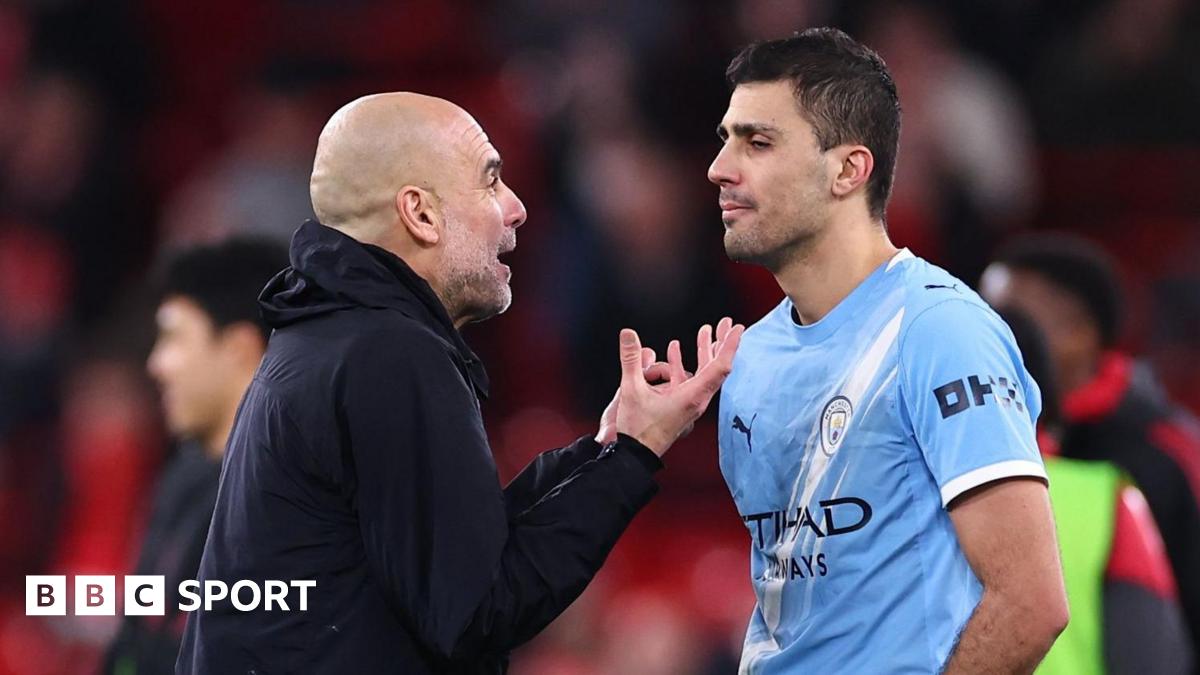
Silva will leave Manchester City after winning the Champions League and six Premier League titles during his nine-year spell.
Published On 6 Apr 20266 Apr 2026
Manchester City captain Bernardo Silva will leave the club at the end of the season, assistant manager Pep Lijnders has confirmed.
“Every good story comes to an end,” Lijnders told reporters after City’s 4-0 FA Cup quarterfinal victory over Liverpool on Sunday.
Recommended Stories
list of 4 itemsend of list
“I hope he enjoys the last months – there are only six weeks left – and has a good farewell. He deserves all that attention.”
The 31-year-old Portugal international, who has won six Premier League titles and the Champions League during nine years at the Etihad Stadium, will depart as a free agent when his contract expires after the campaign concludes.
Pep Guardiola, who was serving a touchline suspension during the match, has previously described Silva as “irreplaceable”.
Silva joined City from AS Monaco in 2017 for a reported fee of about $57.35m and has since made 450 appearances for the club.
Known for his tactical versatility, superb technique and tireless work rate, the midfielder has been a cornerstone of City’s side under Guardiola.
After winning the League Cup last month, City remain in contention for a domestic treble as the 2025-26 campaign enters its final weeks, despite trailing Premier League leaders Arsenal by nine points.
The Manchester club have a game in hand and eight matches remaining to bridge the deficit.
Silva will become the second major player to leave the top four Premier League clubs this season, joining Liverpool legend Mohamed Salah, who confirmed he will exit the defending champions in May.
The 33-year-old Egypt international confirmed the news via a video message on his social media accounts last month.
“Unfortunately, the day has come. This is the first part of my farewell,” Salah said. “I will be leaving Liverpool at the end of the season.”
Signed from AS Roma in 2017, Salah established himself as one of the best players in the club’s history, helping Liverpool to two Premier League titles, the Champions League, FIFA Club World Cup, UEFA Super Cup, FA Cup and two League Cups, as well as an FA Community Shield.
He has scored 255 goals in 435 appearances, making him the club’s all-time third highest goal scorer, during which he won the Premier League Golden Boot on four occasions.
Beyond Paradise fans think Humphrey and Martha will leave Shipton Abbott for good
17:23, 04 Apr 2026Updated 17:43, 04 Apr 2026
Kris Marshall plays Detective Humphrey Goodman(Image: BBC)
Beyond Paradise enthusiasts have voiced a devastating theory that Detective Humphrey Goodman (portrayed by Kris Marshall) will depart the Shipton Abbott police force to protect one of his team members.
During the opening episode of series four, Humphrey was informed by his new superior that, due to budget constraints, he must dismiss one of his colleagues.
One viewer commented on social media, “Could this be his last outing as they are looking to reduce staff? May he goes to save the others?”
Another concurred, “I was thinking the same thing,” while a third speculated, “Could be Humphrey, maybe he and Martha go back to Saint Marie?”, reports the Express.
“I’d love for this to happen,” a fourth enthusiast continued, with another suggesting, “Humphrey leaves to save the station and takes a job in Saint Marie.”
After Friday evening’s second episode, Zoe Williams (Melina Sinadinou) revealed to PC Kelby Hartford (Dylan Llewellyn) her intentions to leave Shipton Abbott and embark on travels to Australia.
Certain viewers also suspect Kelby might ultimately depart to travel alongside Zoe. One fan posted on social media, “Is Kelby going to leave to go travelling with Zoe?”
Another proposed, “Zoe off to Dolphin Cove would be great!!! Kelby in tow even more amazing (as long as he comes back) Poor Esther.”
A third enquired, “Kelby and Zoe off travelling?” Fans were equally quick to spot the nod to Death in Paradise spin-off, Return to Paradise, and were delighted at the possibility of a crossover between the two series.
As Zoe and Kelby crossed paths, Zoe remarked, “Sorry, I was miles away.”
“In Dolphin Cove,” Kelby replied, to which Zoe asked, “Have you been?”
“I wish,” the police officer responded. “It just says there. Sorry, I wasn’t snooping; it caught my eye. It looks like paradise. Are you planning on a holiday?”
“I am thinking about going travelling, seeing a bit of the world,” Zoe replied. “That is what life is about, isn’t it?”
Rodri won the Ballon d’Or in 2024 but missed almost the entirety of last season after sustaining a knee injury and City failed to win a major trophy for the first time in eight years.
He has missed large chunks of this campaign because of a hamstring issue but has played 28 games in all competitions, helping the side to win the Carabao Cup against Arsenal at Wembley.
During his time at City, Rodri has won four Premier League titles, the Champions League, FA Cup and three League Cups.
Rodri previously said to Spanish media: “There have been many players who’ve gone down that path [playing for Atletico and Real].
“Not immediately, but over time. For me, you can’t turn down the best clubs in the world.”
Guardiola said Rodri has shown over time “how attached, how close he is” to City and his “contribution has been massive”.
The manager confirmed he would “absolutely” not stand in the midfielder’s way if he wanted to leave, adding: “The organisation of the club is above all of us – if one player is not happy they have to leave and [we] continue the same always if they are happy – and I think he is happy.
“If he is not happy just knock on the door of the sporting director, accept an offer according to his incredible quality and after that he doesn’t belong to the club – only himself.
“I know what the club wants. They informed me what they want from Rodri – it is to stay, stay, stay. I always had the positive [feeling] with that but at the end I don’t know.”
Chelsea secure a vital three points as they beat Aston Villa 4-3 to go second in the league table and get back on track for Champions League qualification.
• The Academy Awards will move from the Dolby Theatre to L.A. Live in downtown Los Angeles beginning in 2029 under a new agreement with AEG that runs through 2039.
• The shift to L.A. Live will place the ceremony within a larger, campus-style complex, allowing the red carpet, show, press operations and post-show events to be staged in a more centralized footprint with increased capacity.
• The move will coincide with the Oscars’ shift to YouTube, part of a broader reset for the ceremony as it looks to expand its global reach after years of declining television viewership.
The Oscars are leaving Hollywood — or at least Hollywood Boulevard.
Beginning in 2029, the Academy Awards will move from the Dolby Theatre, their home for nearly a quarter century, to L.A. Live in downtown Los Angeles, the Academy of Motion Picture Arts and Sciences and AEG announced on Thursday. The ceremony will be held in the theater currently known as the Peacock Theater, which is expected to be renamed before the Oscars arrive as part of a new naming rights deal.
The new agreement runs through 2039. Discussions about the move have been underway for the last couple of years, according to people familiar with the planning who were not authorized to speak publicly.
The change in venue comes as the Oscars are also moving away from their traditional home on broadcast television. Earlier this year, the Academy announced that the ceremony will begin streaming live worldwide on YouTube in 2029, ending a five-decade run on ABC.
Since 2002, the show has been closely associated with Hollywood Boulevard, where the red carpet runs alongside the Walk of Fame and, for one night a year, the area becomes the symbolic center of the film industry. The Dolby Theatre sits at the corner of Hollywood and Highland, inside a retail and entertainment center near the TCL Chinese Theatre and the El Capitan.
L.A. Live offers a more centralized, campus-style setting, with venues and event spaces clustered together. The complex is adjacent to Crypto.com Arena and the Los Angeles Convention Center and is part of a larger sports and entertainment district developed and operated by AEG that regularly hosts concerts, sporting events and awards shows, including the Emmys and the Grammys. AEG has recently proposed adding a new hotel, residences and additional entertainment space to the complex, part of a longer-term expansion of the site.
In some ways, the move out of the Dolby is less a break than a return: The ceremony was staged for years in downtown L.A. at the Dorothy Chandler Pavilion and at the Shrine Auditorium before settling at the Dolby.
At the Oscars’ new home, the red carpet, ceremony, press operations and post-show events can all be staged within a compact footprint that includes the adjacent JW Marriott hotel and its ballroom. The theater itself is expected to undergo upgrades to its stage, sound and lighting systems, allowing it to be configured more specifically around the show. The move is also expected to increase capacity, a growing consideration as the academy’s ranks have expanded significantly in recent years, now numbering more than 11,000 members.
At the Dolby, space has long been tight. Each year, multiple blocks of Hollywood Boulevard are shut down for days at a time, rerouting traffic and turning the area into a heavily secured zone — conditions that were even more restrictive this year with security tightened further amid the war in Iran, including a one-mile police buffer around the theater.
The Academy had been looking for a venue that offered greater control over how the show is staged, including how the audience is arranged and how the room is used for both the broadcast and the live event. The new venue is expected to provide more room for press areas, green rooms and backstage operations, along with upgraded technical infrastructure for staging the ceremony.
Early design renderings released by the academy suggest that, for viewers at home, the Oscars may not look all that different. The stage retains the sweeping, curved proscenium that has defined the Dolby Theatre era, suggesting a similar visual approach at a larger scale, with expanded screen space and a more immersive ceiling design.
For both the academy and AEG, which owns and operates the complex, the appeal is in keeping everything in one place — arrivals, ceremony, the Governors Ball and afterparties — rather than spreading events across multiple locations. The setup also creates new opportunities for hospitality and sponsorship tied to the broader campus.
“L.A. Live was built to host the moments that define culture and there is no greater global stage than the Oscars,” said Todd Goldstein, AEG’s chief revenue officer. “Together, we will create an environment that celebrates creativity, honors excellence and delivers an unforgettable experience for movie fans everywhere.”
Taken together, the changes amount to a significant reset for the Oscars, which have seen their audience decline from more than 40 million viewers in the late 1990s to 17.9 million this year, down 9% from the previous year. Moving to YouTube offers a way to reach a broader, more global audience at a time when traditional television viewership has declined.
The Oscars will remain at the Dolby through the 100th ceremony in 2028 before making the transition the following year.
“For the 101st Oscars and beyond, the Academy looks forward to closely collaborating with AEG to make L.A. Live the perfect backdrop for our global celebration of cinema,” Academy Chief Executive Bill Kramer and President Lynette Howell Taylor said in a statement.
Salah has played a key role in reviving Liverpool‘s fortunes on the pitch during the past nine years.
He helped the club to two Premier League titles, the Champions League, Fifa Club World Cup, Uefa Super Cup, FA Cup and two EFL Cups, as well as the Community Shield.
Salah’s tally of 255 goals in 435 appearances for the Reds has him third in the pantheon of all-time leading goalscorers for the club, behind Ian Rush (346) and Roger Hunt (285).
He has won the Premier League golden boot on four occasions and been named the Professional Footballers’ Association player of the year three times – in 2018, 2022 and 2025.
Salah also hailed the support he has received from Liverpool fans who “showed me through the best time of my career” and also “stood by me in the toughest times”.
“It’s something I will never forget and something I will take with me always. Leaving is never easy,” he added.
“You gave me the best time of my life, I will be always one of you. The club will always be my home, to me and to my family. Thank you for everything. Because of all of you I will never walk alone.”
Liverpool said that Salah’s time at Anfield had been a “remarkable nine-year chapter” and plans to show their appreciation will come at a later date.
“With plenty still left to play for this season, Salah is firmly focused on trying to achieve the best possible finish to the campaign for Liverpool,” the club added.
“Therefore, the time to fully celebrate his legacy and achievements will follow later in the year when he bids farewell to Anfield.”
This is the April 21, 2021, edition of the Essential Politics newsletter. Like what you’re reading? Sign up to get it in your inbox three times a week.
Outgoing presidents often leave decisions for their successors to take on.
Over the last two decades, and four presidents, how to end America’s longest war — in Afghanistan — has been among the largest open questions. President Biden inherited it from President Trump, who inherited it from President Obama, who took it from President George W. Bush. Unpopular, seemingly unending and unwinnable, the war is a case study in how the choices of one administration echo into the next.
Last week, Biden formally announced a deadline of Sept. 11 — the 20th anniversary of the terrorist attacks that provoked the U.S. invasion of Afghanistan — to end military involvement in the country.
“War in Afghanistan was never meant to be a multigenerational undertaking,” he said.
The prospective exit also has been years in the works. Obama promised to scale back U.S. involvement, but first he sent a surge of troops. Trump vowed several times to withdraw all troops, making chaotic progress that stopped short of a full exit. Biden is now the third president to make a similar commitment.
Whether he will follow through remains to be seen. My colleagues David S. Cloud and Tracy Wilkinson have extensively covered the American involvement in Afghanistan, from Trump’s growing tensions with the Pentagon over withdrawal to the lives of Afghanistan’s youngest generation, which was born into U.S. occupation.
Taken together, their work over the last few years reveals the deep roots of Biden’s promise, and the complicated history that will color his path forward.
Get our L.A. Times Politics newsletter
The latest news, analysis and insights from our politics team.
By continuing, you agree to our Terms of Service, which include arbitration and a class action waiver. You agree that we and our third-party vendors may collect and use your information, including through cookies, pixels and similar technologies, for the purposes set forth in our Privacy Policy such as personalizing your experience and ads.
The long path to leaving
January 2017: A president who promised peace leaves office after eight years of war
During his first presidential campaign, Obama pledged to end the war in Afghanistan, as well as in Iraq. He ended his presidency as the first two-term president to see U.S. forces at war for all eight years.
Experts saw his legacy as mixed. He did reduce the number of troops in Afghanistan, cutting their ranks to 8,400, and his administration reduced American deaths — if not Afghanis’ — by relying on diplomacy and on drones to launch airstrikes. Yet intelligence officials said the U.S. faced more threats in more places than the country had seen since the Cold War. “We’re now wrapped up in all these different conflicts, at a low level and with no end in sight,” one expert told The Times.
August 2017:Trump presides over a stalemate and negotiated settlement
Trump the candidate ran as a tough-on-the-Taliban leader, promising a hard-fought and fast victory to end U.S. engagement. But Trump the president softened when it came time to reveal formal plans, Cloud and Wilkinson wrote with former Times reporter W.J. Hennigan. Fighting continued — to show U.S. forces could not be pushed out — while Trump promised that the 16-year war might end “some day” in a negotiated settlement. It was an acknowledgment that victory would elude a president who loved to win and refused to concede defeat.
“This entire effort is intended to put pressure on the Taliban, to have the Taliban understand you will not win a battlefield victory,” then-Secretary of State Rex Tillerson said. “We may not win one, but neither will you. So at some point, we have to come to the negotiating table and find a way to bring this to an end.”
By February 2018, the Trump administration proposed a defense budget that increased spending in Afghanistan by almost $2 billion, for a total of $48.9 billion in the next fiscal year.
December 2018:Trump presses for peace talks and announces a withdrawal of half of troops
That month, a series of announcements signaled Trump’s growing dissatisfaction with involvement in Afghanistan. Increased Taliban attacks had caused hundreds of Afghan civilian and military casualties a month, prompting Trump administration officials to press for a cease-fire agreement, but with dim prospects, Cloud wrote.
Less than two weeks later, administration officials announced a drastic plan: withdraw up to half of the 14,000 American troops serving in Afghanistan, potentially by summer. The backlash was swift from U.S. lawmakers, allies and even the Pentagon. Defense Secretary James N. Mattis was so furious that Trump would abandon allies in Syria and Afghanistan that he resigned in protest, as Cloud reported.
February-May 2020: A truce and a landmark agreement to withdraw
With 12,000 troops still in Afghanistan, the Trump administration brokered a temporary deal with the Taliban to reduce violence for a week in February, Wilkinson reported. The test was a success, and on Feb. 29, U.S. and Taliban officials signed an accord to end the war. The Taliban would prevent Al Qaeda and other terrorist groups from using Afghan territory to threaten the U.S., without renouncing its terrorist ties. In return, the U.S. would withdraw its troops within 14 months, setting a deadline of May 1, 2021.
The plan again drew backlash, from former Trump and Obama administration officials, who warned a complete withdrawal could backfire, Cloud, Wilkinson and Stefanie Glinksi reported. Even as conflict continued between the Taliban and the Afghan government into May, the Trump administration remained committed to removing troops.
November 2020: Hopes of exiting before the election dashed
Trump, hoping that a full exit in 2020 would boost his reelection prospects, made clear to advisors that he cared little about conditions in Afghanistan, Cloud and Wilkinson reported. He wanted out, period. By July, the number of troops on the ground had shrunk to 8,600.
But as the peace talks the U.S. hoped to broker struggled to get off the ground, administration officials said about 4,000 troops would have to remain into November. The Pentagon said too rapid a withdrawal would doom the talks, invite violence and cause American forces to have to abandon valuable equipment. Trump said he wanted a withdrawal by the end of his term in January, and in November — as he refused to concede his loss to Biden — he ordered troop levels reduced in Iraq and Afghanistan, to 2,500 in each country.
Trump’s relationship with Congress further deteriorated in December, in part over the bipartisan pushback to his withdrawal plans. It was among the reasons he cited in vetoing the annual National Defense Authorization Act, Cloud and Jennifer Haberkorn wrote.
April 2021: Biden says it’s “time to end the forever war.”
When Biden took the oath of office on Jan. 20, 2,500 troops remained in Afghanistan. But the new president faced the decision of whether to honor Trump’s May 1 deadline for withdrawing them — the final exit from the war, Cloud wrote. Once again, Defense Department officials pressured the president to delay a full withdrawal as the deadline the Trump administration negotiated with the Taliban approached.
On April 14, Biden made his decision public: The drawdown would proceed, but not so quickly. The U.S. would fully exit by Sept. 11, Cloud and David Lauter wrote.
“I am now the fourth United States president to preside over an American troop presence in Afghanistan. Two Republicans. Two Democrats,” Biden said. “I will not pass this responsibility onto a fifth.”
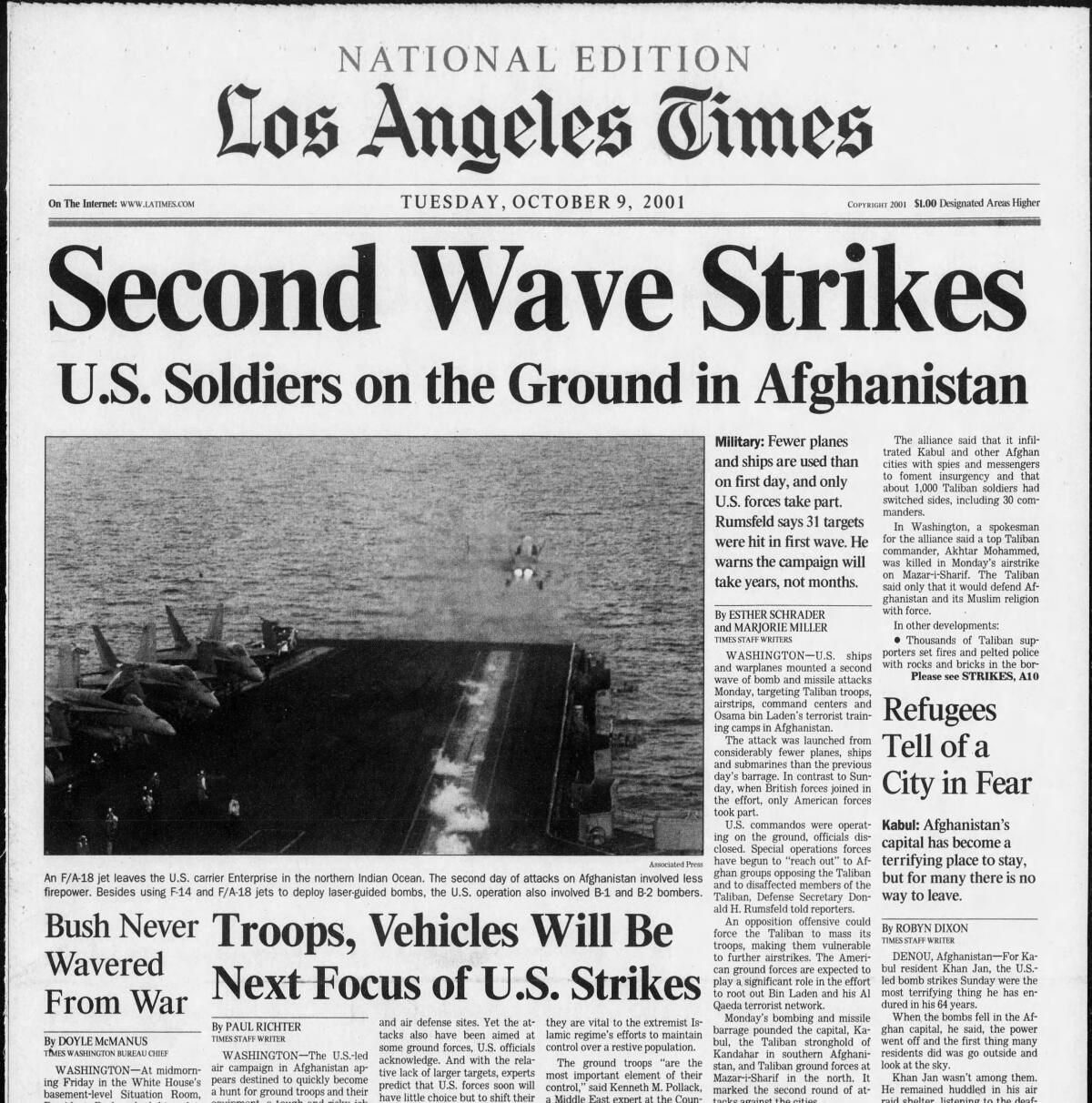
The top half of the front page of the Los Angeles Times on Oct. 9, 2001.
(Los Angeles Times)
Enjoying this newsletter? Consider subscribing to the Los Angeles Times
— The conviction of former Police Officer Derek Chauvin for the murder of George Floyd reenergized a push for sweeping criminal justice reform by President Biden and leading Democrats, who said Tuesday’s verdict was just the first step on the path to national healing, report Evan Halper, Eli Stokols and Sarah D. Wire.
— Anticipating an uproar, Facebook said it would crack down on violent content, hate speech and harassment ahead of the Chauvin verdict. But as Brian Contreras reports, critics are wondering why the platform doesn’t take those precautions all the time.
The latest on the environment
— China, Japan and South Korea are the world’s biggest funders of coal-fired power plants around the globe — and the Biden administration is looking to win their agreement to deep cuts in their greenhouse gas emissions by the end of the decade, write Anna M. Phillips and Wilkinson.
— Biden will convene leaders from around the world on Thursday and Friday as he marks the United States’ return to the global fight against climate change, Chris Megerian writes. Three people with knowledge of the White House plans say Biden will pledge to cut U.S. greenhouse gas emissions at least in half by 2030.
— Solar panels, wind turbines and electric cars will go far in helping California and the Biden administration meet their aggressive climate goals — but not far enough. As time runs short, scientists and government officials say the moment to break out the giant vacuums has arrived, Halper writes.
More from Washington
— Vice President Kamala Harris traveled to North Carolina on Monday to talk about economic opportunities and electric school buses as part of the Biden administration’s efforts to promote its roughly $2-trillion infrastructure, clean energy and jobs plan, Noah Bierman writes.
— The Supreme Court is weighing whether immigrants granted temporary protected status can get green cards — and if the Biden administration will make that decision, David G. Savage reports.
— The Justice Department has brought charges against hundreds of people who stormed the Capitol during the Jan. 6 riot, but one of its most pivotal potential cases involves a man who never set foot inside the building, writes Del Quentin Wilber.
— After Jan. 6, many of the nation’s largest corporations pledged that they would suspend donations to elected officials who opposed the certification of Joe Biden’s victory, hindered the peaceful transfer of power or incited violence. The vast majority kept their word, report Seema Mehta, Maloy Moore and Matt Stiles.
— What is there left to say about House Speaker Nancy Pelosi? Plenty, it turns out. In a new biography, Pelosi dishes on chiding Rep. Alexandria Ocasio-Cortez and using the nickname “Moscow Mitch,” writes Wire.
Other money-saving tips include leaving jewellery and laptops in the UK
12:02, 17 Mar 2026Updated 12:03, 17 Mar 2026
Britons urged to ‘leave watch at home’ this summer to save hundreds
Specialists at travel insurance firm Staysure have revealed the key factors that determine insurance prices and provided guidance on cutting costs when arranging your travel cover this summer. Travel insurance premiums can vary considerably depending on numerous factors, including existing medical conditions, age and your chosen destination.
Luckily, holidaymakers can slash costs by avoiding travelling with expensive valuables. The travel specialists recommended always “leave expensive valuables such as laptops, watches and jewellery at home”.
This is because “adding protection for valuable items, such as cameras or precious watches and jewellery, will push premiums higher”.
“If you need to insure expensive gadgets like cameras or valuables like watches and jewellery, your premium will be higher as there are pricier sums involved.
“Travelling without these items can help to lower the cost of your travel insurance policy and means you are at less risk of losing them,” reports the Express.
Premiums increase with age due to higher illness risk, especially for those aged over 65. Existing medical conditions are equally important as they raise the probability of needing emergency medical care abroad.
The specialists emphasised it is vital to consistently “declare all of your pre-existing medical conditions to ensure your policy is valid, should you need to make a claim”. Trip length and location also affect insurance costs, as extended holidays raise the chances that travellers might need emergency medical care.
Cover works out cheaper for countries deemed low risk, such as Spain, whilst high-risk destinations such as Sri Lanka may attract higher premiums due to repatriation costs.
The experts recommended opting for a lower-risk destination to cut expenses. “A change of country could save you hundreds. For example, a holiday to Paris will usually cost you less in insurance premiums than a trip to New York.
“It’s also important to check the country you are travelling to will be covered by your travel insurer. Some places in the world are considered too high risk.”
The village was evacuated in 1943 when residents were given just one month to leave – now frozen in time, it’s a haunting tourist attraction
The abandoned church in the ghost village of Tyneham in Dorset, where locals left a heart-wrenching note(Image: Getty Images/iStockphoto)
A deserted Dorset village stands as a unique place in Britain, a relic from the past that hasn’t been erased from memory. Tragic events forced inhabitants to abandon their cherished homes many decades ago.
Tucked away on Dorset’s breathtaking Jurassic Coast, a visit to Tyneham village feels like travelling through time. Visitors can catch a window into the existence of the residents who were compelled to desert the village during the Second World War.
It was 1943 when the thriving settlement of Tyneham saw their world turned upside down forever. Britain was deep into World War Two when the military commandeered the village for training operations.
This meant heartbroken locals were handed just one month’s warning to evacuate their properties where countless families had resided for centuries.
The wartime government seized Tyneham village and its surrounding territory to establish a training facility for the Allied forces, due to its proximity to the Lulworth firing range.
Residents were convinced they were sacrificing their properties for the nation’s benefit and expected to come back after the war ended.
A message was attached to the church door, which stated: “Please treat the church and houses with care. We have given up our homes where many of us have lived for generations, to help win the war to keep men free. We will return one day and thank you for treating the village kindly.”
Tragically however, the villagers were never able to return to their homes in Tyneham as even after World War Two concluded, the village and surrounding area remained a training ground for military exercises.
Today the village, still preserved in time after more than 80 years, serves as a ‘thought-provoking and interesting’ visitor attraction. It welcomes guests at certain periods throughout the year and tourists praise its ‘fascinating insights into the lives of residents’.
When the village closes to visitors, the gates preventing entry are secured at dusk each evening.
One TripAdvisor review states: “This deserted village has such an interesting history. The boards within the church detailing the villagers fight to be allowed to return to the village and the current position are very moving.”
Another TripAdvisor user called it ‘a wonderful place – very atmospheric and sad but in a way that keeps drawing you back to visit’.
Tyneham’s final resident, Peter Wellman passed away aged 100 in April this year – the centenarian made one last journey to the village in 2024, to revisit the location where he was born and raised.
During his 2024 visit to Tyneham, Peter recalled his early years, telling the Dorset Echo at the time: “We had no electricity, no mains gas and no running water – we had to pump that from near the church.
“I remember going to the beach and fishing and we often had mackerel. We were happy until we got moved out.”
Tyneham village sits within the Isle of Purbeck, though it’s not truly an island but rather a peninsula surrounded by the English Channel in Dorset.
Despite the miserable weather, it wasn’t quite a storm in Dublin on Thursday, but one is quietly brewing for Saturday night when James ‘Jazza’ Dickens puts his WBA super-featherweight world title on the line against Anthony Cacace in the city’s 3 Arena.
As is the way, there were no bold statements or gimmicks from either at Thursday’s final press conference as their no-frills approach to the fight game ensured the exchanges were complimentary rather than confrontational.
Described as Cinderella Man v Cinderella Man, the pair have travelled rough terrain to get here and that is what sets this up perfectly.
Both have had their setbacks in boxing, with 34-year-old Dickens falling short in world title fights at super-bantamweight and featherweight before getting his hands on the gold when upgraded from the ‘interim’ title he won against Albert Batyrgaziev last summer.
Cacace, 37, endured years of disappointment before stopping Joe Cordina for the IBF version in May 2024, opting to vacate in order to face Leigh Wood in Nottingham last year.
“Until that first bell, all of this [build-up] is just nonsense and we have to sit here and talk,” said Liverpool’s Dickens.
“We just like to fight, but this is part of the business. I think we both just want to get in there and get the respect, throw some punches and shake hands after.”
Cacace is cut from the same cloth, with the Belfast man fully aware of what it has taken the champion to get here considering he has travelled a similar road.
“There is no point sitting here and saying ‘I’m going to do this and that’ because we are fighters and one punch can change everything,” Cacace said.
“I know Jazza has a big heart, same as me. We’re pretty similar in terms of career, so I fully respect Jazza for what he’s done in his career. He’s here for the same reason as me – to put food on the table for his family and that’s the bottom line.”