learn

Bob Chesney says UCLA will learn from ugly loss to USC

The Chesney Train derailed.

In a must-win game, No. 9 UCLA squandered its best opportunity at making the Big Ten championship game and College Football Playoff, getting walloped 45-10 by crosstown rival No. 15 USC Saturday afternoon in front of an almost sold out crowd at the Rose Bowl.

“I talked to [athletic director] Tim Harris after the game, and he said you picked a bad day to have a bad day, and we definitely had a bad day,” UCLA coach Bob Chesney said. “A lot of things that were uncharacteristic. It needed to be our absolute best. We understood that it needed to be an uncommon effort, and we needed to make some tough plays and we didn’t do any of that.”

After starting the season 10-0 and claiming the No. 4 slot in the CFP rankings, the Bruins have lost two straight and must wait to learn their postseason fate with the wrong kind of momentum.

“I do know our future at this moment is no longer in our hands, but I know that if we are given the opportunity, I know what these guys will do, and if there’s a team that could rebound from something like this, it is 100% this team,” Chesney said. “I’m excited to watch this film and learn a lot from it.”

The Battle for Los Angeles looked to be settled before the end of the second quarter. USC dominated every facet of the game, bringing the edge, tenacity and toughness one would think UCLA would have in a win-and-in affair against its biggest rival.

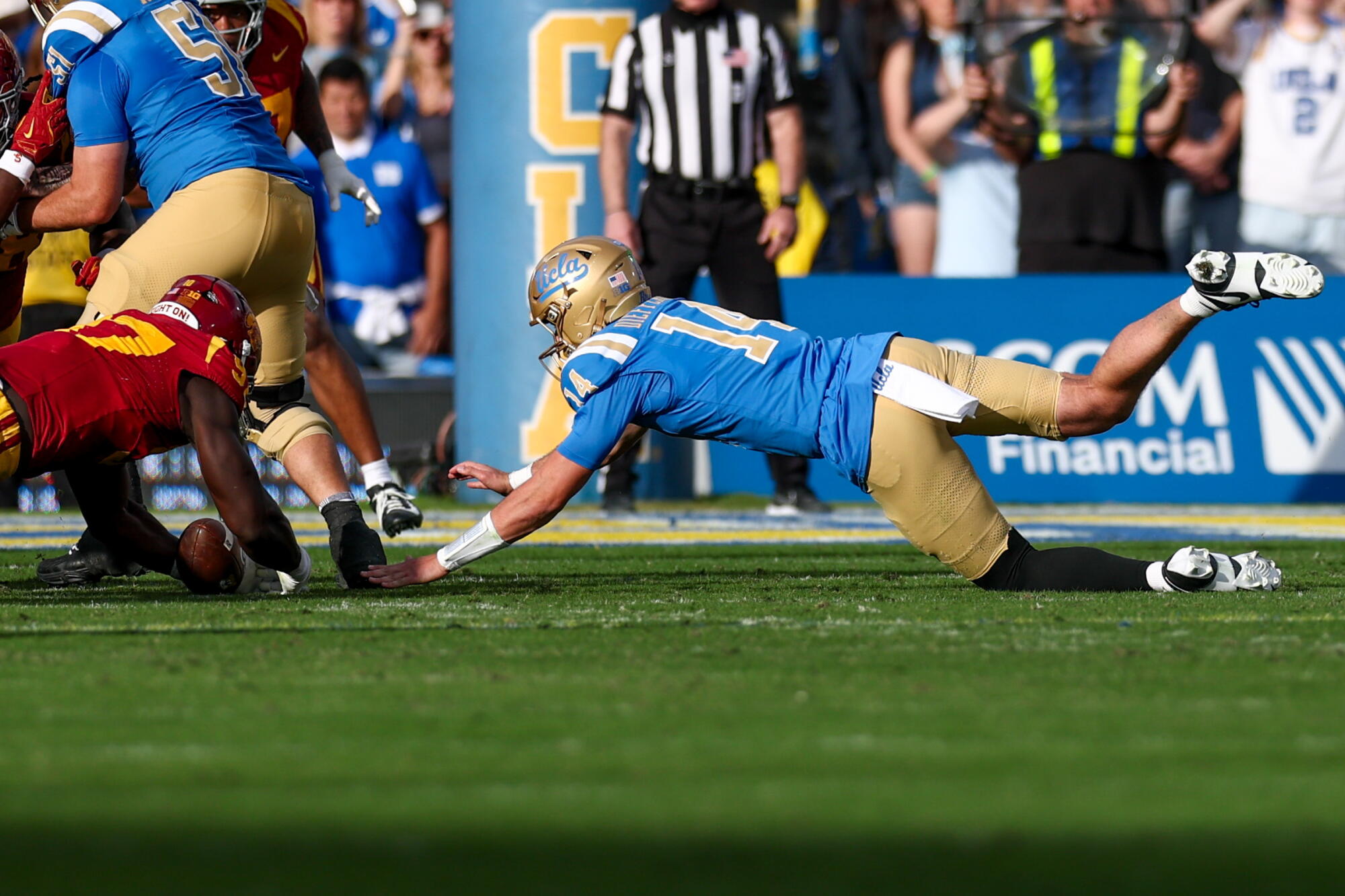
UCLA quarterback Ty Dieffenbach dives for a ball he fumbled as USC defensive tackle Jide Abasiri grabs it.

UCLA quarterback Ty Dieffenbach dives for a ball he fumbled as USC defensive tackle Jide Abasiri grabs it at the Rose Bowl on Saturday.

(Ronaldo Bolanos/Los Angeles Times)

Consequently, USC reached the end zone on each of its first four drives, taking a 14-0 lead before UCLA even earned a first down, and a 28-3 lead heading into halftime. The 14-point lead the Trojans took to start the game was the largest deficit the Bruins had faced all season.

“It’s the first time you’re there. Did it rattle them? I don’t know if it necessarily rattled them. There were things that we had to try to tighten up, and we were not able to do that for whatever reason,” Chesney said. “… It was just a lot of unfortunate things that occurred. And again, hats off to [USC]. They played a very physical, their best brand of football up to this point, this year.”

Defensive coordinator Colin Hitschler’s unit — a defense that ranked in the top 10 in scoring, rushing and total defense heading into the game — was picked apart from the beginning to the end.

USC running backs King Miller and Waymond Jordan combined for 173 rushing yards and four touchdowns, averaging 4.1 and 6.5 yards per carry, respectively.

“They were doing a good job of just getting double teams up and just controlling the line of scrimmage, and we have to do a better job stopping the run,” UCLA linebacker Sammy Omosigho said. “That’s simply how it is. When a team can run the ball, that opens up the pass, opens up the play action. Our main focus was to stop the run and we didn’t get it done today.”

Although quarterback Jayden Maiava threw for just 179 yards, the signal caller carved up UCLA’s secondary, finding open receiver after open receiver for easy first downs, continuing drives and preventing the “Bruin Bullies” from leaving the field.

UCLA’s defensive line did not help its secondary, failing to create any pressure in the pocket and allowing Maiava to sit back, be patient and allow routes to open up downfield. The Bruins finished the game without a sack and just one quarterback hit.

“They did a really nice job of pre-snap reads and understanding the numbers game and putting the ball where we weren’t,” Chesney said. “They were not looking for the big shot, I don’t know if they took one over the top, it was really them taking what we were giving them and at the same point in time committing to the run.”

USC defensive end Luke Wafle knocks the ball out of the hands of UCLA quarterback Ty Dieffenbach at the Rose Bowl.

USC defensive end Luke Wafle, left, knocks the ball out of the hands of UCLA quarterback Ty Dieffenbach at the Rose Bowl on Saturday.

(Allen J. Schaben/Los Angeles Times)

The Bruins’ offense sputtered and failed to ignite, scoring just 10 points — matching the Bruins lowest output since last season, which also came against USC.

Quarterback Ty Dieffenbach returned a week after getting carted off the field in Ann Arbor, Mich., but the signal caller struggled. Dieffenbach was responsible for five turnovers, three interceptions and two fumbles. Two giveaways came in the red zone and one backed up in Bruin territory.

UCLA’s three running backs could not offset Dieffenbach’s difficulty passing the ball, running for just 47 yards. The Bruins have recorded less than four yards per carry during the past three games.

“The best teams have to be able to run the ball, have to be able to stop the run, and have to win the turnover battle. We didn’t do either of those three things today,” Chesney said. “So that’s why we’re looking at the scoreboard and why it looks like it looks. Is that a matter of scheme? Is that a matter of technique? Is that a matter of personnel? Those are all things we have to evaluate.”

UCLA's Donavyn Pellot, Drew Spinogatti and Sammy Omosigho pursue USC receiver Trent Mosley at the Rose Bowl on Saturday.

UCLA’s Donavyn Pellot, left; Drew Spinogatti, middle; and Sammy Omosigho pursue USC receiver Trent Mosley at the Rose Bowl on Saturday.

(Allen J. Schaben/Los Angeles Times)

Chesney doubled down after the game, calling Dieffenbach the best option to play against USC. The coach said he believes players should not lose their jobs because of injuries if they are medically cleared to return.

Receiver Semaj Morgan seemed to be the sole Bruin to deliver a productive day, catching nine passes for 132 yards and a touchdown — career bests in both receptions and yards.

“My mindset is always just never quit. Always go as hard as possible. I just try to get my teammates on that same wavelength,” Morgan said. “A loss is going to happen, it’s the game we are in. We just got to learn how to keep going forward. And Coach Chesney does a great job of telling us how quickly we can get to the next play.”

Regardless of whether or not UCLA plays in the Big Ten title game, Chesney emphasized that he believes his team is capable of success in the College Football Playoff.

“What showed up out there today is obviously not a great sign of that,” Chesney said. “I look across the board and the teams that we played, and the way that we played, and the belief that we have, and the toughness that we’ve displayed, ultimately the adversity that we faced and overcame. Those are all things that a championship level team is built with.”
Source link

USC aims to learn from past mistakes entering big game at Indiana

After USC’s bye earlier this season, the Trojans flopped.

They lost 24-7 to unranked Wisconsin. Quarterback Jayden Maiava passed for 257 yards, one touchdown and two interceptions. USC’s rushing game was held to minus-18 yards, while the offense averaged 3.2 yards per play.

The experience changed the way coach Lincoln Riley approached the team’s second bye week leading into No. 18 USC’s big game at No. 9 Indiana (8-1, 5-1 Big Ten) on Saturday. If the Trojans (7-2, 4-2) win, they keep their College Football Playoff hopes alive. A loss would eliminate USC from playoff contention.

“We were on the field more last week, certainly than we were the first time around,” Riley said of his team’s workouts during the bye. “We handled the weekend a bit differently, both with players and staff, and I think we came into this week with probably more good work under our belt and a little bit more prepared.”

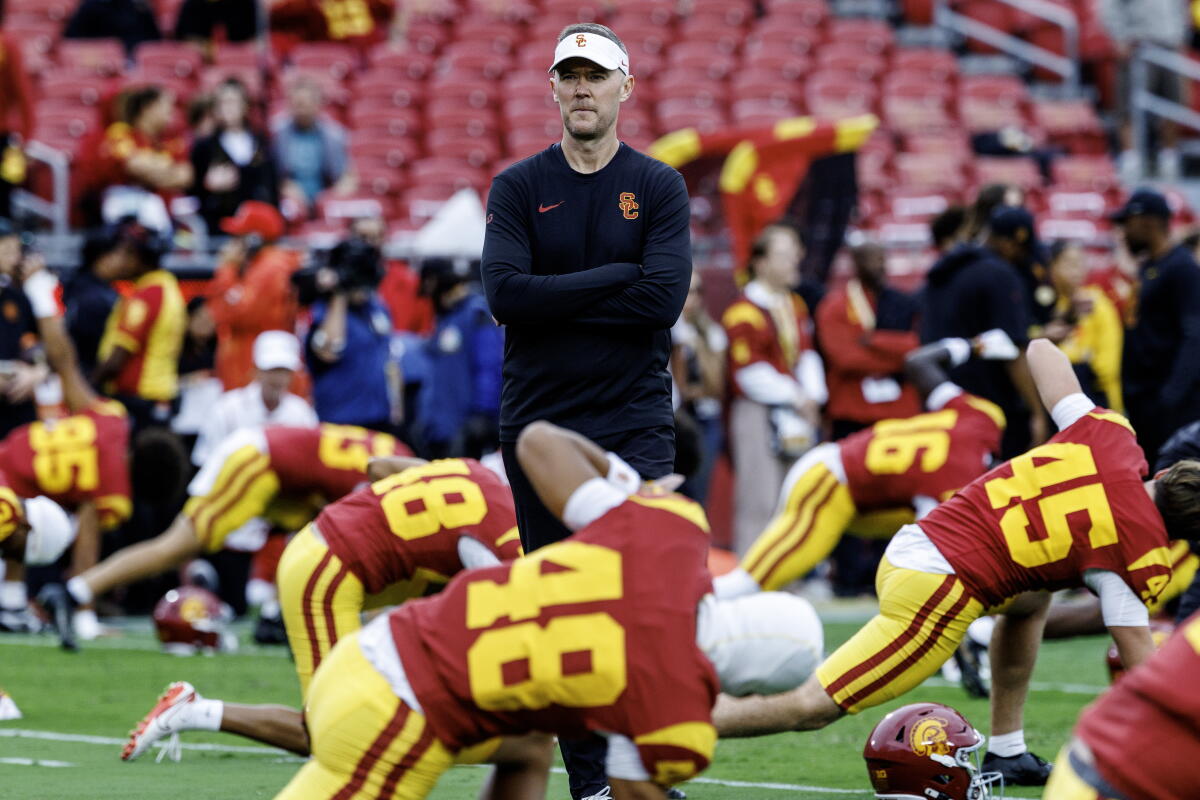
USC coach Lincoln Riley watches his team warm up before beating Ohio State at the Coliseum on Oct. 31.

USC coach Lincoln Riley watches his team warm up before beating Ohio State at the Coliseum on Oct. 31.

(Gina Ferazzi/Los Angeles Times)

“We’re quite a bit further ahead than we were at this point before playing Wisconsin,” he added.

This bye week comes after the Trojans beat No. 2 Ohio State 30-18. But that victory remains in the rearview mirror for Riley and Maiava. Just as the team needs to move past a loss, Maiava understands the importance of looking beyond arguably the team’s best win of the season and remaining focused on the present.

“Every single day requires our best. If we’re focused on yesterday’s victories, you lose out on opportunities for today’s victories,” Maiava said.

It’s a message Riley reiterated.

“The reality is you’re not gonna play your best every week. You want to get as close to it as you can, and then you want to get good enough that even when you’re not at your best, you still find ways to win ballgames,” he said. “… These are one-week seasons, and we got to be our very best here this week.”

With three games left in the season, USC’s fate remains in its own hands. A win at Indiana followed by a home game against Maryland at the Coliseum would set up a consequential matchup with No. 4 UCLA to close out the season.

Wide receiver Trent Mosley believes the team has prepared for that pressure during its two weeks of practice.

“We’re all pushing every day. We all know what’s in front of us, and we’re taking it week by week,” he said.

Saturday’s matchup will mark the fifth meeting between the two teams. Historically, the competition has been one-sided, with USC winning all four previous meetings.

Indiana enters Saturday’s game with the nation’s fourth-ranked scoring defense, allowing 12.4 points per game. The Hoosiers also have 32 team sacks, the fourth-most in the nation. Tight end Tucker Ashcraft trusts that USC’s offensive line will keep Indiana’s pass rush away from Maiava.

“[We need to] take advantage of all our opportunities, find the space in their zones and make big plays,” Ashcraft said.

Riley said he sees the opportunity to face reigning national champions as a benefit, helping the team make a late-season playoff push.

“Whether it’s [a] big end-of-season game, championship game, the more you’re in those scenarios, the more you’re used to being in that level of competition,” Riley said. “It’s a different type of feeling and a different type of strength that it takes to win and excel in those games.”

This will be the first time the teams meet during the Curt Cignetti era. The game will also mark the first meeting between Riley and Cignetti as opposing coaches.

“We sit next to each other in Big Ten meetings and make comments back and forth to each other the whole time,” Riley said. “He’s been a fun guy to interact with.”

As the Trojans head to Bloomington, they’ll face a significant change in weather, going from a high of 71 degrees in Los Angeles to a forecast high of 47 degrees in Indiana. For Hawaii native Maiava, playing November football in colder weather is a dream come true.

Regardless of the weather, USC is exactly where it wants to be at this point in the season, Riley said.

“We worked hard and it hasn’t been perfect, but there’s been a lot more good than bad, and that’s why we’re one of the few teams that sits here right now controlling our destiny in so many ways,” he said.

Source link

Tony Pulis column: Why managers can learn a lot from leaders like Napoleon Bonaparte

As well as great military triumphs, I studied defeats too – they are as much a part of football management as victories, after all – and you can compare the organisational brilliance of Napoleon to the disaster of the Battle of Balaclava and the Charge of the Light Brigade.

One summer, I travelled out to Crimea to witness the scene of that tragic charge by the bravest of brave men.

Lord Raglan, the British commander-in-chief, was based on the high ground and could see everything in the Russian positions and the brigades.

His order to attack was ambiguous and although Lord Cardigan, who led the charge, questioned it, he still followed it through – leading to one of the most infamous military disasters in history.

It should never have happened but, just as in football, leadership and communication from the top was key. The instructions were passed down from Raglan to Lord Lucan to Cardigan and became garbled – too many cooks, in my opinion!

The last book which really stuck with me, in terms of inspiring me as a leader, was the story of HMS Endurance – disaster strikes during a journey through the ice fields of the southern hemisphere when the ship becomes stuck.

I cannot do justice to the deeds of Sir Ernest Shackleton in this column but his leadership of his men, along with his number two Frank Worsley, was extraordinary.

Both dovetailed in a way that gave their men the energy, desire and determination to believe and follow instructions in the most appalling conditions, never once questioning their leaders’ abilities to help them survive.

Over the years, I’ve never stopped reading about, or watching, great leaders like that – there is so much that young coaches can learn from other sports or history that will benefit then, the same way it did me.

Going to games was still the most important thing when I was between jobs, because I would always believe my own eyes when watching players.

There were times when that became more of a challenge, especially at the back end of my career, but times change and if you are not in tune with what is happening in the game then you can get dropped very quickly.

But I am sure that most of my managerial compatriots would also agree with me that experience in all walks of life can be invaluable.

I learned so much when I was out of work, about all aspects of leadership, individually and collectively.

My advice to managers out of work now is the same that I received from Jim, all those years ago – pick yourselves up and get off the sofa to get back in work as quickly as possible.

You should never be afraid of dropping down a level the way I did, too. It is better to get a job, any job, than be out of football full-stop. That hasn’t changed since my day, either.

Tony Pulis was speaking to BBC Sport’s Chris Bevan.

Source link