Prep Rally: What do high school coaches learn from their players?
Hi, and welcome to another edition of Prep Rally. I’m Eric Sondheimer. Teacher/coaches are always teaching lessons, but what lessons do they learn from players?
Coaches learning lessons

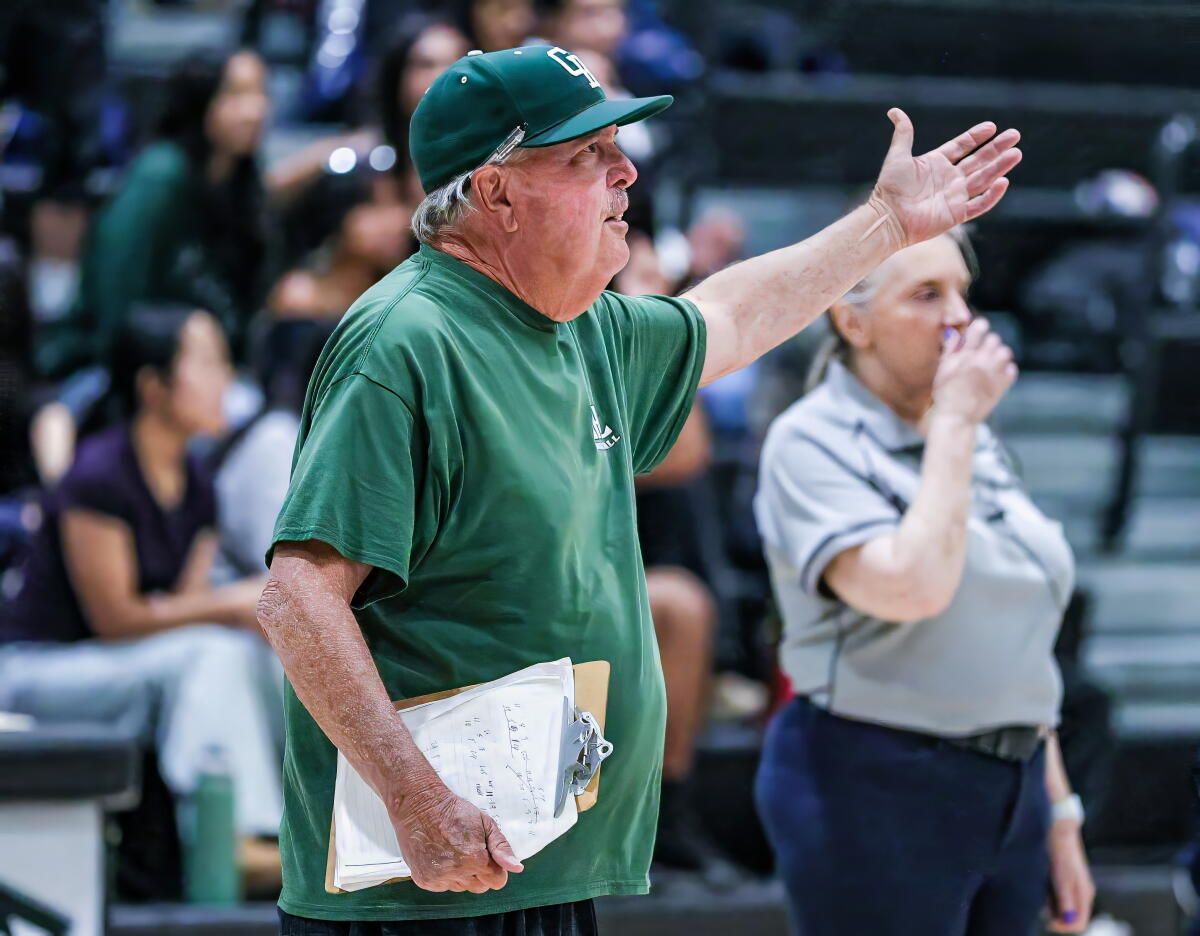
Tom Harp, the longtime girls’ volleyball coach at Granada Hills.
(Craig Weston / For The Times)
Coaches are trained to be good teachers, which means offering life lessons and sports lessons. But what do they learn from their players?
For months, a simple questions has been asked: What’s the best lesson a player taught you?
Very few coaches asked could immediately answer. They needed to think long and hard, which meant the question was good.
Here’s a look at what some coaches offered as lessons learned from their players.

It was the battle in the trenches between Orange Lutheran and Sierra Canyon, which won 28-10.
(Craig Weston / For The Times)
Sierra Canyon and Orange Lutheran engaged in a penalty-filled nonleague game that should get both teams ready for league play. Thanks to running back Jaxsen Stokes, Sierra Canyon won 28-10. Here’s the report.
Bishop Amat made JSerra pull out every trick before the Lions prevailed 37-28 behind quarterback Hayes Cloutier. Here’s the report.
One of the best games of the week was Corona del Mar holding off La Serna 30-24. Here’s the report.

The Long brothers growing up, with the youngest, Grady, now the quarterback at La Serna.
(Long family)
The quarterbacks in the game are youngest brothers from families that combined to produce six quarterbacks. Here’s the report.
Huntington Beach knocked off Yorba Linda to go to 5-0 for the first time since 1998.
Receiver Paul Turner had five catches for 134 yards and two touchdowns to help Birmingham win its first game against a Southern Section opponent, beating Burbank 23-18. The Patriots play unbeaten Harvard-Westlake on Friday before switching to City Section action.
Marshall improved to 5-0 with a 28-27 win over Marquez, stopping a two-point conversion try in the final minute.
San Pedro picked up a forfet win over Palisades when the Dolphins couldn’t field enough players after a breakout of COVID.
Here’s this week’s top 25 rankings by The Times.
Here’s top individual performances from Week 4.
Here’s the schedule for this week’s games.
QB works all hours

Marshall quarterback Nathaniel Cadet started work for his senior season on New Year’s Eve.
(Eric Sondheimer / Los Angeles Times)
At midnight on New Year’s Eve, Marshall quarterback Nathaniel Cadet was jump roping. He practices morning, afternoon and night trying to put himself in position to play college football. He has led his team to a 5-0 start.
Here’s a look at his passion and commitment to be a quarterback.
JSerra is 17-0 and keeps beating one challenger after another. The Lions will face Trinity League rival Orange Lutheran at home Tuesday. The Lancers’ only loss was to Orange Lutheran.
El Camino Real, which looked competitive with top City Section teams during the summer, will make its debut this week.
Here are the top 10 rankings by The Times.
Girls volleyball
The No. 1 and No. 2 teams in Southern California, Sierra Canyon and Mater Dei, played in the championship of the Durango tournaent in Las Vegas. Mater Dei handed the Trailblazers their first defeat by sweeping both sets.
Oak Park won the Chatsworth tournament.
Water polo
This was supposed to be the year another team in boys water polo was supposed to rise up and end Newport Harbor’s domination.
Last week’s South Coast tournament showed Newport Harbor isn’t going away without a fight.
The Sailors won the tournament title with lots of drama, beating Cathedral Catholic 16-15 in the semifinals, then winning the championship in three overtimes over Miramonte 11-10.
The DeShaun Jackson Story

A documentary on former Long Beach Poly and NFL receiver DeShaun Jackson debuts Sept. 24 on Prime Video.
(Amazon MGM Studios.)
Former Long Beach Poly and NFL receiver DeShaun Jackson gets the documentary treatment beginning Thursday when Amazon Video runs, “Going deep: The DeShaun Jackson Story.”
The story is told from his Pop Warner days through the NFL.
Notes . . .
Baseball coach Josh Lienhard was reinstated as a teacher and coach at El Camino Real and returned Wednesday. He was one of three coaches placed on administrative leave last month after school officials had questions why his CPR and first-aid courses he said he completed were not in the Red Cross database. The school spent thousands of dollars on an investigation that remains uncompleted. Two other coaches, tennis coach Jason Grider and girls soccer coach Eric Choi, also were allowed to return….
Junior Karl Robinson from Santa Margarita has committed to Notre Dame for lacrosse….
Catcher Logan Miller of Mater Dei has committed to San Diego State….
Shortstop Zion Avina of Orange Lutheran has committed to USC….
Junior pitcher Jax Janeski of JSerra has committed to USC….
Junior infielder/pitcher Griffin Doane of Santa Margarita has committed to UC Santa Barbara….
Junior Theo Swafford of Sierra Canyon has committed to Texas….
Standout guard Maxwell Scott of Corona del Mar has committed to Harvard….
Tess Oldenburg from Etiwanda has committed to Nevada for women’s basketball….
Former Crenshaw football coach Robert Garrett said he’s a volunteer at Lawndale, where he “coaches the coaches.”…
Offensive lineman Dylan Felli of Mission Viejo has committed to the University of San Diego….
Eliana Corona from La Habra has committed to Cal Baptist for softball….
Longtime basketball coach Joe Reed has been reinstated as the head coach at Huntington Park. He had been coach since 1991, then lost his position when placed on administrative leave for 14 months because of an investigation. After being cleared to return, he was not given his coaching position back….
Evan Guadalupe from Summit has committed to Loyola Marymount for baseball….
Cody MacArthur has been promoted to interim football coach at Royal. He took over after the head coach was dismissed following an incident when he angrily kicked a football that struck a Royal player and was dismissed….
The Woodbridge Classic in cross country featured lots of race winner from outside Southern California. Here’s the results. …
Servite’s baseball team has one player signing with USC next month and another with UCLA. Let the rivalry begin.
From the archives: Cody Decker
Once a baseball player at Santa Monica High and UCLA, Cody Decker has taken his personality and ability to talk about anything to sports talk radio as a morning co-host for 97.1 with Crespi basketball coach Derek Fisher.
He had 11 at-bats in major league baseball with the San Diego Padres.
He showed off his entertainment and singing skills by getting the top role in the school production of “The Music Man.” He had 18 home runs when he was playing catcher, then singing, so he knows how to multi-task.
Here’s a story from 2005 about his baseball and off-the-field talents.
Recommendations
From the Star-Telegram, a story on a top high school baseball pitcher being ruled ineligible in Texas for transferring for athletic reasons.
From the Daily Bulletin, a story on a 6-7 tight end who’s overcome the death of his father when he was 4 to become a top athlete at Webb School.
From Wyomingnews, a story on former Banning football standout Steve Perez.
Tweets you might have missed
Until next time….
Have a question, comment or something you’d like to see in a future Prep Rally newsletter? Email me at eric.sondheimer@latimes.com, and follow me on Twitter at @latsondheimer.
Did you get this newsletter forwarded to you? To sign up and get it in your inbox, click here.