What It Would Take To Seize Iran’s Kharg Island According To Top Former Military Leaders
With President Donald Trump proclaiming his desire to take Iran’s Kharg Island — whether he actually means it or not – we reached out to some former military commanders to get a sense of what it would take to seize and hold it and how telegraphing such a move could impact operations. The island, as we have noted in the past, is Iran’s main center of oil exportation, and a U.S. seizure would have tremendous military and economic impacts. An attempt to take it by force and hold it, as we have highlighted in prior reporting, would be an extremely risky operation, by all accounts.
Trump’s latest statements about taking Kharg Island came in the wake of the most intense round of tit-for-tat attacks between the U.S. and Iran since the ceasefire went into effect April 8. The U.S. launched waves of strikes across Iran, including firing what Trump said was 49 Tomahawk land attack cruise missiles at Iranian targets. In response, Iran launched missiles and drones at U.S. bases in Kuwait, Jordan and Bahrain.
Meanwhile, Iran claimed it shut the Strait of Hormuz completely after the new round of kinetic action while U.S. Central Command (CENTCOM) insisted it remains “open for transit.”
However, in the wake of yesterday’s back-and-forth strikes, Trump proclaimed his desire to seize Iran’s vital oil infrastructure, including Kharg Island.
“At some point in the not too distant future, we will be taking Kharg Island, and other oil infrastructure points, and assume total control of their Oil and Gas Markets, much like we have with Venezuela, which is working out brilliantly for both Venezuela and the United States of America,” Trump said on Truth Social.
A short while later, the president modified those remarks in an interview with Fox News.
“I don’t know that America has the stomach for it, to be honest with you,” Trump later told the network. “You’d make a fortune, but I don’t know that America has the stomach, I think they’d like to see us come home.”
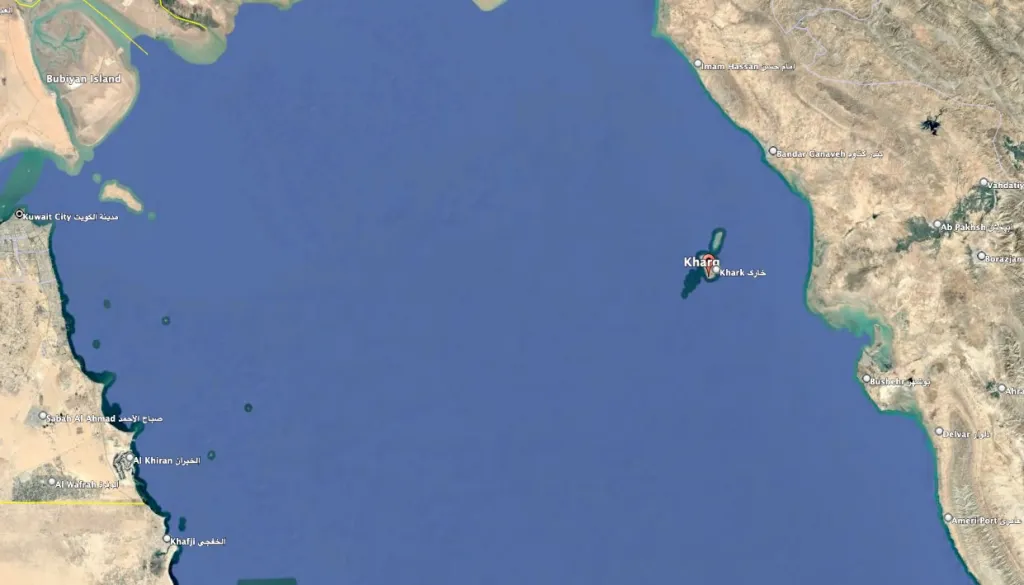
Located about 20 miles from the Iranian coastline, Kharg Island presents a daunting challenge, leaving troops trying to take it under threat from Iran’s remaining arsenal of ballistic and cruise missiles, drones, rocket artillery, and fast boats that can launch swarming attacks on ships, fire missiles, and lay mines. This is something we were among the first to point out, before the possibility of invading the island became a nation news story.
“It seems unusual that we would announce an intention to seize Kharg Island in advance,” retired Army Gen. Joseph Votel, former leader of U.S. Central Command, told us. “Military commanders always want to preserve the principle of surprise in any operation – it helps reduce risk and often times gives us the tactical edge.”
“In this case the president did not announce any specific details – which can preserve some operational flexibility,” Votel noted. “It may also be a part of a more elaborate communications strategy that is focused on getting the regime to understand they are running out of options and that we can and will do whatever we need to, militarily, to support diplomatic efforts and bring the conflict to a conclusion.”
“Seizing Kharg Island is a significant undertaking,” added Votel, now a Distinguished Military Fellow at the Middle East Institute. “Not only will it involve ground troops to actually control the terrain – but also tactical delivery means, air cover, a strike campaign to set the conditions and then all the resources to protect this force while they are on the Island. In addition – the force has to be sustained meaning we have to have a way to get them supplies, engineering capabilities, life support, evacuate casualties, and if necessary reinforce them with additional force.”
All these actions would be taken close enough to the Iranian coast to “potentially subject [assault forces] to missile and drone attacks,” the former CENTCOM commander noted. “Not impossible, but certainly not insignificant either.”

When we first spoke to Votel about this issue in March when stories first bubbled up about Trump threatening Kharg Island, he told us that “a battalion sized force of Marines or soldiers could probably do that. So you’re probably looking at 800 to 1,000 troops, kind of size, maybe a little bit smaller, probably not much larger than that.”
Plans for the US military to try and capture the island “have been drawn up for months but continuously shelved because the operation was considered too risky,” a senior Pentagon official and two administration officials told CNN.
Speaking to us on Thursday, Chris Miller, who served as acting Defense Secretary at the end of Trump’s first administration, said it would take considerably more troops for such an operation than Votel first suggested.
“I would expect it would take an infantry brigade at a minimum,” said Miller, referring to a unit of between 3,000 to 5,000 troops. “I’d prefer two brigades and a lot of mobile air defense to protect from Shaheds and plenty of barrier material to make bunkers when artillery starts dropping in. Plus, obviously, significant air power to hit time-sensitive Iranian targets like artillery and missile batteries.”
“It’s completely doable by our combat forces in the region, ” added Miller, now founder and CEO of FPF Defense, a startup building a low-cost Shahed drone interceptor. “This is exactly the type of operation they are designed and optimized for. It’s not that heavy of a lift for them.”
Holding the island, if taken, won’t be easy, however, Miller posited.
“The logistics would be challenging for us because it will be difficult to get resupply ships in under the Iranian defensive shield,” he explained. “And aerial resupply will be contested as well.”
Miller said he was not concerned that Trump told the world he wants Kharg Island.
“My assessment is the Iranian regime continues to misunderstand President Trump,” Miller said of his former boss. “I suspect the Iranians have already prepared for such an eventuality.”
Former Army Maj. Gen. Pat Donahoe, who retired in 2022 as commanding general of the U.S. Army Maneuver Center of Excellence and Fort Benning in Columbus, said asking how Kharg Island can be taken “is the wrong question.”
“It’s not taking it, it’s holding it over time and enduring the slow bleed of casualties that comes with holding it,” noted Donahoe, now chief operating officer at Columbus State University in Columbus, Georgia.
“It’s Khe Sanh,” explained Donahoe, a reference to one of the longest and bloodiest battles of the Vietnam War, where about 6,000 Marines and their South Vietnamese counterparts held out at a base along the Laotian border against 20,000 North Vietnamese troops for nearly 80 days.
“Sure we can grab it, but it puts us in range of all their stuff,” Donahoe said. “And we have to resupply it etc. It’s dumb.”
The U.S. struck military targets on the island during Epic Fury, but Trump has stated he ordered all the oil infrastructure to be left untouched. Since the ceasefire, Iran has been preparing for a possible U.S. operation to take control of Kharg Island, CNN noted today.
“Iran laid traps and moved additional military personnel and air defenses there earlier this year, according to multiple people familiar with US intelligence reporting on the issue,” the network reported. “The island already has layered defenses, and the Iranians moved additional shoulder-fired, surface-to-air guided missile systems known as MANPADs there.”
It remains to be seen whether Trump actually takes any action against Kharg or anywhere else on the ground in Iran. As we have previously noted, Trump has threatened to put boots on the ground to capture Iran’s highly enriched uranium and has constantly made grand military threats without following through. This includes repeated threats that he would order the destruction of Iran’s civilian infrastructure. Clearly these are meant to push the adversary to the negotiating table, but their potency has degraded as this has become increasingly clear.
Hours after raising the specter of seizing Kharg Island, the president seemingly reversed course, saying he was halting orders to bomb the Islamic Republic tonight due to a breakthrough in negotiations.
“Based on the fact that discussions with the Islamic Republic of Iran have been brought to the highest level of Iranian leadership and approved, I have, as President of the United States of America, cancelled the scheduled strikes and bombings against Iran this evening,” Trump stated on Truth Social. “Discussions and final points have been, in both concept and great detail, approved by all parties involved, including the United States, Israel, Saudi Arabia, UAE, Qatar, Turkey, Pakistan, Bahrain, Kuwait, Jordan, Egypt, and others. The Naval Blockade will remain in full force and effect until this Transaction is finalized — Time and place of the signing to be announced shortly.”
The Islamic Revolutionary Guard Corps (IRGC), however, reportedly pushed back on Trump’s negotiations claims.
“The Fars News Agency, associated with the Revolutionary Guards, quoted a ‘knowledgeable source close to the Iranian negotiating team’ who denied President Trump’s claim regarding an agreement on an initial deal, and stated that ‘no text of the initial memorandum of understanding with the United States has been approved,’” Axios reporter Barak Ravid stated on X.
Trump has made repeated claims that a deal was virtually done, when it never materialized and the Iranians certainly have their own strategy they are executing. Whatever comes next, whether it be more bombing, a peace deal, a continued blockade and strait closure, or even an invasion of Kharg Island, it’s unclear, and that may be just as true moment-to-moment for the President of the United States as it is to everyone else.
Contact the author: howard@twz.com