The art and architecture of Metro’s D Line
The Westside subway extension has long been L.A’s most stubborn urban fantasy: an infrastructural mirage chugging toward the sea, and then, with less sex appeal, Westwood. Stalled since the ‘80s, the first western leap of the elusive project is now real. And in the month or so since the Metro D Line pushed beyond Wilshire/Western to three new stations — Wilshire/La Brea, Wilshire/Fairfax, and Wilshire/La Cienega — multiple rides have made the benefits, and shortcomings, clear.
Suddenly the city feels different. Not transformed, exactly. But more connected. The fracturing grip of the city’s incomprehensible expanses, clogged arteries, and stagnant governance — all intimidating barriers to healthy civic life — feels a little looser. The dense belt tying the city together more complete, a critical mass of movement, still expanding, where there used to be a vestigial nub.
The stations, too, feel more connected, with art, architecture and infrastructure blending seamlessly into a cohesive experience, a tribute to Metro’s sharpened design approach and its ever-evolving commitment to public art. But above ground, it’s a tale of two (transit) cities. Outdoor plazas lack the kind of textured civic presence that’s been created below. Metro, which has become the most dominant regional force for urban transformation, is still less ambitious once it leaves the station box.

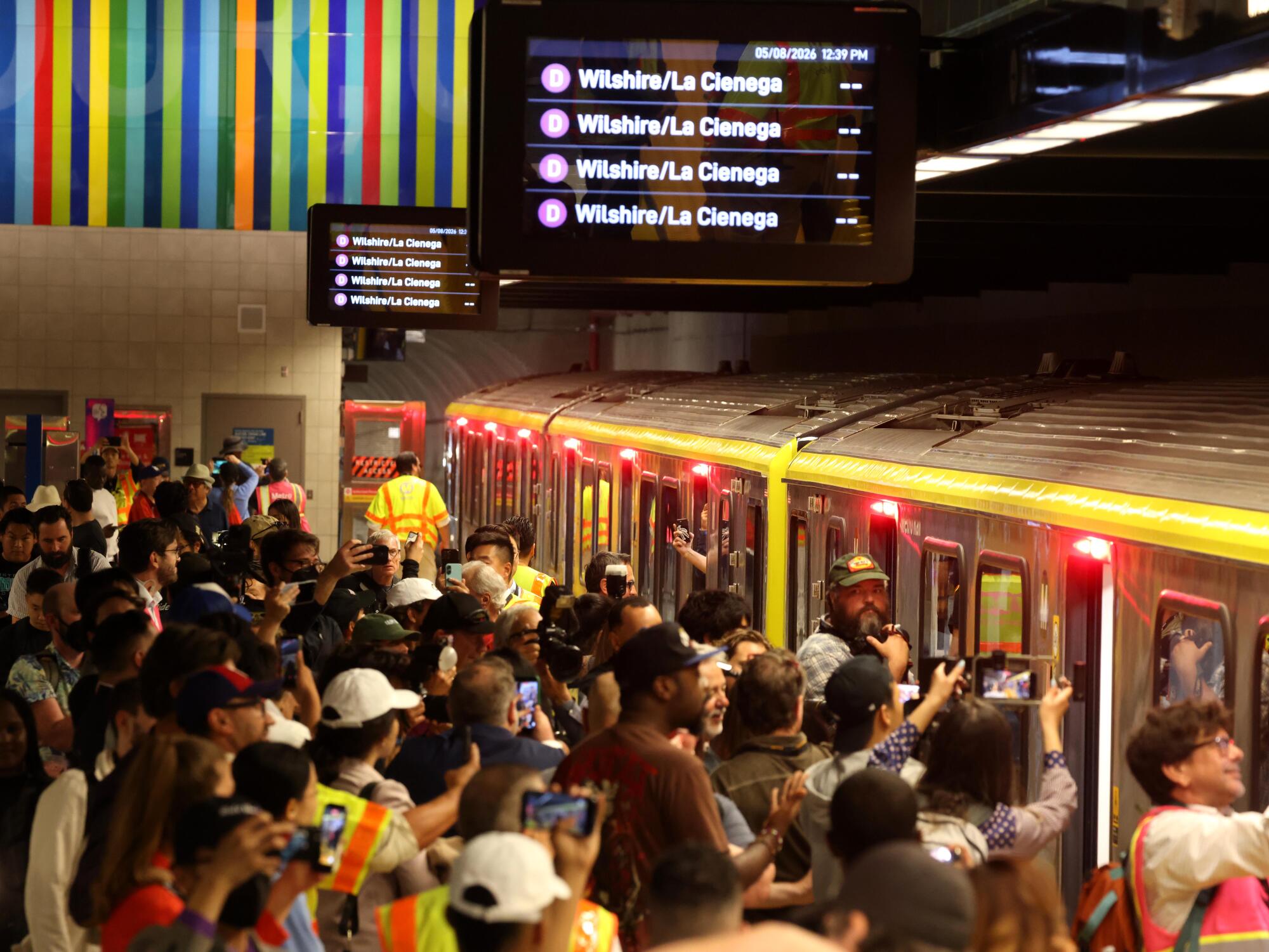
Passengers wait to board the first train to arrive at the Metro D Line at the Wilshire/Fairfax station in Los Angeles in early May.
(Genaro Molina / Los Angeles Times)
Before descending into the new stations, you might want to take a moment to appreciate that they exist at all, surviving, among other trials, a massive methane explosion, federal and local bans, major delays, and a battalion of lawsuits. Then notice how their myriad components work together. Art, for instance, is not simply attached to walls, but forms them, its patterns tracing your descent through space. Lighting doesn’t just illuminate surfaces, but becomes an artful complement to what’s around it. Escalators are not just conveyances, but reflective surfaces forming a utilitarian palette for art and light. The line between each piece becomes blurred, creating a sense that all is working together — a layered place that is intuitively easy to use.
This fluent incorporation of art builds on the long-running L.A. Metro Art program (formerly Metro Art in Transit), which since the early ‘80s has commissioned and installed over 200 artworks across the sprawling system, from mosaics and photography to multi-story murals. In fact, it’s quietly hummed along as one of the most successful public art programs in the country.

Artist Fran Siegel’s artwork at the Wilshire/La Brea Metro station is part of one of the most successful public art programs in the country.
(Carlin Stiehl / For The Times)
In many of its earlier iterations, art and architecture were conceived together to create strange, jaw-dropping, one-of-a kind spaces, like Peter Millar and Ellerbe Becket’s Santa Monica/Vermont station. Opened in 1999, this Red line stop featured among other things, a goliath stainless steel wing canopy topping a 42-foot-tall, raw concrete-clad escalator cavern, lit by massive skylights, etched with row after row of enigmatic questions.
Another personal favorite is Stephen Antonakos’ “Neons for Pershing Square,” a postmodern wonderland of suspended neon sculptures in the depths of downtown’s Pershing Square station that creates a kind of 3-D sculpture playing off the ‘80s gridded ceilings and Miami Vice white columns.
Wild creativity aside, these 20th century stations are marked by inconsistency in quality, comfort, and maintenance — and the lack of predictability can be confusing. (Wait, where do I go now?) This includes Metro’s inaugural A line, in which art-driven architecture, though fun, often feels like a quixotic gesture, unable to compete with loud, uncomfortable, concrete-dominated settings.

A man waits for a train on a platform at the Wilshire/Vermont station, which is along Metro’s B Line, formerly the Red Line.
(Brian van der Brug / Los Angeles Times)
Lines opened in the 2010s had their own issues. The Expo line (now the E line), barely 14 years old, features rather tentative wavy canopies and surface wraps and comparatively small spaces for artworks. With the new extension, Metro has found a balance between completely foregrounding art and relegating it to background. The new designs are guided by a “kit of parts,” a shared language of materials, lighting, signage, and wall systems that was developed first by local architects Johnson Fain and later by the global architectural firm Gensler, which served as the D Line’s systemwide station designer.
Yes, I miss the epic scale and immersive feeling of those older stations. But the tradeoff is a cleaner, brighter, more legible and human-scaled version, lending long-needed coherence to both the stations themselves and the system at large. And by the way, the art is still fantastic.
At the descending entryway of Wilshire/La Brea, for instance, the cosmic, angled lines of Eamon Ore-Giron’s “Infinite Landscape: Los Angeles Para Siempre,” which are embedded into porcelain enamel, channel not only the geometric forms of Wilshire’s Art Deco Buildings, but the visceral one-point perspective of a train speeding into a tunnel, and even the angled geometries of adjacent escalators.

Artist Eamon Ore-Giron’s “Infinite Landscape: Los Angeles Para Siempre,” at the Wilshire/La Brea Metro station.
(Carlin Stiehl / For The Times)
Heading down allows you to ponder its shifting mysteries. Circular abstractions might suggest headlights zooming along Wilshire, or perhaps a train’s fast-approaching lights? Its artfulness expands outward. Frosted glass panels wrapping the entry portal are clad with a similarly mystical language, accentuated by neon strips of light, with the lightweight canopy above reflecting the colorful lines. Art and architecture are working together, each feeding off the other.
A particularly fertile locale for drama at each station are the wide bands of art topping the tunnels themselves: beacon-like destinations for your eyes, not to mention invitations to occupy more of the platform. In the same station, Mark Dean Veca’s “Miracle of La Brea” takes its cues from the curvy ornament and stepped motifs of the nearby Wilshire Tower’s Art Deco façade. Look closer, and those crisp patterns dissolve into swirling, viscous forms that evoke the La Brea Tar Pits, flowing oil, and even barley-shaped references to the area’s agricultural past. The mural’s repeating forms also mirror the station’s rigorous order, its clean, syncopated forms and linear perspectives.
Another hallmark of the new stations is how they subtly make infrastructure itself into art. Celebrating — whether intentionally or not — the improbable engineering feat of carving a subway under one of the most dense, congested, and geologically and politically complicated parts of Los Angeles. Jogging white lines along concourse floors, meant as tactical guides for the vision impaired, rhythmically and playfully lead you forward. Glinting stainless steel railings, gridded perforated metal ceilings, and thin bands of suspended light bouncing off polished terrazzo floors, pull you forward on stairs and platforms, tracing the speed and linear movement of trains. Corduroy concrete walls, etched with endless vertical grooves, give tunnels a tightly rhythmic texture while still exposing their hefty bones.

The Wilshire/La Brea Metro station is part of the D Line extension and features evenly lit spaces, with porous surfaces and long sight lines to improve navigation and safety. Glass fare gate doors organize entry without turning the stations into fortresses.
(Carlin Stiehl / For The Times)
The quality of surfaces and experiences has been upgraded too. Unlike most older Metro stations, where low light and heavy surfaces can feel tired and oppressive, spaces are more evenly lit, with porous surfaces and long sight lines to improve navigation and safety. Glass fare gate doors organize entry without turning the stations into fortresses. Glass elevators and large cuts between levels create a sense of connected, kinetic openness.
Sometimes this palette feels too uniform and predictable. The heroic scale and quirkiness of older stations can be more exciting; more unique to their place. A surprise or two never hurt anyone. But overall it’s a good balance of unity, utility and identity, allowing the art to sing, but as part of a chorus, not a soloist.
The tune, however, shifts dramatically above ground. Station plazas wrap handsome modern architecture—clean, controlled, well-detailed portals of beveled stainless steel, frosted glass, and art peeking above entryways and on peripheral panels. But the hard plazas themselves are barren; lacking enough shade, art, greenery and invitation. Benches, where they exist, are tiny and defensive.

Pedestrians walk past the Metro D Line at Wilshire and LaBrea, which features a barren plaza lacking the beauty and design of the art-filled stations below.
(Kayla Bartkowski / Los Angeles Times)
These places seem scared to let people linger — clearly trying to avoid some of the city’s intransigent challenges, like homeless encampments, disorder, maintenance burdens, and controversy. This is understandable, but in avoiding those risks, the areas also avoid the purpose of public space: to create a place for everyone, not just a zone for people passing through.
Yet life appears anyway. At Wilshire/Fairfax, a dance class from a nearby studio recently gathered in a thin sliver of shade around the station. It was beautiful, and improvised, but also indicative of the underlying problem. Civic life was there, but the space had failed to make enough room for it. Imagine if that plaza had real shade, generous seating, creative sculpture, plantings, water, and edges that encouraged people to stay.
Another unresolved question is service. On multiple visits trains were not crowded. They also didn’t come often enough. Ten or 12 minutes of stagnant wait time does not feel like freedom if you are trying to lure Angelenos out of cars.
The last-mile problem doesn’t help. There is no easy parking near stations for those who don’t live close, no seamless transfer or final step. The bikes that Metro provides still have share docks, meaning you’ll need to find another dock on the far end (good luck). This remains, as it should, a system for people who already need transit. But for an institution struggling to add ridership, you wonder if it can become a system for people who have choices.

The Wilshire/La Cienega Metro station is part of L.A.’s new D Line extension. The outdoor plazas are not conducive to community or gatherings.
(Carlin Stiehl / For The Times)
Still, we should not understate what has happened. Los Angeles finally has subway stops that serve some of its densest, most public destinations, and Metro is still growing. The D Line makes the Miracle Mile feel less like a traffic corridor and more like a metropolitan spine. It suggests a Los Angeles in which neighborhoods, jobs, cultural destinations, and sidewalks begin to connect physically and with surprising immediacy. (Twenty minutes from LACMA to downtown feels like light speed!) It makes the city feel more like a city.
It also reveals the imbalance of power and imagination in Los Angeles. Metro, for all its flaws, has the ability to marshal money, planning, engineering and art at a scale the city itself generally cannot. All the more reason to branch more boldly beyond its tracks and stations.
The question remains: Can the agency coordinate with government, developers, cultural institutions, and neighborhoods to make these stations into places rather than portals?
The new stops prove that Los Angeles can design infrastructure artfully below ground. Above ground, however, it too often retreats into caution. The subway has arrived. The city around it still has to catch up.