Law and Crime

2 police officers shot at Chicago hospital, 1 critical

April 25 (UPI) — Two police officers were wounded in a shooting Saturday at a Chicago hospital, leaving one of them in critical condition, officials said.

The two officers were shot at Endeavor Health Swedish Hospital on the north side of Chicago at around 11 a.m., the hospital’s parent company said on Facebook. Endeavor said the shooter was brought to the Emergency Department for treatment around 9 a.m. CDT Saturday in the custody of the officers. He was wanded and escorted by the officers at all times, Endeavor said. At around 11 a.m. he shot the officers and left the building. He was caught and is in police custody.

Law enforcement sources told the Chicago Sun Times that the shooter disarmed one of the officers before opening fire.

No patients or hospital staff were injured.

“The safety of our patients and team members remains our top priority,” Endeavor said. “We are cooperating with law enforcement during their investigation and our deepest compassion remains with the officers and their families.”

The condition of the other officer isn’t clear.

The hospital was locked down Saturday afternoon, but there is no ongoing threat.

Source link

‘Communities Not Cages’ anti-ICE protests planned nationwide on Saturday

April 24 (UPI) — Hundreds of rallies are planned nationwide on Saturday as part of a “Communities Not Cages” action aimed at protesting the number of people detained by Immigration and Customs Enforcement.

The protests come amid ICE’s plans to construct eight new detection centers and 16 processing centers, adding at least 116,000 beds to the number the agency has available for detaining people who are allegedly in the country illegally, Axios reported.

At the end of March, No Kings held its third protest — which saw more than 3,000 simultaneous demonstrations across the United States — since President Donald Trump retook office and engaged in a crackdown on immigration.

Detention Watch Network, the organization behind this Saturday’s rallies, called the scouting, purchasing and retrofitting of warehouses to detain between 1,500 and 10,000 people each “particularly horrifying.”

“Shockingly, ICE’s budget now exceeds many militaries around the world,” the organization said on its website.

“In the face of the administration’s unrelenting expansion of immigration detention, communities across the country are demanding to shut down detention centers and halt detention expansion,” it said.

One local group that is coordinating with Detention Watch Network’s “Communities Not Cages National Day of Action” is Shut Down Etowah, a group that previously protested the Biden administration until it stopped detaining people there, AL.com reported.

The Etowah County, Ala., facility is “too broken to be fixed,” the group said this week in a press release, noting that its’ “atrocious” conditions include bed bugs, 23-hour lockdowns and light fixtures that have not been fixed.

ICE earlier this year said it was launching a program under section 287(g) of the Immigration and Nationality Act after lauding its 2025 record of motivating 2.5 million alleged illegal immigrants to leave the country, more than 600,000 of whom were arrested and deported.

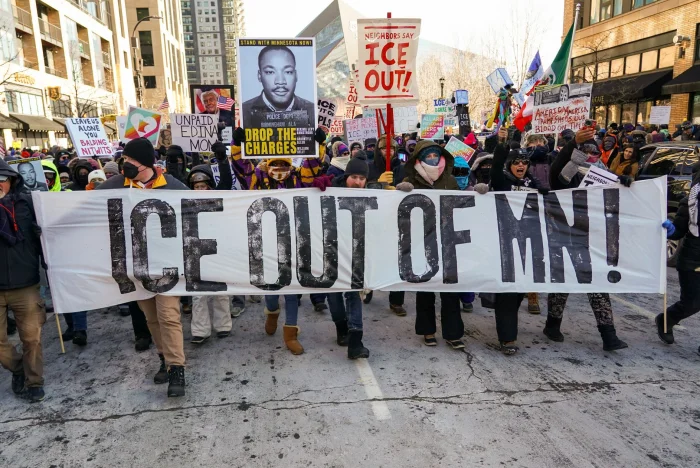
Thousands of protesters march in sub-zero temperatures during “ICE Out” day to protest the federal government’s immigration enforcement surge in Minneapolis, Minnesota on Friday. Photo by Craig Lassig/UPI | License Photo


Source link

British assisted-dying bill falls after runing out the clock

Members of the non-profit Dignity in Dying campaign group protest outside Parliament in London on Friday where the House the Lords was holding its final debate on an assisted-dying bill before it runs out the clock in the legislative timetable of the current session of parliament, which is due to end next week. Photo by Andy Rain/EPA

April 24 (UPI) — A bill to legalize assisted-dying in England and Wales was Friday set to run out of time to complete all the necessary stages for it to become law in the current session of parliament, 10 months after MPs passed the legislation.

The Terminally Ill Adults (End of Life) Bill has been stalled in its committee stage in the House of Lords since June but with Friday set to be the final debate in the upper chamber before the 2024-2026 session ends in early May, it has run out of road.

“Detailed line-by-line scrutiny of the Terminally Ill Adults (End of Life) Bill continues,” The Lords said Friday in its order of business for the day.

Members have used up all 14 committee-stage days allotted for the bill as they attempted to grapple with more than 1,000 amendments covering everything from blocking overseas patients from accessing the treatment and the inclusion of people injured serving in the military or in industrial accidents to making patients aware of non-lethal treatment options.

Only around halfway through the stages required before it can receive “Royal Assent” from King Charles and finally become law, the bill can no longer proceed and cannot be carried over to the 2026-2027 session.

Supporters vowed not to give up on the bill, which would give terminally ill adults with less than six months to live the legal right to end their lives with the help of medical professionals, saying they would try to reintroduce it when the new parliament convenes on May 13.

The bill’s sponsor, Labour MP Kim Leadbeater, said she had a group of backers who had agreed to try to bring back the bill immediately following the state opening of parliament.

To do so, they need to prevail in a ballot in which MPs compete for 25 slots to introduce legislation they have authored to the House of Commons, so-called private members’ bills.

The next private members’ bill ballot is scheduled for May 21.

Leadbeater said she was disappointed, upset and angry at the outcome.

She said that terminally ill patients and their families she had been speaking with felt “a real sense of feeling let down by our democratic system.”

“This is not over. The issue is not going to go away just because of an undemocratic filibuster in the Lords. We will keep pushing for a safer, more compassionate law until parliament reaches a final decision.”

Opponents were concerned over the watering down of key safeguards in the original bill introduced in the House of Commons in November 2024, including dropping the requirement for a High Court judge to review every case.

“If we’re going to do this, we have to have safeguards and I really don’t think there are anywhere near enough safeguards in it,” said Baroness Grey-Thompson, adding that it was the job of peers to go through every line in legislation.

She told the BBC that when bills failed it because it was usually because they were poorly drafted, rather than because of the number of amendments tabled.

“It was written in haste and there are so many gaps in it that a number of peers are really uncomfortable with this particular bill, even though they may be in favor of the principle,” she said.

Leadbeater said she hoped the Commons would pass the bill again and an accommodation could be agreed with members of the upper house over amendments.

She did not rule out invoking a very rarely used procedural maneuver, a theoretical nuclear option that dates back more than a century in which the Lords is rendered powerless to stop a bill that the House of Commons has passed more than once from becoming law — but said she hoped that would not be necessary.

Children race to push colored eggs across the grass during the annual Easter Egg Roll event on the South Lawn of the White House in Washington on April 21, 2025. Easter this year takes place on April 5. Photo by Samuel Corum/UPI | License Photo

Source link

Soldier charged with using classified information to bet on Maduro capture

April 23 (UPI) — A U.S. Army special forces soldier who participated in capturing Venezuelan leader Nicolas Maduro has been charged with using classified information about the operation to make bets on Polymarket, a decentralized prediction platform, federal prosecutors said Thursday.

Gannon Ken Van Dyke, stationed at Fort Bragg in Fayetteville, N.C., is alleged to have profited by more than $400,000 through wagers he made on Polymarket concerning the future of Venezuela, Maduro and U.S. military intervention.

“Our men and women in uniform are trusted with classified information in order to accomplish their mission as safely and effectively as possible, and are prohibited from using this highly sensitive information for personal financial gain,” Acting Attorney General Todd Blanche said in a statement.

Polymarket is one of several crypto-based prediction markets that grew in popularity during the 2024 general election, allowing users to make wagers on seemingly anything, from who will be drafted first overall in the NFL Draft to when President Donald Trump will announce the war in Iran is over.

In the indictment unsealed Thursday, federal prosecutors alleged that starting from around Dec. 8, Van Dyke participated in the planning and execution of Operation Absolute Resolve.

On Dec. 26, Van Dyke allegedly created a Polymarket account, which he used to make 13 bets from Dec. 27, wagering a combined $33,034 on contracts concerning U.S. military involvement in Venezuela.

Before dawn on Jan. 3, U.S. military forces conducted a clandestine operation in Venezuela, resulting in the capture of Maduro and his wife, who were brought back to the United States to face narco-trafficking charges.

After Trump announced the operation that night, Van Dyke allegedly made $409,881 off his bets, which he withdrew to a foreign cryptocurrency vault before depositing them into a newly created online brokerage account, federal prosecutors said.

After the operation, news broke that one user had wagered $32,000 that Maduro would be ousted by the end of January, netting the multi-hundred-thousand-dollar payout.

Prosecutors alleged that as reports of the unusual wager spread, Van Dyke asked the platform on Jan. 6 to delete his account and he allegedly changed the email address registered to his cryptocurrency exchange account.

The indictment charges him with use of confidential government information for personal gain, theft of nonpublic government information, commodities fraud, wire fraud and making an unlawful monetary transaction.

If convicted, Van Dyke faces up to 10 years in prison for each of the three Commodity Exchange Act counts, 20 years for the one wire fraud count and 10 years for the unlawful monetary transaction charge.

The charges come amid concern about such decentralized markets that allow for betting on real-world events and calls for them to be regulated

In late March, dozens of lawmakers called on the Commodity Futures Trading Commission and the Office of Government Ethics to address illegal insider trading on these platforms by federal employees following the Polymarket payout on the capture of Maduro and other suspicious trades.

Asked about the development and if he is concerned about bets being placed on the Iran war, Trump told reporters at the White House that he will look into it.

“The whole world, unfortunately, has become somewhat of a casino. And you look at what’s going on all over the world, in Europe and every place, they’re doing these betting things,” he said.

“I was never much in favor of it. I don’t like it, conceptually, but it is what it is.”

Source link

Senate passes resolution to begin budget reconciliation to fund DHS

April 23 (UPI) — Senate Republicans were up all night voting, eventually adopting a budget reconciliation package Thursday morning to prepare to fund the Department of Homeland Security.

The Senate plans to fund the department without Democrats’ help. The resolution was adopted at around 3:30 a.m. EDT Thursday by a vote of 50-48 after about six hours.

The only Republicans to vote against the resolution were Sens. Lisa Murkowski, R-Alaska, and Rand Paul, R-Ky. The bill now goes to the House. If the House adopts the resolution, the final funding bill can be written and voted on by Congress.

They are following a deadline of June 1 set by President Donald Trump.

“We have a multistep process ahead of us, but at the end Republicans will have helped ensure that America’s borders are secure and prevented Democrats from defunding these important agencies,” said Senate Republican Leader John Thune, R-N.D.

Thune told fellow senators to keep the package narrow to ensure speedy passage.

Since the January deaths of Renee Good and Alex Pretti in Minnesota, both shot and killed by DHS officers, Democrats have refused to support funding the department without reforms. The department has been shut down since Feb, 14, though Trump told the department to use emergency funds to pay essential workers.

Just before the Easter recess, the Senate passed a bill that would fund most of DHS but not ICE and Border Patrol. But the House rejected it.

Republicans are hoping to fund the department through 2029 at a cost of between $70 and $80 billion.

The late-night vote-a-rama included votes about amendments that could be added to the resolution. Two Republican Senators who are vulnerable in the November elections — Sens. Susan Collins, R-Maine, and Dan Sullivan, R-Alaska — broke ranks on some amendments.

Collins and Sullivan voted for amendments to lower health care costs, to reverse last year’s Supplemental Nutrition Assistance Program cuts and to tackle insurance companies that delay or deny medical care. Sen. Josh Hawley, R-Mo., joined with Collins and Sullivan on the latter.

Sen. Bernie Sanders, I-Vt., also sponsored an amendment that would tell the budget committee chair to help cut prescription drug prices by half. Hawley, Collins and Sullivan supported Sanders on it. Sanders said his amendment would codify ensuring that Americans wouldn’t pay more for prescriptions than Canadians or Europeans.

The amendments wouldn’t have the power to force Republicans’ hands, but they would make Republicans go on record about their views of these items.

“This reconciliation, or this budget act, will show who’s on whose side, and clearly if Republicans vote against our amendments, they’re not on the side of the American people,” Democratic Leader Chuck Schumer, D-N.Y., said on the Senate floor.

Homeland Security Secretary Markwayne Mullin told Fox and Friends on Tuesday that the department will run out of money for salaries next month.

“I’ve got one payroll left, and there is no more emergency funds so the president can’t do another executive order because there’s no more money there,” The Hill reported he said.

The resolution does not include the SAVE America Act, the voter security bill that Trump and other Republicans have pushed for. Sen. John Kennedy, R-La., sponsored an amendment to add similar restrictions, but it failed 48-50. Collins, Murkowski, Sen. Thom Tillis, R-S.C., and Sen. Mitch McConnell, R-Ky., voted against it.

FBI Director Kash Patel speaks during a press conference at Department of Justice Headquarters on Tuesday. The Trump Administration announced charges against the Southern Poverty Law Center, which the government alleges funneled over $3 million toward white supremacist and extremists groups. Photo by Bonnie Cash/UPI | License Photo

Source link

Mother sentenced to life for brutal abuse, murder of 4-month-old son

Demonstrators calling for heavy punishment against a woman on trial for murdering her four-month-old son block an inmate bus carrying the woman near Gwangju District Court in Suncheon on Thursday. Photo by Yonhap

A woman who brutally beat her four-month-old son and left him to die in a bathtub was sentenced Thursday to life imprisonment in a child abuse case that stunned the nation.

The Suncheon branch of the Gwangju District Court ruled that the mother, in her 30s, had “cruelly” abused her child for half of his short life before ending it.

The woman was indicted for indiscriminately beating her son and leaving him in a running bathtub at their home in Yeosu, about 310 kilometers south of Seoul, on Oct. 22. The infant died of multiple fractures and internal bleeding.

The court also sentenced the child’s father to four years and six months in prison on charges of neglecting the abuse and threatening a witness in the case.

“Despite the defendants having the infinite responsibility of raising their child safely as parents, the child died 133 days after being born due to the abuse from his own parents, who should have been the world to him,” the court said.

Prosecutors had sought a life sentence for the mother and a 10-year term for her husband.

Investigators earlier determined that the woman had abused her child on 19 separate occasions since Aug. 24, and found multiple bruises and signs of internal bleeding on the infant’s body.

The case drew nationwide attention after footage of the abuse was aired by local broadcaster SBS’ investigative series “Unanswered Questions.”

A group of protestors staged a rally outside the court earlier in the day calling for heavy punishment.

Copyright (c) Yonhap News Agency prohibits its content from being redistributed or reprinted without consent, and forbids the content from being learned and used by artificial intelligence systems.

Source link

2 killed, 1 critically injured following West Virginia chemical leak

April 23 (UPI) — A chemical leak at a decommissioning plant in West Virginia has killed two people and left a third in critical condition, according to officials.

More than 30 people required medical treatment because of the leak Wednesday at Catalyst Refiners, a silver recovery plant in Institute, an unincorporated community west of Charleston.

Kanawha County Commissioners President Ben Salango told reporters at a press conference that workers were cleaning and decontaminating the site ahead of its shutdown when at about 9:31 a.m. EDT Wednesday a chemical reaction occurred, creating hydrogen sulfide, a flammable, colorless gas that can be fatal to those who breathe it, according to the Environmental Protection Agency.

Twenty-one people at the site were initially reported by county officials to have either been transported to the hospital or sought medical attention, a number that West Virginia Gov. Patrick Morrisey told reporters during a second press conference held Wednesday night had increased to more than 30.

“To the families we lost today, our hearts are with you and our state grieves with you,” Morrisey said.

“We stand ready to support you in every possible way.”

Among the injured were seven emergency ambulance employees who had responded to the scene, Kanawha County Emergency Management Agency Director C.W. Sigman said.

“When I got there, firefighters and EMS were doing CPR on two of the patients, trying to revive them,” he said.

He said the hydrogen sulfide was the product of nitric acid and M2000A mixing while workers were decommissioning a tank on the site. Sigman explained he was told by the plant manager that it’s “not uncommon” for workers to mix the two together as part of the decommissioning work.

“But there was something going on that was different,” he said. “But that will be for the investigators to determine.”

Officials said an investigation is ongoing and will involve local, state and federal agencies.

A one-mile-radius shelter-in-place order around the plant that was issued has since been lifted and several roads that were closed have been reopened, officials said.

Source link

Venezuela’s repressive system still active, Amnesty International says

Repression in Venezuela has continued under interim President Delcy Rodriguez, Amnesty International says. File Photo by Henry Chirinos/EPA

April 22 (UPI) — Amnesty International said Venezuela has not dismantled its “repressive apparatus” nearly four months after former President Nicolás Maduro was arrested in a U.S. military operation.

During the presentation of its annual report in Bogotá, the organization said the country’s system of repression remains fully operational under the interim government led by Delcy Rodríguez.

Valentina Ballesta, research director for the Americas at Amnesty International, said Tuesday that Venezuela’s repressive structure continues to operate despite the political transition, according to reports by Infobae.

According to the report, Maduro’s government maintained a policy of systematic repression throughout 2025, with all branches of the state acting in coordination.

Amnesty International said authorities continue to use arbitrary detentions, forced disappearances and torture as tools of social control.

“These are not isolated incidents, but rather a pattern that amounts to crimes against humanity,” the report said.

The organization documented hundreds of cases in which detainees faced judicial proceedings without basic legal guarantees, including ineffective public defenders, the use of special anti-terrorism courts, lack of access to charges and repeated violations of due process rights.

Amnesty International also criticized the implementation of the Amnesty Law approved in February, saying its enforcement has been arbitrary and selective.

Many requests for relief were rejected without explanation, while some people initially granted benefits later had those measures reversed, according to Venezuelan news outlet Efecto Cocuyo.

While the nongovernmental organization Foro Penal and other groups confirmed the release of 673 political prisoners between Maduro’s capture and mid-April, Rodríguez’s government has reported much higher figures as part of what it described as “peace and reconciliation” measures.

In March 2026, government spokespeople said as many as 7,000 people had been granted full release or alternative legal measures. That figure, however, includes common criminals and people already serving conditional release.

Foro Penal said nearly 500 political prisoners remain in detention.

The Amnesty International report said impunity remains the driving force behind Venezuela’s repressive system and warned that the lack of an independent judiciary prevents victims from obtaining justice inside the country.

Analist also pointed to the recent restructuring of the Attorney General’s Office as an example of political control. The move replaced an official close to Maduro with another figure aligned with the Rodríguez political faction, which currently controls both the interim presidency and the National Assembly.

About 7.9 million Venezuelans have fled the country since 2015. Nearly 2 million people depend on international humanitarian aid, while severe shortages in basic services such as water, electricity and food persist, the report said.

Amnesty International further warned about the growing use of new technologies and artificial intelligence for population surveillance, along with continued harassment of journalists and human rights advocates.

Without a genuine dismantling of coercive state structures, Amnesty International said, Venezuela will not be able to restore fundamental freedoms.

Source link

Milei pushes sweeping overhaul of Argentina’s electoral system

Proposed electoral reform revives one of Argentine President Javier Milei’s campaign promises. File Photo by Demian Alday Estevez/EPA

BUENOS AIRES, April 22 (UPI) — President Javier Milei said he will send Congress a bill Wednesday to overhaul Argentina’s electoral system, including eliminating primary elections and changing the way political parties are financed.

The proposal revives one of Milei’s campaign promises and places renewed focus on a contentious issue in Argentina: how candidates are selected and how political campaigns are funded.

Milei announced the initiative on X, where he defended the reforms and intensified his criticism of the country’s traditional political establishment.

“We are eliminating the PASO: enough of forcing Argentines to pay for the internal elections of the political caste,” Milei wrote.

PASO, the Spanish acronym for Open, Simultaneous and Mandatory Primaries, is a nationwide system used in Argentina to determine candidates ahead of general elections. Under the current model, all political parties participate in a unified primary election to select candidates for national offices.

The government proposal would eliminate the mandatory national primary process and allow each political party to choose its candidates through its own internal mechanisms.

The PASO system has been in place since the 2011 elections and applies to national offices. The primaries are held every two years in August and determine party lists for congressional races, as well as presidential tickets that compete in the October general elections.

If approved, the reform would mark a significant change to Argentina’s electoral structure. Since its implementation, the PASO system has served both as a mechanism to organize internal party disputes and as an early measure of political strength before general elections.

The government also proposes changes to political financing, an issue that has long generated controversy in Argentina amid concerns over campaign funding sources and the use of public resources. A bill seeks to reduce public financing for political parties and strengthen oversight mechanisms.

Another central component of the proposal is the so-called “Clean Record” initiative, which would bar individuals with final corruption convictions from running for elected office.

In his post, Milei sharpened his confrontational rhetoric.

“Impunity is over. The party is over. Long live liberty, damn it,” he wrote.

According to Argentine newspaper La Nación, the bill also includes broader disqualifications for candidates. Those barred from the electoral registry under existing laws would be ineligible to run, as would people charged with serious crimes that include genocide, crimes against humanity, war crimes and human rights violations.

The proposal also would prohibit members of the armed forces and security services, judges, judicial officials and executives or representatives of companies holding public service concessions or linked to gambling operations from seeking elected office.

The measure further provides that people affected by these restrictions could not hold key executive branch positions, diplomatic posts or leadership roles in state-owned companies.

With the proposal, Milei adds another measure to his broader reform agenda and shifts the debate to Congress, where lawmakers are expected to face intense negotiations in a politically divided environment.


Source link

Appeals court rules Texas can require Ten Commandments in school

Texas Attorney General Ken Paxton, seen here in April 2024, celebrated an appeals court ruling on Tuesday in favor of Senate Bill 10, which mandates public schools to display the Ten Commandments in all classrooms. Pool File Photo by Justin Lane/UPI | License Photo

April 22 (UPI) — A U.S. appeals court has ruled that Texas can require schools to display a copy of the Ten Commandments, finding the legislation that mandates the Decalogue in classrooms does not require students to believe in the religious teachings.

The Tuesday ruling from the Fifth Circuit Court of Appeals is a victory for Texas conservatives and Christians who have fought to further include religion in public spaces. The decision is expected to be appealed to the Supreme Court.

“This is a major victory for Texas and our moral values,” the state’s Republican attorney general, Ken Paxton, said in a statement.

“The Ten Commandments have had a profound impact on our nation, and it’s important that students learn from them every single day.”

Texas Gov. Greg Abbott signed Senate Bill 10 into law June 10, directing every classroom in all Texas public schools to display the Ten Commandments starting Sept. 1, but has been tied up in litigation since.

While proponents argue the Decalogue is foundational to American life, opponents state that mandating it in schools is an unconstitutional violation of the separation of church and state.

The American Civil Liberties Union, which represented multi-faith Texas families in the case, said it was “extremely disappointed” by the decision and expects the Supreme Court to reverse it.

“The court’s ruling goes against fundamental First Amendment principles and binding U.S. Supreme Court authority,” the ACLU of Texas said in a statement.

“The First Amendment safeguards the separation of church and state, and the freedom of families to choose how, when and if to provide their children with religious instruction. This decision tramples those rights.”

The appeals court on Tuesday ruled 9-7 to overturn a lower court’s preliminary injunction that found S.B. 10 likely unconstitutional.

In its ruling, the appeals court found S.B. 10 “looks nothing like a historical religious establishment.”

“S.B. 10 authorizes no religious instruction and gives teachers no license to contradict children’s religious beliefs (or their parents’). No child is made to recite the Commandments, believe them or affirm their divine origin,” the court said.

Source link

Justice Department indicts Southern Poverty Law Center on financial fraud charges

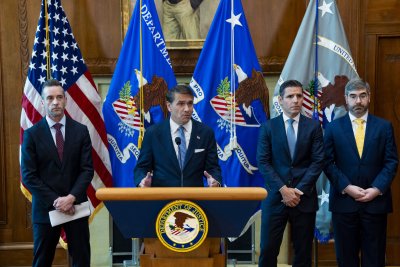
April 22 (UPI) — Federal prosecutors Tuesday evening announced an 11-count indictment against the Southern Poverty Law Center, accusing the non-profit of defrauding donors by using their money to pay informants within hate groups they were monitoring.

Acting Attorney General Todd Blanche announced the indictment from a Montgomery, Ala., grand jury during a press conference, alleging that between 2014 and 2023, the SPLC paid more than $3 million to informants in hate groups the organization had vowed to dismantle.

“As the indictment described, the SPLC was not dismantling these groups, but it was instead manufacturing the extremism it purports to oppose by paying sources to stoke racial hatred,” he said, alongside FBI Director Kash Patel.

The indictment, which was returned by an Alabama grand jury just minutes before the press conference, details payments to informants in groups such as the neo-Nazi National Alliance and the Ku Klux Klan, but does not detail extensive evidence that the money was “used to fund the leaders and organizers of racist groups.”

Federal prosecutors allege that the SPLC obtained money via donations by making “‘materially false representations and omissions about” what the money would be used for and utilized bank accounts linked to “fictitious entities” to covertly pay their field sources.

One SPLC informant is described in the court document as a member of the online leadership chat group behind the 2017 Unite The Right protest in Charlottesville, Va., where one person was killed when a car rammed counterprotesters.

This informant was paid more than $270,000 between 2015 and 2023, according to the indictment, which alleges that they attended the Unite the Right event “at the direction of the SPLC,” made “racist postings under the supervision of the SPLC and helped coordinate transportation to the event for several attendees.

Another SPLC informant described by federal prosecutors as being affiliated with the neo-Nazi National Alliance organization stole 25 boxes of documents from the headquarters of a violent extremist group, copied the materials for the SPLC and returned the originals. The court document alleges that the SPLC paid the informant more than $1 million between 2014 and 2023.

Blanche told reporters during the press conference that the informants were paid via pre-paid cards with funds from donors that were moved from bank accounts that the SPLC created for five fictitious organizations in order to shield the source of the funds.

“They attempted to hide their criminal activity from our financial banking network,” Patel said.

“They set up shell companies and entities around America so that the financial system that we rely on as everyday Americans were deceived into believing that money is not coming from the Southern Poverty Law Center in the perpetration of this scheme and fraud but rather fictitious entities they stood up to perpetuate this ongoing fraud.”

The indictment charges the SPLC with six counts of wire fraud, four counts of bank fraud and one count of conspiracy to commit money laundering.

Ahead of the press conference, SPLC CEO Bryan Fair announced in a video statement that the organization and its employees were the target of a federal investigation focused on its use of informants, though they had yet to know all the details.

He defended the SPLC’s use of informants as necessary to protect themselves and the public after decades of being “engaged in unprecedented litigation to dismantle the Klan and other hate groups.”

Information the SPLC gained from the informants was frequently shared with local and federal law enforcement, including the FBI, he said, adding that they did not broadly share their use of informants to protect their identities.

“While we no longer work with paid informants, we continue to take their safety seriously. These individuals risked their lives to infiltrate and inform on the activities of our nation’s most radical and violent extremist groups,” he said, vowing to fight the allegations.

“We will not be intimidated into silence or contrition, and we will not abandon our mission or the communities we serve.”

The SPLC has long faced criticism from some Republicans and conservatives, who say the prominent anti-hate nonprofit has drifted from its mission of fighting extremism and White supremacy by labeling several right-wing organizations as hate groups.

In October, Patel announced that the FBI severed ties with the SPLC, accusing it of having “long abandoned civil rights work and turned into a partisan smear machine.”

Democrats, SPLC supporters and critics of the Trump administration lambasted the indictment as politically motivated, with the American Civil Liberties Union calling it “another example of the Trump administration’s extreme attempts to silence its critics.”

“Let’s be clear about what’s happening here. This administration is using the full weight of federal prosecution to target an organization whose mission is rooting out violent extremism,” Sen. Cory Booker, D-N.J., said online.

“This is part and parcel of Trump’s assault on free speech, on nonprofits and on anyone who dares to disagree with him.”

House Majority Leader Hakeem Jeffries, D-N.Y., called the indictment “baseless and illegitimate.”

“These partisan hacks who continue to weaponize the criminal justice system against perceived opponents will never intimidate us,” he said.

Source link

High court to examine rights of green-card holders charged with crime

WASHINGTON, April 22 (UPI) — The Supreme Court will hear arguments Wednesday whether immigration officers can place permanent residents charged with a crime on parole if they leave and then re-enter the country.

In immigration, parole is a temporary, discretionary permission granted by the Department of Homeland Security that allows a person to enter or remain in the United States, even though they are not formally admitted.

Parole does not cancel a person’s green card, but essentially gives the Department of Homeland Security time to decide whether the person should be admitted or deported based on how the issue is resolved.

The court is poised to hear oral arguments in Blanche vs. Lau, which would determine when immigration officers can demote a permanent resident’s status to parole, a temporary status that can be revoked and result in deportation.

Lau is Chinese immigrant Muk Lau, a permanent resident with a green card. Blanche is Todd Blanche, the acting U.S. attorney general and named defendant in the case.

Typically, permanent residents are allowed to leave and re-enter the United States as they wish, with a few exceptions. If these immigrants have committed certain kinds of crimes, for example, officers can have them placed on parole when they return to the country after going abroad.

The case stems from an event on June 15, 2012, when 69-year-old Lau, who had gained permanent residency five years earlier, landed in a New York-area airport after traveling to China.

He presented his green card and passport to border control. His entry triggered an FBI match because a month earlier, Lau was charged with third-degree trademark counterfeiting for selling nearly $300,000 of fake designer shorts.

“I was arrested at a warehouse that contained some merchandise I had stored there,” Lau told the Customs and Border Protection agent, according to court documents. “I went to the warehouse to retrieve the merchandise because I had not paid rent, and when I got there, the cops were there and arrested me.”

The agent declared Lau inadmissible as a returning permanent resident due to the crime exception, and decided to let him in on parole, instead. A year later, Lau pled guilty to the counterfeiting, and in 2014, the Department of Homeland Security began deportation proceedings against him.

At the time, the Customs and Border Patrol agent did not know whether Lau was guilty — just that he had been charged with a crime. The crux of Lau’s case is whether the CBP agent needed “clear and convincing” evidence of a crime when placing him on parole or whether just charges were enough without such evidence.

Immigrant advocates argue the agent erred.

“Mr. Lau was absolutely, unequivocally, at that time, admissible,” said Jonathan Weinberg, who worked on the American Immigration Lawyers Association’s brief to the court. “He just was. He hadn’t been convicted of a crime. There was nothing else that would render him inadmissible.”

After an immigration judge and the Board of Immigration Appeals sided with the government, Lau appealed to the U.S. 2nd Circuit Court of Appeals. The appellate court, agreeing with Weinberg’s reasoning, granted Lau’s petition in March 2025.

The Federation for American Immigration Reform, a nonprofit advocating for lower immigration rates, also submitted a brief to the court. It argued that the border patrol officer did the right thing by paroling Lau into the country, and that the clear and convincing standard was too high.

“If you’re going to say that the officer in an airport is supposed to have all this information, you’re assigning that individual with an impossible task,” FAIR spokesman Ira Mehlman said. “You have thousands of people coming through the airports every day, and these are decisions that have to be made on the spot.”

Mehlman also said that the decision “shouldn’t be a problem” for green-card holders without any criminal history.

“When you come to the United States as a non-citizen, you are here on a conditional basis,” Mehlman said. “Even if you’re a green card holder, you’re subject to removal if you violate the terms of your presence here in the United States.”

There are nearly 13 million legal permanent residents in the United States. Legal immigrants, including green card holders, commit crimes at lower rates than natural-born citizens, according to research by the Migration Policy Institute. However, Weinberg said the ultimate decision would impact all legal permanent residents, including those who have not been convicted of any crime.

“If the government can admit Lau on parole, then the government can basically admit any returning green card holder on parole if it chooses to,” Weinberg said.

Lau’s case joins several immigration-related issues, including birthright citizenship and temporary protected status, which have made their way to the Supreme Court this spring.

“The immigrant advocacy community is, I think, fighting an uphill battle,” Weinberg said. “But that doesn’t mean you don’t give it your best shot.”

Source link

SPLC: Justice Department investigating the civil rights organization

April 21 (UPI) — The Southern Poverty Law Center announced via YouTube Tuesday that it is now the target of an investigation by the Department of Justice.

“Although we don’t know all the details, the focus appears to be on the SPLC’s prior use of paid confidential informants to gather credible intelligence on extremely violent groups,” said CEO Bryan Fair in the video. “This use of informants was necessary because we are no stranger to threats of violence. In 1983, our offices were firebombed, and in the years since, there have been countless credible threats against our staff.”

The Southern Poverty Law Center is a nonprofit advocacy and litigation organization that tracks White supremacist and other hate groups in the United States. Republicans have criticized the nonprofit for acting as a far-left entity that they say targets conservative organizations and people. It was founded in 1971 by Morris Dees, Joseph Levin Jr. and Julian Bond as a civil rights law firm in Montgomery, Ala.

The case is being led by the U.S. Attorney’s Office for the Middle District of Alabama, CBS News reported.

Fair said the probe is targeting the organization and its employees.

“For decades, we engaged in unprecedented litigation to dismantle the Klan and other hate groups. In light of that work, we sought to protect the safety of our staff and the public,” Fair said in the video. “We frequently shared what we learned from informants with local and federal law enforcement, including the FBI. We did not, however, share our use of informants broadly with anyone, to protect the identity and safety of the informants and their families.

“And while we no longer work with paid informants, we continue to take their safety seriously. These individuals risked their lives to infiltrate and inform on the activities of our nation’s most radical and violent extremist groups,” Fair said.

Fair said the organization will fight the allegations.

“We stood in the vanguard then, and we stand in the vanguard today,” he said. “We will not be intimidated into silence or contrition, and we will not abandon our mission or the communities we serve.”

Secretary of Health and Human Services Robert F. Kennedy, Jr. speaks during a House Appropriations Subcommittee on Labor, Health and Human Services, Education, and Related Agencies hearing on the budget for the Department of Health and Human Services in the Rayburn House Office Building near the U.S. Capitol on Thursday. Photo by Bonnie Cash/UPI | License Photo

Source link

2 killed in mass shooting near North Carolina middle school

April 20 (UPI) — Two people were killed Monday in a shooting near a North Carolina middle school where two children agreed to meet for a fight, police said.

Law enforcement officials were alerted to a fight at Leinbach Park on Robinhood Road near Jefferson Middle School in Winston-Salem, N.C., at 9:52 a.m. EST. As officers were on the way to the scene, the call was upgraded to a shooting.

The Winston-Salem Police Department posted on Facebook that “two young individuals” met at Leinbach Park for a “planned fight.” When those individuals arrived, “the situation escalated significantly, leading to multiple people exchanging gunfire.”

The police department didn’t say how many people were injured in the shooting, but used a hashtag for “mass shooting” in its post on X.

“Several individuals — both victims and suspects — have been identified and located,” the Winston-Salem Police Department posted on social media. “Due to the number of people involved, efforts are ongoing to account for everyone. At this time, some of those involved in the incident are juveniles.”

Police advised that nearby schools were operating on a normal schedule, but community members were urged to avoid the area to allow emergency responders to operate safely at the scene. The park and two nearby roads were closed as officers processed the scene.

“This is an isolated incident and remains under active investigation,” the police department said.

Source link

Two arrested in London synagogue arson case amid terrorism probe

April 20 (UPI) — British police overnight arrested two teens in connection with an attempted arson of a London synagogue, authorities said Monday as they investigate a rash of recent attacks targeting the Jewish community as possible terrorism.

A Metropolitan Police spokesperson told UPI in an emailed statement Monday that a 17-year-old boy and a 19-year-old man were arrested overnight in the London area for the weekend arson attack targeting Kenton United Synagogue in Harrow, northwest London.

The suspects, who were not identified, remained in police custody on Monday when authorities were expected to announce additional details.

The synagogue was attacked overnight Saturday, suffering only minor smoke damage to an internal room, according to Community Security Trust, a British charity with the mission to protect Britain’s Jewish community. It said in a statement that no injuries or significant structural damage were reported.

There have been at least five separate arson attacks in London since four ambulances used by the Jewish community in Golders Green were set ablaze March 23.

Police said there were three attacks over the weekend: the one targeting Kenton United, another targeting a communal block in Barnet and a third late Friday, targeting a row of shops in Hendon.

Several people have been arrested in connection with the various attacks, including a fourth person detained related to the Golders Green arson attack on Thursday.

The Met’s Counter Terrorism Policing unit is leading an investigation into all of these incidents, Deputy Assistant Commissioner Vicki Evans told reporters outside Kenton United in a Sunday press conference, stating that the “nature” of all the crimes has been similar — “arson attacks targeting Israeli- and Jewish-linked premises in London.”

Most of the attacks have been claimed online by Harakat Ashab al-Yamin al-Islamia, which translates to the Islamic Movement of the Companions of the Right, Evans said.

“This same group has claimed several incidents over recent months at places of worship, business and financial institutions across Europe. These locations all appear to be linked to Jewish or Israeli interests,” she said.

The attacks were committed amid the U.S.-Israeli war with Iran.

The Met said that, as the conflict continues, its Counter Terrorism Policing unit is aware the threat Iran poses to Britain and is investigating whether those who committed these arson attacks in London had been recruited by the group to carry out its crimes.

Those recruited often have no allegiance to Iran’s cause but are paid with “quick cash,” she said.

“To anyone even considering getting involved — my message to you would be this — the stakes are high — and it is absolutely not worth the risk for a small reward,” she said.

“Those asking you will not be there when you are arrested and face court. You will be used once and thrown away without a second thought.”

Ashab al-Yamin, a front group with suspected links to Iran, has claimed responsibility for several attacks in Europe targeting Jewish and Western institutions since March 9, according to a report published earlier this month by the Washington-based nonpartisan Foundation for Defense of Democracies research institute.

No deaths have been reported in the attacks that have spanned Belgium, the Netherlands, Greece and Britain, it said.

Source link

Two U.S. Embassy staffers, Mexican officers die in Chichuahua crash

April 20 (UPI) — Two employees of the U.S. Embassy in Mexico and two Mexican law enforcement officers were killed in a car crash over the weekend while returning from an operation to destroy laboratories in the northern state of Chihuahua, officials said.

The four people were traveling in a vehicle when they skidded off the road and into a ravine at about 2 a.m. Sunday, Chihuahua Attorney General Cesar Jauregui Moreno told reporters in a press conference.

He identified the deceased as Agency Director Pedro Roman Oseguera Cervantes and officer Manuel Genaro Mendez Montes of the Chihuahua State Investigation Agency and two instructor officers from the U.S. Embassy, whose names have not been made public.

“From here, we extend our deepest condolences and wish peace and resignation to the families of those who died in this unfortunate accident,” he said.

U.S. Ambassador Ronald Johnson to Mexico offered his condolences online.

“We honor their dedication and tireless efforts to confront one of the greatest challenges of our time. Our thoughts and prayers are with them and their loved ones,” he said in a statement.

“This tragedy is a solemn reminder of the risks faced by those Mexican and U.S. officials who are dedicated to protecting our communities. It strengthens our resolve to continue their mission and advance our shared commitment to security and justice, to protect our people.”

The incident occurred as they were returning from an operation that destroyed six clandestine laboratories in the municipality of Morelos, where Jauregui said synthetic drugs were being produced.

The site was located following a three-month investigation and destroyed on Friday and Saturday.

“It is one of the largest sites found in the country where chemical drugs were being produced,” Jauregui said during the press conference.

Source link

U.S. kills three in latest military strike on a suspected drug boat

April 20 (UPI) — The U.S. military announced late Sunday that it has killed three men in its latest strike targeting a suspected drug-smuggling boat in the Caribbean.

Seventeen people have been killed in six strikes the U.S. Southern Command has carried out in little over a week, marking one of the deadliest publicly announced stretches of the Trump administration’s monthslong anti-drug smuggling operation.

As in previous strike announcements, SOUTHCOM released little information.

The attack occurred Sunday, targeting a boat operated by a designated terrorist organization in the Caribbean, SOUTHCOM said in a statement, without naming the organization or providing evidence.

“Intelligence confirmed the vessel was transiting along known narco-trafficking routes in the Caribbean and was engaged in narco-trafficking operations,” it said.

A 12-second, black-and-white clip of the strike posted to SOUTHCOM’s social media shows a boat moving across the ocean before disappearing in a large fiery explosion.

Since the first strike on Sept. 2, the U.S. military has killed at least 180 people, according to UPI’s tally of publicly released data. Fifty-five boats have been destroyed in the more than 50 strikes.

President Donald Trump argues that the use of deadly military force is warranted as the United States is in “armed conflict” with the 10 drug cartels and gangs he has designated as terrorist organizations since returning to the White House in January 2025.

The operation comes as the Trump administration seeks to expand its influence in the Western Hemisphere, including by using its military to dismantle what Trump has called “narco-terrorist networks.”

The strikes have been repeatedly condemned and their legality questioned by Democrats, rights groups, critics and United Nations experts, who accuse the Trump administration of violating international and maritime law over the use of the military to conduct law enforcement drug operations.

Last month, Ben Saul, the United Nations’ special rapporteur on counter-terrorism and human rights, lambasted the Trump administration over “its phony war on so-called narco-terrorism.”

“These serial extrajudicial killings gravely violate the right to life, which applies extraterritorially,” he said on March 13.

“The attacks were not in national self-defense, since the vessels were not engaged in any armed attack on the U.S. Drug trafficking is crime, not war.”

On Wednesday, the same day the U.S. military killed three people in a strike in the eastern Pacific, a group of Democrats, led by Rep. John Larson of Connecticut, filed six articles of impeachment against Defense Secretary Pete Hegseth, with one of the articles accusing him of violating the law of armed conflict over the strikes.

Larson accused Hegseth of abusing his position by ordering “our armed forces to strike boats in the Caribbean,” he said in a statement.


Source link

Eight children dead in mass shooting after domestic dispute in Louisiana

Eight people died — all children — and two adult women were injured in a mass shooting early Sunday morning in Shreveport, La. File Photo by Justin Lane/EPA-EFE

April 19 (UPI) — Eight children were killed, and two more injured, in a mass shooting in Louisiana on Sunday morning that police said started as a domestic dispute.

The two survivors are both adult women, with one thought to have been in a relationship with the shooter, who was killed by police after stealing a car and leading them on a short chase, KSLA and NBC News reported.

Officials said they are still investigating the crime scenes to figure out what actually happened, as one of the two women has life-threatening injuries resulting from what is believed to have been a shot in the head.

Some of the children that were killed, who ranged in age from 1 year to 14 years, were related to the alleged shooter, police said.

“This is an extensive scene unlike anything most of us have ever seen,” Shreveport, La., Police Chief Wayne Smith told reporters.

Police responded to reports of a domestic disturbance on the 300 block of West 79th Street in Shreveport around 6 a.m. EDT to find the widespread crime scene.

The initial shooting, police said, occurred at two houses before the suspect attempted a carjacking around the block and then, after a chase, attempted to escape on foot but was shot and killed by police.

A fourth location, a house where one of the shooting victims ran to, is also part of the investigation.

“This is a tragic situation, maybe the worst tragic situation we’ve ever had in Shreveport,” the city’s mayor, Tom Arceneaux, told reporters.

A motive for the shooting remains undetermined, police said.

Secretary of Health and Human Services Robert F. Kennedy, Jr. speaks during a House Appropriations Subcommittee on Labor, Health and Human Services, Education, and Related Agencies hearing on the budget for the Department of Health and Human Services in the Rayburn House Office Building near the U.S. Capitol on Thursday. Photo by Bonnie Cash/UPI | License Photo

Source link

Judge blocks Trump administration’s pre-emptive lawsuit against Hawaii

April 17 (UPI) — A federal judge on Friday blocked a lawsuit against the state of Hawaii that the federal government filed to prevent it from suing oil companies.

The Department of Justice last year sued Hawaii to stop a suit against fossil fuel companies for the impact of climate change on the state, but Senior Judge Helen Gillmor of the U.S. District Court in Hawaii said they it has no standing, The Hill and The New York Times reported.

In the ruling, Gillmor said that an “abstract, theoretical future harm” is not a valid basis for a lawsuit because stating an intention to file suit — which the state’s governor declared on television that he planned to do — does not amount to “concrete harm” that would allow an entity to sue.

Gillmor blocked the lawsuit because the DOJ’s theory of harm would require predicting claims brought against unknown companies; predicting that the lawsuit would be successful; “guessing” that oil companies would react in specific way; and then hypothesizing that the reaction would somehow harm the United States’ commerce and future energy policy, she wrote in the 30-page decision.

The DOJ’s suit, which was filed by now-former Attorney General Pam Bondi, alleged that Hawaii’s action was a “burdensome and ideologically motivated” lawsuit that could cause “crippling damages” with the energy and climate policies the state allegedly is pursuing.

“We disagree with the Hawaii District Court’s ruling, which ignored Supreme Court precedent regarding the United States’ interest in the supremacy of federal law,” the DOJ’s principal deputy assistant attorney general Adam Gustafson said in a statement. “We are exploring all options.”

Source link

Dubai police arrest alleged Irish organized crime boss

April 17 (UPI) — An Irish man who allegedly laundered money and trafficked drugs and firearms throughout Europe was arrested in Dubai after officials in Ireland tracked him around the world.

Law enforcement officials in the United Arab Emirates said in a statement that Daniel Joseph Kinahan was arrested on Wednesday after a joint international criminal investigation, The Guardian and The Washington Post reported.

Officials from both Ireland and the UAE noted that the arrest comes after work in recent years to rein in “serious and organized crime.”

“The arrest comes as part of efforts to combat cross-border crime,” Dubai police said in a statement.

“The arrest followed the receipt of a judicial file from Irish authorities detailing the suspect’s alleged crimes and his involvement in an international criminal organization,” they said.

Kinehan is one of the leaders of the Kinahan Organized Crime Group and the founder of the MTK Global boxing management company.

In addition to Irish authorities, he was also being pursued by U.S. law enforcement because he was “believed to run the day-to-day operations” of the cartel, the Biden administration said when it announced sanctions against the group in 2022.

Officials in Dubai issued an arrest warrant after getting word from Irish authorities as part of a larger operation between Ireland and the UAE to stem criminal enterprises that operated in or through the two nations.

The report from Irish law enforcement had traced in him around the globe, including the use of fake names and other methods of avoiding arrest, and Kinehan was arrested within 48 hours of the the UAE warrant being issued.

Secretary of Health and Human Services Robert F. Kennedy, Jr. speaks during a House Appropriations Subcommittee on Labor, Health and Human Services, Education, and Related Agencies hearing on the budget for the Department of Health and Human Services in the Rayburn House Office Building near the U.S. Capitol on Thursday. Photo by Bonnie Cash/UPI | License Photo

Source link

Supreme Court rules for Chevron in Louisiana wetlands damage case

April 17 (UPI) — The Supreme Court ruled unanimously in favor of Chevron in a case related to damage to wetlands in Louisiana that dates to World War II.

The case was brought more than a decade ago and relates to damage allegedly done when Chevron’s corporate predecessors were refining aviation gas on behalf of the federal government during the war, Scotusblog and The Washington Post reported.

The 8-0 ruling sent the federal lawsuit back to a lower court in a move that could jeopardize a $745 million ruling against the company to restore the wetlands, as well as other similar cases with fossil fuel companies before courts in the United States.

Parishes in Louisiana filed the case with the help of state officials against oil and gas companies refining crude oil along the coast during the war, claiming that proper permits were never obtained for their work and that they had not followed “prudent industry practices.”

The previous decision on the $745 million ruling was made by a state court, which Chevron contended does not have the jurisdiction to rule because it was working under the auspices of the federal government.

After the state court judgement was handed down, the company’s lawyers asked the U.S. Supreme Court to move the case to a federal court, where it may be able to have the ruling thrown out.

U.S. President Donald Trump departs the White House en route to Davos, Switzerland on Wednesday. Photo by Olivier Douliery/UPI | License Photo

Source link

Judge halts above-ground White House ballroom construction

April 17 (UPI) — All above-ground construction of the White House ballroom must be stopped amid litigation, a federal judge ordered Thursday, reprimanding the Trump administration for trying to justify continued work on the building as necessary for national and presidential security concerns.

“National security is not a blank check to proceed with otherwise unlawful activity,” U.S. District Judge Richard Leon said.

The ruling comes almost three weeks after Leon issued a preliminary injunction against the $400 million project, finding that construction at the White House requires congressional approval. While ordering the construction halt amid appeal, Leon carved out an exception for the government to continue underground work deemed necessary for the White House’s safety and security.

That prompted litigation over the scope of the carve-out and the Trump administration argue that construction of the ballroom above ground was needed as security elements ran through the entire facility.

“Defendants argue that the entire ballroom construction project, from tip to tail, falls within the safety-and-security exception and therefore may proceed unabated. That is neither a reasonable nor a correct reading of my order!” Leon said Thursday.

“It is, to say the least, incredible, if not disingenuous, that defendants now argue that my order does not stop ballroom construction because of the safety-and-security exception!”

The federal government has filed an appeal against the Thursday ruling.

“We are pleased the court upheld the preliminary injunction and halted above-ground construction of the White House ballroom until Congress approves the project,” Carol Quillen, CEO and president of the National Trust for Historic Preservation, which filed the initial lawsuit, said in a statement.

Trump has said building a White House ballroom has been his dream since before he was president, and has said its price tag, which has ballooned from an initial $200 million, is to be covered by private donors.

In December, as construction was underway following the October demolition of the East Wing, the National Trust for Historic Preservation sued to stop the project, arguing U.S. law mandates the project be authorized by Congress, resulting in the March 31 injunction and the Trump administration filing an appeal.

After the Thursday ruling, Trump chastised Leon in a series of posts on his Truth Social platform, calling him an “out of control Trump hating” judge whose ruling “severely jeopardizes the lives and welfare of the people who work, and will be working, at the White House.”

“The underground doesn’t work, isn’t necessary and would indeed be useless without the above-ground section,” he said in a Truth Social post.

“This highly political Judge, and his illegal overreach, is out of control, and costing our Nation greatly,” he said in another statement.

“This is a mockery of our Court System! The Ballroom is deeply important to our National Security, and no judge can be allowed to stop this Historic and Militarily Imperative Project.”

Source link