Law and Crime

3 Australian women linked to ISIS charged after returning from Syria

A group of supporters surround an ISIS-linked family as they arrive at Melbourne International Airport in Melbourne, Australia, Thursday. The group of 13 women and children came home to Australia after years spent in a Syrian refugee camp following the fall of the Islamic State. Three of the women have been charged with crimes. Photo by Joel Carrett/EPA

May 8 (UPI) — Australia has charged three women linked to ISIS with crimes against humanity after they returned home from Syria.

They had allegedly moved to Syria to be part of the Islamic State caliphate in Syria, but once it fell, they were in refugee camps guarded by Kurdish guards. They were part of a group of 13 people who were returned to Australia. It’s not yet clear if other people returning to Australia will face charges.

Australia’s Prime Minister Anthony Albanese said in February that he would not allow the refugees to repatriate to Australia.

Kawsar Ahmad, 53, and her daughter Zeinab Ahmad, 31, appeared in a Melbourne court Friday. Kawsar Ahmad was charged with four counts of crimes against humanity. Police allege she went to Syria in 2014 and kept a female slave in her home. Zeinab Ahmad faces two similar charges.

Another adult child of Kawsar Ahmad, Zahra Ahmad, arrived in Melbourne Thursday, but was not arrested.

Janai Safar, 32, appeared in a Sydney court and was charged with entering and remaining in a declared conflict zone and joining ISIS. She returned to Sydney Thursday with her son.

Safar’s lawyer, Michael Ainsworth argued for her release on bail, saying her alleged offenses happened when she was 21, and she has been in a refugee camp for nine years.
“This young lady … lived in truly horrific conditions in these refugee camps for many years,” Ainsworth said. “She has significant community ties here in Australia, she’s one of seven children. There’s a place for her to live.”

The Australian Federal Police said Kawsar Ahmad moved to Syria with her husband and children in 2014 and was complicit in buying a female slave for $10,000, “and knowingly kept the woman in the home.”

Zeinab Ahmad allegedly also traveled to Syria and kept a female slave in the home. A slavery conviction can bring up to 25 years in prison.

Federal police assistant commissioner for counter-terrorism Stephen Nutt said Thursday night that planning for the return of people from the Middle East began in 2015.

“Australian joint counter-terrorism teams methodically investigated all Australians who travelled to declared conflict areas and will ensure those who are alleged to have committed a criminal offense are put before the courts,” Nutt said.

Source link

Trump threatens ‘much higher’ EU tariffs if deal not signed by July 4

May 8 (UPI) — President Donald Trump threatened to raise tariffs to “much higher levels” on the European Union if it doesn’t agree to a trade deal by July 4.

“I had a great call with The President of the European Commission, Ursula von der Leyen. We discussed many topics, including that we are completely united that Iran can never have a Nuclear Weapon. We agreed that a regime that kills its own people cannot control a bomb that can kill millions. I’ve been waiting patiently for the EU to fulfill their side of the Historic Trade Deal we agreed in Turnberry, Scotland, the largest Trade Deal, ever! A promise was made that the EU would deliver their side of the Deal and, as per Agreement, cut their Tariffs to ZERO! I agreed to give her until our Country’s 250th Birthday or, unfortunately, their Tariffs would immediately jump to much higher levels,” the president said Thursday afternoon on Truth Social.

The threat came after The EU has struggled to agree on the terms of the Turnberry Accord, which was for the United States to lower tariffs on EU products and for the EU to remove tariffs on U.S. industrial goods and invest billions in U.S. industries, including energy.

Von Der Leyen said on X that the bloc is still committed to the deal.

“I had a very good call with @POTUS. We discussed the situation in the Middle East and our close coordination with regional partners. We are united that Iran must never possess a nuclear weapon. Recent events have clearly shown that the risks to regional stability and global security are too great.

“We also discussed the EU-U.S. trade deal. We remain fully committed, on both sides, to its implementation. Good progress is being made towards tariff reduction by early July.”

Last week, Trump threatened to raise tariffs on European autos to 25%. It’s unclear if his renewed threat is specifically for vehicles or if it encompasses all EU exports.

Complicating matters is that Trump’s current method of levying tariffs was blocked Thursday by the U.S. Court of International Trade.

In February, the U.S. Supreme Court struck down the administration’s tariffs issued under the International Emergency Economic Powers Act of 1977. Trump then added a 10% across-the-board tariff and then later upped it to 15%.

U.S. Trade Representative Jamieson Greer said in an interview with Politico Thursday that the EU is moving slowly.

“With the tariffs, they’ve at least started a process. They’re working it through,” Greer said. “It’s a pain. I understand it’s slow. We’re not patient. But there are other things where they haven’t even started a process.”

“We’re 95% compliant for nine months … and they’ve been 0% compliant during that time. What am I supposed to do?” he said.

Speaker of the House Mike Johnson, R-La.,, speaks during an observance celebrating the 75th National Day of Prayer in Statuary Hall at the U.S. Capitol on Thursday. Photo by Bonnie Cash/UPI | License Photo

Source link

Mexico’s Sheinbaum rejects Trump’s criticism about drug cartels

Mexican President Claudia Sheinbaum, in her morning press conference Thursday, rejected criticism from the President Donald Trump over her government’s anti-drug efforts after Trump suggested the United States could take unilateral action against drug cartels operating in Mexican territory. Photo by Isaac Esquivel/EPA

May 7 (UPI) — Mexican President Claudia Sheinbaum rejected criticism from the U.S. President Donald Trump over her government’s anti-drug efforts after Trump suggested the United States could take unilateral action against drug cartels operating in Mexican territory.

“President Trump has said this several times before, but we are acting,” Sheinbaum said Thursday during her daily morning press conference.

During a White House event Wednesday, Trump said his administration already had reduced maritime drug trafficking by 97% and would now begin a “land phase” against drug smuggling operations.

“If they are not going to do the job, we will,” Trump said.

Sheinbaum defended her administration’s security strategy and said Mexico has achieved a nearly 50% reduction in homicides, dismantled 2,500 clandestine laboratories used to manufacture synthetic drugs and reduced fentanyl trafficking from Mexico into the United States.

The Mexican president also urged Washington to recognize the severity of the U.S. drug consumption crisis and strengthen efforts to stop the illegal flow of firearms into Mexico.

She said the trafficking of weapons strengthens the operational capacity of criminal organizations and fuels violence across several regions of the country.

During the press conference, Sheinbaum said the 2026 U.S. National Drug Control Strategy, presented Tuesday, marked the first time the Trump administration formally acknowledged the seriousness of domestic drug consumption in the United States.

According to Sheinbaum, the report recognizes that the United States faces “a serious drug consumption problem” by proposing prevention measures, public awareness campaigns and public health programs to combat addiction.

Asked about comments made Wednesday by U.S. Deputy Attorney General Todd Blanche to U.S. network NewsNation regarding possible new investigations into Mexican officials allegedly linked to drug trafficking, Sheinbaum again demanded evidence from U.S. authorities.

“Evidence, send evidence, because extradition treaties and mutual trust agreements require proof,” she said.

The Mexican president reiterated that drug trafficking and drug consumption must be addressed as a shared responsibility between both nations.

She said her government remains willing to cooperate with the Trump administration on security, migration and anti-drug policies, but stressed that any collaboration must respect Mexico’s sovereignty.

The 2026 U.S. National Drug Control Strategy identifies Mexico as the center of Washington’s anti-drug campaign, reaffirming the designation of Mexican cartels as terrorist organizations and classifying fentanyl as a weapon of mass destruction.

The document conditions future security cooperation on measurable results in extraditions and the dismantling of drug laboratories, warning that the United States will use “all available capabilities” against criminal networks.

Source link

Feds arrest 18 in MacArthur Park drug bust

May 7 (UPI) — Federal law enforcement agents have arrested and charged 18 people accused of selling drugs in and around downtown Los Angeles’ MacArthur Park, according to authorities who say additional drug operations will be conducted.

The 18 people arrested over the last 24 hours in the so-called Operation Free MacArthur Park are among 25 defendants named in a federal criminal complaint charging them with distribution of, and possession with intent too distribute, a controlled substance, the Justice Department said in a statement Wednesday.

First Assistant U.S. Attorney Bill Essayli for the Central District of California told reporters during a press conference that some 300 federal drug and law enforcement agents participated in the raid and that they “are not going anywhere.”

“This is not a one-and-done operation,” he said. “We are here and we are not leaving.”

Located in Los Angeles’ Westlake neighborhood, the historic MacArthur Park is within a densely populated immigrant area and has long been associated with drugs, crime and gangs.

Last summer, it was the backdrop for National Guard and federal agents deployed to the city as part of President Donald Trump’s immigration crackdown.

On Wednesday, it was the location of a similar show of force as heavily armed federal drug and law enforcement agents, with military-style vehicles, conducted raids in and around the park as they sought to arrest those named in the criminal complaint.

Among those arrested were Mallaly Moreno-Lopez, 32, and her boyfriend, Jackson Tarfur, 28, whom authorities believe are the main sources of fentanyl and methamphetamine in MacArthur Park.

The pair are accused of delivering narcotics to the MacArthur Park-adjacent Alvarado Corridor to be stashed in storefronts and then distributed to street-level dealers. Their Westmont residence is allegedly used as a stash location for drugs that are to be sold in MacArthur Park, according to authorities.

The complaint alleges 27 separate drug deals between March 9 and April 15 in and around the MacArthur Park area.

According to authorities, Justice Department and Drug Enforcement Administration personnel seized about 40 pounds of fentanyl at one defendant’s Calabasas residence.

Seven suspects remained at large, authorities said.

Essayli said they were at MacArthur Park on Wednesday “to liberate it,” while blaming the Democratic-led government of California for allowing the area to become what the Justice Department called an open-air drug market.

“Look, we’re here today because California policies have failed. The policies of California to let people use drugs open and notoriously, with little to no criminal consequences, is a failed experiment,” he said.

“MacArthur Park should be for families, should be for residents of Los Angeles, not for drug dealers and gangsters.”

The Los Angeles Police Department said it assisted the federal agencies in the operation.

President Donald Trump speaks during an event honoring military mothers and spouses in the East Room of the White House in Washington on Wednesday. Photo by Bonnie Cash/UPI | License Photo


Source link

Guatemalan attorney general sanctioned by U.S. to leave office

Guatemalan Attorney General Consuelo Porras arrives April 9 at the Nominating Commission in Guatemala City, Guatemala, for an interview as part of the selection process for attorney general and head of the Public Prosecutor’s Office from 2026 to 2030. She lacked support for another term. Photo by Alex Cruz/EPA

May 6 (UPI) — Consuelo Porras, Guatemala’s attorney general, will leave office May 17 after years of confrontation with President Bernardo Arévalo.

Porras is ending an eight-year term that began in 2018 under sanctions imposed by the United States, the European Union and more than 40 countries that accused her of corruption and undermining democracy by attempting to interfere with the results of Guatemala’s 2023 presidential election.

The relationship between Porras and Arévalo was marked by open confrontation and institutional hostility since the president’s electoral victory in 2023.

Arévalo repeatedly accused Porras of leading an “attempted coup” through judicial investigations aimed at dismantling Semilla, the political party that brought him to power, and blocking his inauguration. Porras defended her actions as enforcement of the law.

After taking office, Arévalo sought to remove her through legal reforms and public meetings that she refused to attend, deepening a political crisis in which the executive branch and the Public Ministry operated as opposing forces until the end of her tenure.

Arévalo announced Tuesday that he had officially appointed attorney Gabriel García Luna to lead the Public Ministry for the 2026-2030 term.

While announcing the appointment, Arévalo said the decision was intended to mark the beginning of a “new stage of justice” in response to demands from the Guatemalan people.

The president said the Public Ministry requires leadership capable of “rescuing” the institution and strengthening its independence. He added that the new attorney general would not serve the interests of the government or “particular or spurious political interests,” but instead guarantee impartial justice.

According to reports by Guatemalan newspaper Prensa Libre and Argentine outlet Infobae, Arévalo justified his choice by saying the country needs officials capable of rebuilding judicial institutions after years of crisis.

Porras attempted to seek a third term, but failed to secure enough votes from the nominating commission to reach the final shortlist of six candidates presented to the president.

Before leaving office, she also unsuccessfully sought a seat on Guatemala’s Constitutional Court, a position that would have granted her immunity from possible future legal proceedings.

Among the most serious allegations she could face is a criminal complaint related to her alleged connection to a network of illegal adoptions of Indigenous children during the 1980s. United Nations experts have already called for independent investigations into the case.

Civil society organizations have also documented at least 16 alleged cases involving misuse of the criminal justice system, including political persecution against the Semilla party, journalists and judicial officials.

Although Guatemala’s current Supreme Court blocked several attempts to strip Porras of immunity while she remained in office, her departure could allow the next attorney general to reopen those complaints and launch additional investigations into alleged obstruction of justice and corruption during her administration.

U.S. sanctions mainly involved the revocation of her visa and a permanent ban on entering the country for both her and her husband after she was designated a “corrupt and anti-democratic actor” under the Engel List.

The U.S. Engel List is a State Department-mandated public sanctions list that names foreign individuals from Guatemala, El Salvador, Honduras, and, since 2021, Nicaragua whom the United States determined engaged in significant corruption, undermined democratic institutions or obstructed corruption investigations. Those on the list are barred from entering the United States and have their visas revoked.

That designation later served as the basis for the European Union and Canada to impose harsher sanctions, including the freezing of assets and bank accounts in those jurisdictions, sharply restricting her financial freedom outside Guatemala.


Source link

Howard Lutnick to testify to Oversight Committee on Epstein ties

May 6 (UPI) — Commerce Secretary Howard Lutnick is scheduled to testify Wednesday before the House Oversight Committee on his ties to Jeffrey Epstein.

The testimony is voluntary and behind closed doors. Lutnick is one of many people called before the committee to explain their ties to the late sex offender and financier.

“The Secretary looks forward to addressing any questions on the record when he testifies voluntarily before the Oversight Committee,” a spokesperson for the Commerce Department told CBS News. “He looks forward to putting to rest the inaccurate and baseless claims in the media designed to distract from his historic work underway at the Commerce Department.”

Lutnick has not been accused of any wrongdoing tied to Epstein.

Lutnick and Epstein were next-door neighbors in New York. He has said his interactions with Epstein were minimal, but earlier this month, he told a congressional committee that he had visited Epstein’s island, Little St. James in the U.S. Virgin Islands, with his family.

“We had lunch on the island, that is true, for an hour,” Lutnick told lawmakers. “Then we left with all of my children, with my nannies and my wife all together. We were on family vacation. We were not apart. To suggest there was anything untoward about that in 2012, I don’t recall why we did it. But we did.”

Epstein was convicted of solicitation involving a minor in 2008.

A photo of Lutnick and Epstein that appears to be on Little St. James with three other men was in the files released earlier this year.

Lutnick and Epstein also invested together in a now-shuttered advertising agency, Adfin, working together as late as 2014.

Lutnick previously claimed that he cut contact with Epstein in 2005

In October, Lutnick said on a podcast that he and his wife, Allison, visited Epstein’s New York townhouse in 2005, NBC News reported.

He said he saw a massage table in the middle of a room filled with candles. Lutnick said Epstein told him he had massages “every day” and got “weirdly close” to say, “The right kind of massage.”

“In the six to eight steps it takes to get from his house to my house, my wife and I decided that I will never be in the room with that disgusting person ever again,” Lutnick said.

“I was never in the room with him socially, for business, or even philanthropy,” he added. “If that guy was there, I wasn’t going, because he’s gross.”

The panel will likely question Lutnick’s credibility, Matt Dallek, a historian and political management professor at George Washington University, told NBC

“It’s risky business for him to go before Congress and testify about Epstein,” Dallek said. “Because lo and behold, he visited the island with his kids.”

Dallek said Trump will pay attention to Lutnick’s performance.

“If Lutnick comes off as wishy-washy or ineffective, Trump could sour on him,” Dallek said. “Especially if he wants a fall guy for the economy.”

President Donald Trump speaks before signing a proclamation inside the Oval Office at The White House on Tuesday. The memorandum is set to restore the Presidential Fitness Test Award, a competitive school-based fitness program last seen under the Obama administration. Photo by Tom Brenner/UPI | License Photo

Source link

Police: One dead after lake party shooting in Oklahoma City suburb

May 5 (UPI) — One of 23 people injured in a weekend shooting at a lake party in an Oklahoma City suburb has died, authorities said Tuesday as they continue to search for a suspect.

The shooting occurred at around 9 p.m. CDT Sunday at Lake Arcadia where a group of young people were having an unauthorized party near a campground that had been advertised across social media.

Police initially said 10 people were taken to area hospitals but warned the number would rise as individuals were transported by private vehicles.

The deceased victim was identified by the Edmond Police Department as “an 18-year-old young woman.”

“Our thoughts are with her loved ones, as well as all those affected by this tragic incident,” the Edmond Police Department said in a statement.

“We thank our community and media partners for their patience and understanding as we work to confirm details and release appropriate information. This investigation is being handled with the utmost care and seriousness.”

The announcement came a day after local police announced the casualty toll had increased to 23, with injuries ranging in severity. Some suffered gunshot wounds, authorities said.

Police said they were not releasing suspect information at this time but asked members of the public with information about the shooting to contact authorities.

Edmond Mayor Mark Nash issued a statement Monday explaining that shootings such as the one on Sunday are rare for the city and “will not define us.”

“We are a strong, engaged community. We support one another, we face challenges directly and we move forward together,” he said.

“That is what makes Edmond special, and that is exactly what we will continue to protect.”

Source link

Contractor who allegedly leaked classified information released ahead of trial

A judge on Monday ordered that a former federal contractor who allegedly passed top secret information to a Washington Post reporter be released on home detention — with his location monitored and no access to internet-connected devices — ahead of his trial next February. File Photo by Sascha Steinbach/EPA

May 4 (UPI) — A man accused of leaking classified military information to a Washington Post reporter will be released on home detention ahead of his trial next year, a judge ruled Monday.

U.S. District Judge Michael Maddox ordered the Justice Department to release Aurelio Perez Lugones to be held on home detention until his trial in February.

Lugones, whose location would be monitored and blocked from using internet-connected devices, is charged with leaking classified information to Washington Post reporter Hannah Natanson, Politico and The New York Times reported.

Natanson’s home was raided in January by the FBI, with the agency seizing two laptop computers, a cell phone and a Garmin Watch as it investigated Lugones, who was a systems administrator at the Pentagon with a top-secret security clearance.

He allegedly had been taking classified reports home and keeping them before passing some to Natanson, which motivated prosecutors to suggest he could send more information to her if she was not held in jail until the trial.

“The government has no way of knowing what he has retained and what he is able to provide to others,” Assistant U.S. Attorney Patricia McLane said during the hearing.

“The person he was communicating with is still employed and has a willingness to accept classified and national defense information … The receptacle of additional national defense information is still available to the defendant,” she said.

The controversial search of a journalist’s home was triggered by stories Natanson wrote about various national security issues, including one that noted the more than 1,000 sources she had cultivated during the course of her reporting.

Magistrate Judge William Porter approved the search warrant, though he was not told about a federal law that restricts the government from raiding reporters and news organizations, and has said he would go through Natanson’s records for things related to the national security case.

Lugones attorney pushed back on the prosecutors’ assertion that he has “a historical Rolodex of classified information in his head,” and that he’d lost his job, top-secret clearance and access to classified information.

The prosecutors said, however, that the information Lugones retained and passed to Natanson “was not old information.”

“This was current information regarding military movement in the Caribbean, in the Gulf and specifically with Venezuela,” McLane said during Monday’s hearing.

“We have a man who has thrown everything away in an attempt to get back at the administration,” she said.

Calling the prosecution’s argument for holding Lugones in jail speculative, Maddox ordered his release and set a trial date of Feb. 22.

Source link

At least 10 hospitalized after lake party shooting near Oklahoma City

May 4 (UPI) — A shooting erupted at a lake party in the Oklahoma City suburb of Edmond on Sunday night, according to police, who said at least 10 people were transported to area hospitals though the number of victims was expected to change.

Multiple law enforcement agencies responded to a party by Lake Arcadia following reports of shots fired just after 9 p.m. CDT and found several victims.

Ten people were transported to local hospitals in various conditions, Edmond Police Department spokesperson Emily Ward told reporters during a press conference, but she said the number was expected to increase as additional victims arrived at the hospitals in personal vehicles.

“At this time, I don’t have a condition on anyone as far as fatality or not,” she said.

No suspects were in police custody, and authorities were asking members of the public with information about the shooting to contact them, she said.

“This is obviously a very terrifying situation, and we understand the concern from the public and those involved, and we are working extremely hard to find the suspects and help these victims,” she said.

Investigators were at the scene and taking statements from victims and witnesses across the metro area, according to police.

“So that’s what we’ll be doing in these next multiple hours,” Ward added.

Little information about the shooting was made public.

Ward did not describe the party at the lake nor those who attended it, other than to say it was “a large group of young people.”

The man-made Arcadia Lake is located on the Deep Fork River in Edmond, an Oklahoma City suburb of about 99,000 people, according to the U.S. Census Bureau.

Source link

ICE enforcement action triggers protests at NYC hospital, 8 arrested

May 3 (UPI) — Enforcement actions carried out by masked U.S. immigration agents triggered an hours-long stand-off and angry protest at a New York City hospital late Saturday, resulting in eight arrests, police officials say.

Crowds gathered outside of Wyckoff Heights Medical Center in Brooklyn, N.Y., around 10 p.m. EDT after images spread online of a man arrested earlier that evening by Immigration and Customs Enforcement and brought to the hospital for treatment of injuries, witnesses told WPIX-TV.

Hospital patients reported they had seen a handcuffed Black man surrounded by ICE agents inside the facility, prompting a crowd estimated at around 200 or more people to gather outside the hospital.

Videos showed scenes of chaos as agitated protesters milled about, throwing garbage containers and fighting with New York Police Department officers as pepper spray is dispersed.

Around 2 a.m., ICE agents were seen dragging a man in handcuffs along the street near the entrance to Wyckoff Hospital while carrying a large canister of what appeared to be pepper spray, amNY reported.

The Department of Homeland Security on Sunday issued a statement to media outlets identifying the arrested man as Chidozie Wilson Okeke, a Nigerian immigrant who had allegedly overstayed his visa and had previous arrests for assault and criminal drug possession.

The DHS said Okeke has requested medical treatment after agents had used force during his arrest.

NYPD officials said eight people were arrested during the melee, adding that they did not assist ICE in the arrest, in keeping with New York’s sanctuary city policies, and responded after receiving multiple emergency calls of people blocking entrances to the hospital.

“People tried to stop the vehicles from leaving,” New York City Councilwoman Sandy Nurse told The New York Times. “That’s when the police arrived, and then it was essentially a standoff for five or six hours, because more and more people showed up from the neighborhood to try to keep that individual from being taken.”

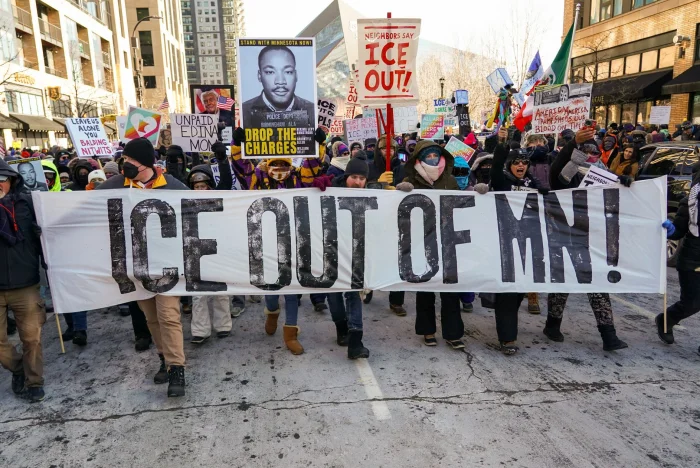
Thousands of protesters march in sub-zero temperatures during “ICE Out” day to protest the federal government’s immigration enforcement surge in Minneapolis, Minnesota on Friday. Photo by Craig Lassig/UPI | License Photo

Source link

Ex-Florida congressman convicted for secretly lobbying for Venezuela

Former U.S. Rep. David Rivera, R-Fla., was convicted on Friday of lobbying on behalf of the Venezuelan government without declaring himself to be a foreign agent. Photo by U.S. House of Representatives

May 1 (UPI) — Former U.S. Rep. David Rivera, R-Fla., was found guilty on Friday of being paid to secretly lobby elected U.S. officials to ease sanctions against Venezuela.

Rivera and a co-conspirator were each found guilty of taking payment from Nicholas Maduro to try to repair ties between the South American nation and the United States but never registering as an agent of a foreign country, The Miami Herald and NBC News reported.

A 12-person jury found the former Miami-Dade congressman and consultant Esther Nuhfer guilty of lobbying Secretary of State Marco Rubio and Rep. Pete Sessions, R-Texas, and attempting to set meetings up for Delcy Rodriguez, Venezuela’s then-foreign minister and current acting president.

Rivera was also found guilty of conspiring to commit money laundering and tax evasion.

Rivera had long been friends with his former roommate Rubio and became friends with Sessions when he was in Congress, and after Maduro gave him a $50 million contract he attempted to leverage those relationships.

Both Rivera and Nuhfer were caught having not registered themselves of lobbying for the federal government on behalf of another nation.

The convictions come after a 5-week trial that saw Rubio, who was in the Senate in 2017, when he met with Rivera and was told a plan to convince Maduro to step down was afoot.

Rivera denied that he was working on behalf of Maduro and the Venezuelan government, insisting that he was working to overthrow the now-deposed ruler rather than to promote his interests.

Nuhfur was released on bond ahead of her sentencing, while Rivera was judged to be a flight risk and will remain in jail until he is sentenced.

Rivera also still faces charges in another foreign lobbying case, as well.

Source link

Brazil Congress approves measure cutting Jair Bolsonaro sentence

Sen. Flavio Bolsonaro (C), son of former Brazilian president Jair Bolsonaro, celebrates with members of Congress a vote that could reduce the sentences for coup attempts imposed on his father and others, in Brasilia, Brazil, on Thursday. Photo by Andre Borges/EPA

May 1 (UPI) — Brazil’s Congress approved legislation that could significantly reduce prison sentences for former President Jair Bolsonaro and several supporters convicted over the 2023 attempted coup.

Both chambers of Congress voted Thursday by wide margins to overturn a veto by President Luiz Inácio Lula da Silva, allowing changes to how sentences are served for crimes linked to coup attempts.

Local media described the vote as further evidence of tensions between Lula’s government and a Congress dominated by conservative factions.

Newspapers, including Estadão and Folha de S.Paulo, said lawmakers dealt a “double blow” to Lula in less than 24 hours after the Senate also rejected, for the first time in 130 years, a presidential nominee for Brazil’s Supreme Court.

The legislation would directly benefit Bolsonaro, who was sentenced to 27 years in prison for leading the alleged coup plot, as well as dozens of former officials and hundreds of demonstrators linked to the Jan. 8, 2023, assault on government institutions in Brasília.

After the congressional vote, Sen. Flávio Bolsonaro, the former president’s son and a presidential candidate, wrote on X that the decision “is the first step toward full justice for the political persecution victims of Jan. 8.”

“The defeat of the Workers’ Party is the victory of Brazil,” he added.

The measure focuses on changes to sentencing rules. By overturning Lula’s veto, lawmakers established that convicts would no longer serve cumulative sentences for each individual offense, such as criminal association or damage to public property.

Instead, courts would apply only the sentence tied to the most serious crime, sharply reducing total prison time.

In Bolsonaro’s case, the change would cut his sentence from 27 years to a maximum of 12 years. Under Brazilian law, inmates may qualify for legal benefits after serving part of their sentence, potentially allowing the former president to seek parole or the end of his house arrest within an estimated two to four years.

The law is expected to face challenges before the Supreme Federal Court on grounds that Congress may have overstepped judicial authority and violated constitutional principles by altering sentences tied to crimes against the state.

While the court reviews the measure’s constitutionality, judges could suspend its implementation, preventing any immediate reduction of Bolsonaro’s sentence until a final ruling is issued.

Bolsonaro, who has been under temporary humanitarian house arrest since March 27 after suffering bilateral pneumonia, was admitted Friday to DF Star Hospital in Brasília after authorization from Supreme Federal Court Justice Alexandre de Moraes, according to local outlet G1 Globo.

The 71-year-old former president is scheduled to undergo shoulder surgery to repair a torn rotator cuff and related injuries.

The judicial developments come amid early campaigning ahead of Brazil’s October presidential election, where Flávio Bolsonaro is emerging as Lula’s main challenger. Several polls show the two tied in a potential runoff election.

Source link

6 people stabbed at Tacoma, Wash., high school

Four students, a security guard and the suspect were injured in a stabbing at a Tacoma, Wash., high school Thursday. File Photo by Bonnie Cash/UPI | License Photo

May 1 (UPI) — A student stabbed four students, a security guard and themselves at a Tacoma, Wash., high school.

The four students at Foss High School are in critical but stable condition, and the suspect and security guard suffered minor injuries after the incident on Thursday. The school canceled classes and after-school activities for Friday.

The suspect was arrested and taken to Pierce County Jail on five counts of first-degree assault. Police have not released the suspect’s name or age.

A student at the school, Imonie, told Fox 13 Seattle a video was sent to some students at the school.

“In class we hear, ‘This is a lockdown,’ and everybody’s like, ‘What is going on?’ And then all of a sudden I see the video Air Dropped to my friend’s phone, and we see the whole video happen — the whole fight and stuff — and it was just crazy. It was so bad, there was blood everywhere. And then I heard that, basically, the person who had the knife was — I don’t even know. They said it was some older kid that had already been to jail and stuff, so they came in with a knife. They only fought because, over a puff,” said Imonie, also in the 9th grade.s

She said she doesn’t feel safe at the school.

The school said counselors would be made available to students when classes resumed on Monday.

Artemis II pilot Victor Glover (L) and mission specialist Christina Koch meet with President Trump in the Oval Office of the White House on Wednesday. Photo by Graeme Sloan/UPI | License Photo

Source link

DOJ sues New Jersey over tuition aid for some noncitizen students

May 1 (UPI) — Federal prosecutors are suing New Jersey for offering qualifying noncitizen residents in-state college tuition and state-funded benefits, the latest state the Trump administration has accused of discriminating against out-of-state Americans in its anti-immigration crackdown.

The Justice Department has brought nine lawsuits challenging states’ laws often called Dream Acts, which generally offer noncitizens who have lived in and attended high school in the state for several years the same college tuition that citizen residents are charged.

The Justice Department filed its lawsuit Thursday, asking the court to block New Jersey from enforcing two laws: one passed in 2013 that offers in-state tuition to eligible noncitizen residents, and another passed in 2018 that extends their eligibility to state financial aid programs and scholarships.

Federal prosecutors alleged in the lawsuit that the laws “blatantly discriminate in favor of illegal aliens over U.S. citizens from other states” and violate federal law, which bars states from offering postsecondary education benefits based on residency to people unlawfully present in the country unless U.S. citizens are eligible for the same benefits.

“Imagine being denied the opportunity of education in our own country. By granting illegal aliens in-state tuition, the state of New Jersey is doing just that,” Associate Attorney General Stanley Woodward said in a statement.

The lawsuit comes as the Trump administration carries out an aggressive anti-immigration policy that has included mass round-ups of noncitizens to revoking deportation protections for those from war- or catastrophe-torn nations.

Almost exactly a year ago, President Donald Trump signed the “Protecting American Communities from Criminal Aliens” executive order, which directed the attorney general to identify laws “favoring aliens over any groups of American citizens,” including state laws “that provide in-state higher education tuition to aliens but not to out-of-state American citizens.”

Of the nine lawsuits challenging these Dream Act laws to date, Texas, Kentucky and Oklahoma have resolved their cases either through agreements, consent decrees or joint motions.

Lawsuits are still pending in Illinois, Minnesota, Virginia, Nebraska, California and now New Jersey.

According to the Higher Ed Immigration Portal, 21 states and Washington, D.C., provide in-state tuition to undocumented students, while 18 and D.C. also provide access to state financial aid.

Artemis II pilot Victor Glover (L) and mission specialist Christina Koch meet with President Trump in the Oval Office of the White House on Wednesday. Photo by Graeme Sloan/UPI | License Photo

Source link

High court weighs temporary protected status for Haitian, Syrian people

1 of 4 | A pro-temporary protected status activist protests outside Supreme Court. Photo by Jamie Gareh/Medill News Service

WASHINGTON. April 29 (UPI) — Fritz Emmanuel Lesly Miot left Haiti in 2010 after a deadly earthquake hit the island nation. As hundreds of thousands of Haitians died in the catastrophe, Miot fled to the United States, where he was granted temporary protected status, a short-term visa program.

Miot, 33, has lived in the States ever since and now researches Alzheimer’s disease in California as a doctoral candidate.

But last year, the Trump administration attempted to revoke his status and send him back to Haiti, along with all other Haitians who had been granted temporary protected status.

On Wednesday, the Supreme Court heard arguments in Miot’s case, along with a similar case that affects Syrian nationals living under temporary protected status. These legal battles, Trump vs. Miot and Mullin vs. Doe, could decide the future of some 350,000 Haitians and 6,000 Syrians living in the United States.

What is TPS?

Temporary protected status began in 1990, enacted as a way to provide foreign nationals relief from war, natural disaster or other “extraordinary and temporary conditions.”

Those with temporary protected status are granted legal status for up to 18 month periods, which can be extended based on an evaluation of the safety conditions in the countries they have left behind.

Currently 1.3 million people in the United States — from 17 countries — rely on temporary protected status. The Trump administration has attempted to terminate that status for those from 13 of those nations in the last year, including Afghanistan, Venezuela, South Sudan and Nicaragua.

Lower courts have blocked many of these terminations, deeming them unlawful, and immigrants under temporary protected status have remained in a state of limbo since. The results of these cases could set a legal precedent that would allow the termination of temporary protected status for citizens from these countries, with minimal oversight.

Two questions

Central to Wednesday’s debate were two questions: First, did then Secretary of Department of Homeland Security Kristi Noem follow correct procedure when deciding it would be safe to send people back to Haiti and Syria? Second, did the judicial branch have the legal right to interfere in the secretary’s decisions on temporary protected status?

Noem was criticized for not sufficiently consulting other state agencies when evaluating Haiti and Syria’s safety conditions. She was accused of violating the Administrative Procedures Act. Some Democratic-appointed Justices highlighted brief email exchanges Noem made with the State Department that led her to terminate Haiti and Syria’s status.

In the case of Haiti, she wrote last September to the State Department in an email, “Can you advise on State’s views on the matter?” The State Department simply replied, “State believes there would be no foreign policy concerns with respect to a change in the TPS status of Haiti.”

Justice Ketanji Brown Jackson on Wednesday questioned whether a “meaningful exchange” of information was made and whether Noem made any effort to actually evaluate the nation’s safety conditions, which is the basis of how temporary protected status is granted.

The government’s attorney, Solicitor General John Sauer, argued that minimal oversight was required of the DHS secretary in these decisions. But Jackson took issue with that, saying it would mean that Noem “can basically do whatever she wants.”

Sauer also vehemently argued that the DHS secretary’s actions should not even be open to judicial review, citing a law that states judges cannot interfere in “any determination with respect to the designation, or termination or extension,” of temporary protected status.

However, Justice Sonia Sotomayor responded that while the courts can’t challenge the secretary’s ultimate decision, they can question whether the procedures taken to come to those decisions fall within the law.

The immigrants’ attorney, Sotomayor and Jackson all later grilled Sauer on whether the Trump administration’s terminations were racially discriminatory.

Sotomayor and Jackson referenced Trump’s previous hostile rhetoric toward both communities. The justices repeatedly referenced one particular post on Truth Social in which Trump said that immigrants are “poisoning the blood of our country.”

Sotomayor said Trump’s statement showed that “discriminatory purpose may have played a part in this decision.”

Immigrant advocates watched the case closely.

“Certainly the goal of this Trump administration is to make people… immediately vulnerable,” Lucas Guttentag, a Stanford law professor who started the ACLU’s Immigrants’ Rights Project, said in an interview.

He said this was part of a much larger campaign to “de-legalize” lawful immigrants and potentially “eviscerate the immigration and asylum protection system covered in this country for decades and generations.”

However, Ira Mehlman, the media director for the Federation for American Immigration Reform, said that many of the immigrants living under temporary protected status had been here far too long.

He said many Haitians arrived 16 years ago. “By no reasonable assessment of the law or English language could you consider that time frame temporary,” he said in an interview.

He added that refugees from many countries, including Haiti and Syria, received temporary protected status because of natural disasters or civil wars that have already ended. So the reason to keep them in the United States has also ended.

“None of them were the Garden of Eden before the earthquake or hurricane … and they’re probably never going to be,” he added.

Kavanaugh echoed this sentiment, saying “The whole thing was the Assad regime was 53 years of brutal treatment and repression. It’s gone.”

Return to literally nothing

Liana Zogbi, a spokesperson from the non-profit Syrian Forum USA, painted a different picture. She said that Syrians would be “returning to literally nothing” should the Supreme Court rule in the government’s favor and Syrians be sent home.

“The majority of the country has been destroyed physically,” she said, explaining that schools, hospitals and even roads are still being rebuilt.

The State Department currently advises U.S. citizens not to travel to Syria “for any reason due to the risk of terrorism, unrest, kidnapping, hostage-taking, crime and armed conflict.”

Haiti is under a similar travel advisory from the State Department, which cites “crime, terrorism, unrest and limited healthcare.” Zogbi said the government would be contradicting itself were it to rule these countries safe for its nationals’ return but not safe enough for U.S. citizens to visit.

Hundreds of thousands of immigrants await a decision by the court, which is expected before July.

“Not only does it bring back up … the kind of trauma around instability and destabilizing their lives,” Zogbi said. “They [TPS holders] never know what can happen and how fast they have to leave. They constantly have to make plan A, B, C and D to just kind of prepare for any outcome of a situation.”

Source link

Supreme Court rules against Louisiana’s congressional map

April 29 (UPI) — The U.S. Supreme Court ruled against Louisiana’s newly drawn congressional map Wednesday, saying it relied too heavily on race.

The 6-3 decision eliminates one of the two predominantly Black congressional districts established by redistricting from the 2020 census.

Supporters of the redrawn map said it abided by Section 2 of the Voting Rights Act, which prevents lawmakers from packing racial minorities in a limited number of districts or spreading them across too many to diminish their voting power.

Justice Samuel Alito, writing for the majority, described Louisiana’s map as “unconstitutional gerrymander.”

“When §2 of the Act is properly interpreted, it imposes liability only when circumstances give rise to a strong inference that intentional discrimination occurred,” he wrote.

The ruling weakens the landmark Voting Rights Act passed in 1965 to limit racial discrimination in voting. The Supreme Court dealt the act a blow in 2013 when it struck a core provision providing oversight to states with a history of voting discrimination.

With the new ruling by the high court, Republican lawmakers will have an easier time redrawing state maps to more closely align with their party.

Justice Elena Kagan, one of the three dissenters, said such intentional discrimination is hard to prove and that Wednesday’s decision serves to “eviscerate the law.”

“Under the Court’s new view of Section 2, a State can, without legal consequence, systematically dilute minority citizens’ voting power,” she wrote.

It’s unlikely the Supreme Court’s ruling will have an impact on midterm elections later this year as early voting in congressional primaries begin May 16.

Britain’s King Charles III delivers an address to a joint meeting of Congress at the U.S. Capitol on Tuesday. The king and Queen Camilla are on a four-day state visit to the U.S. with stops in Washington and New York. Photo by Bonnie Cash/UPI | License Photo

Source link

Court sentences Purdue Pharma to pay $5.5B, clearing settlement path

A federal court on Tuesday sentenced Purdue Pharma to pay more than $5.5 billion in criminal penalties. File Photo by Justin Lane/EPA-EFE

April 28 (UPI) — A federal judge on Tuesday sentenced Purdue Pharma to pay more than $5 billion in criminal penalties, clearing the way for the OxyContin maker to complete its bankruptcy settlement agreement and resolve thousands of opioid-related lawsuits filed against it by states, local governments, tribes and other plaintiffs.

The sentence, handed down by a federal court in Newark, N.J., comes after Purdue pleaded guilty in October 2020 to charges over its role in the opioid crisis.

Prosecutors said the Sackler family-owned company worsened the crisis that has killed hundreds of thousands across the United States by aggressively marketing its addictive drugs while downplaying the risks of overdose and addiction.

Thousands of lawsuits have been filed against the company over its role in the crisis, and Purdue filed for Chapter 11 bankruptcy in 2019 as part of an agreement to resolve them.

With Tuesday’s sentence, Purdue can be dissolved and replaced by the public benefit company Knoa Pharma, which will receive the assets and expertise of the old company to produce addiction treatments and overdose-reversal medications.

“Purdue Pharma put profits over patient health and safety,” Acting Attorney General Todd Blanche said in a statement announcing the sentence handed down by a federal court in Newark, N.J.

“The company willfully rejected the law and ignored the diversion of their highly addictive prescription drugs.”

About 806,000 people died from an opioid overdose from 1999 to 2023, according to the U.S. Centers for Disease Control and Prevention.

Court documents accused Purdue of illegally marketing its opioids from 2007 to 2017, generating billions in profit.

The penalties announced Tuesday include a $3.544 billion criminal fine and an additional $2 billion in criminal forfeiture, though the Justice Department said it will credit up to $1.775 billion against the forfeiture amount based on the value conferred to state, local and tribal governments through its bankruptcy.

“No penalty can undo the widespread devastation Purdue has inflicted, but today’s sentence serves long-overdue accountability for its reckless and unlawful conduct,” Inspector General T. March Bell of the U.S. Department of Health and Human Services said in a statement.

Source link

Supreme Court mulls liability of tech firms in overseas rights abuses

A member of the Bulgarian Falun Dafa association attends a protest in front of the Chinese embassy in Sofia, Bulgaria, in July 2023. The protest marked the 24th anniversary of the start of a massive campaign against Falun Dafa in July 1999, when the Chinese Communist regime began the repression and persecution of Falun Gong and its followers in China. File Photo by Vassil Donev/EPA

WASHINGTON, April 28 (UPI) — Supreme Court justices appeared divided Tuesday morning about whether a U.S. tech company can be held liable for aiding the Chinese government’s alleged torture of a spiritual minority.

The case is centers on whether practitioners in China of the Falun Gong religion — also called Falun Dafa — can sue California-based tech company Cisco Systems for aiding and abetting violations of the 18th-century Alien Tort Statute and the Torture Victim Protection Act, which was enacted in 1992.

Cisco attorney Kannon Shanmugam called for barring aiding and abetting liability. He argued that allowing liability to be implied would harm the government’s separation of power.

Much of Tuesday’s debate hinged on whether the statute’s 200-year-old “law of nations” wording was applicable to the relatively more modern concept of human rights abuses, as well as whether the first Congress meant for the victim protection act to include second liability for aiding and abetting torture.

The case marks the latest attempt to define the scope of the statue, which for over two centuries has allowed foreigners to bring lawsuits in U.S. courts for serious violations of international law.

More than 20 years ago, Cisco developed and sold to the Chinese government a surveillance system, which the government used to find, interrogate and allegedly torture Falun Gong practitioners.

During arguments for Cisco Systems Inc. vs. Doe I, some justices emphasized Cisco’s awareness of their technology’s role in persecution, while others said that including liability for aiding torture in the alien tort statue contradicted with historical precedent and had foreign policy risks.

But no clear majority converged around either position in the conservative majority court.

“We’ve maybe misled Congress into thinking, ‘Oh, we don’t need to do anything about these human rights things, the courts are taking care of it,'” Justice Brett Kavanaugh said.

“I’m concerned at a separation of powers level that we’re not really allowing suits to go forward, but Congress thinks we are because of a lack of clarity in our case law.”

Justices Ketanji Brown Jackson and Sotomayor appeared more supportive of those who brought forward the original lawsuit — several Chinese nationals and one U.S. citizen.

Addressing the wording of the Torture Victim Protection Act, Sotomayor told Shanmugam: “I’m not sure how you get to your position that ‘subjects to’ can’t mean aiding and abetting because command liability doesn’t necessarily require subjecting someone to the torture.”

“It makes someone who’s in a command position who knows of the torture and permits it to happen … aiding and abetting. We’ve defined aiding and abetting as an active step in permitting and encouraging the substantive act.”

The Alien Tort Statute grants federal district courts original jurisdiction over any civil action in which an alien sues for a tort “committed in violation of the law of nations or of a treaty of the United States.”

“What’s the point of previous [Supreme Court] decisions that determined U.S. corporations could be defendants?” said Sophia Cope, senior staff attorney at Electronic Frontier Foundation, who helped write an amicus brief in support of the Falun Gong members.

“Excluding second liability from the ATS would be a huge loophole for companies to sell services which are used for human rights violations.”

By rejecting judicially created aiding and abetting liability, the court would close the last major loophole that the plaintiffs’ lawyers have “exploited” to keep cases with such claims under the ATS and TVPA alive, said Cory Andrews, vice-president of litigation at the Washington Legal Foundation. The foundation submitted a brief in support of Cisco in February.

“It would reaffirm that the ATS is a narrow 1789 statute, not a modern vehicle for global human-rights enforcement,” Andrews said.

The case had its origins 15 years ago. In 2011, the plaintiffs — 13 Chinese nationals and one U.S. citizen — filed the original suit in the District Court for the Northern District of California, claiming they were targeted using Cisco’s technology and then detained and tortured.

The district court dismissed the claims, but it was brought to the Supreme Court after a panel of federal judges on the U.S. Court of Appeals for the Ninth Circuit agreed in 2023 that the plaintiffs had met a legal threshold to continue with the lawsuit.

A decision is expected by the end of June.

Source link

Appeals court: Pentagon may require escorts for reporters

April 28 (UPI) — The Department of Defense may require reporters to be escorted inside the Pentagon, a federal appeals court has ruled, handing the Trump administration a rare win in litigation challenging its press restrictions.

A divided three-judge panel of the U.S. Court of Appeals for the D.C. Circuit granted the Trump administration’s emergency request for a stay pending appeal, but only concerning its Pentagon escort requirement.

The 2-1 ruling stays part of U.S. District Judge Paul Friedman‘s April 9 order that had found an interim Pentagon policy was in violation of his earlier order that blocked the Department of Defense’s initial policy requiring journalists to sign a form acknowledging that they could have their credentials revoked for gathering unauthorized information.

The Trump administration argued that the escort requirement of the interim policy was a new rule not affected by the initial order and was put in place to prevent the disclosure of sensitive or classified information.

The appeals court agreed that the administration was likely to win on the merits of its narrow argument.

Chief Pentagon spokesman Sean Parnell said Monday that the Department of Defense “welcomes” the court’s decision.

“The department looks forward to presenting its full case to the D.C. Circuit on the merits,” he said in a social media statement.

The Trump administration has repeatedly taken actions critics see as attempting to influence media coverage, including a Defense Department policy announced in October that threatened the credentials of reporters who gather sensitive information.

Most credentialed journalists refused to sign, and The New York Times and one of its reporters sued.

Friedman blocked the rule. The Pentagon then attempted to enact an interim policy that was again blocked on April 9 by Friedman, who ruled that the Trump administration “cannot simply reinstate an unlawful policy under the guise of taking ‘new’ action and expect the court to look the other way.”

D.C. Circuit Judge J. Michelle Childs said in dissent that though the escort policy on its face appeared different from the policy blocked by the March order, its practical effect was the same: denying reporters meaningful access to the Pentagon.

“The point of the injunction, as the district court interpreted it, ‘was to restore The Times journalists’ access to the Pentagon, not merely to ensure that they have possession of a physical credential,” she said.

“Reporters can hardly verify sources, gather information, or speak candidly with department personnel with an escort looming over their shoulders.”

Source link

U.S. attorney: Suspect in shooting at correspondents’ dinner due in court

April 27 (UPI) — Cole Allen was due to be arraigned in federal court in Washington, D.C. on Monday, accused of carrying out a shooting at the White House Correspondents’ Association Dinner on Saturday, at which President Donald Trump, the First Lady and many of his cabinet were present.

U.S. Attorney for the District of Columbia, Jeanine Pirro, told a news conference that a suspect would be formally charged with an initial two counts — using a firearm during a crime of violence and assaulting a federal officer using a dangerous weapon.

“The defendant will be arraigned on Monday in federal district court. But make no mistake, there will be many more charges based upon the information that we are learning in this very fluid situation,” said Pirro.

“It is clear, based upon what we know so far, that this individual was intent on doing as much harm and as much damage as he could,” added Pirro, who said she was present when the shooting started at the event at the Washington Hilton hotel on Saturday night.

Beyond that, Pirro said investigators were working to discover the suspect’s possible motivation for the alleged attack and would not be drawn on whether he was specifically targeting Trump, or whether he was cooperating with law enforcement.

“At this point, what we know is the individual charged the checkpoint with a firearm in his hand. We know he was running in the direction of the ballroom that the president was in as well as other cabinet members. So what his specific motivation was, we can’t say at this point. However, as we continue to investigate that, we’ll continue to work towards that,” she said.

Monday’s hearing is expected to be short — only for the judge to make Allen aware of his legal rights and for Pirro’s office to apply to remand Allen in custody.

The suspect has yet to be officially named by authorities but NPR said two people familiar with the investigation, who were not authorized to speak publicly, identified him as Cole Tomas Allen, 31, of Torrance, Calif.

Authorities believe the suspect acted alone in the incident in which a Secret Service Uniformed Division officer was allegedly shot and no one else has been arrested.

The Secret Service officer, who was wearing a bullet proof vest, was treated in the hospital and released.

Trump said Sunday that a suspect arrested in connection with the shooting had written an anti-administration “manifesto” that allegedly stated he was targeting members of the Trump administration.

He said that, based on the contents of the document, the suspect was “a sick guy” and anti-Christian.

“When you read his manifesto, he hates Christians. That’s one thing for sure. He hates Christians, a hatred. And I think his sister or his brother actually was complaining about it. You know, they were even complaining to law enforcement. So he was, he was a very troubled guy,” said Trump.

The suspect reportedly sent the manifesto to members of his family minutes before that incident occurred, along with an apology, who then raised the alarm

The New London Police Department in Connecticut confirmed being contacted about two hours after the alleged attack at around 10:49 p.m. EDT on Saturday “by an individual who expressed concern about the incident that occurred at the White House Correspondents’ Association Dinner earlier in the evening.”

Allen was a mechanical engineering graduate from the California Institute of Technology in Pasadena and also had a master’s degree in computer science from California State University Dominguez Hills in Carson City, according to the Los Angeles Times.

His LinkedIn profile states that he was a member of Caltech’s Christian fellowship, as well as the Nerf club.

More recently, he was working developing video games and as a part-time private tutor teaching math and biology.

Allen’s voting registration record denotes “no party preference” and the only known record of any political donation in the past 10 years dates from 2024 when he gave $25, via an online fundraising platform, to former Vice President Kamala Harris’ presidential campaign in the Nov. 2024 election.

President Donald Trump and first lady Melania Trump participate in the 2026 White House Correspondents’ Association Dinner in Washington on April 25, 2026. Photo by Yuri Gripas/UPI | License Photo

Source link

Australian police believe missing 5-year-old girl was abducting

Authorities in Australia said Monday that they believe Sharon Granites, 5, was abducted from her Alice Springs, Northern Territory, home over the weekend. Photo courtesy of Northern Territory Police Force/Release

April 27 (UPI) — A 5-year-old girl who went missing from a central Australian Indigenous community over the weekend was abducted, authorities said Monday, as they search for a 47-year-old man who they believe may be connected.

Sharon Granites was reported missing from her residence in Old Timers, an Aboriginal town camp in Alice Springs, located in Australia’s Northern Territory, at about 1:35 a.m. local time Sunday, according to a statement from the Northern Territory Police Force.

She was last seen at about 11:30 p.m. Saturday wearing a dark blue short-sleeve T-shirt with white stripes around the neck and sleeve hemlines and a pair of black boxer-style underwear.

Northern Territory Police Acting Commander Mark Grieve told reporters at a press conference that they believe Sharon was abducted and that officers are seeking to speak with Jefferson Lewis, “who may be able to provide us with some information in regards to that.”

Grieve said Lewis had been in and around Sharon’s residence on Saturday, is one of the few people who were in Old Timers who have not made themselves known to police and is believed to have gone missing at around the same time as the little girl.

Grieve stopped short of accusing Lewis of being involved in Sharon’s disappearance, saying police wanted to speak with him because he and Sharon appeared to have disappeared around the same time.

“Considering himself and Sharon went missing at around about the same time, it certainly brings about those suspicious circumstances and we’d like to speak to him about that,” he said.

Lewis was recently released from prison and has a criminal history that includes physical assault and domestic violence, Grieve said, adding that no offenses were related to child endangerment.

Drones, dogs, horses, ATVs, motorcycles and ground patrols were among the assets police deployed in the search for Sharon, he said, stating they are calling on members of the public with information on either Sharon or Lewis’ location to contact authorities immediately.

“Obviously, it’s a terrible situation to have such a young child go missing,” he said. “We’re just over 24 hours now, so it would certainly be my worst nightmare as a parent.”

Source link

U.S. kills three in latest suspected drug boat attack in Pacific

April 27 (UPI) — The U.S. military has killed another three men in its latest attack targeting suspected drug-trafficking boats in the eastern Pacific, U.S. Southern Command announced late Sunday.

It was the 54th strike in the Trump administration’s violent anti-drug smuggling campaign that has killed at least 185 people since early September, according to UPI’s tally of publicly released data. At least 57 boats have been destroyed in the attacks in the eastern Pacific and Caribbean.

SOUTHCOM has announced each strike on social media, accompanied by a short black-and-white aerial video of the attack, showing the boat erupting in flames.

As with the previous strikes, SOUTHCOM said in a statement that the boat it attacked Sunday “was transiting along known narco-trafficking routes in the eastern Pacific and was engaged in narco-trafficking operations.”

The Trump administration claims the vessels are operated by 10 drug cartels and gangs that President Donald Trump has designated as terrorist organizations since returning to office, but has yet to provide evidence.

Trump argues the use of deadly force is warranted as the United States is in “armed conflict” with those organizations, but his administration has come under mounting accusations of conducting extrajudicial killings.

The strikes have been repeatedly condemned and their legality questioned by Democrats and human rights organizations, who accuse the Trump administration of violating international and maritime law by using the military to conduct law enforcement drug operations.

Ben Saul, the United Nations’ special rapporteur on counterterrorism and human rights, chastised the Trump administration last month for “responding with lawless violence that flagrantly violates human rights, in its phony war on so-called narco-terrorism.”

The attacks are not permissible law enforcement action in self-defense, authorized under the law of the sea, in national self-defense or under international humanitarian law, he said.

On Thursday, 125 humanitarian, human rights, peacebuilding and other related organizations from around the world called on all states to “immediately cease or refrain from supporting U.S. extrajudicial killings.”

The letter warned that states could be held legally responsible for aiding or assisting the United States by sharing intelligence as well as providing access to military bases and logistical support with the U.S. military.

The groups argue that the consequences of these killings are being felt throughout the hemisphere.

“Families awaiting the return of their loved ones may never know what happened to them and have no access to recourse,” the organizations said in their open letter.

“Coastal communities have witnessed human remains washing up on shore and fear for their lives when they trade and fish, sowing psychological trauma and undermining livelihoods.”


Source link