The 79th Tony Awards went off without a hitch at Radio City Music Hall, Sunday. The show, hosted by Pink, ran just over three hours and was relatively unsurprising when it came to the wins it delivered. Although each year it seems more marquee film and television stars appear in the audience as celebrities of a certain caliber continue to flock to the stage in search of a more authentic—and immediate—connection to their audience.
This year viewers could see Adrien Brody, John Lithgow, Laurie Metcalf, Rose Byrne, Daniel Radcliffe, Nathan Lane, Alden Ehrenreich and more. Despite, or perhaps because of the star power, the show stuck to its expected script with “Schmigadoon!” winning best musical, “Ragtime” best musical revival, “Liberation” best play and “Death of a Salesman” best revival.
Still, the night had enough laughs, groans and tender moments to keep things interesting. Here are seven of our favorites.
Vampires as metaphor for what ails America
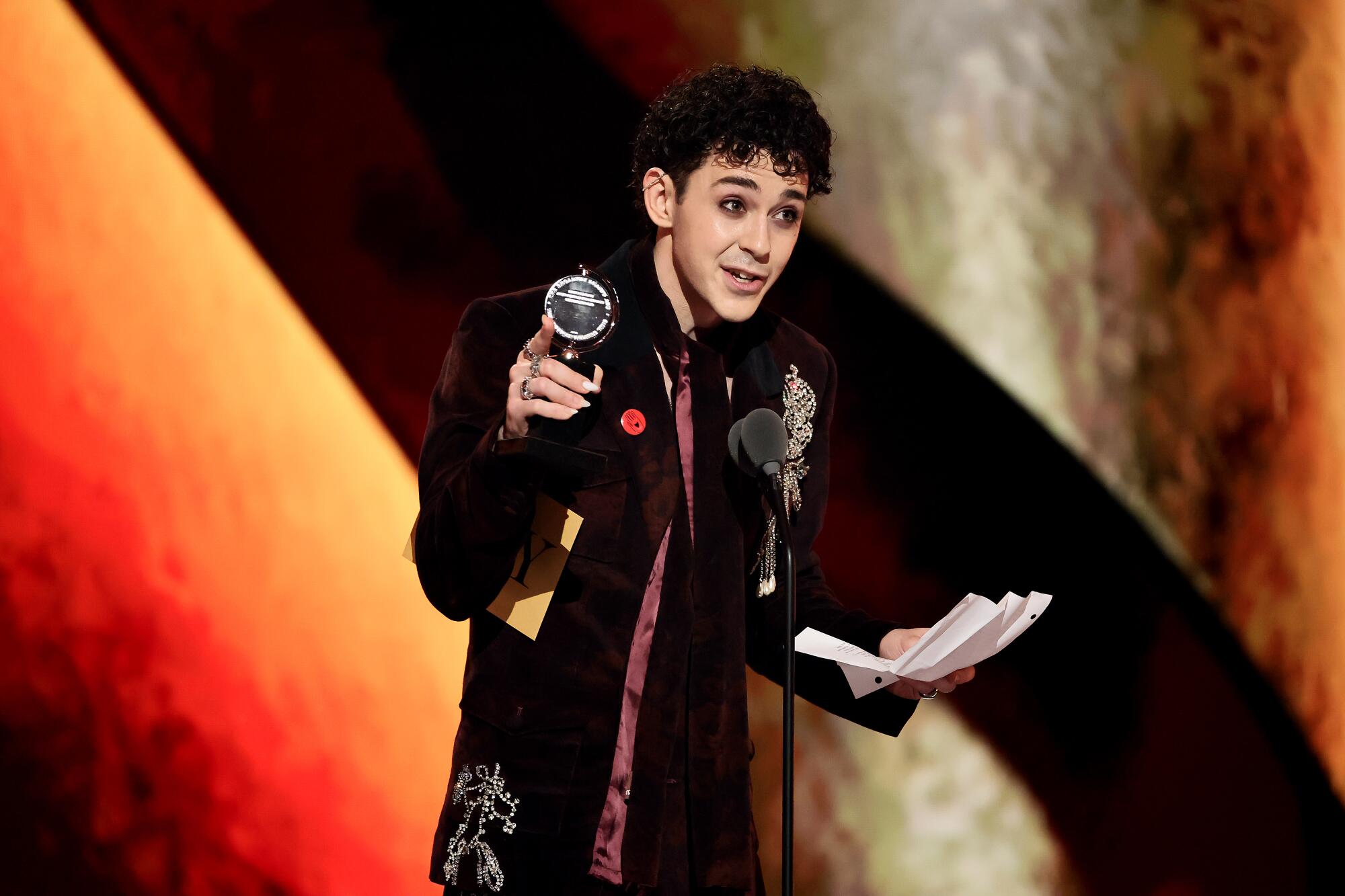
Ali Louis Bourzgui used vampires as a metaphor for American folly in his acceptance speech for performance by an actor in a featured role in a musical at the 2026 Tony Awards.
(Theo Wargo / Getty Images for Tony Awards Productions)
Who knew vampires made such a good metaphor for America’s worst excesses? When 26-year-old Ali Louis Bourzgui took to the stage at Radio City Music Hall after an upset win for performance by an actor in a featured role in a musical, he used the undead to poignantly describe the country’s biggest sociopolitical challenges.
“Vampires represent those who have shunned their own humanity in order to achieve a nonexistent sense of superiority. The billionaires will never find happiness from their money. The colonizers will never find fulfillment from the land and lives they steal. The fascists will never find meaning from their conformity, not in this lifetime or eternity,” said Bourzgui, who originated the role of David in the musical adaptation of the cult vampire horror film “The Lost Boys.”
—Jessica Gelt
A Tony trifecta for John Lithgow and Laurie Metcalf
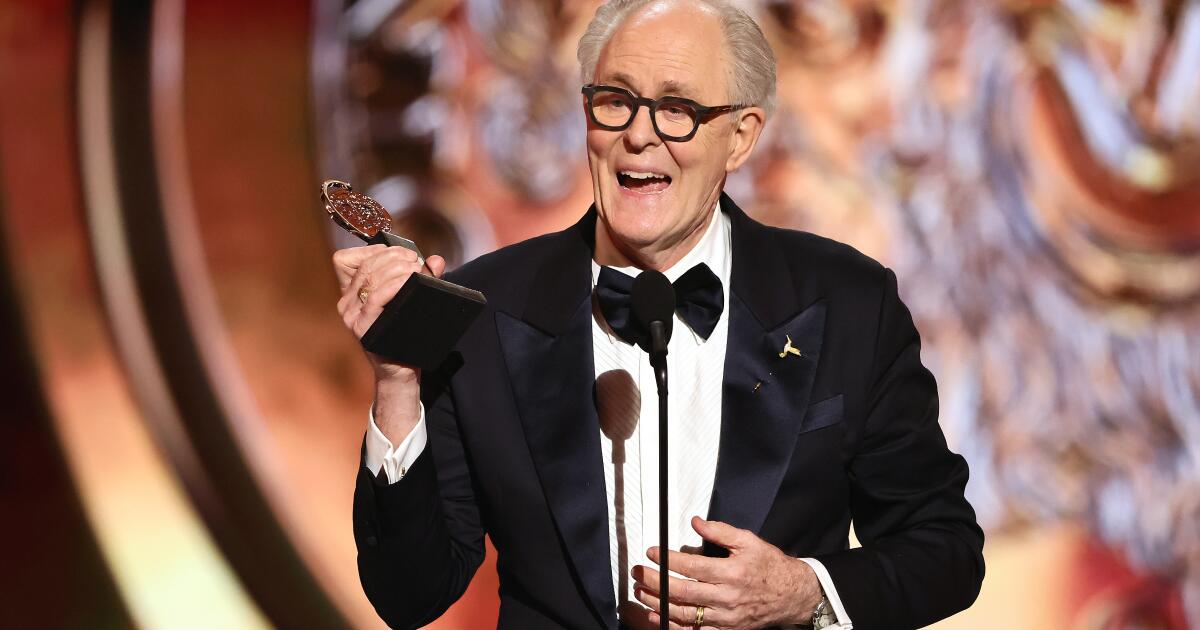
John Lithgow won the third Tony Award of his career at the 2026 Tony Awards at Radio City Music Hall.
(Theo Wargo / Getty Images for Tony Awards Productions)
It’s always a good feeling when actors we have known and love get rewarded by a well-deserved win, and so it was on Sunday night when John Lithgow and Laurie Metcalf took back-to-back wins early in the show. The former for performance by an actor in a leading role in a play for his portrayal of the controversial, beloved British author Roald Dahl in Mark Rosenblatt’s drama “Giant.” The latter for featured actress for her portrayal of Willy Loman’s protective wife, Linda, in “Death of a Salesman.” The plays were quite different, but the winners shared a very specific honor: the night marked the third Tony win for each actor.
Lithgow won his previous trophies in 1972 and 2002, and Metcalf in 2017 and 2018.
—Jessica Gelt
Nathan Lane is an ‘American theatrical treasure’
Nathan Lane accepts the best revival of a play award for “Death of a Salesman” at the 2026 Tony Awards.
(Theo Wargo / Getty Images for Tony Awards Productions)
Unless Nathan Lane gets a crack at playing King Lear, his Willy Loman in Joe Mantello’s production of Arthur Miller’s “Death of a Salesman” will go down as one of the peak challenges of his acting career. Not winning the Tony for his indefatigable performance must sting, but John Lithgow was favored to win for his brave turn as the baleful Roald Dahl of Mark Rosenblatt’s “Giant.” Lane had to have been prepared but a subtle wince of disappointment could be detected when the camera pryingly caught his immediate reaction.
So it was gratifying to see Lane receive his due from Mantello, who upon accepting his award for directing credited Lane with being the inspiration for the production. And when “Salesman” won for best revival, it was only fitting that Lane accepted the award on behalf of the company about a play that, ultimately, he pointed out, is about a family.
It was a point that Laurie Metcalf, who won for her featured performance as Linda Loman, also raised when she thanked Lane, Christopher Abbott (who played Biff) and Ben Ahlers (who played Happy) —her ferocious Loman family— for making her better.
A three-time Tony-winner already, Lane doesn’t need another trophy to assure him that he’s an American theatrical treasure. But this wasn’t just another Broadway outing for him. This was Miller’s masterwork in a production that will be remembered long after the tally of this year’s Tony Awards are long forgotten.
—Charles McNulty
Joshua Henry is a good person, a great actor and everybody loves him
Joshua Henry won a Tony Award for performance by an actor in a leading role in a musical at the 79th Annual Tony Awards, earning perhaps the most rousing standing ovation of the night.
(Theo Wargo / Getty Images for Tony Awards Productions)
The biggest standing ovation of the night came when Joshua Henry won the award for performance by an actor in a leading role in a musical for his critically acclaimed portrayal of Coalhouse Walker Jr. in the revival of “Ragtime.” Wearing a show-stopping black suit with golden flowers, Henry rushed to the stage as the star-studded crowd leapt to its feet to deliver a rousing standing ovation.
Henry first came to the full attention of fans playing Aaron Burr in the 2017 national tour of “Hamilton,” and has since gone on to distinguish himself as one of Broadway’s most charming and relatable stars. His optimism and kindness shine through, as does his fierce love of his art form, which was apparent as he gave his acceptance speech, thanking — in particular — his first vocal coach for believing in him. He also gave a poignant shout-out to the show’s original cast members Brian Stokes Mitchell and Audra McDonald, and sent all the love to his three young sons.
—Jessica Gelt
Pink had fun, but didn’t seem to know why she was there
Neil Patrick Harris and Pink perform during The 79th Annual Tony Awards at Radio City Music Hall.
(Jenny Anderson / Getty Images for Tony Awards Productions)
Pop star Pink kicked off the show with a wink and a nod to her hit “Lady Marmalade,” and went on to wow the audience with an action-packed opener filled with more than 150 performers and riffs from every Broadway show imaginable, plus a spirited appearance by Megan Thee Stallion. But the line that resonated most came early on when she spun hopelessly on a rope above the stage dressed as Peter Pan and a worried Neil Patrick Harris appeared to ask why she was performing in such an old-fashioned show.
“I just want to show how much I love theater even though I’ve never been on Broadway,” Pink said, still dangling, but nailing a few tricks. “I’m just concerned people might be like, ‘Why’s Pink hosting the Tonys?’”
That wasn’t the first time she seemed to be apologizing to the audience for being there.
—Jessica Gelt
Darren Criss gives happy endings
Darren Criss and Nicole Scherzinger joked it up during the 79th Annual Tony Awards at Radio City Music Hall.
(Theo Wargo / Getty Images for Tony Awards Productions)
Darren Criss is a Broadway superstar who consistently delivers “Happy endings,” according to co-presenter Nicole Scherzinger.
In what might have been the show’s most racy and deliciously groan-worthy joke, Scherzinger, stood side-by-side with the “Maybe Happy Endings” star to deliver the penultimate awards of the night, and noted, “You gave the world happy endings.”
“I did?” asked Criss, feigning innocence.
“You’re a giver,” said Scherzinger.
The pair took a beat through bubbling titters from the audience before knowingly yelling, “Happy Pride everyone!”
—Jessica Gelt
Leslie Odom Jr. delivers a moving in memoriam
Leslie Odom Jr. performs the In Memorium tribute during The 79th Annual Tony Awards at Radio City Music Hall.
(Theo Wargo / Getty Images for Tony Awards Productions)
Tony Award winner Leslie Odom Jr. sang a soulful rendition of “Without You” from “Rent” during the ceremony’s In Memoriam segment, which honored artists who died in 2025 and 2026, including Diane Keaton and Robert Redford. These annual segments are mournful — and tricky — and the “Hamilton” star managed to create an understated atmosphere that set the perfect tone for the somber projection of recently lost greats such as Robert Duvall, Tom Stoppard and Carmen de Lavallade.
The 79th Tony Awards telecast kicked off with a bang by giving out two major awards in the first 30 minutes — and before viewers could blink both John Lithgow and Laurie Metcalf had each won the third Tony Award of their careers.
Lithgow won best performance by an actor in a leading role in a play for his portrayal of the controversial, beloved British author Roald Dahl in Mark Rosenblatt’s poignant drama “Giant,” directed by Nicholas Hytner. Times theater critic Charles McNulty called Lithgow’s performance “at once terrifying and never anything less than human,” and “one of the bravest” of the Broadway season.
Lithogow’s win, however, was far from assured. He was in the running against Nathan Lane in the season’s most talk-about show’s “Death of a Salesman,” and many bets were surely placed on the latter to sweep.
Lithogow is among a cadre of accomplished film and television actors who have a deep love of the stage. His first Tony win came for best featured actor in a play for his 1972 Broadway debut in “The Changing Room.” His second came 30 years later in 2002 when he he won for best actor in a musical for “Sweet Smell of Success.”
Metcalf won best featured actress for her portrayal of Willie Loman’s protective wife, Linda Loman, in “Death of a Salesman.” This is Metcalf’s third win in less than a decade, and was not a surprise as she has inherited “Helen Hayes’ mantle of First Lady of the American Theater,” according to McNulty.
Perhaps that explains her perfunctory, somewhat rote speech — which still didn’t detract from the joy of her win. Viewers know a towering talent when they see one.
Lithgow, to the contrary, was clearly stunned — and deeply honored.
“I’ve had dozens and dozens of static, ecstatic moments on stage, but I have to tell you right now, this moment has got to be one of the best,” he said as he held his award.
The show that has had everyone clamoring for tickets this spring, Joe Mantello’s cobweb-clearing production of Arthur Miller’s “Death of a Salesman,” won, as expected, for best revival.
Mantello, who received a Tony for his direction (his third such award), swept away the cliches that have accumulated around this American classic to reveal a “Salesman” like none we’ve experienced before. The Loman family home isn’t depicted in a literal fashion but instead fluidly suggested in a warehouse space that allows the actors to move unfetteredly between past and present. (The physical production was honored with awards for Mikaal Sulaiman’s sound design, Jack Knowles’ lighting and Chloe Lamford’s scenic design.)
Laurie Metcalf, confirming her standing as the First Lady of the American Theater, won for her portrayal of Linda Loman, a more formidable than usual interpretation of Willy’s stalwart wife. Metcalf, who endowed her characterization with a sharp-edged autonomy and transfixing gravitas, added another Tony to her two previous acting wins (“Three Tall Women,” “A Doll’s House, Part II”).
Joe Mantello wins the Tony for his direction of “Death of a Salesman.”
(Evelyn Freja / For The Times)
Nathan Lane was in a tight race with John Lithgow, who won for his ruthlessly uncompromising portrayal of a wrathful and dyspeptic Roald Dahl in Mark Rosenblatt’s “Giant.” Lane’s Willy leaves a lasting memory in “Salesman,” but it would be hard to imagine “Giant” having the same impact without Lithgow, who provides a terrifying human foundation to this explosive play about a writer’s political commitments tipping over into toxic antisemitism. (The performance slips into a sinkhole of animus in the uncanny way of one of Dahl’s recognizably terrifying, psychologically plausible stories.) In his almost but not quite valedictory acceptance speech, the 80-year-old Lithgow acknowledged that this Tony win, his third, comes 53 years after his first — and feels every bit as satisfying.
Aya Cash and John Lithgow in “Giant.”
(Joan Marcus)
Rather than a slight to Lane, Lithgow’s win is a sign of the dramatic depth that characterized this otherwise squirrely season. Indeed, Lithgow’s performance was as thrilling to experience as that of British powerhouse Lesley Manville, who won for her portrayal of Jocasta in Robert Icke’s modern reworking of “Oedipus.” The play was categorized by the Tony committee as a revival, but it’s really an original drama — one that gave rise to one of the most enthralling productions of the year.
In a season lifted up by Bess Wohl’s magnificent “Liberation” and capacious enough to include a first-rate “Salesman,” a searing “Oedipus” and a smartly contentious “Giant,” it should be no surprise that there were more great performances than statuettes to dole out.
This article contains spoilers for the series finale of “Hacks.”
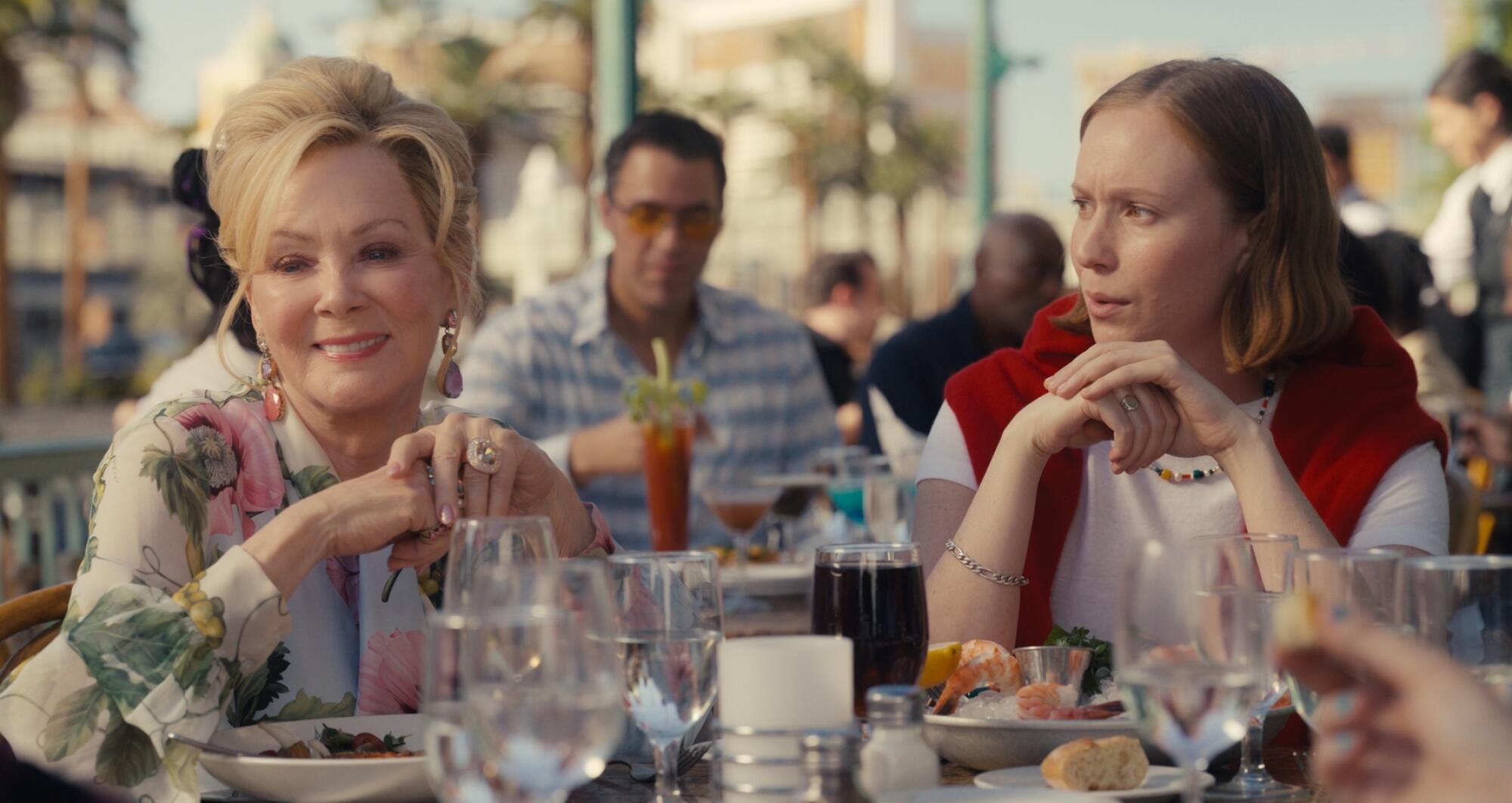
After five seasons and (thus far) 12 Emmys, “Hacks” has come to an end. The story of how Deborah Vance (Jean Smart), a 70-something comedian of the Joan Rivers type, and Ava Daniels (Hannah Einbinder), a prickly 20-something comedy writer, came together to resurrect both their careers was a roller coaster ride of intergenerational judgment, wins, setbacks, ruthless behavior, personal growth, power reclamation and much general hilarity.
Deborah sees Ava as entitled and self-righteous, Ava sees Deborah as washed-up and boring. Eventually, of course, they realize they are kindred spirits who do their best work together.
In Season 5, Deborah attempts yet another comeback. Having walked off her late-night show rather than fire Ava in Season 4, she is determined to rewrite her premature obituary by playing Madison Square Garden. When that too is snatched away, she pivots (with much difficulty and hilarity, including a show-stopping monologue by Laurie Metcalf’s tour manager Weed) to Central Park, where she is finally allowed a moment of glory, basking in the adulation of applauding thousands.
But that is not the end of “Hacks.” In the final episode, Deborah reveals she has cancer and rather than undergo treatment, she is choosing to “go out on top” with the aid of a Zurich clinic. She asks Ava to accompany her, after they take a girls trip to Paris. After an emotional meltdown, Ava agrees, hoping to persuade Deborah to change her mind. She does, but only after Deborah realizes that she cannot bear to walk away from the jokes she could write about dying. And so the show ends, with the two women walking arm in arm, first in Paris and then in Las Vegas, working on Deborah Vance’s final show.
Here, Times TV and culture critics Robert Lloyd and Mary McNamara discuss the ending, and legacy, of “Hacks.”
Deborah, left, decides she doesn’t want to get treatment for cancer despite Ava’s protests. Deborah changes her mind when she realizes she could write jokes about dying.
(HBO Max)
Mary McNamara: Hey there, Robert; are you as devastated as I am that we have no more “Hacks” to look forward to? The only solace I can find is the news that creators Lucia Aniello, Paul W. Downs and Jen Statsky are planning to release a DVD box set of the series. And the possibility that there could be a movie sequel — I for one want to see Deborah Vance’s death tour, especially since you know she’ll beat the odds and survive.
Seriously, though, sad as I am to contemplate life without “Hacks,” I am equally thrilled that the show so thoroughly stuck its landing. Finales are always a crap shoot and I appreciated how this season managed to show growth and cosmic justice while never tipping into treacle. I love that everyone ended on a win — including Marty! (Christopher McDonald) — and I didn’t even mind that suddenly Deborah had cancer (what?), was choosing assisted suicide (double what?) or that we were whisked to Paris (sure, I guess, why not?) because it made just enough narrative sense to set up Deborah’s decision to live because she just couldn’t leave good material on the table. “I may not have 30 years, but I do have one more hour,” may be the best line from a TV finale ever.
It is too easy to think of people like Deborah as clawing back their careers for fame, validation or money rather than a deep and essential love of their art. Having Deborah decide to prolong her life with chemo because she could not resist mining this final seam of comedic gold was a coup de grace.
What did you think?
Robert Lloyd: Hail, Mary. Reviewing the first-season finale, I wrote that the series was at heart a romantic comedy. And though many timely points were made along the way about artificial intelligence, the fate of late-night television and the awfulness of rich jerks who control media companies — Deborah’s Madison Square Garden show was undermined by the network head she named on national television in her resignation speech — the show asserted itself as a love story once again in the end. Where earlier seasons had depended on creating friction between Deborah and Ava, this one was mostly of concord, their only real clash being Deborah’s decision, introduced late in the season, to end her life (in a clean, posh way); her climactic change of heart spared us a medical tearjerker, but, believe me, I shed plenty of tears along the way. Unlike most seasons of “Hacks,” the fifth and final was orchestrated very much as a feel-good experience — “Ted Lasso” has nothing on it. A fairy tale, almost, as you point out, full of fairy-tale endings and plot points that were as good as magic. It could be contrived and improbable and old-fashioned in its triumphs snatched from the jaws of defeat, and I completely loved it.
Deborah Vance (Jean Smart) didn’t get the Madison Square Garden show she imagined, but she did get one at Central Park.
(HBO Max)
McNamara: The series had a lot to say about a lot of things (including vengeful power brokers/network executives) that feel particularly pointed now. But I deeply appreciated that while underlining the real obstacles Deborah and Ava faced, the writers showcased and explored how the bad choices each women had made, and defended, also contributed to their situations. Obviously having the great Jean Smart in the driver’s seat helped a lot — she revealed the woman beneath the diva even in Deborah’s most outrageous actions. The writers did not shy away from calling attention to the blatant sexism female comedians faced (and continue to face) or how the “woke” women of Ava’s generation are often able to see that kind of injustice more clearly.
It was, as you say, more rom-com than morality play, and rom-coms are often based on discovering that the differences that initially divide are too often based on, well, to put it in its original form, pride and prejudice. So while there was some hilarious and spot-on commentary about intergenerational miscommunication, there was also a clear message of how important it is for people with vastly different experiences to listen to, and learn from each other, which also feels incredibly important at this moment in time, especially given the show’s essential, and deeply human, respect for creative work. What motivated Deborah and Ava, and virtually every character in “Hacks” — agent Jimmy (Downs), his assistant Kayla (Megan Stalter) and later Randi (Robby Hoffman); Deborah’s staff, including Marcus (Carl Clemons Hopkins), Damien (Mark Indelicato) and Josefina (Rose Abdoo) — was a belief in the importance, and difficulty, of the creative process. It’s something that is rarely, if ever, the work of a single individual — as Deborah finally acknowledges at the opening of the Diva casino. Or as Laurie Metcalf’s Weed makes clear in her hilarious monologue before the Central Park gig.
1
2
1.Creativity isn’t the work of a single individual: Damien (Mark Indelicato), Marcus (Carl Clemons-Hopkins) and Deborah (Jean Smart) at work on the casino.(HBO Max)2.Deborah’s crew at her Central Park show.(HBO Max)
Lloyd: In a way Deborah’s speech summed up what we’d already been seeing through an especially generous season that served as “Hacks’” tribute to itself and its people. It was a party to which most every significant and many minor characters were invited, including Metcalf and McDonald; Luenell as comedian Miss Loretta; Poppy Liu as Deborah’s personal blackjack dealer, Kiki; Jane Adams as Ava’s mother, Nina; J. Smith-Cameron as Deborah’s estranged sister, Kathy; and Kaitlin Olson as Deborah’s daughter, DJ, who finally got her mom to partner with her on “The Amazing Race” and was allowed to sell her detachable earrings on QVC.
Gifts were distributed widely, including a previously unseen interview with Deborah’s late husband and co-star, Frank (Peter Strauss), giving her credit for their success — credit he had previously accepted for himself — and thus removing a giant thorn that drove the early plot. These kind-hearted acts of closure were performed both for the benefit of these very real, made-up people, and for We the Viewers, who have made them our family. Declarations, or at least demonstrations of love, were abundant, not merely between Deborah and Ava, with the characters acting as our proxies, feeling what we want them to feel, and what we feel for them ourselves. (There are moments this year when Einbinder — whose brilliance Smart could seem to outshine, but who was never less than an equal partner — absolutely killed me, just in the tender way she gazed upon Deborah.) That’s why it’s so hard to let go of a show like this, even when we know it’s time to say goodbye. You can only stretch an arc so far before it breaks.
McNamara: You’re right, of course. But I still want to see the “Hacks” movie.
The Dropout tells the story of the rise and fall of Elizabeth Holmes, the founder of biotech company Theranos, starring Amanda Seyfried.
Angie Quinn Screen Time Reporter
17:32, 15 Apr 2026Updated 17:33, 15 Apr 2026
The Dropout: Official trailer from Disney+
The true crime series starring Amanda Seyfried is now available to stream on ITVX.
The Dropout chronicles the true story behind the collapse of tech firm Theranos and its founder, Elizabeth Holmes.
The tale commences in 2002, when Holmes embarked on a chemical engineering degree at the prestigious Stanford University in California, where she quickly began developing concepts for groundbreaking inventions.
Professor of Medicine Dr Phyllis Gardner (Laurie Metcalf) advised Holmes of this, but she appeared to dismiss the academic’s knowledge as an underestimation of her capabilities.
Holmes insisted that she could “change the world” with this pioneering technology and garnered international acclaim, reports the Express.
She left Stanford before completing her second year to concentrate on her new venture, Theranos, which centred around an equally ambitious and potentially transformative piece of technology.
Nevertheless, when The Wall Street Journal launched an investigation into the firm, its reporting triggered a cascade of enquiries and increased scrutiny of Theranos, prompting it to become more transparent about its tightly guarded methods.
The Securities and Exchange Commission (SEC) launched an investigation, and 40 per cent of staff were made redundant a year later as the company went through restructuring.
Following the charges, the trial was postponed due to Holmes’ pregnancy and the COVID-19 pandemic, but eventually commenced in September 2021, with a jury convicting her on four counts of defrauding investors four months later.
No verdict was reached on three additional counts of wire fraud against investors, which the government later dropped, while Holmes was also acquitted on four counts of defrauding patients.
On 18th November 2022, Holmes received a sentence of 11 years and three months in prison, and she began serving her sentence in Texas on 30th May 2023.
The Dropout chronicles the dramatic downfall of the woman Forbes once dubbed the “youngest self-made female billionaire” in the world.
“Wow.. this show is insane. I want to start off by saying that I know movies and shows overdramatise true stories, so I’m speaking solely about the show right now. This goes from you rooting for the main character to you hating her.. like a real life Anakin Skywalker story”, one viewer commented about the series in a review on IMDB.
Another remarked, “The story itself is good. It moved at a quick pace, and everything they got is amazing. The one that played Edmund Ko, Stephen Fry as Ian Gibbons, are standouts for me. Sunny was also great.”
A third wrote: “Highly Watchable With Great Performances”, while another stated: “Wonderful! One of the very best shows you can see. Amanda Seyfried deserves every award to which she is eligible. Her performance as Elizabeth Holmes is off the chart.”