late show

Stephen Colbert escalates dispute with CBS over Talarico interview ban

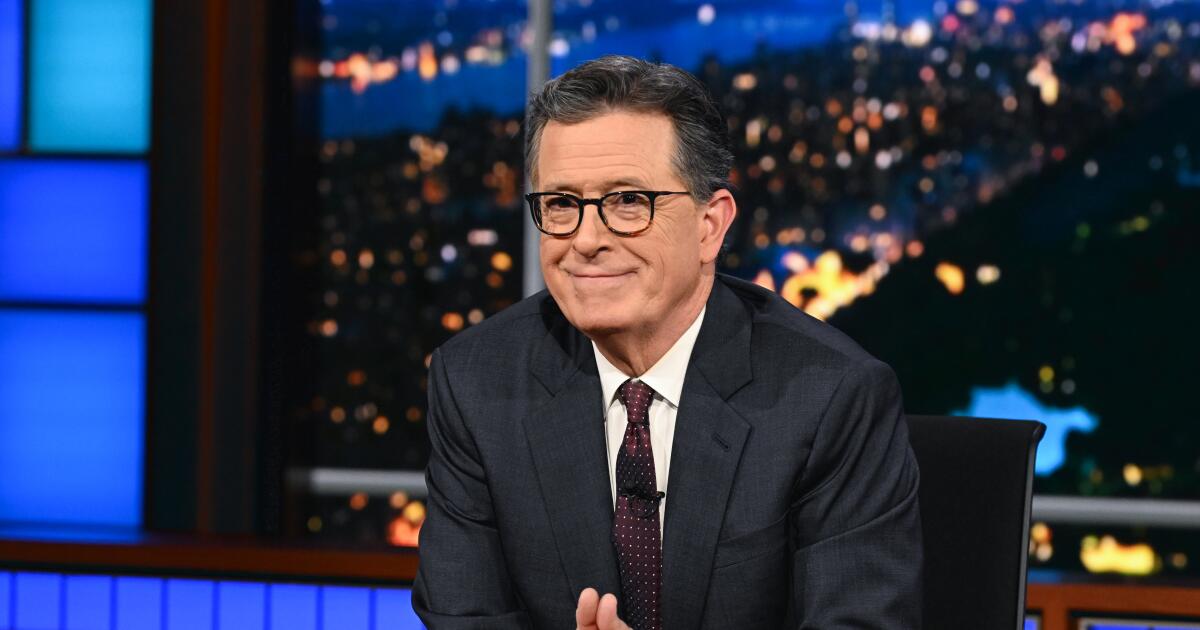
CBS late-night host Stephen Colbert shot back at his network Tuesday over its handling of his interview with Democratic U.S. Senate candidate James Talarico of Texas.

Colbert told viewers Monday he was instructed by CBS “in no uncertain terms” that Talarico could not appear on his “Late Show” program because it would require offering equal time to the candidate’s opponents in the Democratic senate primary. The host also said he was told by CBS not to discuss the matter on the air, a demand he ignored.

CBS contradicted Colbert’s account in a Tuesday statement, saying “‘The Late Show’ was not prohibited by CBS from broadcasting the interview with Rep. James Talarico,” and that Colbert was only advised the program would have to make the time available to Talarico’s opponents.

In his Tuesday “Late Show” monologue, Colbert described the CBS denial as “crap.” He said the CBS legal department cleared his Monday comments and even advised him on his language on the matter.

“They know damn well that every word of my script last night was approved by CBS’ lawyers, who for the record approve every script that goes on the air whether it’s about equal time or this image of frogs having sex,” he said.

Colbert took a paper copy with the CBS statement, crumpled it, and put it in a plastic bag typically used to collect dog feces.

The showdown centers on the Federal Communications Commission’s equal-time rule — which applies only to broadcast TV and radio. The rarely enforced regulation requires broadcasters who interview qualified candidates for office to offer equal time to other contenders on the ballot. Exceptions are typically given to interviews on news programs and talk shows.

FCC Chairman Brendan Carr has called to end the exception for talk shows. Experts say such a change would be difficult to enforce and even chill free speech by limiting which guests programs can book.

Carr’s move is largely seen as an accommodation to President Trump, whose animus toward late-night programs that frequently lampoon him is well-known.

Colbert conducted the interview with Talarico and posted it on YouTube, which is not under the FCC’s jurisdiction, where it attracted several million views.

On Tuesday, Colbert claimed CBS management is kowtowing to Carr and showing a lack of corporate courage. He noted that the talk show exemption in the equal time rule is still in place

“I’m just so surprised that this giant global corporation would not stand up to these bullies,” he said.

A CBS representative did not respond to a request for comment.

Colbert has little to risk by publicly taking on CBS management as his program is ending in May. The company cited financial losses as the reason for the cancellation, but the timing of the decision in July came before CBS parent Paramount Global closed its merger deal with Skydance Media, which required regulatory approval from the Trump administration.

Trump celebrated the announcement that Colbert’s program is ending and has called for the firing of late-night hosts Jimmy Kimmel of ABC and Seth Meyers of NBC.

Colbert is under contract through May and has been kept on the air since the cancellation announcement last year. But if CBS execs lose their patience, it’s conceivable that the network can pull him off the air and use guest hosts until the end of the program’s run.

CBS has yet to decide on a replacement for “The Late Show,” which was launched in 1993 when David Letterman joined the network.
Source link

Stephen Colbert calls out CBS for barring interview with Democratic candidate

The Federal Communications Commission‘s stronger enforcement of its “equal time” rules is already affecting late-night TV.

During Stephen Colbert’s Monday night monologue on “The Late Show With Stephen Colbert,” he carried on per usual, introducing the Late Show Band and his guest Jennifer Garner. He then posed the question, “You know who is not one of my guests tonight?”

The late-night host was meant to have Texas state representative James Talarico on the show. But he said on air that he was “told in no uncertain terms by our network’s lawyers, who called us directly, that we could not have him on the broadcast.”

He continued on to explain the FCC’s new guidance for equal time rules under its Chairman Brendan Carr. The rules require broadcasters who feature political candidates to provide the same time to their rivals, if requested. Typically, news content, daytime and late-night talk shows have been excluded from these regulations, as it’s been an informal tradition for presidential candidates to make their rounds on various late-night shows.

But the FCC under Carr, who has made no secret of his intention to carry out an agenda that is aligned with President Trump’s wishes, has questioned whether late-night and daytime talk shows deserve an exemption from the equal-time rules for broadcast stations using the public airwaves. Many legal and media experts have said a stricter application of the rule would be hard to enforce and could stifle free speech

“Let’s just call this what it is. Donald Trump’s administration wants to silence anyone who says anything bad about Trump on TV, because all Trump does is watch TV,” said Colbert Monday night.

Earlier this year, ABC’s “The View” featured Talarico, as well as his main rival and fellow Democrat Jasmine Crockett. Talarico is currently facing off with Crockett and Ahmad Hassan in the Democratic primary for one of Texas’ two seats in the U.S. Senate. The FCC is also reportedly investigating his appearance on “The View.”

Experts consider the equal time rule to be antiquated, designed for a time when consumers were limited to a handful of TV channels and a dozen radio stations if they lived in a big city. The emergence of cable, podcasts and streaming audio and video platforms — none of which are subject to FCC restrictions in terms of content — have greatly diminished traditional broadcast media’s dominance in the marketplace. Carr has previously suggested that if TV hosts want to include political candidates in their programming, they can do it — just not on broadcast TV.

Colbert said he was taking Carr’s “advice” and revealed that his entire interview with Talarico was instead uploaded on YouTube. During the interview, Talarico calls out the Republican Party for initially running against “cancel culture.”

“Now they are trying to control what we watch, what we say, what we read. And this is the most dangerous kind of cancel culture, the kind that comes from the top,” said Talarico. “They went after ‘The View’ because I went on there. They went after Jimmy Kimmel for telling a joke they didn’t like. They went after you for telling the truth about Paramount’s bribe to Donald Trump.”

“The Late Show with Stephen Colbert” is leaving the air come May, signaling the end of CBS’s longstanding relationship with the late-night talk show. Its cancellation was a “purely financial decision,” according to CBS. But it also came at a time when Paramount Global, which owns CBS, was seeking regulatory approval from the Trump administration to sell itself to Skydance Media. The merger was finalized in August.

L.A. Times staff writer Stephen Battaglio contributed to this report.

Source link