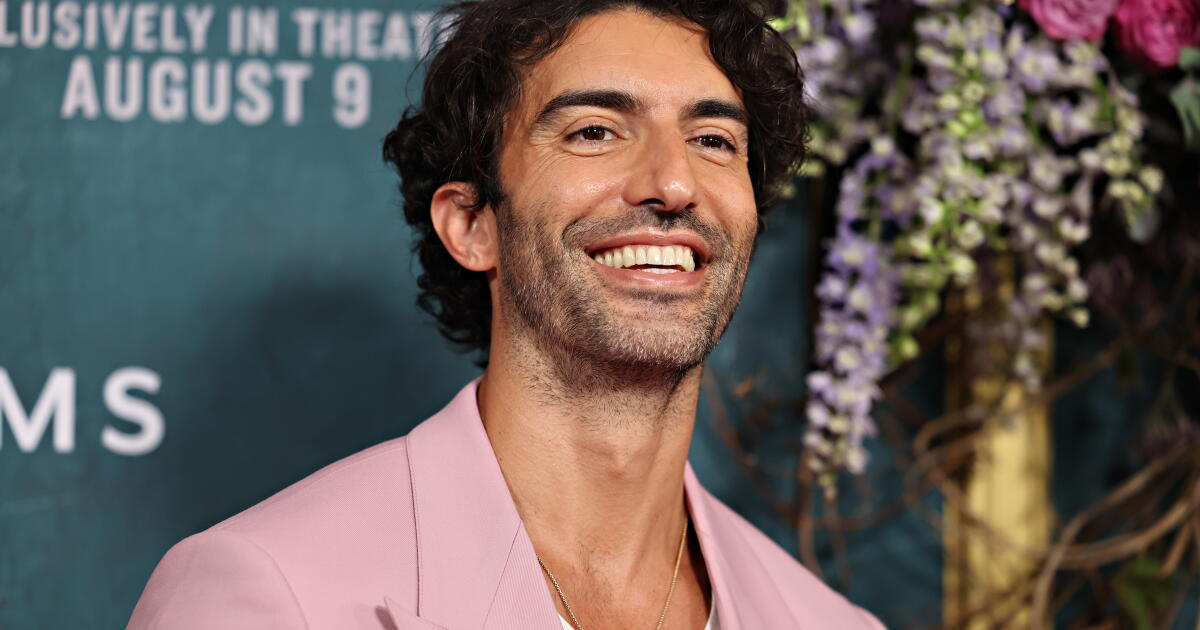
Melissa Nathan, the crisis management public relations pro hired by actor-director Justin Baldoni amid his lengthy legal feud with actor Blake Lively, is in the hot seat after Baldoni’s former publicist claimed that Nathan played a key role in operating a network of anonymous “smear” websites.
The publicist, Stephanie Jones, filed an initial complaint in New York Supreme Court in December 2024, accusing Baldoni’s crisis PR team of waging a coordinated effort to undermine her and deflect blame for what she called a retaliatory smear campaign targeting Lively.
But new documents filed last week brought front and center a “key question from the outset of this case”: Who was behind the creation of anonymous websites that popped up in May 2024 and accused Jones of “holding clients hostage” and leaking their secrets?
Nathan did not immediately respond to The Times’ request for comment Friday. But in a deposition, she said she was absolutely not the mastermind behind the now-defunct stephaniejonesleaks.com.
In the recent filing, Jones claims she repeatedly sought communications that could support her suspicions about the website’s origin, and last week received documents from Katherine Case, a former employee of Jones’ PR firm, Jonesworks, who subsequently worked for Nathan’s crisis management firm, the Agency Group.
Those documents, the filing alleges, show Nathan repeatedly testified falsely about the websites, and confirm that “Melissa Nathan was directly involved in a scheme to utilize untraceable websites to destroy the reputation of her competitors and those adverse to her clients. Stephanie Jones and Jonesworks were among her victims.”
In alleged text messages between Nathan and Case included in court documents, Nathan appears to have offered Case “three or four grand” to make the website copy tarnishing Jones’ reputation “a lot more meaty” — “good enough for us to be able to point a journalist towards.”
Nathan also appears to direct Case to discuss “holding clients hostage” and detail how people are “scared of” Jones, the documents allege.
Nathan is alleged to have instructed Case to write copy that would “follow along the lines of a purported ‘whistleblower’ narrative.” In Case’s notes from a subsequent phone call, she allegedly wrote, “Copy for the website along the lines of — I can’t sit and watch this woman continue to do this, this is what she does … it’s now a time where I can speak my truth about what I saw there.”
The filing claims that a record from Zelle, a money-transferring service, shows a subsequent payment to Case in the amount of $4,000 from “Melissa E. Nathan.”
The websites weren’t a one-off, according to the filing. They were allegedly one of Nathan’s specialties, and a hot commodity among embattled celebrities.
Three months after the Jones website went live, Nathan allegedly texted “Pitch Perfect” star Rebel Wilson, who was involved in a dispute with producer Amanda Ghost over Wilson’s directorial debut, the 2024 musical “The Deb.”
“Nathan quoted Wilson $110,000 for an untraceable site with a satellite, ghost server, ghost hosting, full build, maintaining, and full algorithmic push across all platforms … for 3 months,” the filing alleges. “The next day Nathan texted Case, ‘Rebel wants a one of those sites.’ ”
When Inglewood High traveled to Texas last month to play Westlake High from Austin, two football players who were listed on the Southern Section transfer portal as not cleared played in the game, according to video obtained by The Times.
Last week, in a game against Long Beach Poly played at SoFi Stadium, Inglewood coach Mil’Von James was not on the sideline, according to a report from the Daily Breeze.
The Southern Section cannot make personnel changes when a school violates rules, but it can prevent teams from playing in the playoffs if schools don’t self-report violations and decline to take action.
The Southern Section and Inglewood Unified School District have declined comment. The two players are still eligible to play this season if cleared. One was cleared last week with a valid change of address. The other has not been cleared. Both are missing from Inglewood’s roster on MaxPreps.
James came to Inglewood, which is 4-1 this season, after being fired at Hawkins in 2016 following the discovery of ineligible players, resulting in Hawkins forfeiting all its games and going 0-13. Since then, the City Section established a rule that teams must exchange rosters before games to verify that players are eligible, known as the “Hawkins rule.”
James took over at Inglewood in 2019 and has built a successful program.
It’s not known if James’ absence will be for one game or multiple games. The only other Southern Section action would be forcing Inglewood to forfeit games the players played in, but the school lost to Westlake, making a forfeit moot.
WASHINGTON — The Supreme Court has blocked President Trump’s plan to restrict voting by mail, ruling it is too late to impose new postal service rules for the November election.
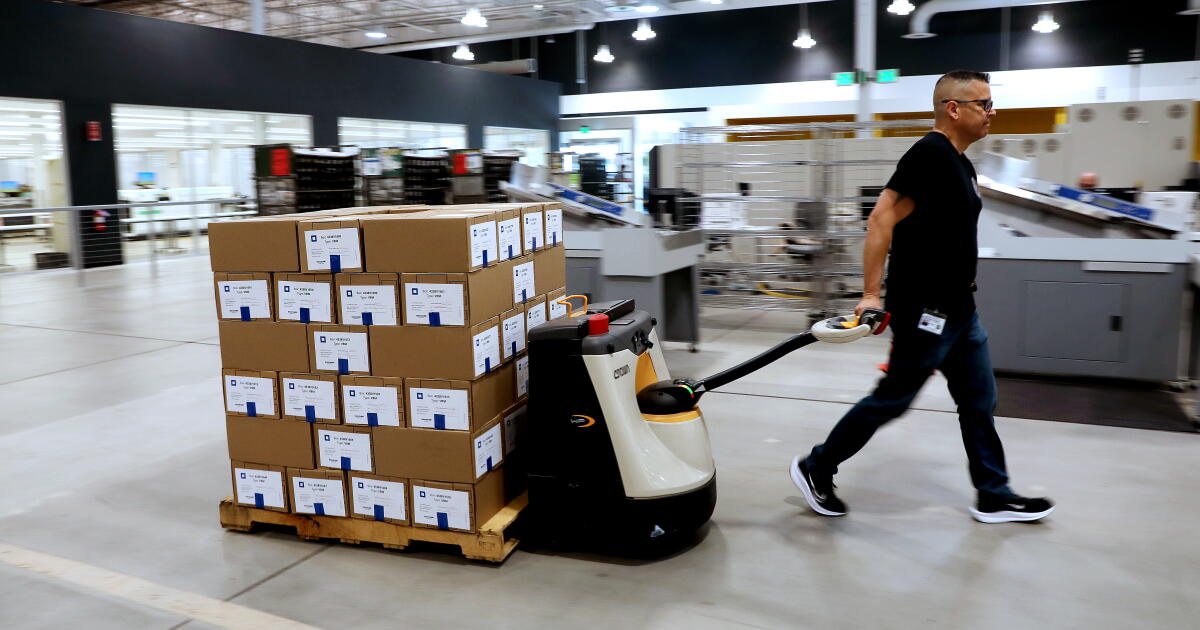
The justices on Monday turned down an emergency appeal from Trump’s lawyers, who argued the government needed a new and untested system of unique bar codes to track all the ballots of the tens of millions of people who vote by mail.
Instead, the justices left in place a judge’s order that prevents the U.S. Postal Service from enforcing the new rules for the midterm elections.
Concurring, Justice Brett M. Kavanaugh agreed it was too late to enforce the new rules for this election.
Justices Samuel A. Alito Jr. and Clarence Thomas dissented.
The decision in USPS vs. California is a victory for California Atty. Gen. Rob Bonta and the attorneys general for 22 other Democratic-led states who sued to block the new rules.
Last week, they warned there would be chaos and confusion if Trump’s rules were put in effect now.
Bonta cheered the decision late Monday, calling it “a victory for our democracy and a powerful affirmation of the rule of law” in a case where the stakes “could not have been higher.”
“Voting is the fundamental right from which all other rights flow, and all 50 states allow ballots to be cast by mail in some form. In California and several other states, mail voting is the primary way elections are conducted,” Bonta said. “Had this rule been allowed to take effect, the consequences would have been catastrophic.”
He said his office “will remain vigilant in safeguarding our elections,” and urged voters to make their voices heard.
Under the proposed rules, state and county election officials across the nation would be required to enroll each voter with a unique bar code and submit this data to a new online portal that, as of last week, was not yet functioning.
Without the individualized bar codes, states could not send ballots through the mail. In California, that would mean election officials would have to enroll 23 million voters with new bar codes before state ballots could be mailed.
“Compliance with the USPS’ rule would be impossible ahead of the midterms, meaning that millions of voters would be unable to vote by mail and some would not be able to vote at all,” the state attorneys general told the court last week.
The impact would not be limited to Democratic-leaning states. Utah Lt. Gov. Deidre Henderson said it would be “an unmitigated disaster” if the new rules were put into effect now. About 30% of the nation’s voters — and 80% of Californians — cast ballots by mail in 2024.
But Trump has maintained, without providing evidence, that voting by mail leads to widespread cheating and fraud.
In March, he issued an executive order that called on the postal service to do more to “enhance election integrity.”
“Unique ballot envelope identifiers, such as bar codes, enable confirmation that only citizens receive and cast ballots,” he said.
Elections experts say there is no evidence of such widespread fraud, despite robust audits and other searches for it.
State attorneys general argued that the Constitution entrusts states, not federal officials, to conduct elections. While Congress may impose new rules, it is not done to limit voting by mail or to empower the postal service to do so, they said.
Trump and his lawyers maintained the administration had a duty to combat fraud, including in elections.
Solicitor Gen. D. John Sauer described the new rules as “modest measures that will help prevent and restrain potential gross abuses of the mails to perpetrate a fraud on the Nation.”
And he said the federal government, the states and the voting public would face irreparable harm if the new Postal Service rules were not allowed to be applied to the coming election.
But U.S. District Judge Indira Talwani, in Boston, ruled the postal service may not put its new regulations into effect for the Nov. 3 election. She found the Trump administration had presented no evidence to the court of widespread fraud existing, while the states had presented ample evidence that implementing such a system on such a fast timeline posed tremendous risk.
The 1st Circuit Court affirmed her order and said the administration’s lawyers “have not even seriously challenged the … detailed findings about the chaos and widespread disenfranchisement that would occur between now and November 3 should the USPS rule take immediate effect.”
On Sunday, U.S. District Judge Carl Nichols — a Trump appointee — also blocked the new Postal Service rules from being implemented in separate cases brought by the NAACP and Democratic groups, finding they clearly exceeding the Postal Service’s authority in elections.
What the future will hold is unclear. The courts did not declare the new rules to be illegal or unconstitutional, though multiple lower courts have suggested that parts of the plan likely would be — including by exceeding the Postal Service’s authority to intervene in elections.
Much of the debate before the appellate and high court related to the rushed timeline under which the Postal Service was seeking to implement the changes. With that set aside by the Supreme Court’s ruling that the rules will not apply this election, the debate in the lower courts may shift focus to whether the new regulations can be applied to the 2028 elections.
Nevada Secretary of State Cisco Aguilar, chair of the Democratic Assn. of Secretaries of State, said the high court’s ruling was a clear loss for Trump, and that state election officials are ready to continue their fight to protect U.S. elections if necessary.
“This ruling affirms what our Constitution has always held: Elections belong to the American people, not a desperate man in Washington,” he said.
Billionaire comedy duo Trey Parker and Matt Stone are unveiling a new name for “South Park” ahead of the show’s 29th season: “South America.”
The satirical series’ name change follows President Trump’s renaming of Lake Ontario to Lake America amid the escalating U.S.-Canada trade war. Last week, tech behemoths Apple and Google honored Trump’s executive order and renamed the Great Lake on their maps for U.S. users.
Parker and Stone made the announcement on social media on Tuesday, writing, “Inspired by the bravery and patriotism of Apple and Google, we are changing the name of South Park to SOUTH AMERICA. We especially want to thank our parent company Paramount — a Skydance Capitulation.”
The duo also jabbed at their parent company and its new owner, Skydance Media, for what media critics have characterized as caving to the Trump administration’s Federal Communications Commission. The “capitulation” involved controversial corporate and programming adjustments as well as agreeing to a $16-million settlement over a lawsuit brought by Trump involving a “60 Minutes” segment to get Paramount’s $8-billion merger with Skydance approved.
Last year, following a particularly incendiary episode of the show — in which a parody of Trump has an X-rated fling with Satan, and the president is portrayed as having an animated micropenis — the White House issued a statement to Variety slamming the series.
“The Left’s hypocrisy truly has no end — for years they have come after ‘South Park’ for what they labeled as ‘offense’ [sic] content, but suddenly they are praising the show,” White House spokesperson Taylor Rogers said in a statement to the outlet. “Just like the creators of ‘South Park,’ the Left has no authentic or original content, which is why their popularity continues to hit record lows.”
Last week, “South Park,” won an Emmy Award for outstanding animated program. And last summer, Parker and Stone reached a five-year, $1.5-billion deal with Paramount to secure exclusive global streaming rights on Paramount+, making the series one of television’s most valuable shows and its creators two of the highest-paid comedy writers in the biz.
The 29th season of “South America” premieres Sept. 16 at 10 p.m. on Comedy Central.
WASHINGTON — Work on the White House North Portico appears to be nearing completion before Chinese President Xi Jinping’s state visit to the United States in late September.
Scaffolding was being taken down Tuesday after workers over Labor Day weekend removed a shroud that had obscured the work. The Executive Mansion’s front columns had been covered since July. The work, ordered by President Trump, began in June.
The portico was first completed in 1830 during Andrew Jackson’s presidency. Administration officials said previously that stonework and plaster on the structure were being refurbished because of routine damage from age and weather exposure.
Trump has said he noticed it was in “deplorable condition” before insisting on repairs. The work is part of the president’s sweeping overhaul of the White House and other federal property in the nation’s capital — with most of his more ambitious moves drawing lawsuits and criticism from preservationists.
Trump said last week that workers finished construction of a helipad on the South Lawn.
His signature project, a White House ballroom and underground bunker, continues as legal fights play out. Multiple lawsuits were filed after Trump demolished the East Wing before going through the usual regulatory steps for major work on historic federal buildings in Washington. The massive project will add more square footage than what the existing White House footprint comprises.
That means Trump must host Xi’s state dinner, scheduled for Sept. 24, in existing spaces and in a construction zone — a circumstance that will afford the president a new opportunity to extol his ballroom project.
Barrow and Martin write for the Associated Press. Barrow reported from Atlanta.
WASHINGTON — President Trump has locked in a deal to develop Venezuela’s vast oil resources, an arrangement the White House says will bring a country battered by years of economic collapse to a “place where elections are possible.”
But the agreement — backed by acting President Delcy Rodríguez, a holdover from the Nicolás Maduro government that Washington deems “illegitimate” — is raising new uncertainty about how entrenched the unelected government may become.
In January, when the U.S. military captured Maduro, Trump did not say how long a democratic transition would take but said Rodríguez was “gracious” and “essentially willing to do what we think is necessary.”
Asked by The Times on Wednesday what was stopping him from demanding Venezuela set a firm election date, Trump was blunt: “I just don’t think they are ready yet.”
“It’s very new. We took them out of a dictatorship and we’re getting along great with the government,” Trump said. But he said an election would happen “soon.”
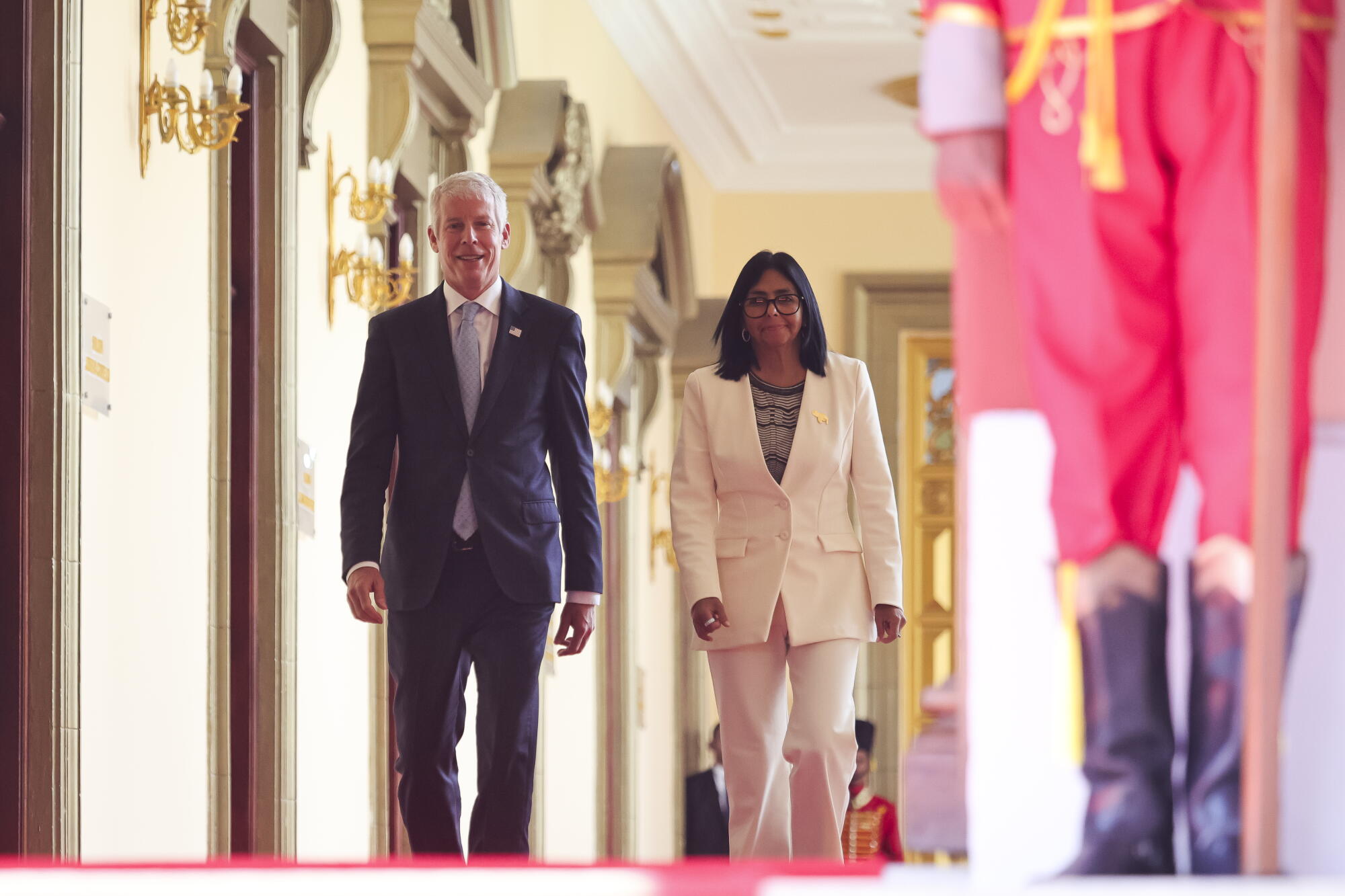
U.S. Secretary of Energy Chris Wright walks alongside Venezuela’s interim president, Delcy Rodríguez, after a news conference on the deal to develop 17 oil fields in the country.
(Jesus Vargas / Getty Images)
Under the deal, the U.S. government is partnering with an oil producer to create a new company, North American Blue Energy Partners, to develop 17 fields with a proven potential of 65 billion barrels. NABEP will have rights to the fields for 100 years.
For many Venezuelans, the lack of urgency around elections — set against a deal that gives the United States majority control over roughly a third of the country’s oil reserves — is starting to feel like a broken promise.
“They tell us we have to wait two years, maybe more, while in the meantime they do business with a government that wasn’t elected, that was imposed on us, and that we don’t want,” Carlos Pérez, a 23-year-old automotive mechanics student, told The Times.
Antonio Marchetti, a 45-year-old plumber and electrician, said that while he sees the removal of Maduro as a “good thing,” the oil deal makes it seem as though Trump’s plans were those of a “cowboy, the invader John Wayne,” all along.
“We were expecting elections,” Marchetti said. “This pact with Trump entrenched the dictatorship that he himself declared war on. But to get rid of Maduro, he left the rest and did business with them. It disgusts me.”
A man holds a sign that reads in Spanish, “Yankee out, murderers” during a protest in Caracas on Aug. 29 against President Trump’s deal giving the United States a stake in Venezuela’s oil reserves.
(Pedro Mattey / Associated Press)
The frustrations go beyond Venezuela. In Washington, Republican lawmakers have praised the oil deal, while calling Rodríguez an “interim dictator” who cannot be trusted.
María Corina Machado, the exiled leader of the Venezuelan opposition and a recipient of the Nobel Peace Prize, on Thursday raised her own worries about what the oil deal means for the future of Venezuela.
In a video message, Machado stopped short of criticizing Trump’s oil deal, but acknowledged concerns about a pact negotiated with an “illegitimate” government.
“Venezuelans know that there can be no development without strong institutions and a government elected by popular vote,” she said. “That is the only real guarantee of success and stability for any large-scale investment.”
A plan in the works
Trump administration officials have characterized the deal as an economic lifeline that will eventually stabilize a country and prepare it for free and fair elections.
Secretary of State Marco Rubio said last week that the United States is facilitating talks between Venezuela’s interim government and Dinorah Figuera, an opposition figure leading Venezuela’s 2015 National Assembly, the last democratically elected legislature recognized by the United States.
Machado has been left out of those talks. They are expected to resume in mid-September.
Rubio says that for any election to be “credible,” the voting system will require an overhaul and political parties will need time to organize. Steps also must be taken to ensure the country has a free press.
Echoing Rubio’s comments, the White House said Friday that Trump wants elections held at the “right time,” but that his top priority is to bring Venezuela “back from the dead and rebuild the country after it was incompetently ruled by a nasty dictatorship.”
U.S. Energy Secretary Chris Wright meets with Venezuelan acting President Delcy Rodríguez at Miraflores presidential palace in Caracas on Sept. 2.
(Pedro Mattey / Ap Photo/pedro Mattey)
On Wednesday, while Energy Secretary Chris Wright visited Caracas, Rodríguez declined to set a firm date for an election, but added, “I have worked tirelessly to ensure that Venezuela is ready and prepared when the time comes for its electoral process, which will take place — have no doubt about that: There will be an electoral process.”
The open-ended approach to holding an election, however, has drawn criticism from former Trump administration officials, who argue the lack of a timeline essentially lets Rodríguez govern indefinitely.
“Here’s my fear: It makes us Delcy’s partner, and gives the president a reason to want her to remain in power,” Elliott Abrams, who served as U.S. special envoy to Venezuela during Trump’s first term, told The Times.
He contended that the White House so far appears to prefer a pliant interlocutor, and Rodríguez, he says, will do “whatever Trump tells her to do.”
If an election is to take place in Venezuela, a nine-month runway for preparation is likely to be expected, Abrams said.
People shop for produce at a market in Maracaibo, the heart of Venezuela’s oil industry. .
(Ariana Cubillos / Associated Press)
In Washington, some Republican lawmakers have continued to call for elections in Venezuela, arguing that Rodríguez cannot be trusted.
“The only way we will have a prosperous Venezuela is with the end of the murderous regime and the return of democracy,” Rep. Carlos A. Gimenez (R-Fla.) wrote on social media. He also called Rodríguez an “interim dictator.”
In an interview with NBC News’ “Meet the Press,” Sen. Ted Cruz (R-Texas) said he does not necessarily think elections should happen before the oil agreement is finalized, but he said they “need to proceed rapidly.”
“I believe they should proceed no later than midway through next year,” he said.
Sen. Rick Scott (R-Fla.) said he is working with Trump and Rubio to ensure “free, fair and transparent elections as soon as possible.” He did not, however, say what would constitute “soon.”
Mixed views on economic hope
In the Lake Maracaibo region, an area that would see renewed investments under the oil agreement, Junior Araujo — a 47-year-old oil worker — sees a “wonderful opportunity to be reborn.”
Araujo, the father of three, is in desperate need of a better economic outlook. He works 120 hours a week and earns only $20. For his family, food alone usually costs about $150 a week.
“We have to get creative and find new ways to make ends meet through side jobs like selling clothes and making yogurt,” he said. “That’s our real financial situation.”
Venezuelans watch oil tankers anchored in Lake Maracaibo on Sept. 4. Much of the country’s oil industry is centered in the Maracaibo region.
(Humberto Matheus/Sipa USA via Associated Press)
For Araujo, the hope for a better economy does not take away his frustrations with the government.
“We’re neither happy nor dancing here, all our benefits have been taken away from us,” he said. “Our main problem is the current government; we need to restore our institutions.”
Nazareth Lezama, a 35-year-old teacher, also sees the oil deal as an economic opportunity but remains concerned that the current government may not have negotiated the best price or conditions for Venezuela. She added this has happened in the past.
“We must be clear that this regime destroyed the oil industry,” she said, adding that Venezuelans “need elections to choose leaders based on merit.”
Marchetti, the plumber from Caracas, says the oil deal is a “100-year chain” on Venezuelans imposed by Trump. He said it has become the “last straw” for him, and he has decided to leave Venezuela and emigrate to Europe.
“With all the pain in my heart, I will leave everything behind. I have a European passport; it won’t be easy to start a life from scratch, but there is no hope left here,” he said.
He does not know where he will land yet. But he knows he needs to leave Venezuela.
“This ship is sinking,” he said.
Times staff writer Ceballos reported from Washington. Special correspondent Mogollón reported from Caracas.
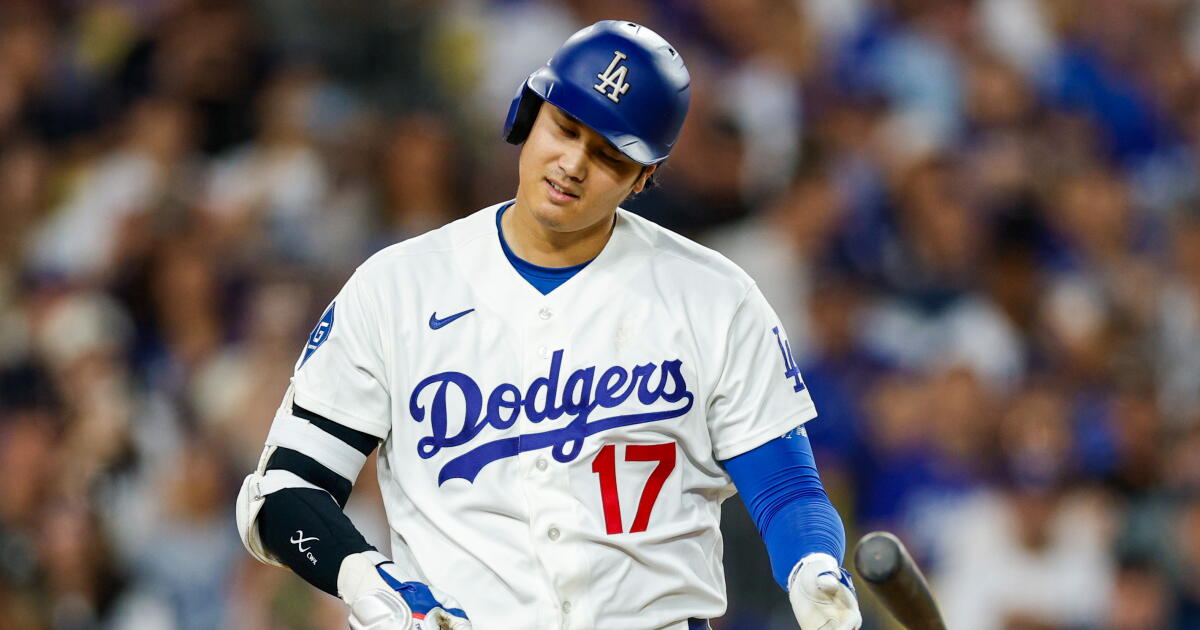
Shohei Ohtani was out of the lineup Thursday and his availability is a “day-to-day situation,” manager Dave Roberts announced before the Dodgers’ series finale against the St. Louis Cardinals.
The area around Ohtani’s right biceps and neck was bothering him during the Dodgers’ loss Wednesday, Roberts said.
“It just wasn’t firing the way he wanted it to,” Roberts said. “That’s why I think you saw some grimacing and some kind of shaking of the arm just trying to get it to fire and he couldn’t do that.”
Ohtani was not made available to talk before the game, and he declined requests for comment twice during the Dodgers’ road series in Detroit this past weekend. He last spoke to reporters on Aug. 17.
Ohtani’s health has been scrutinized for much of the season and even more over the last week. He hasn’t pitched since July 3 because of soreness and threw a bullpen session last Friday in hopes of pitching one inning Sunday against the Detroit Tigers. But, not feeling “100%,” as Roberts put it, Ohtani didn’t return to the mound, and his throwing progression stalled.
Though Roberts described Ohtani’s ailment as an overall issue, including his left knee and right biceps, he remained in the lineup. Roberts said then that he’d been given no indication that swinging the bat was affecting Ohtani, but if that changed, the manager would have no problem with sitting the superstar.
Wednesday, as Ohtani went 0 for 4 in the midst of a two-for-23 skid, his body language sounded alarm bells.
“I saw the same thing that everyone saw,” Roberts said after the Dodgers’ 8-6 loss to the Cardinals. “I saw the shaking of the arm, I saw the wincing, and clearly the swings aren’t who he is. And so, obviously, there’s some compensation. So I’m going to talk to him, and then I’ll make a decision about his availability.”
Roberts said a stint on the injured list was unlikely “but not impossible.”
“Ideally, he takes it as a mental and physical day,” Roberts said. “And then it’s just getting together with him later [Thursday] and seeing how the day is and how [he responds to] the day of rest. … At that point in time, we can make a decision as far as [Friday].”
Managing Ohtani’s health will continue to be a priority for the Dodgers. He’s been dealing with lingering knee soreness and inflammation since at least mid-June, and his biceps issue has flared several times this season.
Ohtani’s buildup back to pitching has been halted twice since he received an Orthovisc injection to lubricate the knee joint over the All-Star break.
As valuable as Ohtani is to the Dodgers as a pitcher, his offensive impact is needed far more, especially with left-hander Tarik Skubal added to the rotation. If continuing to try to pitch jeopardizes Ohtani’s production with his bat, it may be in the team’s best interest to take pitching off the table for him.
Tommy Edman was penciled into the leadoff spot and will play center field, while Alex Call will be the designated hitter and bat eighth.
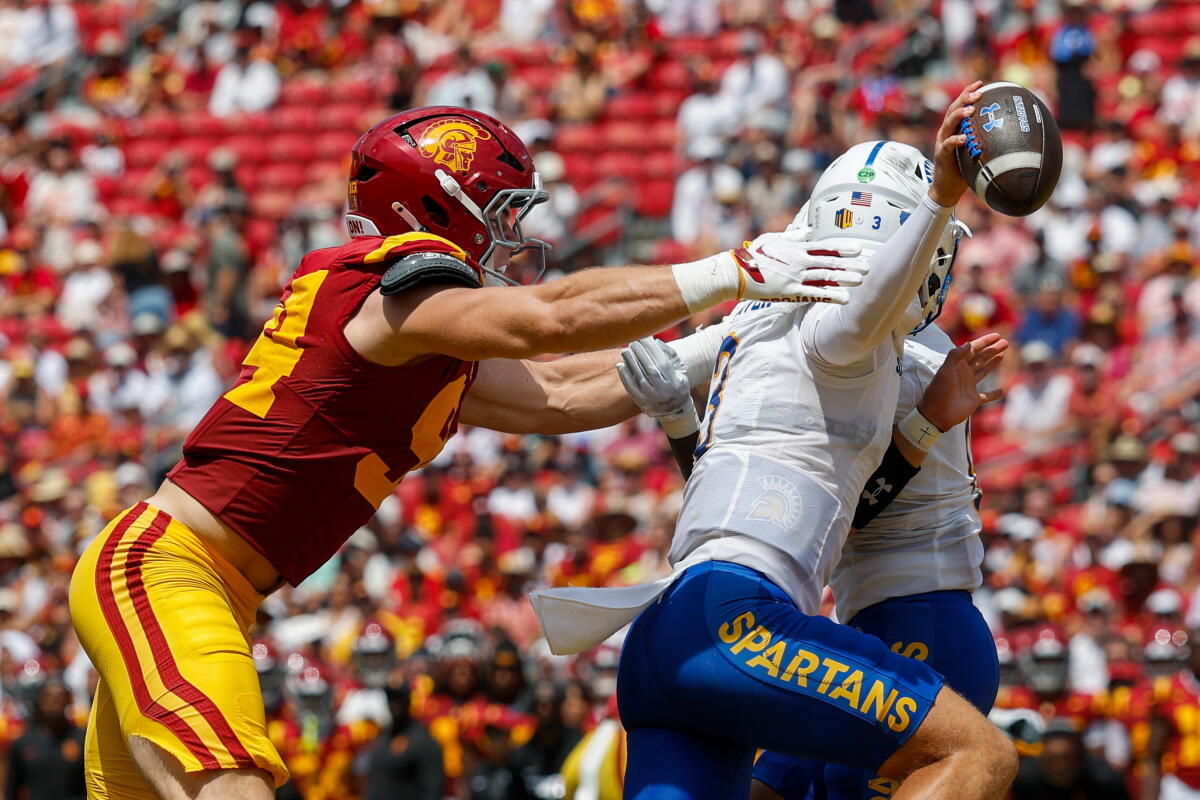
It was still just the first quarter of his first college football game at USC when Luke Wafle offered a first glimpse of his staggering potential. The freshman defensive end tossed aside a San Jose State tackle with one swift move, then steamrolled a running back standing in his way. In the process, San Jose State’s quarterback was forced from the pocket and Wafle, now sprinting from the other direction, nearly forced a safety.
It would’ve been an eye-opening sequence for any pass rusher, let alone a true freshman. But at USC, those who have watched Wafle for months now say it’s basically what they’ve come to expect from the Trojans’ top defensive prospect.
“He’s a very special player,” said linebacker Desman Stephens II.
“Probably the most talented freshman I’ve gone against in my time here at USC,” said left tackle Elijah Paige.
“Just a beast on the field,” added defensive tackle Floyd Boucard. “He doesn’t play like a freshman.”
Wafle played just 23 snaps in his first game, but he made the most of them. He was the Trojans’ highest-graded defender, according to Pro Football Focus, with two pressures on 13 pass rushes and two stops on the other 10 in the victory.
And when USC takes on Fresno State on Friday night, chances are he’ll get even more reps to wreak havoc.
“A young man like that brings a lot of excitement on the other side of the field,” defensive tackle Kameryn Crawford said with a smile.
He called it “a crazy feeling” just to play along the defensive front with Wafle.
The freshman’s presence alone should help change the trajectory of a Trojan defensive line that’s fallen short of expectations the last few seasons under coach Lincoln Riley. USC’s top pass rusher from a year ago (Crawford) had 5 1/2 sacks last season, while no one outside of Tuli Tuipulotu has had more than 6 1/2 in a single season under Riley at USC.
Wafle might change that this season. That certainly looked like the case last Saturday.
“The thing I liked most about him Saturday is he didn’t hesitate,” Riley said. “He was around the ball. He was around the quarterback. He made some plays for us, obviously, and he was really close to making a bunch of others. And I think that’s just scratching the surface of how good this guy can be.”
USC defensive end Luke Wafle (94) pressures San Jose State quarterback Luke Weaver (3) during the first quarter of the season-opening game last Saturday at the Coliseum.
(Ronaldo Bolanos / Los Angeles Times)
Even beyond Wafle, Riley has reason to feel good about his defensive line. Namely because it’s as deep as it’s been in his five seasons at USC. Two of the Trojans’ better linemen — Jahkeem Stewart and Braylan Shelby — didn’t play in the win, and the unit still looked like the strength of the defense.
Whether those reinforcements will be back Friday remains to be seen. Both were listed on USC’s second depth chart of the season after being absent from the first, suggesting they could suit up.
Safety issues
The reviews coming out of last week’s debut for USC’s defense were less glowing for the secondary, which gave up three pass plays of 20 yards or more in the second half.
Most of those coverage busts came from USC’s backups at the position, but it does beg questions about the depth in the Trojans’ defensive backfield.
Riley acknowledged that the Trojans “need a couple of those guys to play a little sharper” at the safety position, primarily. Redshirt senior safety Prophet Brown said that he tried to put his arm around those young players this week.
“Nobody is perfect,” Brown said. “The greats aren’t perfect. But they do learn from their mistakes.”
How much USC’s secondary will be tested this week by Fresno State remains to be seen. The Bulldogs are breaking in a new quarterback, junior Jayden Mandal.
Dolly Parton may have been a worldwide musical icon, but she shared a special connection with her home state.
Parton died last week at age 80 after a brief battle with cancer. And now the University of Tennessee will honor that special relationship with the singing superstar with a helmet decal to be worn by Volunteers players all season.
Coach Josh Heupel announced the tribute Monday while talking to reporters ahead of his No. 20-ranked team’s opener against Furman this weekend.
“I’d be remiss if I didn’t also talk about the passing of Dolly Parton — all that she’s meant across the world, this country, and certainly, the queen of East Tennessee and a lady that was extremely proud of her roots,” Heupel said.
“You look at her impact, you know, just her ability to give back, make an impact to people, certainly here in East Tennessee — she means a lot to people across this country but certainly here inside the state of Tennessee, too, so we’ll be wearing a sticker patch on the back of our helmet to recognize her, her accomplishments and everything that she’s meant.”
The sticker will feature a butterfly — an image that Parton had long used in her logos — with the singer’s first name in her handwriting in the middle, all in Tennessee orange and white.
Parton grew up in Sevierville, Tenn., roughly 30 miles east of the university’s Knoxville campus.
While she did not attend college, Parton was presented with an honorary doctorate of humane and musical letters from Tennessee in 2009 following her commencement address to the graduating class of that year. She also received an honorary doctorate degree of letters from Carson-Newman University in Jefferson City, Tenn., in 1990.
In 2023, Parton was escorted onto the field by legendary Tennessee quarterback Peyton Manning to lead the crowd in singing “Rocky Top” following the first quarter of the Volunteers’ game against the Georgia Bulldogs. The Pro Football Hall of Fame quarterback paid tribute to Parton following her Aug. 25 death.
Share via
“There was only one Dolly and I feel lucky to have known her,” Manning wrote in an Instagram post that also included a photo of the two of them at the 2023 event. “We’ll miss you, Dolly. Tennessee won’t be the same without her!”
Last week, Middle Tennessee State University announced its football team would wear a patch honoring Parton during its home opener against Murray State on Saturday. In addition, the Blue Raiders will display QR codes on the scoreboard screen for donations to Parton’s book-gifting program, the Imagination Library.
Dolly Parton has been laid to rest in a private ceremony.
The immediate family of the country western star who died last week gathered at Woodlawn Memorial Park and Mausoleum in Nashville on Friday morning.
Parton was buried alongside her husband of almost 60 years, Carl Dean, who died in March 2025. The bronze crypt plate mounted at the mausoleum had the star’s name engraved on it before she died, alongside her husband’s name and a depiction of her Tennessee home.
In a social media post, Amelia Young from Nashville’s NewsChannel 5 shared photos of Parton’s burial site and said that the cemetery had set out velvet ropes and guest books so fans could visit Parton and pay their respects.
“Dolly’s fans and friends from around the world are encouraged to pay tribute to Dolly on social media tagging @dollyparton,” according to the cemetery’s obituary. In lieu of flowers, the family asks for donations to be made to Dolly Parton’s Imagination Library.
Woodlawn Memorial Park and Mausoleum is Nashville’s largest cemetery, where many other country western stars have been interred including George Jones, Tammy Wynette, Eddy Arnold, Marty Robbins and Porter Wagoner — Parton’s former mentor, for whom she wrote “I Will Always Love You” as a professional farewell when she went solo in 1973.
Parton’s great-niece Lainey Parton shared a tribute following the funeral, writing on Instagram, “This is a really hard post for me to make. I wanted to wait until after my granny was laid to rest yesterday before I tried to put any of this into words.
“From the time I was little, my granny always had a way of making me feel like I was enough. She never made my dreams feel too big or made me feel like I couldn’t do something. She believed in me before I even knew how to believe in myself.
“Most people can think of at least one bad memory with everyone in their family. I honestly can’t think of one with her.
“Because she couldn’t have kids of her own, she always made us feel like we were hers. She loved us that way, and I’ll forever be grateful for that.
“One memory I’ll always hold onto is when she asked me to sing with her on her @smokymountaindna album. I was a freshman in high school and SO nervous. But she had a way of making me feel like nothing bad could happen. She made me feel safe, confident, and like I belonged right there beside her. …
“She didn’t just tell me to chase my dreams, she helped me get there.”
Parton died peacefully last week, her nephew Bryan Seaver announced in a news release shared with The Times. Seaver also announced her death in a video shared to the singer’s Instagram page. Parton was 80.
In a statement, a representative for the country music icon said: “After bravely facing a brief battle with cancer, Dolly departed her Earthly life today at the Vanderbilt-Ingram Cancer Center surrounded by loved ones.”
ATLANTA — Tiger Woods was going for his seventh straight PGA Tour victory when he tied for second at Torrey Pines. He earned $264,000 that day to move to No. 1 in career tour earnings.
That was Feb. 13, 2000, and Woods stayed there ever since — until Sunday.
Scottie Scheffler won the Tour Championship to capture his second FedEx Cup title and the $10 million prize — now considered official money — to raise his career total to $130,390,661.
Woods had been at $120,999,166 since he made his last cut on the PGA Tour at the 2024 Masters.
This is an entirely different era of golf, and Scheffler finally topping Woods in career earnings was inevitable. That it happened so quickly is a testament to Scheffler’s dominance. He has been No. 1 in the world since May 2023.
The popularity and momentum Woods brought to the sport 30 years ago generated enormous spikes in prize money. And then with the arrival of Saudi-funded LIV Golf in 2022, the PGA Tour responded with even greater increases to keep more players from defecting.
There were 15 prize funds of $20 million or more this season on the PGA Tour schedule. Woods never played for a $10 million purse during his peak years from 1997 through 2009.
Woods won the FedEx Cup twice when it was worth $10 million, all in bonus money. Scheffler earned $23 million in bonus money last week by leading the FedEx Cup in points. The FedEx Cup finale has counted as official the last two years.
Most telling about the rapid increase in money was the 2024 Masters. Woods, at age 48 and trying to recover from multiple back surgeries and a 2023 car crash that shattered his right leg and ankle, finished in last place and made $44,000.
Scheffler won the Masters that year and moved to No. 12 on the career earnings list at $57,658,464. He has earned just over $72.7 million in his last 50 tournaments over two years and four months.
It was a matter of time, and it really doesn’t matter to Scheffler.
“The reason our purses are so large today is because of the influence and impact that Tiger had on the game,” Scheffler said before the Tour Championship started. “I wouldn’t really consider that a Tiger record being broken. I think it just shows one of the many effects he had on the game of golf in a positive way.”
Scheffler indicated last week in St. Louis the Tiger number he cares about his victories. Scheffler won for the 22nd time Sunday at East Lake. Woods shares the PGA Tour record at 82 victories.