last several year

Mater Dei and Sierra Canyon setting the pace in girls’ volleyball

Mater Dei and Sierra Canyon have been the two best high school girls’ volleyball teams in the Southland the last several years and the likelihood is high that they will meet in the Southern Section Division 1 finals for a third consecutive season.

Mater Dei won the state Open Division championship in November, led by four seniors now suiting up for NCAA Division I programs — setter Sam Capinpin at Cal State Bakersfield, libero Lizzy Robinson at Oregon and middle blocker Addison Coady and outside hitter Layli Ostovar (the 2025 Gatorade California player of the year) at USC.

The Monarchs won the Queen’s Court Invitational (the last preseason warmup tournament) in Irvine at the start of the month and boast one of their deepest rosters in coach Dan O’Dell’s 14 seasons thanks to five elite transfers: senior opposite hitter Katherine Nowak from JSerra; junior outside hitter/defensive specialist Sienna Cicero from Orange Lutheran; junior middle blocker Reagan Williams from Sunny Hills; junior outside hitter Janiah Burrage from Rancho Christian and senior middle hitter (and Long Beach State commit) Saaliyah Brown from Etiwanda, all of whom are eager to contribute once the mandatory sit-out period ends Sept. 13.

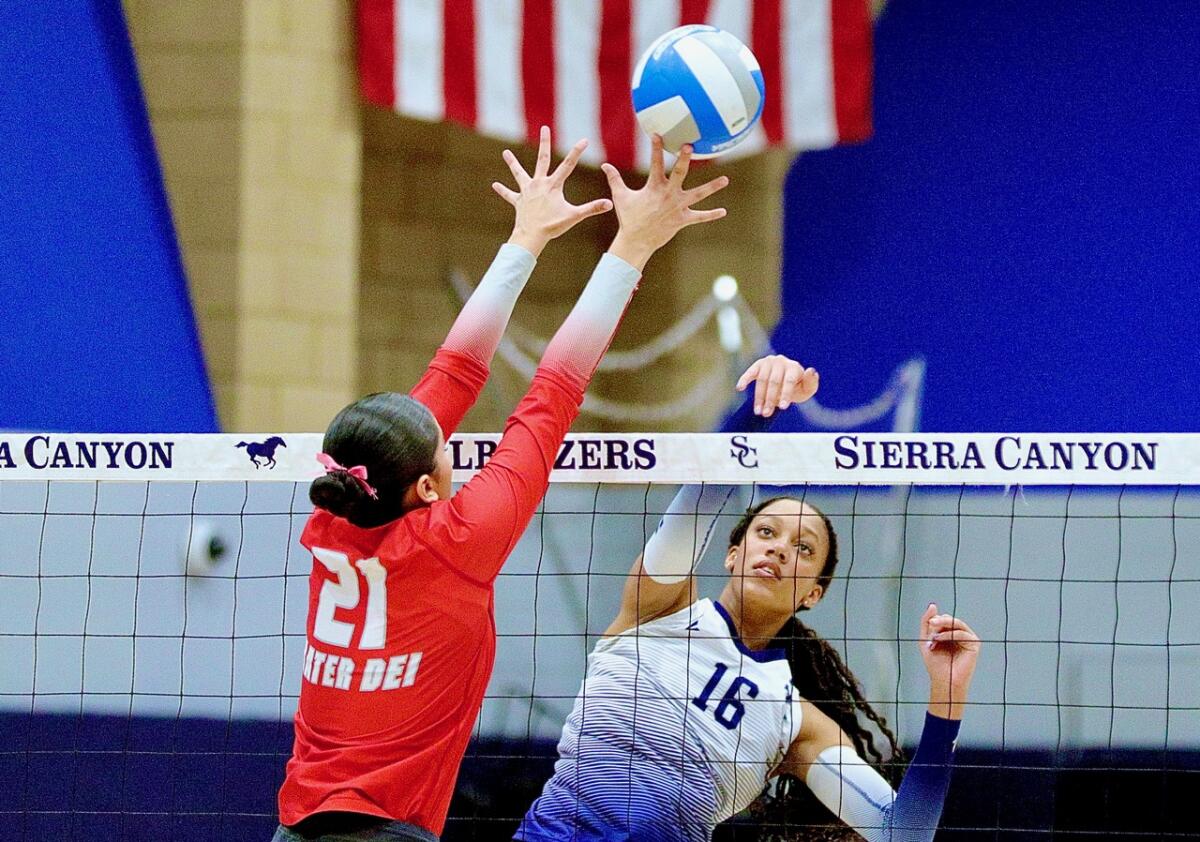
Sierra Canyon senior Kendall Omoruyi, right, is one of the top middle blockers in the country.

Sierra Canyon senior Kendall Omoruyi, right, is one of the top middle blockers in the country.

(Steve Galluzzo / For The Times)

In a matchup of reigning state champions, Mater Dei prevailed in five sets over Harvard-Westlake in its Aug. 11 season opener, and it was no surprise that UCLA-bound senior hitter Westley Matavao made her presence felt with 16 kills, 19 digs and six aces. California commit Emma Kingston added 13 kills and three blocks as setting duties were shared by senior Kalea Lee (24 assists) and junior Riley Stringer (20 assists).

“It’s great to start out playing a team that’s just as competitive as us — it’s good prep for what we can expect all season,” said Matavao, who recorded 405 kills, 177 digs, 37 aces and 32 blocks a year ago. “This teaches us to not be laid back, to keep our foot on the gas. I think we’re better than last season because we have more versatility.”

Making an immediate influence was freshman Jimin Seung, who ended the first point of the season with a kill and finished with 10. On a team with 11 seniors, Seung is fitting right in with a fearless attitude and competitive drive.

“It was nerve-racking, but knowing our team is one, the nervousness turns to confidence,” Seung said. “I came to Mater Dei because it’s the place that felt most like home and I wanted to grow in my religion. I’ve only known Westley a few weeks and she’s already like a big sister to me. She’s a senior and I’m a freshman, but we have a lot in common because we play the same position.”

Mater Dei coach Dan O’Dell speaks to his players during a match.

Mater Dei coach Dan O’Dell guided the Monarchs to the CIF State Open Division championship in 2025.

(Steve Galluzzo / For The Times)

Though Mater Dei has superior depth, Sierra Canyon has a more experienced starting lineup — a nucleus of All-Americans consisting of Missouri-bound setter Lucky Fasavalu, Nebraska-bound middle Kendall Omoruyi and a trio of outside hitters in Eva Jeffries (Tennessee), Hanna McGinest (Texas Tech) and McKenna McIntosh (USC).

Filling the last rotation spot will be Isabella Torres-Wallace from ICL Academy; fellow sophomore middle Cassie Smith and junior Raneighla Gonzalez, who transferred from Heritage Christian last year but got hurt and played in only two sets. The top back row options for coach Stefanie Wigfall, who will likely pass the 400-win mark this season, are senior Olive Shum and Mira Costa transfer Blake Gurney.

Sierra Canyon, which beat Mater Dei to win its second section title in four years last fall, finished fifth at Queen’s Court without Fasavalu, Omoruyi and McGinest, who led the team a year ago with a combined 469 kills, 265 digs, 29 blocks and 28 aces. The Trailblazers beat Kahuku (Hawaii), Mira Costa, JSerra, San Juan Hills, Palos Verdes, Harvard-Westlake and Cornerstone Christian (San Antonio) to reach the finals of the Ann Kang Invitational in Honolulu. They then rallied past host Iolani, 18-25, 25-11, 15-9, in Saturday’s championship match to win the prestigious tournament for the first time.

Sierra Canyon's Lucky Fasavalu holds the ball during a match.

Lucky Fasavalu helped lead Sierra Canyon to the Southern Section Division 1 title in 2025.

(Steve Galluzzo / For The Times)

Division I state champion Harvard-Westlake got 12 kills each from sophomore Brooke Cotter and Boston College-bound Ruby Sampson and 11 from Princeton commit Sophia Cotter against Mater Dei. Last year the Wolverines finished third in the Mission League behind Sierra Canyon and Marymount, which has lost five Division I players to graduation — Sammy Destler (Washington), Elle Vandeweghe (Southern Methodist), Declan Eastman (Rice), Olivia Penske (Georgetown) and Frankie Jones (Brown) — but brings back Northwestern commit Makenna Barnes, setter/hitter Leighton Devereux and Katelyn Oerlemans, a middle/opposite hitter committed to Stanford for beach volleyball.

Challenging Mater Dei in the Trinity League will be Santa Margarita, which won the Southern Section Division 2 title last year behind player of the year Ireland Real, a Texas commit who pounded more than 400 kills and had 150 digs.

Mira Costa will be led by senior captains Brynn Barry (libero), Lerin Rosenthal (setter, opposite) and Allyn Hilt (outside hitter) but will have to overcome the loss of setter Milly McGee (USC) and hitters Audrey Flanagan (Wisconsin) and Simone Roslon. Bay League rival Redondo Union is in a similar circumstance, having to replace hitter Abby Zimmerman (Cal), twins Avery and Addi Junk (Florida State) and middle blocker Taylor Boice (UC Irvine). Cypress graduated CIF-SS Division 3 player of the year Isabella Faro.

Defending champion Palisades and Taft, which lost to the Dolphins in the Open Division semifinals last fall, are the preseason favorites in the City Section.

Matavao relished a chance to face her cousin Fasavalu (the CIF-SS Division 1 player of the year) in the finals again: “I think there’s a good chance we’ll see them again.”

Teams to watch: Mater Dei, Sierra Canyon, Marymount, Harvard-Westlake, JSerra, Santa Margarita, San Juan Hills, Mira Costa, Redondo Union, Newport Harbor, Los Alamitos, Long Beach Poly, Temecula Valley, Crean Lutheran, West Ranch.

Source link

There might be one advantage to climate change. More home runs at Dodger Stadium

Not much good comes to mind when you think about the effects of climate change.

Wildfires, floods, melting ice caps, heat waves, the bleaching of ocean reefs.

But then there’s baseball, and one possible silver lining.

Has global warming turned Dodger Stadium into a home run launching pad?

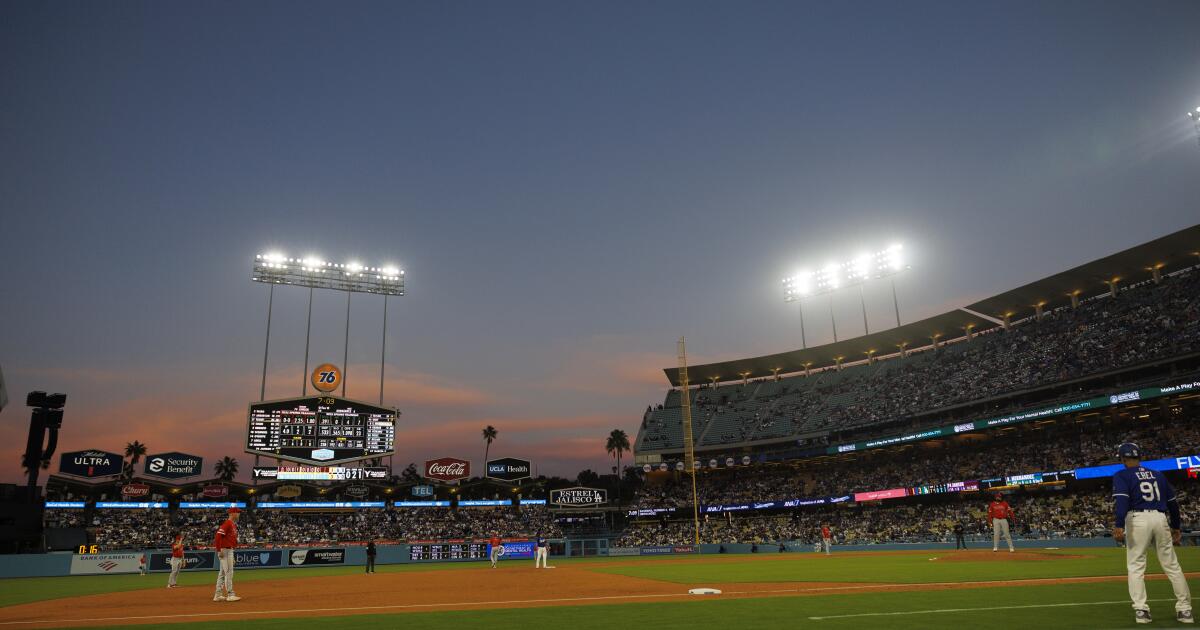
I was watching Monday night’s ESPN telecast of the L.A. game against Tampa Bay when the play-by-play announcer said that once upon a time, it was an article of faith that fly balls didn’t carry far in the heavy night air of Chavez Ravine.

However, the announcer continued, a Dodger executive had told him that over the last several years, “in general, the marine layer is gone, and the ball has started to carry at night, and you can see it now in the numbers. It is a great home run hitters park.”

This is statistically true. Between 2020 and 2025, Dodger Stadium had more home runs than any other major league park, although this year’s total is lagging behind last year’s pace. In all of Major League Baseball, home run totals have fluctuated but gradually increased over the years, with this year’s pace running slightly ahead of last year’s.

That can’t all be attributed to climate change, as retired Dodger great Steve Garvey is going to explain in a minute. When considered city by city and decade by decade, there are lots of factors in home run totals, from ballpark dimensions to playing strategies to the number of long ball hitters in each lineup.

But with Dodger Stadium, the marine layer angle jumped out at me because I’m always on the lookout for relatable ways to tell the climate change story. In the past, I’d written about the gradual demise of Joshua trees, the effect of receding fog and higher heat on the California wine industry, the growing nuisance of backyard bug bites and the gradual migration of juvenile great white sharks up the coast.

And now we have to ask ourselves: Is global warming producing more home runs than steroids did?

The warm-up is real, but it isn’t new. In Game 2 of the 2017 World Series, the temperature at Dodger Stadium topped 100 when the first pitch was thrown, and the ballpark was like a popcorn machine. The Dodgers and Astros combined for a record eight home runs, and The Times’ story quoted a NASA climate scientist who noted that the marine layer was a no-show.

While watching Monday night’s game, I emailed Dodger fan Edgar McGregor, the meteorologist who warned neighbors about the catastrophic weather conditions that resulted in the Eaton fire. I asked what he thought about this theory of a link between a diminished marine layer and the number of home runs.

“There is absolute truth to that,” said McGregor, explaining that “when oceanic temperatures are warmer, the marine layer is weaker.”

McGregor broke down the aerodynamics: “Cold air is dense, so a baseball has to push more atoms out of the way as it travels deep. Warm air has lower density, so balls travel farther.”

UC climate scientist Daniel Swain said this pattern will accelerate “for the rest of our lives as air continues to warm and baseballs continue to meet less and less resistance.”

This doesn’t mean that an infield pop-up will become a home run, but Swain said balls travel four inches farther per 1 degree Fahrenheit increase, “meaning that the average hit goes about 1-2 feet further than it would have in the early 20th century.”

That doesn’t sound like a staggering difference, but with thousands of batted balls over the years, that’s a lot of outs turning into doubles, triples and home runs. Swain sent me a 2023 study from the American Meteorological Society journal titled “Global warming, home runs, and the future of America’s pastime.”

Researchers reviewed data between 2010 and 2019, finding that “higher temperatures substantially increase home runs,” with about 50 per year “attributable to historical warming.” That adds up to about 500 more home runs.

The scientists concluded: “Each degree of global warming is associated with an additional 95 home runs per baseball season.”

Home runs bring fans to their feet, as in Monday night’s game, when Kyle Tucker pumped one that made it just over the right field wall and Miguel Rojas popped the game-winner with a shot that barely cleared the left field fence. So I don’t want to sound like a party pooper, but there is no bigger story in the world than the accelerating destruction of the only sandlot we’ve got.

If the right team hits a homer, feel free to go ahead and cheer. But if the wrong team hits one, you can remind friends and loved ones that each homer is like a fossil fuel bugle call signaling the end of the world as we know it.

Thankfully, the marine layer has not yet disappeared entirely. We still got some May gray this year and some June gloom as well. I wondered, though, if there were any retired Dodgers out there who might be thinking they’d have walloped more home runs if they’d had the advantage of warmer air.

“I do remember some balls just not traveling far, especially compared to day games,” said James Loney, who played first base for the Dodgers from 2006 to 2012 and had 106 career homers with three teams.

Today’s Dodgers hit a lot of home runs primarily because the lineup is stacked, Loney said. But he said he recalled players from visiting teams hammering a long ball and passing him at first base, thinking “they had a home run, and then making a right turn back to the dugout.”

Garvey, also a first baseman, slugged 272 home runs in his 18-year career and told me that if he were playing in this era, “I probably would have hit another 40 or 50 home runs.”

But Garvey, who started with the Dodgers in 1969, said weather is just one of many factors that have led to more home runs in today’s game, which has abandoned finesse in favor of brute force.

Garvey said the bats are harder, the balls are livelier, the pitchers throw harder (more velocity means more pop for batters) and launch angles are talked about more in baseball than at Cape Canaveral.

“We never heard the term ‘launch angle,’” said Garvey, who told me he went up to the plate trying to hit a line drive, not a moon shot.

“My goal used to be a .300 average, 200 hits, 100 RBIs and 20-plus home runs,” said Garvey, who hit 20 or more homers six times, with a high of 33 in 1977.

Today’s Dodgers have plenty of swat in their lineup, ranking behind only the Yankees in home runs so far as they chase a third straight World Series ring. They’re in first place even though one of their biggest bombers, Shohei Ohtani, is about a dozen homers shy of last year’s pace.

But Swain has good news for Ohtani, for Dodger fans and for manufacturers of short-sleeved shirts.

“This year, there is going to be exceptionally high humidity for most of baseball season in SoCal due to the developing very strong El Niño event and record warm coastal ocean temperatures,” he said.

“So, it’s indeed plausible,” Swain continued, “that the combination of long-term warming from climate change, plus shorter-term warming and humidity increase from El Niño and near-shore ocean warming, might increase the number of home runs this season.”

One can only hope the home team does the most celebrating.

Go Dodgers.

steve.lopez@latimes.com

Source link