A HISTORIC town will host a festive wonderland with real reindeers for just one day.
The UK’s largest single-day Christmas market is returning with more than 120 stalls this December.
Beverley Festival of Christmas is branded the UK’s largest single-day Christmas marketCredit: East Riding of Yorkshire CouncilThe festive event even features a real reindeerCredit: Visit East Yorkshire
The Beverley Festival of Christmas will return on Sunday, December 13, bringing thousands of visitors to the East Yorkshire town for one of the country’s biggest festive events.
Shoppers will be able to browse more than 120 stalls selling everything from handmade gifts and Christmas decorations to jewellery, homeware and locally produced food.
Sign up for the Travel newsletter
Thank you!
The market will spread across Beverley’s historic Saturday Market, Wednesday Market and North Bar, with independent traders offering plenty of inspiration for anyone still searching for Christmas presents.
The day will kick off with a spectacular parade at 10am, setting off from Wednesday Market and travelling along Toll Gavel towards Saturday Market.
Santa Claus will lead the procession alongside his reindeer, with live music, comedy acts, Steampunks, majorettes and Bernese mountain dogs also expected to take part.
Visitors can browse through over 120 market stalls for freeCredit: East Riding of Yorkshire Council
After the parade, Father Christmas and his reindeer will remain in Saturday Market until mid-afternoon, giving families the chance to see them up close and take photographs.
Visitors can also expect traditional Victorian fairground rides, face painting, birds of prey displays and ice sculptures throughout the day.
Brass bands, carol singers and dancers will provide a festive soundtrack as shoppers explore the town centre.
The festival will be running from 10am until 4pm and the entry is free.
The event was first established in 1995 by local shop owner John Bird, who brought Beverley’s traders together to create a special day of Christmas shopping.
It has since grown into one of East Yorkshire’s best-known festive traditions, with 2026 marking its 30th year.
AS someone with a fear of heights, dangling by a thin rope from a cable several hundred metres above a deep mountain valley is not on my bucket list.
But here I am, suspended 2,000ft up with nothing between me and the valley below (a situation that could soon change as I feel the pastries I had for breakfast make their way back up).
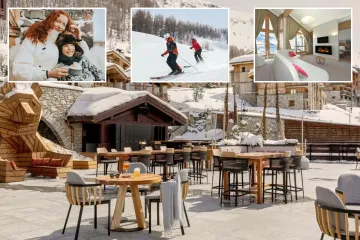
The Sun’s Colin Robertson tests out the mountain gondolaCredit: SuppliedAerial view of the skiing area of Paradiski, La PlagneCredit: Getty
I have reluctantly agreed to take part in the so-called Aerolive experience, which is essentially a gondola without walls.
“Aerolive invites you to slow down, take a deep breath and appreciate the sheer scale and beauty of the mountains,” teases the bumpf.
Sign up for the Travel newsletter
Thank you!
Heavenly stuff, but no one has told my pulse, which is going like the clappers as I gingerly step nearer the edge.
I watch in awe as my fellow daredevils lean out into the abyss and decide on a half in/half out strategy, which would typically be described as “chicken”.
Because yes, Aerolive is exhilarating and yes, the view is magical but my God it is also bloody terrifying.
This mountain masochism is the latest thing to do in La Plagne — a French ski resort which has spent millions installing the superfast gondola from which I now teeter, to whisk visitors up to the top of its 3,080m-high Roche De Mio mountain.
Of course, you don’t have to — literally — put your life on the line to get up here. Normal, sealed cabins are available.
And while Roche De Mio is most definitely the highest, it is just one of numerous peaks in this vast Alpine resort, with its 77 lifts, 143 pistes and 225km of skiing.
The Aerolive experience, which is essentially a gondola without wallsCredit: en.la-plagne.com/Daredevils lean out into the abyss and decide on a half in/half out strategyCredit: en.la-plagne.com/
That nearly doubles when you add the runs and lifts in neighbouring resort Les Arcs, which offer a combined 425km of pistes — the third largest ski area in the world.
You could spend a week here and not cover half the terrain, even if you bomb down a few slopes after hours on a sledge, which local ski firm Oxygene offers for around 40 euros.
I gave their so-called Superluge Derby a go and wow, it’s probably the fastest — and most out of control — you can go on these mountains.
Helpfully La Plagne is HIGH, with 70 per cent of runs above the treeline between 2,000m and 3,000m, which is perfect for a late break (I went in late March and conditions were ideal).
From the top of the highest runs, the views across the bowls are spectacular and there are plenty of big, wide runs.
And when your legs get tired, you are spoilt for choice for places to stop, from cosy chalet-style joints serving all the Savoie usuals — such as tartiflette and fondue — to more modest snack bars pumping out croque monsieurs.
So you don’t blow a hundred euros every lunchtime, I’d suggest nipping over to Plagne Bellecote, where cheaper snack bars abound but the view is still cracking.
If you do fancy spending a few bob and you can’t visit the mountains without a blast of electronic dance music, there is a Folie Douce-style bar on the way down to Plagne Village called La Bergerie.
The Ski Beat package delivered service that was first class, with top quality food also laid onCredit: SuppliedColin on the pisteCredit: Supplied
It’s a straight rip-off of the Val d’Isere original Folie Douce and features DJs, half-naked dancers and, of course, some dude on a saxophone.
Getting a big round in here is only for the brave, though. I bought three pints and am still paying off the credit card bill.
But it’s a good laugh for a quick stop and hey, you’re on holiday.
I stayed just down the hill from Bellcote in a Ski Beat chalet in one of La Plagne’s smaller satellite villages, Plagne 1800.
It’s a charming little place with a few bars and restaurants but most importantly, it’s about a five minute totter from the lifts.
This is my second year on a Ski Beat package and again the service was first class and the food top quality.
While Plagne 1800 is a sleepy hamlet, there is enough to keep you entertained if you’re not quite ready to turn in at 9pm.
I spent a few nights in the rowdy La Mine Bar, themed on a “traditional English pub” and it has made a pretty good fist of it.
You can watch Premier League matches here and neck a few proper pints but, with its wooden beams and Gore-Tex-clad clientele, you still feel like you’re in the Alps.
Bomb down a few slopes after hours on a sledge, which local ski firm Oxygene offers for around 40 eurosCredit: oxiski.comFor those who prefer a slightly more conventional gondolaCredit: Alamy
Musical acts take to the stage most nights and, depending on how smashed you are when you ask them, they’ll play requests.
The only, er, downside is you have to walk back up the hill when you’ve reached capacity.
Where’s that windowless lift when you need it, eh?
GO: LA PLAGNE
GETTING/STAYING THERE: A week in a slopeside chalet in La Plagne costs from £731pp including flights from Gatwick or Manchester, transfers and a chalet host to cook breakfast, afternoon tea, and three-course evening meals with wine.
OUT & ABOUT: A La Plagne Lift Local Pass costs from £220 for six days. A Paradiski Unlimited Area Pass costs from £244 for six days. For details, see en.la-plagne.com.
CHICAGO — The U.S. can deport the leader of Wisconsin’s largest mosque — an outspoken advocate of Palestinian rights — on the grounds that he is a threat to national security, an immigration judge ruled Wednesday.
Salah Sarsour was detained in Milwaukee in March by U.S. Immigration and Customs Enforcement officers. A federal judge ordered Sarsour’s release in June, saying he raised a “substantial” claim that the Trump administration was targeting him for speaking out against Israel and advocating for Palestinian rights.
Sarsour called the ruling “deeply disappointing,” but said he intends to appeal.
“I will continue fighting to defend the right to free speech and to stay in the country I have called home for more than three decades,” Sarsour said in a statement.
Government attorneys say Sarsour’s decades-old convictions in Israel make him a threat to national security and accuse him of lying on his green card application. Judge Jayme Salinardi, with the Chicago Immigration Court, found him removable on foreign-policy grounds but tossed out the government’s claim that Sarsour lied to immigration authorities.
Sarsour says he fears for his life if he is deported to the West Bank
Sarsour, who was born in the Israeli-occupied West Bank, was imprisoned in Israel in 1988 after confessing to throwing a Molotov cocktail and stones at Israeli military personnel. In 1995, he was convicted of attempting to possess weapons. Sarsour denies committing those crimes. His attorneys say he was tortured and coerced into confessing in both instances.
Sarsour, the president of the Islamic Society of Milwaukee, does not have a criminal record in the U.S., where he has lived since 1993. His attorneys say the U.S. government has known about Sarsour’s convictions in Israel since he arrived.
Deportation to the West Bank “means the end of my life,” Sarsour told the Associated Press on Tuesday.
One of his attorneys, Patrick Taurel, told the AP that Sarsour’s earlier treatment by Israeli authorities is “probably a good indicator of what awaits him” if he is deported.
At a status hearing Wednesday, Taurel pressed the judge to specify that Sarsour can only be deported to Israel or the Palestinian territories. Jordan, a country to which Sarsour has no connection, is listed as a possible destination on the order of removal.
Sarsour was instructed by immigration officers to list Jordan as his home country on an immigration form because his preferred entry — “Palestine” — is not a fully independent, unified state. But he “has no right to reside in Jordan,” Taurel said.
Salinardi declined, calling it an issue to be addressed on appeal.
Attorney says Sarsour will fight deportation
Taurel said Wednesday that Sarsour is being unfairly targeted.
“If Salah can be deported for his speech in support of Palestinian rights, anyone can face the same fate,” he said.
Secretary of State Marco Rubio issued a memo in June 2025 invoking a rarely used immigration provision saying Sarsour could be deported on the same grounds as Mahmoud Khalil and Mohsen Mahdawi, both advocates for Palestinian rights whom the Trump administration has tried to expel, according to court documents.
Before the judge’s ruling, Taurel said Sarsour would need to demonstrate on appeal that he could be tortured again if he were deported.
“It’s a very high bar, although I think we can meet it in this case, given what Salah has already experienced, and given the government of Israel’s treatment” of others like him, Taurel said.
A notice of appeal is due within 30 days. Salinardi did not schedule a new hearing and announced he is retiring and that Judge Craig Defoe will oversee the case going forward.
Sarsour says he was tortured and coerced into confessions
Jawad Boulos, who represented Sarsour when he was convicted in Israel, testified in August that Sarsour was coerced into confessing and that he wasn’t convicted of any charge tying him to a terrorist organization. He said Sarsour was tortured by Shin Bet, Israel’s internal security agency.
The Department of Homeland Security challenged Boulos about the torture allegations, questioning how he could know it was true.
Sarsour’s current defense team has asked why U.S. authorities waited until this year to detain him. Taurel said the government has known about Sarsour’s imprisonment in Israel for decades and that he has not concealed that from immigration authorities.
Experts on forced confessions and the treatment of Palestinian prisoners in Israeli prisons also testified in Sarsour’s defense. Israeli military courts have faced repeated scrutiny over allegations of limited due process and the high conviction rate of Palestinians. Israel rejects the claims.
In June, U.S. District Judge James Patrick Hanlon ordered Sarsour released from ICE custody saying he could have a case arguing the U.S. government detained him in retaliation for protected speech. Further, Hanlon said, government attorneys had not explained why Sarsour was suddenly considered a threat after decades as a lawful permanent resident.
The Trump administration has appealed Hanlon’s ruling.
Sarsour, who has Type 2 diabetes, lost more than 30 pounds while detained by ICE, and his blood sugar levels were checked only once a month, putting him at risk of organ failure or death, his attorneys said.
An investigation by KFF Health News and the Associated Press found that hundreds of detainees in at least 33 states have filed federal lawsuits with similar allegations of medical neglect.
In Philippe Caland’s semi-autobiographical 2003 film “Hollywood Buddha,” his mother, Huguette Caland, plays herself. Wearing her signature white smock, inscribed with a flurry of painted swirls, circles, letters and cross-stitches, the Lebanese artist makes precise gray-blue lines on a canvas spread across her dining room table as her son laments a fickle movie industry.
Filmed in her Venice home, the scene, her three children agree, was true to life. Caland worked constantly: on stretched canvas, on fabric folded in her lap, on a children’s menu, on the wall of her kitchen, or the sleeve of her smock. Whatever was at hand.
“Of course it could be frustrating,” said her daughter Brigitte, an elegant, soft-spoken scholar of Semitic languages who has managed Caland’s estate since her death in 2019.
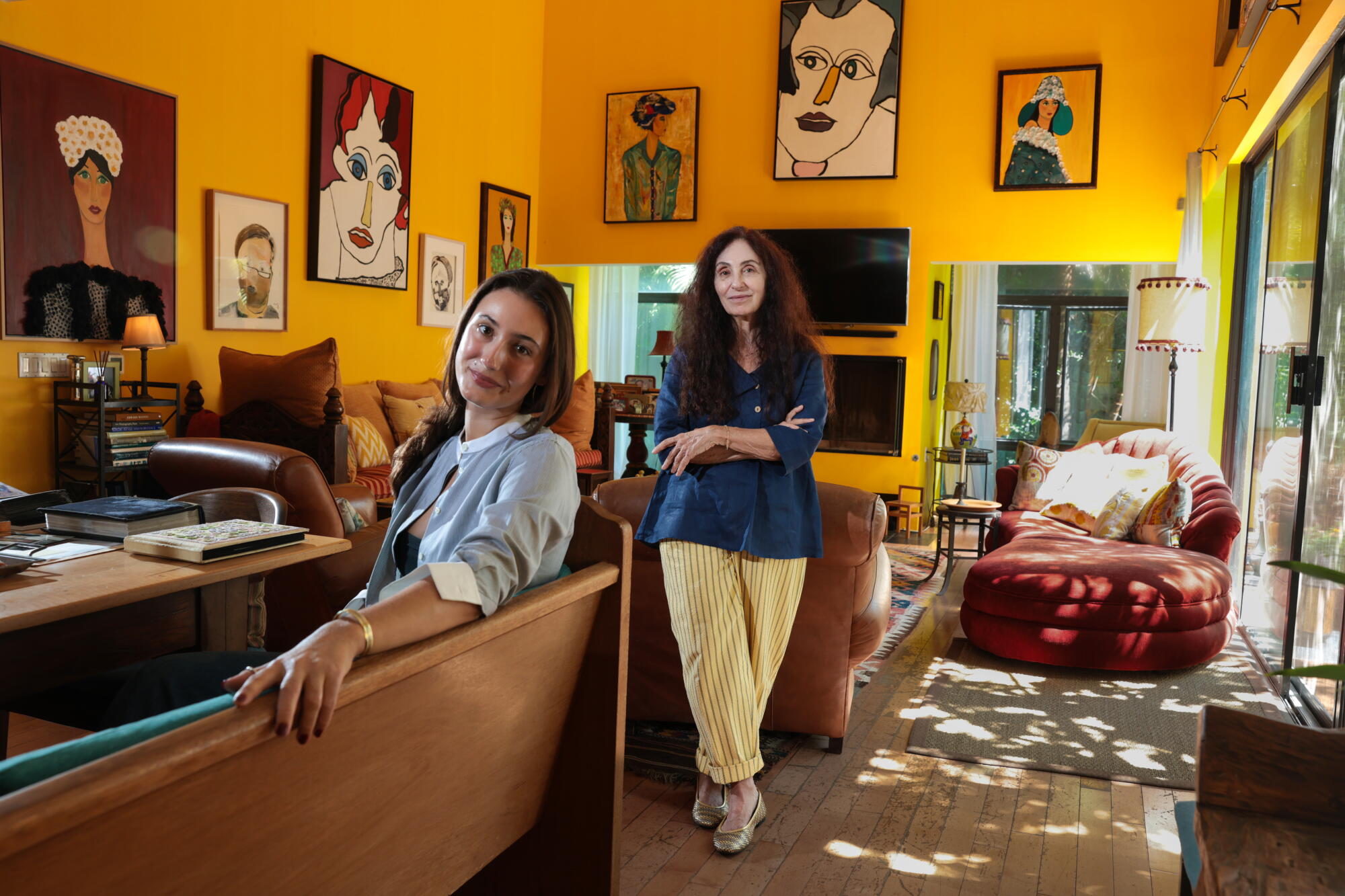
Brigitte Caland, right, and Charley Caland — the daughter and granddaughter of the Lebanese-born painter, sculptor and fashion designer Huguette Caland — stand in Caland’s former L.A. home and studio.
(Robert Gauthier / Los Angeles Times)
Sitting in that very home, which Caland had built in 1997, Brigitte recalled the many times her mother invited her over only to continue working as they talked. “I’d go to leave, and she’d put the canvas away, beg me to come back, and as soon as I did, she’d start painting again.” Still, from early on, Brigitte understood the compulsion as evidence of her mother’s resolve. “She had this incredible drive to create.”
“Huguette Caland: A Life in a Few Lines,” opening Sunday at the Hammer Museum, traces that relentless drive across nearly 150 paintings, drawings, sculptures, garments and tapestries. Organized by the Museo Nacional Centro de Arte Reina Sofía in Madrid in collaboration with the Deichtorhallen Hamburg, the show comes to Los Angeles as the largest Caland survey in the country to date. Spanning five decades and installed chronologically, it features work from the 26 years she spent immersed in Venice’s creative community even as her practice was largely ignored.
It was Caland’s generous hospitality and boisterous wit that made her custom château a gathering place for a vibrant Westside art circle. Ed Moses, who lived around the corner, visited several times a week; Larry Bell, Frank Gehry, Robert Wilhite and others joined her for long meals and even longer parties. Her work surrounded them, and her studio, the grandest space in the house, stood open just beyond the living room. Yet her guests remained uninterested. “No one,” Brigitte said, “would walk the 10 steps.”
Huguette Caland in Stone Doorway, France, 1970.
(Huguette Caland Estate)
Curator Hannah Feldman sees that tension as central to Caland’s California years. “Instead of supporting and bolstering her as a creative in their midst, she became their salon host,” she said. The lack of recognition, Feldman argues, reverberates through Caland’s heavily impastoed portraits of Moses and her enigmatic late abstractions such as the rectilinear paintings in the “Silent Letter Series.”
“To draw a line is a way to contain one’s emotion, one’s anger, one’s anguish,” wrote Caland of her challenging relations with fellow artists in “Sketchbook 2” (1990-91). “My lines tell the story of my life, of people encountered along the path, people I loved, and found and even lost.”
Caland is perhaps best known for her cheeky, erotic paintings of fulsome body parts and for a biography too often reduced to cliché: the libertine daughter of Lebanon’s first post-independence president who left her husband and children in Beirut to pursue an art career in a less repressed Paris.
Huguette Caland, “Self-Portrait in Smock,” 1992
(Huguette Caland Estate)
Feldman hopes the exhibition, which spans fine-line drawings of entangled lovers and radiant topographical tapestries, will complicate that familiar account. “There’s joy, and there’s sex,” she said, “but there’s also pathos, vulnerability. The search for autonomy is not an easy one; it comes with conflict, strife.”
Caland’s freedom was no doubt hard-won. She first picked up a brush as a married mother of three in her thirties, and only after her father’s death. In her first painting, alternately titled “Soleil rouge” and “Cancer” (Red Sun/Cancer) (1964), hazy concentric circles gather in a crimson orb at the center of the monochromatic plane. Simultaneously a tumor and a light source, the refulgent motif holds grief and release.
Soon after, Caland enrolled in art classes at the American University of Beirut, relinquished much of her constricting couture wardrobe, and adopted a uniform of loose, flowing kaftans, which she would later turn into works of art in their own right. Archival photographs show a glamorous Caland arriving at an event in a floor-length garment bearing painted breasts, a belly button and a triangle of curly pubic hair.
Huguette Caland, “Bribes de corps,” 1973
(Huguette Caland Estate)
Caland moved to France in 1970, leaving her children (then 15, 13 and 12) in Beirut with their father, a French-Lebanese lawyer named Paul Caland. In paintings from that decade, Caland’s imagery of bodies swell, split, meld and dissolve. In “Enleve ton doigt” (Remove Your Finger) (1971), lipstick-red lips receive a pale finger reaching out from a crush of fantastical profiles; two years later, in “Self-Portrait” (Bribes de corps), Caland dispersed a sensual body across a pale pink field interrupted at the lower edge by a slight, shadowed cleft — either buxom cleavage or buttocks.
The distance from her children produced another kind of line: text. Philippe recalled receiving illustrated letters almost every week, filled with drawings, doodles and notes of affection. Most of these were later destroyed when the family house was bombed during the Lebanese Civil War of 1975. “I always knew my mother loved me,” Philippe said. “The family was not torn apart. She took a break, and in the end made a home for us in Paris, where we all landed when the war was raging.”
After the death of her lover, Romanian sculptor George Apostu, whose rough-hewn wood sculptures still populate the house’s patio, Caland’s children encouraged yet another departure. Her eldest son, Pierre, a businessman and former Olympic swimmer, paid for a stay at a friend’s Venice bed-and-breakfast, all but forcing his grieving mother out of Paris and to sunny L.A. Her initial reluctance gave way to affection. The light, arid climate and mountains sloping into the sea reminded her of Lebanon. “She liked that California land sounded like Caland,” Brigitte said.
Huguette Caland works at her home and studio in Venice, date unknown.
(Huguette Caland Estate)
After making Venice her primary residence, Caland collaborated with architect Neil Kaufman on the design for her enclosed château. Its towering, mostly unbroken face and narrow swimming pool suggested a rampart and a moat, but behind the concrete exterior, Caland eliminated every door save the guest bathroom. Long vertical windows opened onto a courtyard shaded by a sprawling olive tree. Art crowded the steep stairwell; it accumulated on scattered plywood and Formica tables and unraveled across the kitchen in an intricate mural composed of tessellated marks that recall Byzantine mosaics and tatreez, a form of traditional Palestinian embroidery.
“There was no distinction for her,” Brigitte said, between the home and the studio, art and life. Caland once described her “very, very mixed media” as including “every single exchange, a look, a smile, a brief encounter.”
That original interior survives in “Hollywood Buddha” and archival photographs. Philippe now lives in the house with his family, and although the concrete exterior remains intact, the rooms and the courtyard have been remodeled around their own aesthetics and routines. Along with the technicolor mural, Caland’s singular sensibility persists in scattered drawings, a bouquet of her preferred 30-inch paintbrushes and a pair of stiff-backed pews. Her presence, too, is felt in the people who now inhabit the space, like her granddaughter Charley, 25, whose easy warmth recalls qualities long ascribed to the matriarch.
The former Venice home and studio of the Lebanese-born painter, sculptor and fashion designer Huguette Caland. The home is still occupied by Caland’s family and no longer looks how it did when she was alive, but her spirit lives on in small details.
(Robert Gauthier / Los Angeles Times)
When the Hammer selected Caland for “Made in L.A. 2016,” the honor brought some measure of the local attention that had long eluded her. “If you had to pick one critical turning point for her career,” Pierre said, “it was the inclusion of her work in that show.” For the family, the coming survey fulfills one of her long-held ambitions.
“She told me, ‘Live your life day by day and plan it on a thousand years,’” Philippe said. Only later did he understand that the advice described her own life. “Today, her work is here,” he added. “She continues with it.”
Huguette Caland, “Le grand bleu,” 2012.
(Huguette Caland Estate)
The final painting in the exhibition, an oceanic large-format canvas titled “Le Grand Bleu” (The Great Blue) (2012), once hung high above the central hearth in the Venice house. Surrounded by undulating circles, spots and stripes, red-roofed Lebanese abodes and white-masted schooners traverse an unsettled horizon line. From the dining table below, where a young Charley often helped her grandmother fill blank planes with delicate dots, Caland could look up and see how far her line had taken her.