Battle over single-use plastics erupts as 17 states move to block California law
Attorneys general in seventeen states are suing California over its landmark single-use plastic law, which went into effect on June 1.
The lawsuit comes after a coalition of environmental groups sued the state over the same law this month, arguing the new final regulations create loopholes so large they gut the law.
The states are led by Nebraska Atty. Gen. Mike Hilgers, and the plaintiffs include the National Assn. of Wholesaler-Distributors. The coalition is asking the court to block enforcement of the law immediately.
“Once again, California is trying to enact a policy that negatively impacts the rest of the country,” said Hilgers in a news release. “If California goes unchecked, consumers will be forced to pay more for basic necessities.”
The other states in the coalition are Alabama, Florida, Georgia, Idaho, Indiana, Iowa, Louisiana, Missouri, Montana, North Dakota, Oklahoma, South Carolina, South Dakota, Texas, Utah and West Virginia. The lawsuit was filed in the U.S. District Court of Eastern California in Sacramento on Monday.
State Senate Bill 54, the Plastic Pollution Prevention and Packaging Producer Responsibility Act, was signed by Gov. Gavin Newsom in 2022. It was considered landmark legislation because it requires plastic and packaging companies to use less single-use plastic and ensure by 2032 that all food packaging is either recyclable or compostable.
Accumulating plastic waste is overwhelming waterways and oceans, sickening marine life and threatening human health.
The intent was not only to reduce single=use plastic, but also to put the onus and cost of dealing with it on packaging producers and manufacturers, not consumers and local governments. It was supposed to incentivize companies to consider the fate of their products and spur innovation in material redesign.

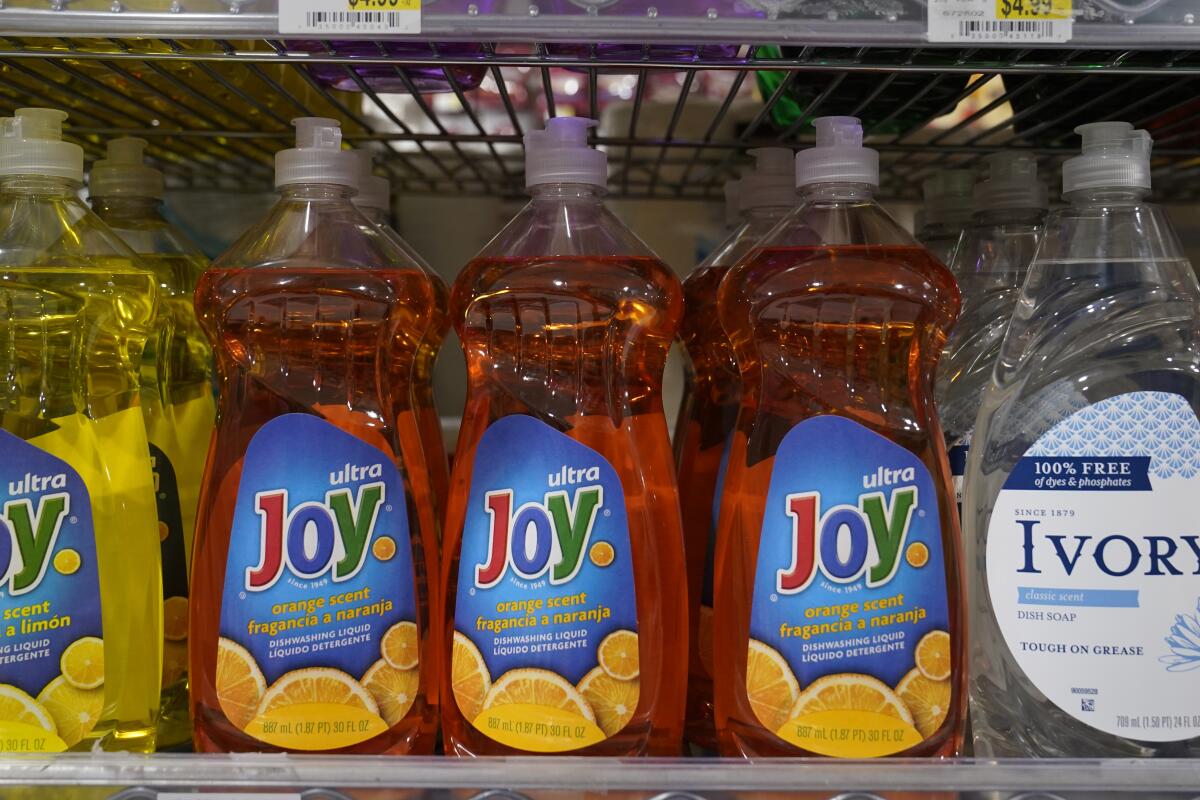
Plastic bottles of dishwashing liquid at Compton’s Market in Sacramento on June 17, 2022.
(Rich Pedroncelli/AP)
According to one state analysis, 2.9 million tons of single-use plastic and 171.4 billion single-use plastic components were sold, offered for sale or distributed during 2023 in California.
The single-use plastic law is what is known as a producer responsibility law. It emphasizes the idea of a “circular economy” in which the producer of a material must consider its fate — making sure it can be reused or recycled, or at least reduced.
In California, all producers of single-use packaging and plastic foodware (plates, knives, spoons, etc.) join a private entity known as a producer responsibility organization. Only one such organization has been approved in California: the Circular Action Alliance.
The states and the National Assn. of Wholesaler-Distributors say the plastic law discriminates against businesses selling into the state in two ways: by making them change or alter their plastic packaging and by conferring government authority upon the alliance, enabling a private entity to regulate and impose taxes and fees on businesses selling into California.
“California is not entitled to pronounce nationwide policies,” Eric Hoplin, president and chief executive of the wholesalers group, said in a statement. “Because the Act extends California’s regulatory reach far beyond its borders and brings within its sweep conduct wholly unconnected to California, the Act violates principles of federalism, the horizontal separation of powers, and due process.”
In addition, the attorneys general say the law suppresses their free speech by compelling companies to join and fund the speech of an organization with which they may disagree.
Hoplin and his organization filed a similar suit in Oregon in February. Oregon has a comparable single-use plastic law. A federal judge blocked enforcement of that law. A trial begins on July 13.
Heidi Sanborn, executive director and CEO of the National Stewardship Action Council, which advocates for the producer responsibility laws and a more circular economy, said in May that both SB 54 and the Oregon law are public policies that were “passed by legislatures and implemented with government oversight.”
She said the laws create clear and consistent rules so all producers contribute fairly to the cost of recycling and waste management.
Meanwhile, environmental groups are also unhappy.
On June 2, Oceana, the Natural Resources Defense Council and Californians Against Waste Foundation filed a lawsuit in San Francisco Superior Court.
They allege that the final regulations for the law, drafted and approved by the state’s waste agency, include exclusions for large categories of plastic packaging that companies could use indefinitely. In addition, they say, the regulations also allow for recycling technologies that pollute, such as chemical recycling, which the law as originally drafted forbids.
“While SB 54 remains a monumental achievement as the nation’s strongest single-use plastic reduction law, some of the final regulations implementing the statute undermine the law’s ambitions,” Christy Leavitt, Oceana’s senior campaign director, said in a statement.