Taiwan President William Lai says island’s sovereignty ‘non-negotiable’
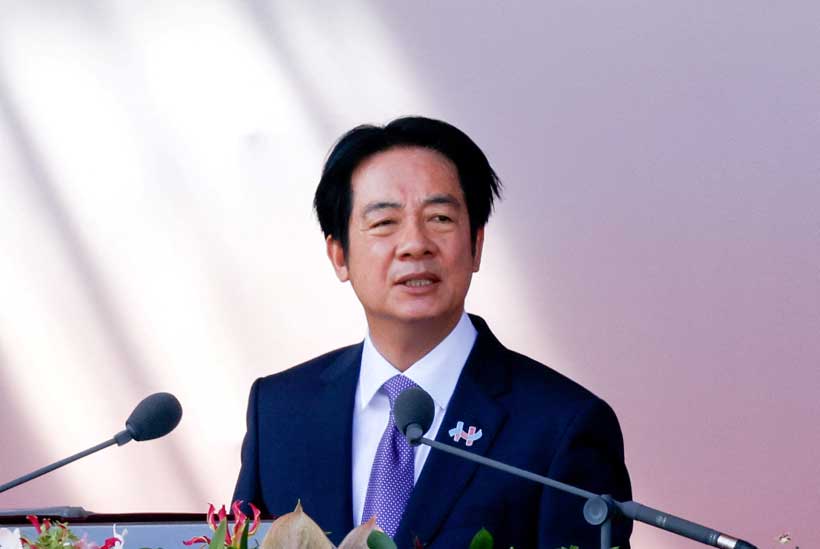
Taiwanese President William Lai Ching-te said Sunday that Taiwan would not do anything to trigger conflict with China but vowed the island would never allow itself to be traded away, or give up sovereignty. File Photo by Ritchie B. Tongo/EPA-EPA
May 18 (UPI) — Taiwanese President William Lai Ching-te said Taiwan would not do anything to trigger confrontation with China but vowed the island would never allow itself to be traded away or give up sovereignty.
In an online post Sunday, Lai said that “as a responsible party in the region and across the Taiwan Strait, Taiwan will not provoke or escalate conflict,” but neither would it yield to pressure to relinquish its “national sovereignty and dignity, or its democratic and free way of life.”
Lai’s statement came after Beijing warned U.S. President Donald Trump to be “extra cautious” over Taiwan, which Beijing regards as a breakaway province, saying it could result in clashes and potential conflict that could place the entire Sino-U.S. relationship “in great jeopardy.”
Speaking aboard Air Force One on his way back to Washington from his summit with Chinese President Xi Jinping, Trump said he had “made no commitment” either way on the Taiwan question or an $11 billion deal to sell arms to the island that was sent to Congress for approval in December.
Trump said he and Xi had discussed the arms deal in depth and that he would make a determination on whether it would go through “over the next fairly short period of time.”
“I’m going to say I have to speak to the person that right now is, you know, you know who he is, that’s running Taiwan,” Lai’s name apparently having slipped his mind.
Trump also strictly adhered to Washington’s long-held position of strategic ambiguity by refusing to answer questions over whether the United States would come to Taiwan’s aid militarily, were it attacked.
Beijing wants reunification and has not ruled out retaking Taiwan by force, particularly if it declared independence.
Back in the United States, Trump appeared to urge caution over Taiwan independence, telling Fox News on Friday that while nothing in the United States’ policy on Taiwan had changed, he wasn’t “looking to have somebody go independent.”
“I’m not looking to have somebody go independent. And, you know, we’re supposed to travel 9,500 miles to fight a war. I’m not looking for that. I want them to cool down. I want China to cool down,” he said.
Although the United States switched diplomatic recognition from Taipei in favor of Beijing in 1979 and acknowledged there is only one China of which Taiwan is a part– the so-called “One China” policy it follows to this day — the Taiwan Relations Act requires it to treat any effort to alter Taiwan’s future by force as a threat to peace in the region and U.S. interests.
The legislation requires the United States to provide the island with arms to defend itself and for the United States to maintain its own capacity “to resist any resort to force or other forms of coercion that would jeopardize the security, or social or economic system, of the people of Taiwan.”
However, there is no guarantee of committing U.S. troops to help defend the island.
In his post, Lai expressed gratitude for the United States’ “continued support” for peace in the Taiwan Strait, as well as ongoing military assistance.
“Given China’s unwavering commitment to the use of force to annex Taiwan and its continued military expansion in an attempt to alter the regional and cross-strait status quo, the United States’ continued arms sales to Taiwan and its deepening of U.S.-Taiwan security cooperation, even to the point of necessity, are crucial elements in maintaining regional peace and stability,” wrote Lai.