Andrew Friedman on looming labor battle and ‘noise’ around the Dodgers
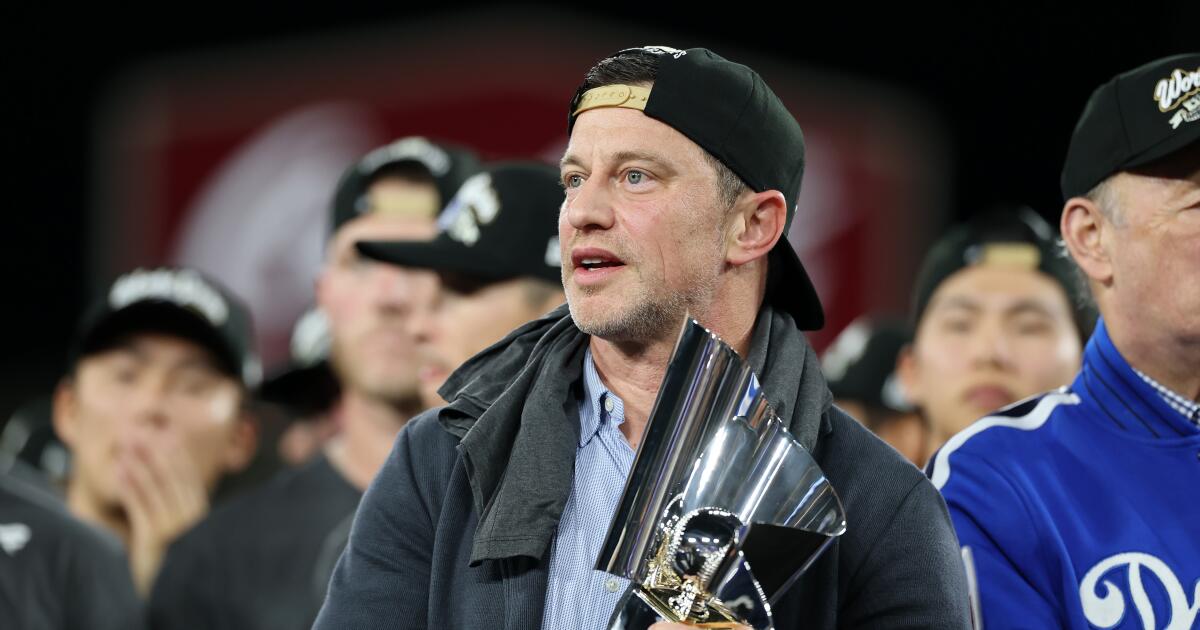
PHOENIX — Dodgers president of baseball operations Andrew Friedman went into the offseason expecting outfielder Kyle Tucker to sign elsewhere.
Sure, Friedman was confident in what the Dodgers could provide on and off the field to the 29-year-old four-time All-Star. And Tucker was a rare hitter who could actually elevate an already star-powered Dodgers lineup. But with the team unwilling to offer a super long-term deal, their chances at landing the best free-agent hitter available this past offseason felt “incredibly low.”
“I can’t remember a time where a player has taken a shorter-term, higher-AAV deal when they’ve had an actual long-term contract on the table,” Friedman said Wednesday.
The Dodgers, however, had already pulled off a bigger surprise when closer Edwin Díaz chose them over returning to the Mets this past December.
The team’s pitch, which included a conversation with the Dodgers’ director of family programs Patricia Romero, discussions about preparation and player resources, and a championship track record, helped land both top-tier free agents.
Of course it didn’t hurt that though Tucker’s contract was only four years, it was worth $240 million. Taking deferrals into account, the net-present day value set an MLB record at about $57 million per year.
The Dodgers’ aggressive offseason, coming off consecutive World Series titles, once again makes them the favorite entering the 2026 season.
They wrap up their Cactus League schedule this week, as World Baseball Classic participants trickle back into camp, and baseball operations leadership make final opening day roster decisions.
Before Friedman headed back to Los Angeles, he spoke with The Times on a range of topics. Here’s part of that conversion, edited for length and clarity.
Q: When it comes to the WBC, there’s variance on how supportive teams are. You have Shohei Ohtani participating as a position player, Yoshinobu Yamamoto pitching after an extra-short offseason, Kiké Hernández supporting Puerto Rico in person while rehabbing. How have you landed in being highly flexible?
Friedman: Obviously everything is case by case. But in a vacuum, we are incredibly supportive of the World Baseball Classic and what it does for our game worldwide. We saw it in ‘23, we saw it this past year, with just how important this is to the players, the staff, the fans — and just how exciting it is for baseball.
So that part’s easy. Now you layer on our situation, us trying to win a World Series. For position players, it’s easier to justify. For pitchers, it’s way harder. Throwing at that intensity in March is really, really challenging. And so we feel like our role is to work with each of our players and have conversations and share our thoughts, listen to their thoughts, and then answers kind of fall out of that.
Q: It’s such a cliche to say you can never have too much pitching, but with this group, are you close?
Friedman: I’ve learned my lesson to never say that we have enough pitching. But I do feel like we are breaking camp with the most talented one through 20 arms — which gets at, obviously, who we’ll break with, and then depth behind it — that we’ve ever had.
Q: Between Díaz, who’s part of that equation, and Tucker, you signed two players this offseason who you didn’t necessarily expect to land. What does that say about this organization and what you’ve done the last few years?
Friedman: Our biggest, most overarching goal is to be a destination spot, where our own players don’t want to leave, where players on other teams are looking longingly, because we feel like championships fall out of that. By having the right environment, having the right culture, that helps your star players want to stay, it helps in the recruitment of others. So we’re way better at it today than we were five years ago. But it’s like a living organism that we have to continue to foster and nurture and develop. And we hope we’re way better at it five years from now.
Q: On that note, the Dodgers are very much caught in the middle of CBA posturing with the current agreement expiring this year. You hear a lot of players saying the Dodgers are doing it the right way and other teams could be doing something similar. On the other hand, the league appears to be floating a salary cap, and plenty of fans are accusing the Dodgers of “ruining baseball.” What’s it been like to see those conflicting narratives?
Friedman: Obviously see it, come across it, hear it quite a bit. But we’re just not that focused on it. We’re a really healthy organization, and the partnership we have with our fans is our guiding light. And we’re doing everything we can to put a team out there that our fans really connect with, and that they feel that partnership with all that they pour into us, and don’t really think about it in any other terms.
And so obviously, there’s a lot of narratives that get extrapolated from that. But our sole focus is on ourselves and the partnership we have with our fans and the rest of it to us, it’s kind of just noise.
Q: You guys raised the bar years ago to, “We’re going to be in the postseason every year.” But there were clear frustrations from the fan base when that wasn’t consistently leading to championships. Is it fair to say that this continued push is almost a response to that frustration?
Friedman: Each year we’ve poured everything we have into winning. And in October, you need a really talented roster, and you need some good fortune. And there’s years where we haven’t been as talented as we wanted to be, whether it’s injuries or lack of performance. There’s years we’ve had really bad fortune, there’s years we’ve had good fortune. And a lot of that is the game, and it’s what I both love and hate about it.
I wouldn’t say our mindset is all that different. But obviously, when you’re in a moment in time with an incredibly talented roster, I think the mindset is, ‘Don’t sit back on your heels, be aggressive, and don’t be nonchalant about the opportunity that we have in front of us.’ And so it’s more the idea of pressing an advantage and being aggressive on that front.
Q: I’m sure when you were pursuing Ohtani, you looked into the revenue ramifications of signing him. Has this been about what you expected? Has it exceeded your expectations?
Friedman: Oh, it’s far exceeded. I don’t think the human brain could have comprehended it correctly. It’s been a perfect storm on a lot of levels, and something that has definitely far exceeded our expectations.”
Q: A three-peat seems to be the goal. Is there such a thing as a successful season without winning a championship, or has this team gotten to a point where you really have to win a World Series in order to claim success?
Friedman: Everything for us, all of our energy and focus, is on doing everything we can to win a championship this year. And our first goal is to win the division and be in position to have a bye. Last year, we added to the degree of difficulty [by winning the division but having to play in the wild-card round] in a way that I’d like to avoid this year.
So that’s the first goal. And then obviously that puts you in the best position to accomplish our ultimate goal, which is winning a World Series. So that’s what all of our energy and focus is on.
And, obviously, if we win the World Series this year, it will be a three-peat. But it’s not how my brain processes it. We’ve won back-to-back, and those are in the bank. And now it’s, do everything we can to win this year, and it’s its own unique, disparate year.