In its latest effort to protect human creators from the flood of synthetic music, Spotify will soon require AI-generated identities to carry an “AI Persona” label while barring their tracks from users’ algorithmic mixes.
The change will take effect in mid-September. It follows Spotify’s earlier moves to help subscribers understand the difference between genuine and artificial creators. The platform announced a verification badge in April designed to highlight human artists. In a statement Tuesday, Spotify said the new AI Persona label is meant to make the streamer “the most transparent and trustworthy place to listen to music.” Music from labeled AI Personas will also be excluded from the Swedish company’s personalized recommendations by default.
“While we believe all artists have creative choice in determining how they present themselves, Spotify’s programming is focused on elevating music from authentic artists building careers in music,” the company said .
The AI persona badge will soon appear on an artist’s profile, in the search feature and in playlists.
This is a step in the right direction, said Tiffany Naiman, the director of Music Industry Programs at UCLA. But, she said, she’s more interested in how the company will be identifying AI personas.
“I want to know the process. How [will they] know the difference? Are there going to be [real] artists that get tied up in it?” Naiman said. “It feels very ‘Blade Runner,’ right? Like you’re human, you’re not human.”
Starting Tuesday, Spotify users will be able to identify themselves as AI personas, if applicable. But the company said it “won’t rely on self-disclosure alone” and will use “human review alongside AI investigative tools to apply the label.”
Artists who get labeled as AI personas by Spotify will be allowed to appeal the label. In the coming months, users will also have the ability to report artist profiles as potential AI personas.
The label is the latest feature from the streaming platform that builds on transparency between the artist and their listeners. Recently, Spotify has also introduced SongDNA, an interactive feature that shows the creative team behind the track; AI Credits, a disclaimer where artists can reveal how much AI was used in their creative process and Artist Profile Protection, which allows artists to review and approve all releases on Spotify.
Artificial intelligence is becoming an essential part of Spotify’s business. The company announced a new AI deal last week with the digital music licensing company Merlin. The partnership will enable artists across the more than 30,000 labels and distributors in Merlin’s network to participate in Spotify’s upcoming AI tool. It hasn’t launched yet, but the goal is to let fans create AI-generated remixes and covers of existing songs on the platform.
Spotify is following in the steps of other streaming platforms that have taken more aggressive approaches to the new technology. Deezer, a French streamer, was the first to detect, tag and exclude AI-generated music from algorithmic recommendations. The company recently disclosed that up to 90,000 AI tracks are being uploaded to the platform daily, representing more than 50% of its new music uploads. Tidal has banned AI-generated music from receiving royalties on its platform.
“We know the music ecosystem is evolving, and so will our approach,” said Spotify in a statement. “We’ll continue to adapt as the landscape changes and as we learn from artists, listeners, and industry partners.”
Artificial intelligence music company Suno is going retro — eventually.
The Cambridge, Mass.-based AI company has announced Suno Vinyl, a service that will press users’ generated AI tracks onto vinyl records. It has not gone live. The company has started a waiting list, with the first pressing reserved for users who sign up. A Suno spokesperson said the company is exploring ways for people to turn their music into physical artifacts.
“Press a banger, because it’s too good to live on a screen,” Suno wrote on its website.
Users will be able to build a tracklist of up to 46 minutes from their Suno library, then either upload their own album artwork or generate it on the platform for the sleeve, labels and cover. Each record will be a 12-inch pressing made from PETG, a type of plastic. Pricing is estimated about $45 plus shipping. Suno has not said who will press the records.
Vinyl records have seen a major resurgence ever since millennials brought the format back into mainstream culture in the 2010s. Over the years, it’s become customary for major musicians to release several vinyl variants to help promote their latest album. Olivia Rodrigo most recently released roughly 10 variants of her new album, “You Seem Pretty Sad for a Girl So in Love,” in June.
Last year, vinyl record purchases accounted for more than $1 billion in U.S. sales, up more than 9%, according to the Recording Industry Assn. of America’s annual report. It was the first time vinyl revenue topped $1 billion since 1983.
The format sold 46.8 million units, against 29.5 million CDs in 2025.
Suno, founded in 2022, has established itself as a leader in AI music tech and maintains an office in Venice. In February, the company said it had surpassed 2 million paid subscribers and was on pace for $300 million in annual revenue. In June, raised more than $400 million in a Series D round led by Bond Capital, more than doubling its valuation to $5.4 billion from $2.45 billion less than a year earlier.
The growth has unfolded as the company fights on several legal fronts. Suno and its competitor Udio were sued for copyright infringement in 2024 by the RIAA on behalf of the industry’s biggest labels, including Warner Music Group, Universal Music Group and Sony Music Entertainment.
WMG was the first of the three to settle with Suno, reaching a deal last November that included a licensing agreement, Suno’s first partnership with a major label, and the sale of Warner’s Songkick concert platform to Suno.
The UMG and Sony litigation is ongoing, with a fair use hearing set for Massachusetts federal court and the labels seeking to expand their complaint. Suno also lost a case brought by German collecting society GEMA last week and is defending against legal actions from Denmark’s Koda.
Separately, class action suits against Suno and Udio have drawn support from more than 1,800 independent artists who say their recordings were used without permission to train the company’s models.
Suno has not said whether users will be able to press tracks that resemble copyrighted work, what rights users hold in the records they order, or whether the company takes a cut.
As AI creeps further into the music industry, copyright remains the sticking point — now on a format that fans seek precisely because a person made it.
As the threat of artificial intelligence continues to creep into the music industry, major record labels are proposing new guidelines for how music generated by artificial intelligence should be treated on the charts.
The coalition of labels, which includes the industry’s biggest players like Sony Music, Universal Music Group and Warner Music Group, as well as some smaller independent labels like BMG and Concord, is trying to establish a new framework for official charts that better separates human creativity from purely synthetic and unauthorized AI creations.
The proposed guidelines unveiled Wednesday say that AI music would qualify for the charts if the AI service used to create it is “properly authorized and lawful” and if it doesn’t violate any copyright laws. The track also has to be “substantially human-made,” and it shouldn’t raise concerns about stream or chart manipulation.
“The principles are intended to provide a unified roadmap for the consideration of official chart compilers, industry bodies and affiliated stakeholders worldwide,” wrote the coalition. “Together, the organizations proposing these principles stand ready to work with charts and industry bodies around the world to discuss these principles and support implementation of these important safeguards for human creativity by charts and industry bodies.”
The labels are hoping that official charts can both “accommodate appropriate use of AI” and maintain “an authentic celebration of human artistry.”
AI-generated tracks are becoming increasingly prevalent on streaming platforms.
Recently, Spotify added a verification badge to distinguish human artists from AI, and Tidal banned AI-generated music from receiving royalties on its platform. Deezer, a French streaming platform, was the first to detect, tag and exclude AI-generated music from algorithmic recommendations.
The company recently disclosed that up to 90,000 AI tracks are being uploaded to the platform daily, representing more than 50% of its new music uploads.
It’s no secret that vinyl records’ resurgence has hit a new plateau, outselling CDs for the first time since 1987 as of 2022, according to a report from the Recording Industry Assn. of America. Three years later, its year-end report flaunts another statistic: Vinyl record sales surpassed $1 billion in 2025 — the first time since 1983.
But there’s an inevitable downside to anything that’s partially made of liquid dinosaur bones. Modern vinyl records are crafted with PVC resin, which makes up more than 75% of an average disk The synthetic polymer itself is made of chlorine and fossil fuel-derived feed stock.
To put its harm in perspective, a first-of-its-kind report from Vinyl Alliance, published in June 2024, found that 50% of a record’s carbon emissions come from this resin. The carbon footprint of a single LP was estimated to be roughly equal to the pollution a gas-powered vehicle emits over a three-mile trip. It adds up quick, considering that 46.8 million new records were sold last year.
Thankfully, it’s not all grim.
Organizations like Music Declares Emergency and the Music Climate Pact initiative are coming together to address the issue. A campaign by the groups — in collaboration with record labels and distribution teams at Secretly Group, Exceleration Music, Warp Records, Ninja Tune and Beggars Group — features titles pressed on 100% reclaimed material.
The release, set in tandem with World Environment Day on Friday, boasts marquee titles such as Elliott Smith’s “Roman Candle,” Bon Iver’s “For Emma, Forever Ago” and Dinosaur Jr.’s “You’re Living All Over Me.”
“What we found talking to a lot of our artists and to customers is that … they are concerned about the environment, and they want to find ways to reduce their footprint,” says Ben Swanson, co-founder of both Secretly Group and the Independent Record Pressing plant in Bordentown, N.J., where the LPs are made. “It’s about 16% less footprint than the traditional piece of vinyl.”
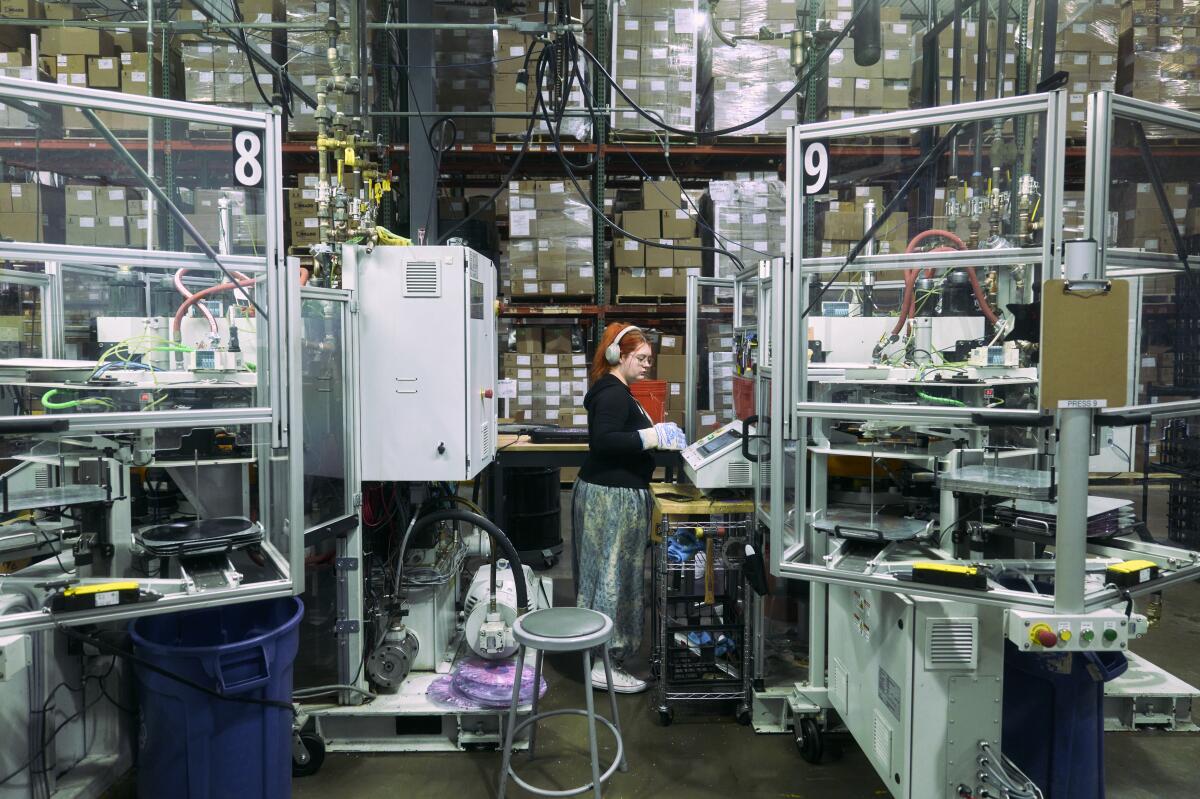
Soren Smith working at Independent Record Pressing in Bordentown, N.J., on May 26, 2026.
(Dutch Doscher / For The Times)
Largely, it’s been people like Swanson who have fully committed to the cause. He says that during the height of the COVID-19 pandemic, in an “activist moment,” several labels signed onto the Music Climate Pact, declaring their intention to reduce their emissions and be better stewards of Earth.
“It had almost no teeth to it,” Swanson explains. “A lot of people signed it, posted something on Instagram, and it sat there for a few years. For us, it was pretty frustrating … it felt very perfunctory.”
His work continued, along with a few others, thanks to support from Murmur, an organization designed to support labels and industry names, effectuating the commitments made when the Music Climate Pact was signed.
“We’re more doers than sayers,” Swanson says. “We’ve really been experimenting with what we’re calling ‘Revinyl’ — post-industrial, pre-consumer, recycled vinyl as a means to reduce our footprint at IRP.”
This is what some of Friday’s release is made of — all the trimmings, tidbits and overstock that would otherwise end up in landfills or on the factory floor. For the time being, it certainly won’t solve the climate cost of vinyl records, but it helps to mitigate it.
Between 2024 and 2025, total units produced at Independent Record Pressing increased by 41% while emissions — which also benefited from lower-carbon transportation — decreased by 34%.
“The idea is, if you can make those records 16% more efficient and also show fans of those records … that it is viable, maybe it makes it a little bit easier next year when we go out to ask other artists to jump on board,” Swanson explains. “We’re not making records that are just going to go sit on the shelf — these are records we’re continually repressing all the time anyway.”
Similarly, Ian Stanton, head of sustainability at Beggars Group, was among the first to sign the pact in 2021. His role was created five years ago to give indie labels a voice in light of minimal resources and capabilities. Though these roles do exist at larger labels, he says they have “slightly different drivers.”
When it comes to records, the pure plastic pollution that comes from them is also a concern. When old records make it to a landfill, they’re not only likely to outlive the site, but can also leach plasticizers, a Keele University report found.
“Vinyl is not like a single-use plastic; we don’t throw it away after one listen. We treasure it, we pass it on through generations, and people have a real connection with it,” he says. “But like any other product, there are ways of making it more sustainable.”
He refers to certain plastics, such as shrink wrap, as the most “visible” aspect of vinyl record pollution to consumers. From a collector’s point of view, shrink wrap can actually increase the value of a record. Though there has been discourse over the years around whether this can actually damage the sleeve, many sellers champion an “in the shrink” label as they mark up prices.
Splatter-patterned records arrive at the trim station at Independent Record Pressing in Bordentown, N.J., on May 26, 2026.
(Dutch Doscher / For The Times)
Other visible aspects, such as the paper sleeves in which the records are housed, are also harmful. However, Swanson says that swapping those for recycled materials outputs a relatively negligible difference in emissions impact, largely due to the process behind producing them.
For the time being, vinyl records made from reclaimed materials are the best that companies like Swanson’s can do, though they’re are always on the lookout for other, viable options for improving their footprint. As an example, they’re actively experimenting with how existing record material can help them.
What can the beat-up, worn-out records at your local thrift store do to dodge a landfill and keep the Earth spinning? As it stands, not much.
Stanton lists an array of challenges, including outdated materials, modern production regulations and contaminants.
“I suppose what we need with PVC for records is a really high-quality, contamination-free material to get that sound reproduction,” he explains. “When you bring in stuff from that post-consumer environment, you’ve got to make sure there’s no contamination in there, because you’re going to end up with sound quality issues.
“It’s all in process,” he adds.
For now, they look to fix the most immediate problems first, such as freight emissions, where Beggars Group has converted the vast majority of its shipping operations to sea freight, a far less harmful alternative compared with air freight.
“We want to look at the full life cycle … not only thinking from the cradle to the grave, but from the point where the raw materials are extracted at the beginning,” Stanton says. “This life cycle analysis now looks at all different environmental indicators on this — the chemical usage, the water usage, and the end-of-life impacts on that side of things.”
Karachi, Pakistan – Over a few breezy winter weeks in Karachi, boxing coach Younus Qambrani sent a steady stream of WhatsApp messages from his neighbourhood of Lyari – videos, photos, old newspaper clippings that together formed an extensive archive of how he teaches girls to throw a punch.
In one of the videos, the bearded and skullcap-clad Qambrani, 60, uses the palms of his hands and ducks as his young students practice throwing their punches. The thuds of the colliding boxing gloves and the scuff of the sneakers against the concrete floor of Qambrani’s Pak-Shaheen boxing club mask the din on the street.
Outside, motorcycles speed and sputter on narrow, labyrinthine roads, past omelettes sizzling on outdoor skillets in the many kebab bun stalls that pepper the neighbourhood of nearly 950,000 people: that is the population of Amsterdam packed into about three percent of the Dutch city’s land area.
To millions of followers of Bollywood, the Indian film industry across the border, Lyari is synonymous with brutal gang warfare waged against a perpetually grey background. It is where Bollywood’s highest grossing film of all time, Dhurandhar and its recently released sequel, Dhurandhar The Revenge are set.
The films — about a fictionalised covert mission conducted by India’s Research and Analysis Wing (R&AW) on Pakistani soil — have each earned more than $100m. In the first film, an Indian spy infiltrates Lyari’s criminal underworld and neutralises threats to India’s national security. In the sequel, the same agent continues his deep-cover operation inside Pakistan’s crime networks, again moving through Lyari’s streets.
But to Lyari locals, the neighbourhood is much more than the backdrop to blood and gore: It is a melting pot of cultures and tradition, rooted in history far deeper than Bollywood has dared to explore. It has an emerging rap and hip-hop scene, launching acts such as hip hop group, Lyari Underground, and masked rapper, Eva B, onto the national stage. The neighbourhood has also earned the nickname of Mini Brazil for being Pakistan’s mecca of football.
To be sure, Lyari has had a past rife with gang violence and unrest. Armed groups held significant influence from the mid‑2000s into the early 2010s, when battles between rival syndicates were at their peak. Gangs led by figures such as Rehman Dakait and, later, Uzair Baloch – both depicted in the Dhurandhar film and its sequel – turned parts of the neighbourhood into a militarised conflict zone. At the height of the violence, human rights groups reported about 800 people killed in Karachi in a single year, many of them in and around Lyari.
In 2012, the government launched what became known as Operation Lyari, a major crackdown in which police, backed by the Sindh Rangers paramilitary force, moved against armed groups in the area. The operation, and subsequent security campaigns, dismantled the main gang hierarchies and largely ended the era of open, large‑scale gang warfare in Lyari, even if other forms of crime persisted.
But Lyari, said social anthropologist Adeem Suhail, has always been about much more than that period of violence.
“Think of Naples or Sicily in Italy, which are among the major cultural hubs of the country (food, literature, music, etc) despite having long been associated with Mafia violence,” Suhail, an assistant professor at Pennsylvania-based Franklin and Marshall College, told Al Jazeera.
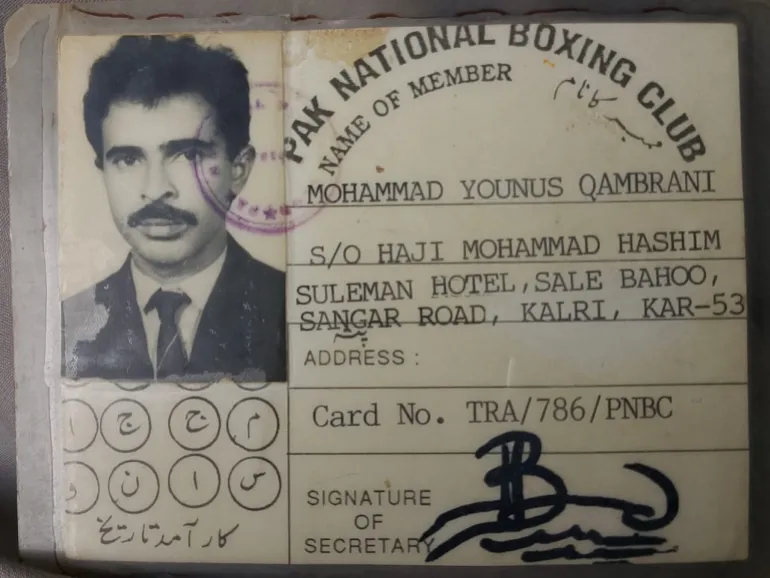
An undated picture of Qambrani’s membership card for Pak National Boxing Club. [Courtesy of Younus Qambrani]
‘Preparing for war’ — of a different kind
Qambrani has been boxing alongside his brothers for as long as he can remember. He began when he was five years old, and was introduced to the sport by his father, uncles and brothers — all boxers. Throughout his childhood, Qambrani says he was a sick and frail child. But he was determined to build muscle and throw punches like the men who had inspired him as he was growing up.
Boxing is so popular in Lyari that in 1989 boxing legend Muhammad Ali visited the neighbourhood, when he was a special guest at the Asian Games in the capital, Islamabad.
Qambrani’s high school, Haji Abdullah Haroon Government College, opened its own boxing club while he was there. He joined, but the club shut down in a few years. So he found another club a little further away and began cycling there to train.
After honing his skills there, Qambrani founded Pak Shaheen Boxing Club in 1992. “I wanted to open a club in my own area,” Qambrani said. At Pak Shaheen, he started out by teaching young boys, aged seven to 16, how to box.
A recent photo at his boxing club. [Courtesy of Younus Qambrani]
A sports enthusiast, Qambrani built friendships with coaches across the city, often visiting their training centres. At a friend’s karate classes at the YMCA (Young Men’s Christian Association) in central Karachi, he noticed young girls practicing kicks and elbow strikes shoulder-to-shoulder with boys. “If girls can do karate, why not boxing?” he wondered.
Qambrani’s students train to spar [Wania Farhan/Al Jazeera]
Soon he began voicing this question to his peers in the local boxing community, saying he wanted to start training young girls. One of them told him that “little girls have weak brains” — a remark that left Qambrani silent.
Then he went home and began looking through news reports featuring stories of girls and women boxing internationally. He would cut out the news clippings and paste them into a notebook. “My eyes were on the whole world,” he recalled. “Girls are boxing in the outside world, why not here?” he would wonder.
So he started at home: when his daughter Anum turned three, he began playfully sparring with her. She would gaze at the many photos of her father and uncles at boxing championships, slip on his medals, and traipse into the living room, mimicking the victorious poses he struck in those pictures. “She couldn’t even run properly, but she would box,” Qambrani said.
Then, in 2013, he opened the doors of his club to young girls. Anum was 16 at the time, and became its first female member.
In 2015, several of Qambrani’s students participated in the South Asian Games, the biennial multi-sport event where athletes from Bangladesh, Bhutan, India, Maldives, Nepal, Pakistan and Sri Lanka compete against each other.
A year later, Anum won a district level championship called the Jinnah First Ever Karachi Women Boxing Championship held at a Lyari stadium. In the same year, she attended a training camp for women organised by the Sindh Boxing Association. Local media reports described this camp as the country’s first government-supported boxing event held for women.
It was Qambrani’s club where Aliya Soomro, Pakistan’s first woman to win a world boxing title, began her training. Last year, Soomro took a mere 45 seconds to knock out her opponent from Thailand to win the WBA (World Boxing Association) Asia 105-pound category.
For Qambrani, though, boxing is about more than medals and trophies. To him, it’s a vital defensive skill.
“Whoever is prepared for war is prepared for peace,” he told Al Jazeera, adding that the defenceless are the ones most likely to be attacked.
With its legion of young boxers, Lyari’s not defenceless. As its reputation and image are mangled by Bollywood, those who know the neighbourhood also turn to its history for support.
An undated childhood photo of son, Munir (L) and daughter Anam [Courtesy of Younus Qambrani]
Lyari’s colonial history
It is not just the Dhurandhar films and Bollywood that Suhail, the social anthropologist, blames for what he describes as “terrible and exploitative” representations of Lyari. Journalistic and scholarly literature have been guilty too, he said.
Lyari is Karachi’s oldest recorded settlement — the earliest inhabitants of the neighbourhood came in 1728. The neighbourhood has survived British colonialism, the partition of the subcontinent, and nearly eight decades in independent Pakistan.
Suhail said Lyari had been a diverse working-class cultural hub since before the 1947 partition of British India.
Some of those working class communities were Baloch and Sindhi, because Karachi is at the tip of the southern Sindh province, which neighbours Balochistan province. Others were Marathi, Gujarati, Afghan and Siraiki migrants from labouring and artisan classes.
“This was because the British required labourers and artisans to develop Karachi into a burgeoning Indian Ocean port city.”
Suhail said that most of these labourers settled on the unplanned sides of the Lyari river, a small 50km-long seasonal river originating in the hills of Sindh, which flows through Lyari before emptying into the Arabian Sea.
“These cosmopolitan working class populations brought with them culinary traditions, dances, religious practices (multi-religious, multi-caste), songs, sports and more,” Suhail said.
He added that Lyari has a “strong cultural memory of East Africa and the Arabian Gulf, which adds to its uniqueness.” The neighbourhood is home to both Baloch and Afro-Baloch communities—people of African ancestry living in Balochistan.
Suhail explained that Lyari’s long history as a cultural hub of Karachi is often forgotten “because, after partition, the city’s demographics shifted drastically and Karachi became an Urdu-speaking Muhajir-majority city.” Muhajirs are Urdu‑speaking Muslims who migrated to Pakistan from India during and after the 1947 partition.
Sarwat Viqar, a professor of humanities at John Abbott College in Montreal, Canada, echoed Suhail’s views.
“Because Lyari has been represented one-dimensionally in the media as only a hotbed of criminality, drugs and the gang wars, what has been overlooked are the rich cultural practices that have always been part of life here,” Viqar told Al Jazeera.
Suhail added that Lyari had also consistently been at the heart of labour movements, and a base of support for reformers, anti-colonial activists and later campaigns for the rights of Pakistan’s various ethnic groups, including the Baloch, Sindhi and Pashtun communities.
“Lyari — because it was the first, most diverse, and most vibrant working-class zone as Karachi was becoming a city — also became the hub of working-class politics,” he told Al Jazeera.
But the neighbourhood’s own fortunes have also oscillated over the years.
“The degree of ‘development’ in Lyari has always been a function of how strong the working-class movement in Karachi was,” Suhail said. “When it was strong—such as in the 1930s and again in the 1970s—Lyari saw development. When ruling elites were strong, it did not.”
What Dhurandhar gets wrong
In the film, Lyari first comes into focus when a long-haired Ranveer Singh, playing undercover Indian RAW [Research and Analysis Wing] agent Jaskirat Singh Rangi, eyes the “Welcome to Lyari town” gate.
The gate looks very similar to the real one in Karachi. Other elements on screen ring familiar too: juice shop owners chanting idiosyncrasies to cajole customers; quick and garbled salams; and the somewhat unkempt colonial era architecture of old Karachi.
But then, the three-hour film’s dusty colour grading seems to wash out Lyari’s cultural depth and its vibrant subcultures.
“We can see how the obscene fetishisation of Lyari and the Baloch with violence and criminality is evident” in the film, Suhail said.
Describing Dhurandhar as “mediocre”, he said it lacks the depth of other Indian gangster films.
For example, in Ram Gopal Varma’s Satya 1998 and Anurag Kashyap’s Gangs of Wasseypur 2012, we see “culturally dense but non-apologetic depictions of Mumbaikar or Bihari gangs that understand the political economy of colonial and post-colonial state formation and how it crystallises in the gangsters portrayed,” Suhail opined.
Satya unpacks the criminal underworld of India’s metropolis Mumbai, following the titular character who arrives in Mumbai seeking a job but is falsely imprisoned and subsequently introduced to the underworld. Gangs of Wasseypur is set in a time before India’s independence in 1947 and follows power struggles, mafias and generational cycles of revenge in India’s eastern state of Jharkand.
In contrast to these films, Dhurandhar, has “heavy-handed homophobic, Islamophobic, hyper-masculine jingoism” and “the characters themselves appear to have no history at all,” Suhail added.
Unlike Lyari
Back at Qambrani’s club, 10 girls aged eight to 16 gather for an hour of sparring every day except Sunday, training for city tournaments that they compete in every two months.
Qambrani is looking to buy a folding, portable boxing ring to take school to school. His dream: to make boxing accessible to as many girls in the neighbourhood as possible. His challenge: he is struggling to find a portable ring in Pakistan and needs funding.
Dhurandhar and Bollywood do not matter at his Lyari club. Qambrani has a new generation of girl boxers to train.