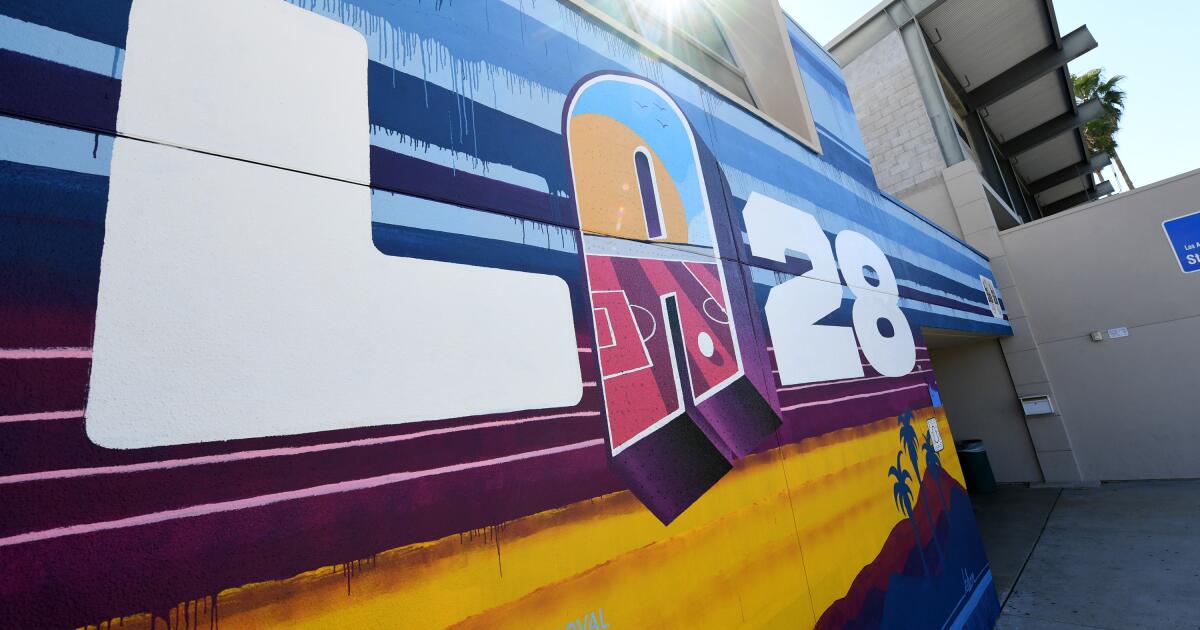
LA28, Rams give out free Olympics tickets
From Thuc Nhi Nguyen: Growing up in Inglewood, Andrew Hernandez heard plenty about the Olympics. Since L.A. was awarded the Games almost a decade ago, the 18-year-old watched preparations slowly improve the infrastructure of his hometown. He still never thought he would ever be able to attend.
Until now.
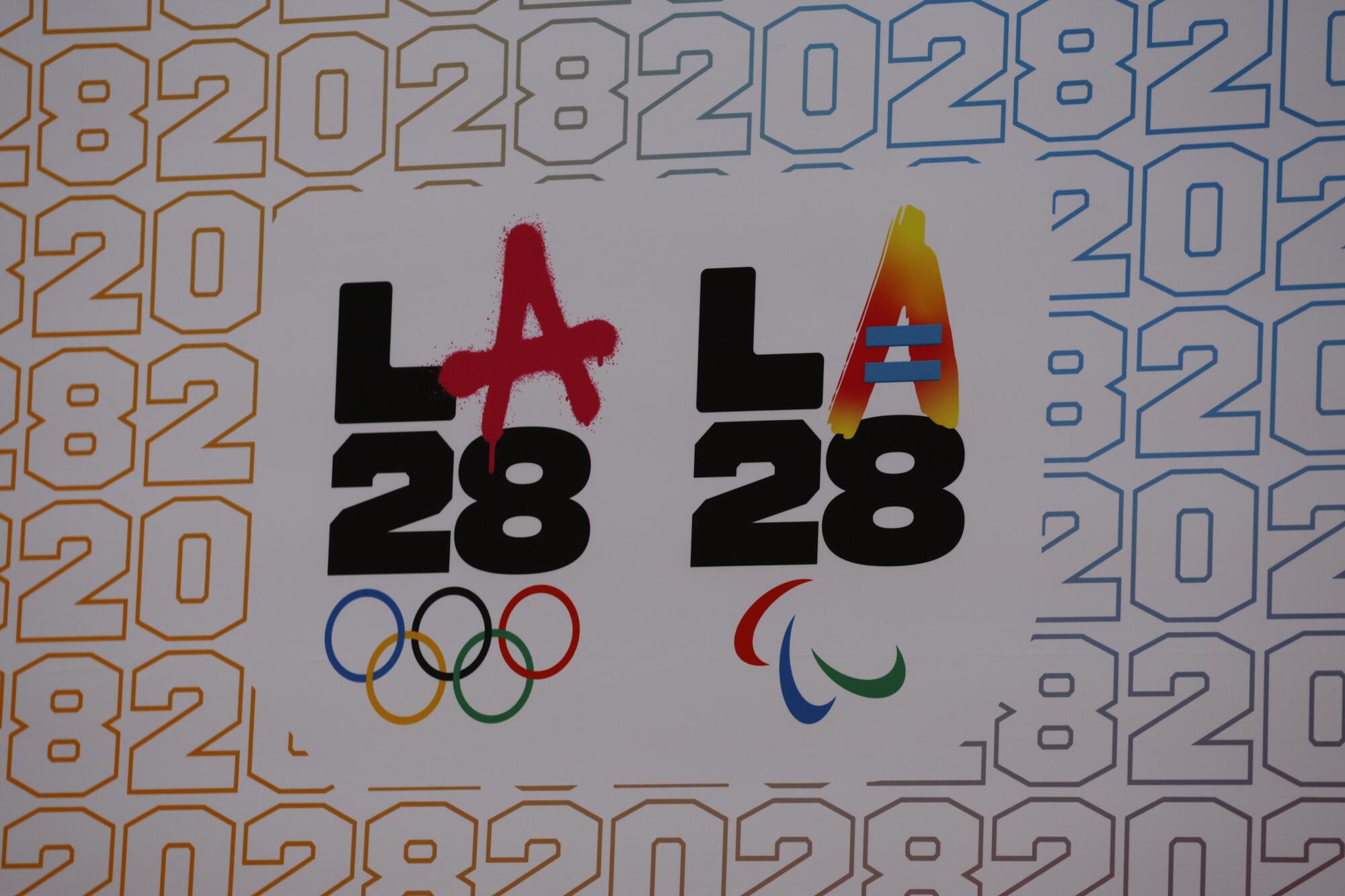
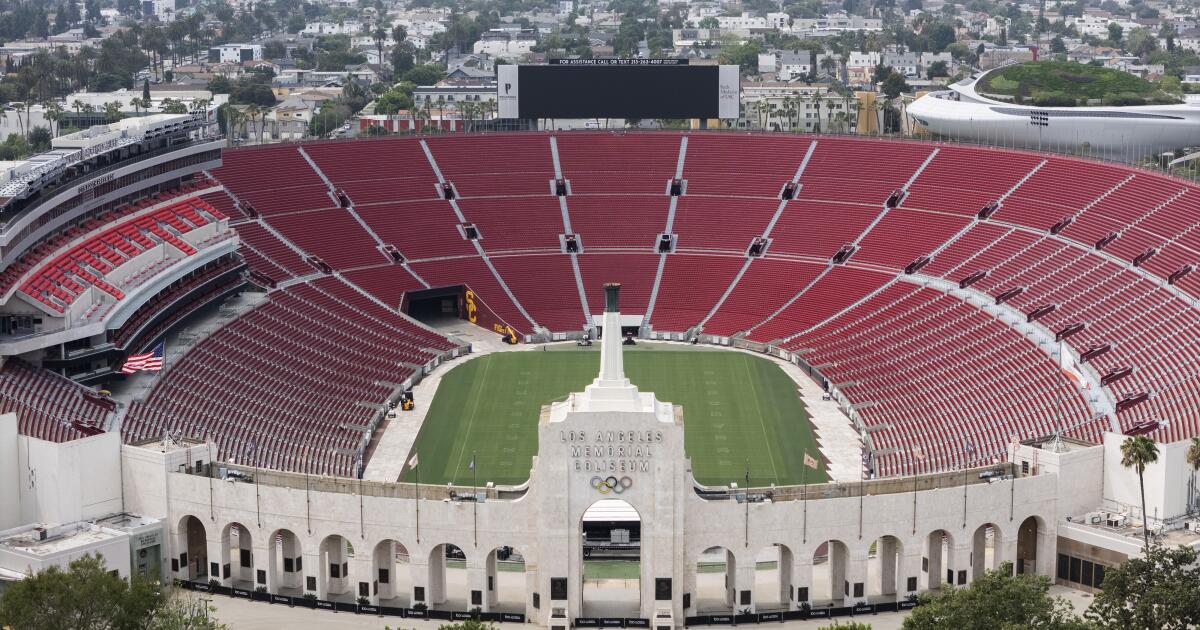
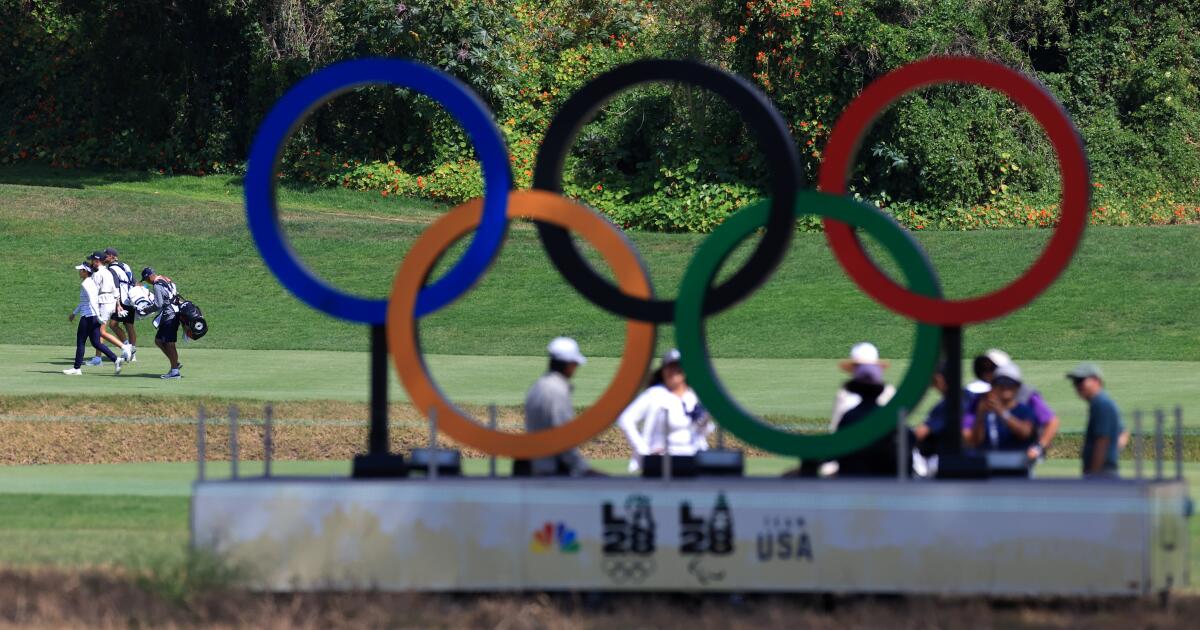
LA28 and the Rams donated 1,000 free tickets to 10 nonprofit organizations Monday, giving local youth such as Hernandez a seat at Olympic flag football or swimming competitions in 2028.
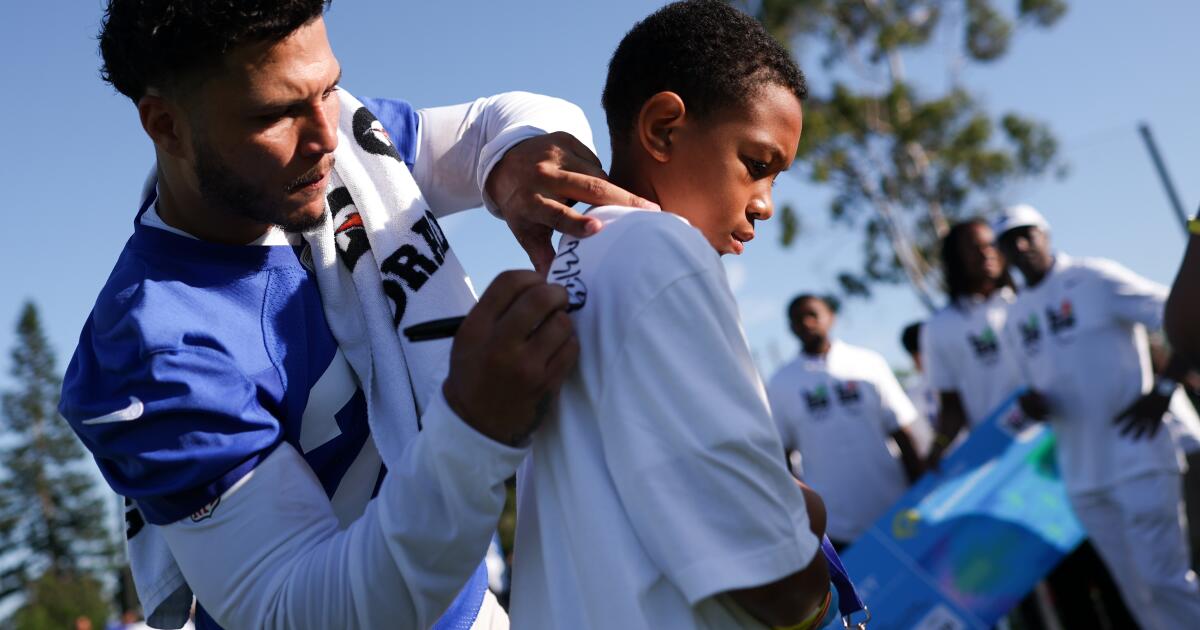
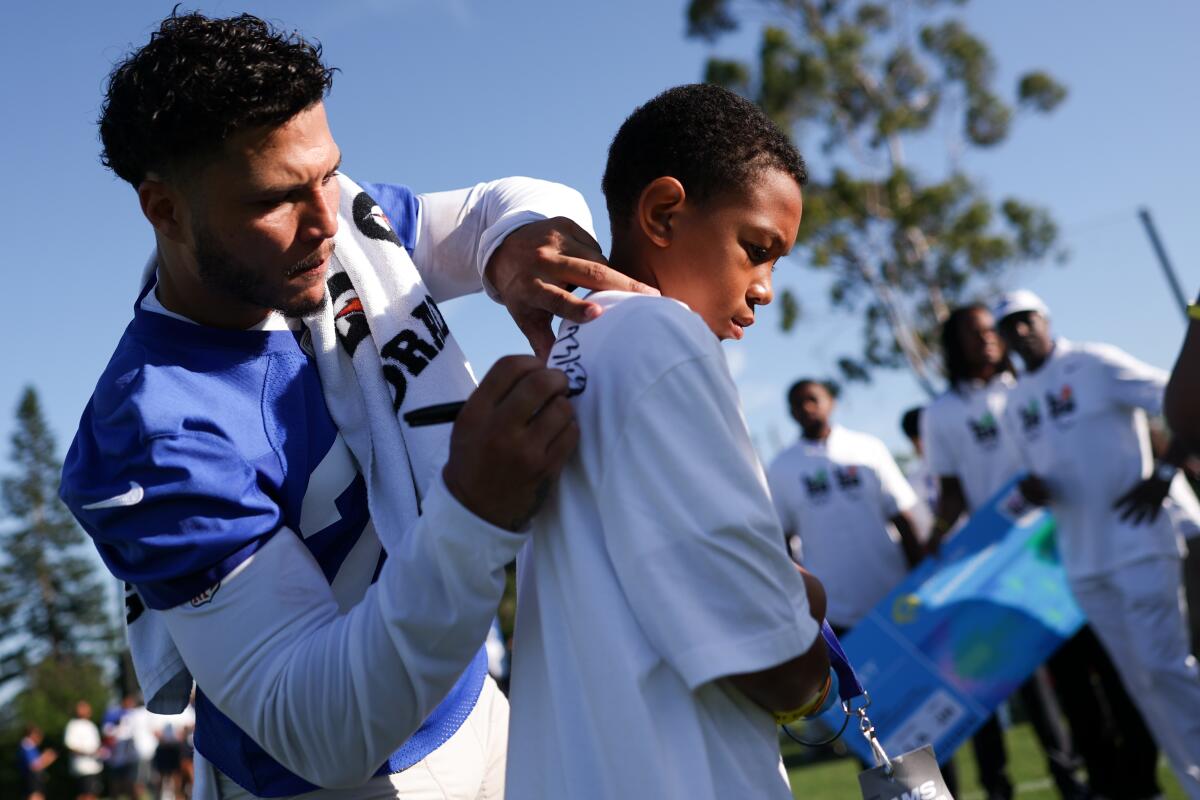
The tickets are the first gifts from LA28’s community ticket program, which launched in November with a $5 million inaugural donation from the Rams. When Rams coach Sean McVay delivered the news to members of the nonprofits at Rams training camp Monday, kids’ jaws dropped as the group broke into applause.
Hernandez, a member of South L.A.-based Brotherhood Crusade, posed in the group behind a giant commemorative Olympic ticket.
“Having grown up in Inglewood, you don’t really have the funds to [go to sporting events],” Hernandez said. “So if it wasn’t for programs like this or the Rams giving out tickets, a person like me, I would have never had imagined I’d be in a stadium watching the game. It’s opened my eyes.”
Continue reading here
Get the latest on L.A.’s teams in the daily Sports Report newsletter.
By continuing, you agree to our Terms of Service, which include arbitration and a class action waiver. You agree that we and our third-party vendors may collect and use your information, including through cookies, pixels and similar technologies, for the purposes set forth in our Privacy Policy such as personalizing your experience and ads.
Dodgers probably won’t get Tarik Skubal
From Maddie Lee: Detroit Tigers ace Tarik Skubal is one of the few players who could actually elevate the Dodgers’ roster at the trade deadline. And the Dodgers are one of the few teams that could reasonably part with the prospect capital it would take to acquire the reigning American League Cy Young Award winner.
That doesn’t mean it will come to fruition.
With a week to go before the MLB trade deadline on Aug. 3, the Dodgers don’t appear to be moving toward a trade for Skubal, according to people with knowledge of the situation not authorized to speak publicly. And it’s unclear whether the Tigers will indeed trade him; rival executives’ expectations appear to be inconsistent.
The Dodgers can never be fully counted out for a big swing, of course. They weren’t expected to sign closer Edwin Díaz or right fielder Kyle Tucker during the offseason, either.
But having a strong farm system supplements big spending. And part of the reasoning behind those indulgent offseason moves was to make a big trade-deadline move unnecessary. So, barring a significant shift either in rotation health or in the market, don’t count on Skubal joining the Dodgers in their quest for a three-peat.
Continue reading here
Dodgers survey
What would you do? Assuming the trade is fair, which would you acquire first, a starting pitcher, reliever, batter or would you stand pat?
Click here to vote in our survey.
Angels
LaMonte Wade Jr. drew a bases-loaded walk that forced home the go-ahead run in a four-run ninth inning, and the Houston Astros came back to beat the Angels 6-4 on Monday night.
The Astros rallied on a hit, two walks, two errors and two hit batters to hand the Angels (42-65) their ninth loss this season when leading after eight innings.
Houston (53-55) trailed 4-0 after three, but Taylor Trammell homered for a second straight game and the fifth time this season to cut it to 4-1 in the fourth
Angels starter Walbert Ureña gave up a run on two hits in six innings and left with a 4-1 lead.
Continue reading here
Angels box score
MLB standings
This day in sports history
1913 — The United States wins its first Davis Cup since 1902 by beating Britain three matches to two.
1928 — The Summer Olympics open in Amsterdam and the Olympic flame is lit for the first time.
1929 — The Chicago Cardinals become the first NFL team to train out of state, holding camp in Michigan.
1972 — The American Basketball Assn. announces that San Diego will receive a franchise and the NBA’s Buffalo Braves relocate to San Diego and are renamed the San Diego Clippers.
1972 — The Dallas Cowboys beat the College All-Stars in Chicago 20-7.
1984 — The Summer Olympics open in Los Angeles with a record 140 nations competing. The Soviet Union and 13 Communist allies, including Cuba and East Germany, boycott the games.
1987 — Laura Davies shoots a 1-under 71 to defeat Ayako Okamoto and JoAnne Carner in an 18-hole playoff to win the U.S. Women’s Open.
1987 — Angel Cordero Jr. becomes the fourth U.S. jockey to win 6,000 races when he rides Lost Kitty to victory at Monmouth Park, N.J.
1992 — American Mike Barrowman sets a world record in winning the 200-meter breaststroke, and Russian Evgueni Sadovyi becomes the Summer Olympics’ first triple gold medalist, also smashing a world record in the men’s 400-meter freestyle.
2000 — Blaine Wilson, America’s pre-eminent gymnast, wins his fifth straight championship in St. Louis. He becomes the first gymnast to win five straight national titles since George Wheeler did it from 1937-41.
2009 — Germany’s Paul Biedermann hands Michael Phelps his first major individual loss in four years, setting a world record in the 200-meter freestyle at the world championships in Rome. Phelps, a body length behind, loses for the first time in a major international meet since Ian Crocker beat him in the 100 butterfly final at the 2005 worlds.
2011 — Ryan Lochte celebrates the first world record set since high-tech bodysuits were banned 1 1/2 years ago. Lochte edges Michael Phelps in 200-meter individual medley at the world championships at Shanghai.
2013 — Brek Shea scores less than a minute after entering the game as a second-half substitute, giving the United States a 1-0 victory over Panama in the Gold Cup final. It’s the fifth Gold Cup title for the Americans but their first since 2007.
2016 — Mirim Lee shoots a 10-under 62 to match the Women’s British Open record and take a three-stroke lead in the major championship at tree-lined Woburn (England) Golf Club.
2016 — Stephan Jaeger shoots a 12-under 58 in the Web.com Tour’s Ellie Mae Classic in Hayward, Calif., for the lowest score in major tour play. The German finishes with a 10-foot birdie putt.
2019 — 22-year-old Egan Bernal becomes the first Colombian and Latin American cyclist to win the Tour de France.
Compiled by the Associated Press
This day in baseball history
1931 — Bob Fothergill of Chicago hit a home run and a triple in an 11-run eighth inning. The White Sox set an American League record with 12 hits in the inning and beat the New York Yankees 14-12.
1940 — King Kong Keller hit three homers to give the New York Yankees a 10-9 win over Chicago in the first game of a doubleheader split.
1951 — Clyde Vollmer of Boston hit a grand slam in the 16th inning, the latest ever hit in a major league game. The Red Sox beat the Cleveland Indians 8-4.
1971 — Sixteen-time Gold Glove winner Brooks Robinson committed three errors in the sixth inning against the Oakland A’s. Frank Robinson’s three-run homer in the ninth won the game for the Orioles.
1976 — John Odom (five innings) and Francisco Barrios (four innings) combined on a no-hitter, and the Chicago White Sox defeated Oakland 2-1.
1983 — AL President Lee McPhail ruled that George Brett’s “pine tar” home run against New York on July 24 should count. The umpires had disallowed the homer because the pine tar on Brett’s bat exceeded the 18-inch limit. The rest of the game was played Aug. 18 with the Kansas City Royals beating the Yankees, 5-4.
1989 — Atlanta’s Dale Murphy tied two major league records by hitting two homers and driving in six runs in the sixth inning in the Braves’ 10-1 victory over the San Francisco Giants. Murphy’s two home runs equaled the record shared by 13 others and the six runs batted in matched a record shared by nine players.
1990 — Shawon Dunston tied a major league record with three triples and led the Chicago Cubs to a 10-7 win over the Montreal Expos.
1990 — Cal Ripken’s errorless streak ends at 95 consecutive games, as Baltimore loses to Kansas City, 10-9. The streak is a new major-league record for a shortstop, eclipsing Kevin Elster’s 89-game mark.
1991 — Dennis Martinez pitched a perfect game for the Montreal Expos, who topped Los Angeles 2-0 at Dodger Stadium.
1993 — Ken Griffey Jr. tied a major league record by homering in his eighth consecutive game, but it wasn’t enough for the Seattle Mariners in a 5-1 loss to the Minnesota Twins.
1994 — On the night the baseball players set an Aug. 12 strike date, Kenny Rogers of the Texas Rangers pitched a perfect game for a 4-0 victory over the Angels.
2004 — Troy Percival recorded his 300th save after John Lackey gave up three hits over 8 1-3 innings to help the Angels beat Texas 2-0.
2006 — Houston rookie Luke Scott hit for the cycle and drove in five runs, but the Astros lost to Arizona 8-7.
2018 — Rookie Francisco Arcia had a homer and six RBIs, giving him a major league-record 10 RBIs in two career games, and Angels rolled past Seattle 11-5.
2021 — In the first Olympic baseball game in thirteen years, Japan rallies to defeat the Dominican Republic 4-3.
Compiled by the Associated Press
Until next time…
That concludes today’s newsletter. If you have any feedback, ideas for improvement or things you’d like to see, email me at houston.mitchell@latimes.com. To get this newsletter in your inbox, click here.