Flames engulfed Kuwait’s Public Institution for Social Security high-rise headquarters after it was hit by a suspected drone amid a wave of Iranian aerial strikes on the country.
Weekly insights and analysis on the latest developments in military technology, strategy, and foreign policy.
Civilian onlookers out in the street filming the air-to-air engagement rapidly unfolding in the bright blue sky above them, a trail of smoke, and the low rumble of fighter jet engines. This is the latest video to have emerged from the extraordinary incident earlier this week in which a Kuwaiti Air Force F/A-18 Hornet was responsible for shooting down three U.S. Air Force F-15E Strike Eagles.
As in the previous videos of the incident and its aftermath, the usual caveats apply as to the nature of its authenticity, which remains unconfirmed. However, everything points to this being genuine, and it clearly indicates a within-visual-range air-to-air engagement, likely involving a heat-seeking AIM-9 Sidewinder series air-to-air missile.
Check the video out here:
New footage shows a Kuwaiti F/A-18C downing a U.S. Air Force F-15E at close range with what appears to be an AIM-9 Sidewinder air-to-air missile on March 2. pic.twitter.com/OZ1vIuOtzq
It was initially rumored that a ground-based air defense system, such as the Patriot, which is present in Kuwait, took the F-15Es out. However, the earlier video footage of one of the jets spiraling to the ground suggested it was an air-to-air engagement, based on the damage to the aircraft.
At 11:03 p.m. ET, March 1, three U.S. F-15E Strike Eagles flying in support of Operation Epic Fury went down over Kuwait due to an apparent friendly fire incident.
The new video is also in line with our original assessment of the likely cause of the shootdowns, namely, tail-aspect missile shots made by smaller-yield weapons. As we noted at the time, under certain circumstances, if the Hornet employed passive heat-seeking missiles (AIM-9), the F-15E pilots may not have known they were being engaged until the weapon detonated.
Footage of an F-15 falling out of the sky this morning over Kuwait, in an apparent “friendly fire” incident involving the U.S. Air Force. pic.twitter.com/GQvryfJ4C4
The video clearly shows one of the F-15Es after being hit, with part of its rear portion burning brightly, and the same aircraft in a flat spin toward the ground. You can also see the two crew members ejecting. The F/A-18 is also seen, toward the top of the frame.
For at least part of the engagement, the F/A-18 and F-15E are clearly in the same frame and are in close proximity.
An experienced former F/A-18 pilot TWZ talked to about the event and the new video concluded that the incident is, altogether, “very strange.”
“I have genuinely no idea how someone could make this mistake,” the ex-Hornet driver continued. “Unless it’s something procedural and GCI [ground-control intercept] has messed up, talked him on, and he’s seen what he wanted to see … but even that’s bordering on implausible.”
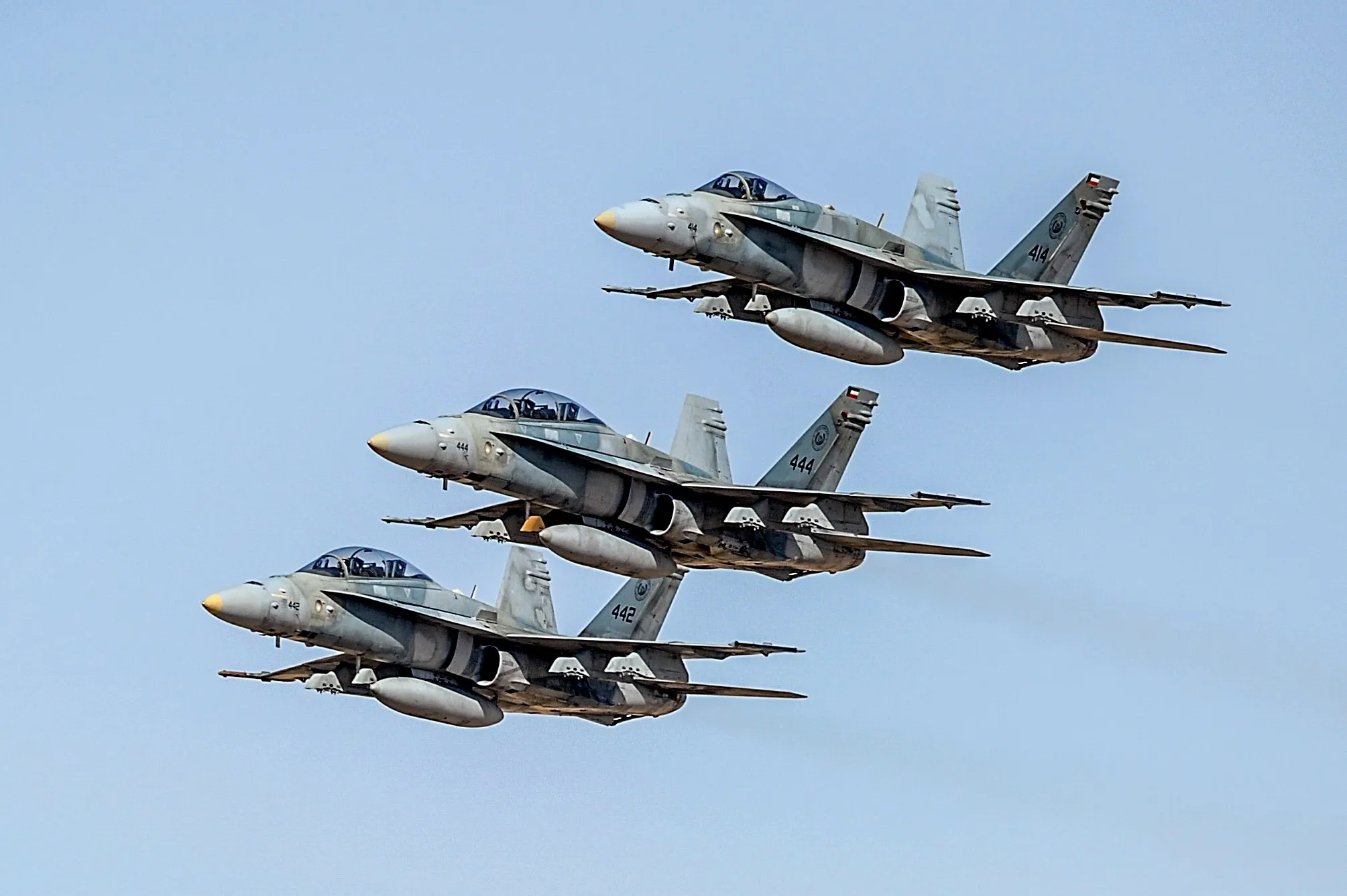
Three Kuwait Air Force F/A-18C/D Hornets during Exercise Storm of 2017 in Jahra, Kuwait on January 17, 2017. Photo by Jaber Abdulkhaleg/Anadolu Agency/Getty Images Anadolu
Undoubtedly, the challenge of deconfliction of friend from foe in a very complex war zone is a significant one, as we outlined previously. At the same time, the threat from Iranian aircraft was, at the time, real. Also this week, a Qatar Emiri Air Force F-15QA shot down a pair of Iranian Su-24 Fencer strike aircraft that were inbound to attack the sprawling air base at Al Udeid.
While the cause of the friendly-fire incident remains unclear, the chance to see such an aerial engagement is remarkable in itself, especially the very rare sight of a modern fighter firing one of its air-to-air missiles in an operational context.
A video shows a U.S. Air Force F-15C Eagle fighter jet destroying a towed target at very close range with one of its Sidewinder air-to-air missiles, during a live-fire exercise over the Atlantic Ocean on December 8, 2020:
F-15 Firing Training Sidewinder NATM-9M At Drone
The same former Hornet driver also explained exactly how a short-range AIM-9 Sidewinder missile would be fired from the jet in a WVR scenario:
“You’d be in air-to-air master mode and bring up the weapon using HOTAS [‘hands on throttle and stick’ controls]. You rock a castle switch that puts you in Sidewinder mode. From there, you can select your radar scan mode, again using HOTAS. Now you have a weapon looking for an infrared signature and a radar looking for a target. In a combat mode, the radar will latch/form a track almost immediately. The weapon system then cues the Sidewinder to the radar track, and so long as it’s within the weapon’s kinematic capabilities, you’ll get a SHOOT cue. The weapon then leaves on trigger press.”
“You can also just point and shoot with a Sidewinder, but then your radar isn’t giving you any info, so you risk a shot that can’t make it.”
In such a scenario, it is conceivable that the F/A-18 pilot might have accidentally launched a missile that then found its target, the same pilot agreed, but that would not explain the three friendly-fire kills.
“Once, yes. Twice, no way. Thrice?”
It is worth bearing in mind that there have been previous incidents of friendly-fire shootdowns, even when a visual ID had been conducted. This happened in 1994, when two U.S. Air Force F-15 Eagle fighters shot down two U.S. Army UH-60 Black Hawk helicopters over Iraq, killing 26. Perhaps the Kuwaiti pilot thought they had encountered Iranian MiG-29 Fulcrum fighters, but, again, to make the same mistake three times over seems highly improbable, especially at close range.
U.S. military personnel inspect the wreckage of a Black Hawk helicopter in the Northern Iraq No-Fly Zone during Operation Provide Comfort, on April 15 or 16, 1994. U.S. Air Force
Another fighter pilot’s analysis, seen in video below, questions whether the Kuwaiti pilot might even have gone rogue against an ally. That actually seems possible based on the evidence, but it is hard to believe.
Accident or Crime? A Kuwaiti F/A-18 Hornet Shot Down Three U.S. F-15E Strike Eagles?
Ultimately, based on the latest video and the limited reports so far, it’s still far from clear how this costly incident happened. A friendly-fire kill involving a longer-range weapon would be more believable, but the within-visual-range nature of this engagement is bizarre, to say the least.
Weekly insights and analysis on the latest developments in military technology, strategy, and foreign policy.
The three F-15Es shot down over Kuwait yesterday met their demise at the hand of a Kuwaiti Air Force F/A-18 Hornet, according to a report by TheWall Street Journal’s Lara Seligman. While it was rumored to have been a ground-based air defense system that took the aircraft out, it does make sense that the friendly fire incident was the result of a series of air-to-air engagements, based on the damage to one of the aircraft. That being said, we cannot independently confirm the report at this time.
SCOOP: A Kuwaiti F/A-18 fighter jet was the cause of the accidental shootdown of three American F-15s on Sunday, according to three people familiar with initial reports of the incident. https://t.co/5xKB9jxwQs
Seligman’s story is based on three sources “familiar with initial reports of the incident.” Just one Hornet was supposedly involved, launching three missiles and taking down the three Strike Eagles. Thankfully, the crews all survived. The report goes on to state that the ‘blue-on-blue’ incident occurred as multiple Iranian drones were penetrating Kuwaiti airspace. One of these impacted a base that resulted in the death of six Americans.
Footage of an F-15 falling out of the sky this morning over Kuwait, in an apparent “friendly fire” incident involving the U.S. Air Force. pic.twitter.com/GQvryfJ4C4
As we have recently explored in detail, mistaking friendly tactical aircraft for real threats in a very complex and quickly morphing battlespace isn’t unprecedented, as it has happened multiple times before, including in relation to Kuwait on two past occasions. The air-to-air aspect of the story is certainly intriguing and would help explain how the crews survived the shoot-downs. We saw one F-15E spin into the ground with its vertical tails missing and its engines on fire. While this is catastrophic damage, it is not typically what you would see in most engagements from heavier surface-to-air missiles, although every engagement is different, so we can’t rule it out. But three shoot-downs and everyone made it out alive sounds like tail-aspect shots made by smaller yield weapons.
Also, if the Super Hornet employed passive heat seeking missiles (AIM-9 Sidewinder), the F-15E pilots would not have known they were being engaged until the weapon detonated. There are caveats to this, including if the Hornet had used its radar to assist in the Sidewinder lock. But Kuwaiti Hornets were clearly in the airspace at the time defending against drones, so even being painted by their radar may not have indicated how serious the situation was about to become.
We will continue to report as the investigation into this bizarre friendly fire event unfolds.