Kraft

Tucker Kraft says fans who boo Packers are ‘not going to help us win’

Green Bay Packers tight end Tucker Kraft dropped two passes during an ugly 35-14 loss to the Atlanta Falcons on Thursday night at Lambeau Field.

He kind of dropped the ball again after the game.

The injury-ridden Packers did not look particularly good in their first two games of the season, needing an overtime win over the New York Jets last week to bring a 1-1 record into their home opener on “Thursday Night Football.”

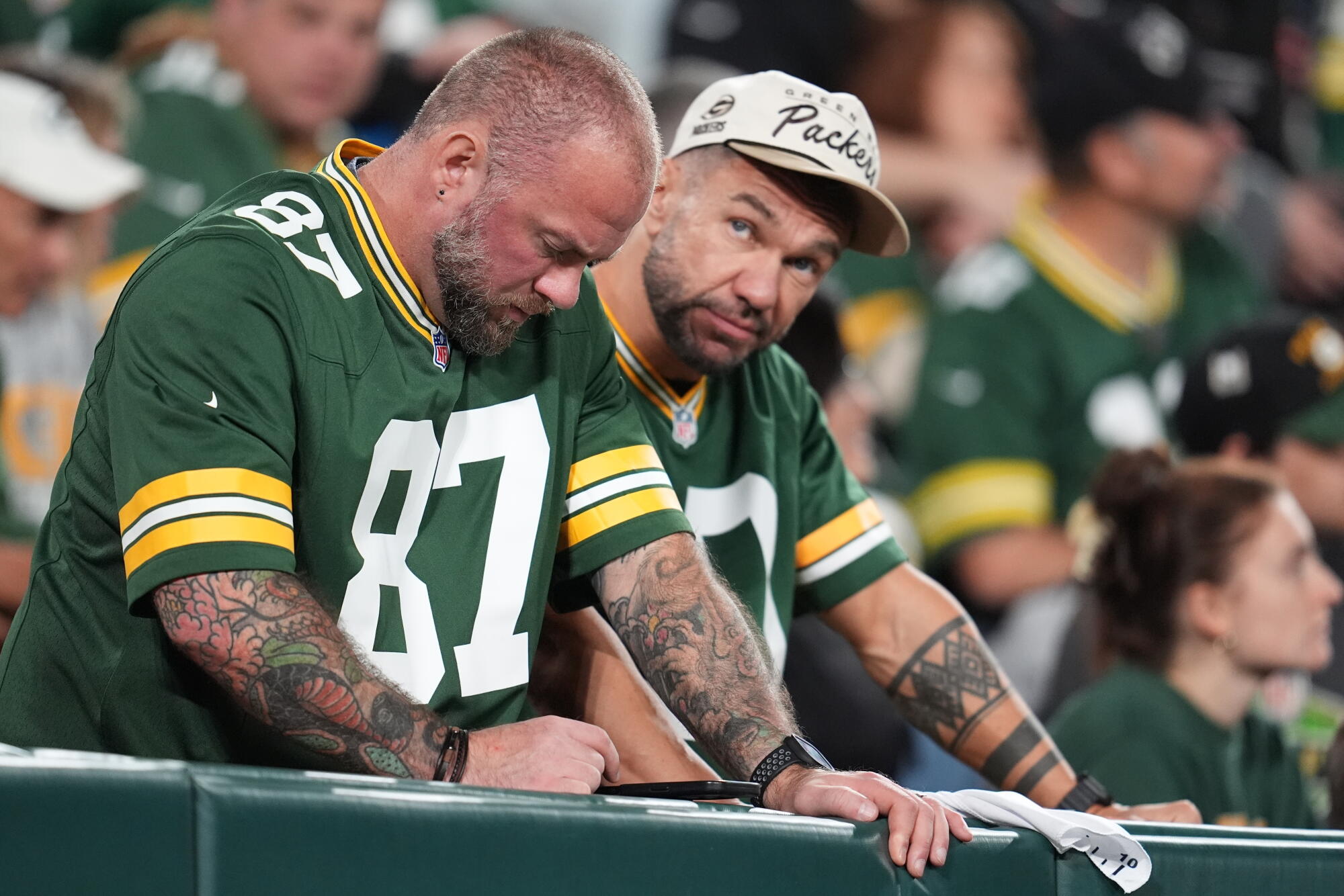
Getting their first live look at the team this season, Green Bay fans did not like what they were seeing. So they let their feelings be known. The boos started late in the first half, with the Packers trailing 17-7, and got louder and more frequent as the game — and the team’s woes — continued.

(At least one Packers fan, however, didn’t even appear to have the strength to boo.)

Speaking to reporters after the game, Kraft expressed his frustration — with the home fans.

“That’s pretty tough. Like, everyone pictures Lambeau Field — and not boos. I don’t picture boos. I picture my home stadium,” Kraft said. “That’s tough. It’s pretty disappointing.”

Green Bay Packers fans look unhappy standing at a railing in the stands at Lambeau Field

Two Green Bay Packers fans can barely watch during the second half against the Atlanta Falcons on Thursday at Lambeau Field.

(Abbie Parr / Associated Press)

One reporter interjected, “Especially for a home opener.”

“Especially for a home opener,” Kraft agreed. “It’s pretty disappointing. It’s not going to help us win. Like, I don’t know what people think, that’s going to rally us or something like that.

“But we’re grown men. We’re mentally strong enough, capable enough to get back on the field and play ball. But it’d probably be much easier with the 70,000 people behind us rather than opposing us.”

Naturally, folks on social media aren’t thrilled with Kraft’s take.

“Try catching a pass once in a while, then the boos may stop,” one person wrote on Kraft’s Instagram page. “Also, grow up.”

Another commenter said: “The response you were looking for was ‘we HAVE TO PLAY BETTER’ … We love the team and the players and always support…if you can hear when you win…you can hear it when yall look god awful.”

Others are simply booing him in the comment sections of his posts.

Three young Packers fans in cheeseheads look sad.

Green Bay Packers fans had little to cheer about Thursday night against the Atlanta Falcons.

(Mike Roemer / Associated Press)

Kraft finished the game with four catches for 26 yards on eight targets. He has 122 receptions for 1,657 yards and 15 touchdowns in his four-year career, but only nine of those catches and 106 of the yards have come in the first three games this season, and he has yet to find the end zone.

The absence of star players like defensive lineman Micah Parsons (knee injury) and running back Josh Jacobs (commissioner’s exempt list) certainly has played a role in the Packers’ struggles, but it’s tough to blame fans for expressing their frustrations.

Speaking to reporters after the game, coach Matt LaFleur called it “a humbling night.”

Rookie cornerback Brandon Cisse told reporters he understands the emotions behind the boos.

“We love the fans, and any time we’re not putting a [good] product on the field, it’s very disappointing to them as well,” Cisse said. “So I understand their frustrations … These fans, they pay a lot of money to come watch us play, so we need to make sure we play better.”

Wide receiver Christian Watson told reporters “it’s tough” to hear the home fans react in such a manner, but he gets it.

“At the end of the day, it’s an entertainment business, so we have to put a better product out on the field if we want to have the fans have our back,” said Watson, who had seven catches for 96 yards and a touchdown. “I mean, obviously, we’d like to think that the fans will be there through the ups and downs, but we’ve got to put out a better performance than that.”


Source link

Breaking down Ed Sheeran’s tour debacle over Macklemore’s ‘Free Palestine’ comments

In a matter of days, Ed Sheeran has gone from the most agreeable, defiantly middle-of-the-road singer-songwriter on the pop charts to music’s newest villain. The Times’ August Brown and Mikael Wood gathered to break down what happened — and to figure out what it all means.

August Brown: To recap, Sheeran dropped his tour opener, the rapper Macklemore, after the MC described Israel’s actions in Gaza as a genocide and said “Free Palestine” onstage this month at two New Jersey dates of Sheeran’s ongoing stadium tour. Macklemore, in a statement, cited his long friendship with Sheeran while criticizing the singer for allegedly acquiescing to a demand from Robert Kraft, the owner of the NFL’s New England Patriots, that the rapper not be allowed to perform at the Patriots’ Gillette Stadium outside Boston due to his comments.

Kraft, a Trump-supporting billionaire with his own colorful history, released a statement about the tour, saying he was “ensuring that events held at our venue do not provide a platform for hate speech.”

But Sheeran, who performed at Kraft’s wedding in 2022, arguably made things much worse with his own comments on the decision to drop Macklemore from the tour, which ranged from shifting accountability (“Macklemore coming off tour was the promoter’s decision, it was not mine”) to promising that he held compassionate beliefs on this volatile issue but wouldn’t articulate them publicly (“I am not complicit. I have my personal views on this devastating conflict. Just because I choose not to speak publicly, it doesn’t mean I don’t have them, and it doesn’t mean I don’t care.”)

This prompted Sheeran’s remaining openers — including the musician and producer Finneas, the Danish rock combo Lukas Graham and singer-songwriter Aaron Rowe — to drop off the tour, each giving their plainspoken support for both Macklemore’s advocacy and the Palestinian people as their reasons for leaving. The traditional Irish group Beoga, which backs Sheeran for a portion of his nightly show, also quit the tour, saying it was responding to “the silencing of Macklemore by Zionist lobbies.”

It’s too soon to know how this will affect a CVS-core pop star like Sheeran, but it’s clear that for the first time in his career, he’s chosen the path of maximum conflict and controversy for little gain. What do you think he should he have done instead?

Macklemore performs at Rod Laver Arena on May 15, 2024 in Melbourne, Australia.

Macklemore

(Morgan Hancock / Getty Images)

Mikael Wood: Not let Macklemore be booted from his tour?

Look, I understand Sheeran’s position here: that he views himself as an artist whose audience comes to his show precisely because they’d like to avoid the messy realities of the world for two or three hours. We can choose a different day to discuss how tenable (or not) that position is here in the era of a reality-TV president who long ago blurred the line between politics and entertainment.

But setting aside one’s views on Israel and Palestine, it’s impossible for me to see how Sheeran ever thought his actions would be seen as anything other than allowing a fellow artist to be silenced — a clear loser in the eyes of both the left and the right.

It would be one thing if Macklemore’s comments in New Jersey truly resembled the hate speech that Kraft accused him of dispensing. (Many online have posted images of a costume the rapper wore onstage in 2014 that resembled an ugly Jewish caricature; Macklemore apologized at the time, saying he understood the criticism.)

And of course I get that the very idea of hate speech is slippery — one reason, perhaps, that the folks at AT&T Stadium near Dallas (where Sheeran is scheduled to perform next month) appear to have no problem hosting a concert in November by Ye, who not so long ago released a song called, uh, “Heil Hitler.”

But given how measured Macklemore’s comments were, Sheeran’s decision to go along with the demands for his removal feels less like a fulfillment of his desire to create a conflict-free zone and more like a capitulation to a rich and powerful friend.

August, what do you make of the various statements from the musicians who’ve opted to leave the tour in the wake of all this?

August Brown: The other openers had the most to lose here by bowing out of a huge tour. Yet they took unambiguous stances in favor of Macklemore’s Palestinian advocacy. (On Wednesday, the rapper said on Instagram that he planned to donate “the entire $1 million of my net earnings” from Sheeran’s tour to six organizations “working directly to support the Palestinian people.” He also invited Kraft to match his donation.)

“Artists must not be silenced when they speak up for the oppressed,” Finneas wrote. “I stand with Palestine and its people.”

Lukas Graham went even harder: “We should be able to speak about war, about civilians being killed, about children who deserve to grow up,” the group wrote. “Money doesn’t give you the right to own the conversation.”

Sheeran could have done what many fans regard as the right thing: Defy Kraft’s demands, cancel the Gillette Stadium dates with Macklemore and reroute the tour to somewhere that would support an opening act’s fairly anodyne support of a popular human rights cause. Sheeran is extremely wealthy, and he’d have been on the right side of history, if for no other reason than to say that billionaires shouldn’t have a veto over an artist’s human rights advocacy onstage.

I’m sympathetic to the idea that crews’ livelihoods and fans’ investment in the shows are meaningful things to toss out. But an artist as big as Sheeran can make up the difference. Even a hypothetical statement like “I stand for Macklemore’s freedom of speech and the rights of the Palestinian people. My team’s livelihoods depends on the shows happening, so I will play the Gillette dates as planned,” with a promise for a donation or a benefit show with Macklemore down the line — even that would have smoothed this over.

But his actions here — deflecting accountability, being vague yet defensive about his own politics — and his history with Kraft suggest his sympathies might not lie with the causes his opening acts stand for.

It’s interesting that Beoga and Aaron Rowe, both Irish acts, acknowledged their own country’s history of colonial occupation as reason to stand up for Palestinians (and free speech around it). “Ed has been a friend to me and has changed my life, I could never thank him enough for this,” Rowe wrote in his statement. “But as Irish people we know all too well about genocide, forced famine, and violent occupation.”

Even Lukas Graham cited the band’s roots in Christiania, a Danish enclave with a history as an anarchist commune, as an example they’re following by bailing on this tour. Sheeran likes to say that, through his father, he is culturally Irish though he was born and raised in England. In a country that rallied for Kneecap, the Irish rap group and advocates for Palestinians, his reputation is likely taking a real hit. Whether that extends to his ultra-mainstream U.S. fan base remains to be seen.

Not every artist is obliged to comment on contentious issues — though the success of Olivia Rodrigo’s Daisy Chain Fields festival, which raised money for an array of abortion-rights advocacy groups, showed that A-listers can speak out when they want to. But whatever he actually believes, Sheeran’s long-cultivated neutrality is in tatters. Taking a stand would have been the path of least resistance. Instead, he committed the most basic onstage error: a failure to read the room.

Source link