KOSPI

KOSPI spikes over 5 pct, briefly topping 9,000 level again on chip rally after Micron earnings

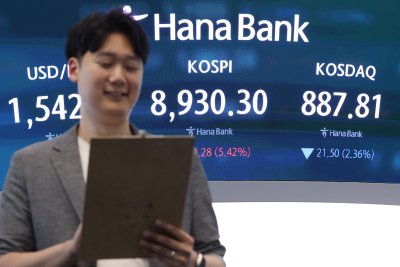
This photo, taken Thursday, shows the trading room of Hana Bank in Seoul as South Korean stocks soared by more than five percent on a tech rally driven by Micron’s earnings report. Photo by Yonhap

South Korean stocks soared by more than 5 percent Thursday, briefly topping the 9,000-point level again, driven by a tech rally ignited by U.S. chip giant Micron Technology’s expectation-beating earnings report. The Korean won fell against the U.S. dollar.

The benchmark Korea Composite Stock Price Index (KOSPI) gained 459.28 points, or 5.42 percent, to close at 8,930.30, following a 3.26 percent gain the previous day.

The index briefly topped the 9,000-point threshold, rising as high as 9,044.04.

Finishing at an all-time high of 9,114.55 on Monday, the KOSPI has remained in the 8,000-point range since it dived 9.99 percent Tuesday.

The index pulled off a strong start, with a buy-side sidecar issued shortly after the market opened, as Micron, the world’s No. 3 memory chipmaker, released its stronger-than-expected quarterly earnings, brushing off lingering concerns about the sustainability of an artificial intelligence (AI) rally.

Micron is a major beneficiary of the AI infrastructure spending boom along with Samsung Electronics and SK hynix thanks to rising demand for memory chips and high-bandwidth memory (HBM).

Trade volume was heavy at 449.3 million shares worth 50.4 trillion won (US$32.7 billion), with losers beating winners 588 to 289.

Institutions purchased a net 3.3 trillion won worth of stocks, while foreigners and individuals dumped a net 819.7 billion won and 2.5 trillion won, respectively.

“Micron’s strong financial report pushed up semiconductor shares here,” Kim Seok-hwan, an analyst at Mirae Asset Securities, said. “Airline shares also rose as the Strait of Hormuz seemed to reopen and global oil prices dropped.”

Samsung Electronics, the world’s largest memory chipmaker, jumped 5.29 percent to 358,500 won, and No. 2 SK hynix surged 13.06 percent to 2.9 million won.

SK Square, the parent of SK hynix, advanced 5.56 percent to 1.9 million won, and Samsung C&T, which holds a stake in Samsung Electronics, soared 7.79 percent to 519,000 won.

Flag air carrier Korean Air vaulted 6.4 percent to 29,100 won, and Asiana Airlines mounted 6.2 percent to 7,710 won.

Brokerages were also strong as Samsung Securities rose 3.07 percent to 110,800 won, and Kiwoom Securities gained 7.48 percent to 337,500 won.

The Korean won was quoted at 1,542.7 won per U.S. dollar as of 3:30 p.m., down 0.9 won from the previous session.

Bond prices, which move inversely to yields, closed higher. The yield on three-year Treasurys fell 1.5 basis points to 3.757 percent, and the return on the benchmark five-year government bonds declined 2.2 basis points to 3.992 percent.

Copyright (c) Yonhap News Agency prohibits its content from being redistributed or reprinted without consent, and forbids the content from being learned and used by artificial intelligence systems.
Source link

KOSPI crashes over 8 pct on tech hemorrhage, U.S. rate woes; won rises after verbal intervention

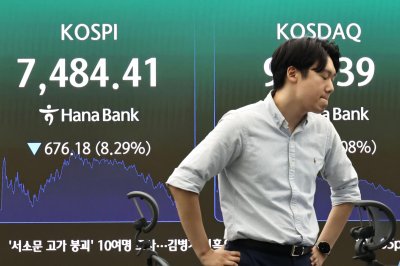
This photo, taken Monday, shows the trading room of Hana Bank in Seoul as South Korean stocks dropped more than 8 percent on concerns over AI profitability and fears over a possible rate hike by the U.S. Fed. Photo by Yonhap

South Korean stocks nosedived more than 8 percent Monday, extending their losing streak to a third consecutive session, as investors dumped market heavyweights on renewed woes over artificial intelligence (AI) profitability and concerns over a possible hawkish pivot of the U.S. Federal Reserve.

The local currency rose against the U.S. dollar after opening at a 17-year low, in the face of verbal intervention by financial authorities.

The benchmark Korea Composite Stock Price Index (KOSPI) plunged 676.18 points, or 8.29 percent, to close at 7,484.41, after falling as low as 7,442.73. The secondary KOSDAQ index sank more than 9 percent to end at 911.39.

The KOSPI’s trade volume was heavy at 448.3 million shares worth 47.8 trillion won (US$31.2 billion), with losers sharply outnumbering winners 873 to 42. Foreigners and institutions dumped local shares worth 355.5 billion won and 1.6 trillion won, respectively, while retail investors scooped up 1.76 trillion won.

The Monday crash was largely anticipated on sharp losses on Wall Street last week, fueled by semiconductor shares’ biggest daily percentage drop since March 2020 and fears over a possible rate hike by the Fed sparked by a hotter-than-expected U.S. jobs report for May.

The Dow Jones Industrial Average closed 1.35 percent lower Friday (local time), while the S&P 500 dipped 2.64 percent and the tech-heavy Nasdaq composite slid 4.18 percent.

Major U.S. chip shares sharply lost ground, with Nvidia slumping 6.2 percent, Broadcom contracting 7.92 percent and Micron shooting down 13.25 percent.

The Korea Exchange (KRX) had activated a circuit breaker for the KOSPI about three minutes after opening, halting trading for 20 minutes, and implemented a consecutive sell-side sidecar at around 9:34 a.m.

The KRX had also issued a sell-side sidecar for the secondary KOSDAQ market about six minutes after opening, suspending trading for five minutes, and activated a circuit breaker for the index later in the day after the KOSDAQ fell by more than 8 percent.

“Today’s pullback appears to be driven not by the weakening of market fundamentals, but by profit-taking sentiment among investors, mainly targeted at the semiconductor sector, as the market reacted more sensitively to negative developments after an extended rally of chip shares,” a report by Samsung Securities said.

The KOSPI has been one of the best performing stock indexes across the world in recent months, surging to near the unprecedented 9,000-point mark on Tuesday last week from the 5,000-point level earlier this year, mainly driven by major semiconductor shares, including Samsung Electronics and SK hynix.

“There is a lot at stake in this week’s financial market, with U.S. inflation data, treasury yields and the ongoing debate over the sustainability of AI-related investment all unfolding simultaneously,” said Seo Sang-young, an analyst at Mirae Asset Securities.

Han Ji-young, a researcher at Kiwoom Securities, also anticipated a “challenging” week for the KOSPI, noting that the release of the U.S. Consumer Price Index for May, the SpaceX listing and Oracle’s earnings results planned for this week may weigh on the market.

Market analysts also said news that Iran and Israel traded strikes dampened investors’ risk appetite, dimming hopes for peace in the Middle East.

Market top-cap Samsung Electronics slid 10.18 percent to 295,500 won, while its chipmaking rival SK hynix dipped 7.68 percent to 1.91 million won.

AI investment firm SK Square nosedived 11.13 percent to 1.12 million won.

Samsung Life Insurance lost 8.97 percent to 375,500 won, and Samsung C&T plunged 11.29 percent to 408,500 won.

Top automaker Hyundai Motor plummeted 8.71 percent to 639,000 won, and its auto parts making affiliate Hyundai Mobis shot down 12.2 percent to 612,000 won.

Leading battery maker LG Energy Solution pulled back 6.16 percent, and its smaller rival Samsung SDI sank 11.44 percent.

Home appliances maker LG Electronics slipped 11.55 percent to 268,000 won, while power plant manufacturer Doosan Enerbility shed 10.25 percent to 85,800 won.

Internet portal operator Naver was among the few winners, jumping 9.2 percent on news that the company is conducting a joint project with U.S. AI chip giant Nvidia to build a massive global AI factory and the nomination of Han Seong-sook, former chief executive officer (CEO) of Naver and incumbent minister of small and medium-sized enterprises (SMEs), as South Korea’s new prime minister.

SK Networks surged 30 percent to 14,170 won on SK Group and Nvidia’s announcement of a broader partnership for AI infrastructure.

The Korean won was quoted at 1,535.0 won against the U.S. dollar at 3:30 p.m., up 4.1 won from the previous session, after opening at 1,555.2 won, the lowest mark since March 6, 2009, when the global markets were in a financial crisis.

The local currency turned higher after financial authorities vowed stern action against excessive volatility and one-sided movements in the foreign exchange market.

Bond prices, which move inversely to yields, closed lower. The yield on three-year Treasurys added 5.8 basis points to 3.940 percent, and the return on the benchmark five-year government bonds gained 7 basis points to 4.190 percent.

Copyright (c) Yonhap News Agency prohibits its content from being redistributed or reprinted without consent, and forbids the content from being learned and used by artificial intelligence systems.

Source link