Why Neon put a Korean-language thriller in 1,500 U.S. theaters
Director Na Hong-jin’s action movie “Hope” opened in 1,500 U.S. cinemas this month, marking the biggest domestic theatrical footprint for a Korean-language film since the Academy Award-winning “Parasite.”
That’s a big bet, particularly for a foreign film. But after the success of “Parasite,” the growth of Korean shows such as Netflix’s “Squid Game” on streaming and the broader acceptance of subtitles in film and television, it was a bet Neon was willing to make.
The indie studio snapped up North American and English language rights to “Hope” for an undisclosed price before the film’s world premiere in the spring at the Cannes Film Festival.
Right off the bat, Neon knew the film would be positioned in South Korea as a big action thriller and massive event film for director Na, and wanted to match that.
In the film, which includes Alicia Vikander and Michael Fassbender in its cast, a group of people fight back against a creature that rampages through a Korean village.
“The reality is that just because a movie has subtitles, doesn’t make it an art film or a niche film,” Elissa Federoff, Neon’s chief distribution officer, told me this month. “And this, to us, felt like a big action blockbuster.”
She continued, “To me, it was this movie that certainly cinephiles were going to be curious about. But I also knew that we could cross over to a broader audience if we gave it a shot.”
So far, “Hope” has grossed more than $8 million domestically and $45.6 million worldwide on a reported production budget of at least $45 million.
Neon expected to reach Korean and Korean American audiences with “Hope,” but the film also over-indexed with Latinos, who represented 27% of the audience, according to PostTrak theatrical data.
Such a wide national release is unusual for foreign films, which typically play in specialty theaters on fewer than 100 screens. Though its domestic box office total doesn’t indicate that the film fully crossed over to mainstream audiences, “for a foreign film, it’s very successful” and has done “solid business,” said David A. Gross, who writes the FranchiseRe movie industry newsletter.
Neon, of course, has experience with Korean cinema. It distributed 2019’s “Parasite,” which became the first non-English-language film to win Best Picture. After “Parasite” won the Oscar, it was shown on 2,000 screens, about 17 weeks after its release. The Bong Joon Ho-directed film ended up grossing more than $53 million domestically and brought in more than $263 million worldwide.
The film put Neon on the map in many ways, Federoff said, and also pushed the boundaries for what the industry considered a best picture nominee. Films such as “Parasite” and “Hope” should also expand what studios consider to be mainstream fare.
“Studios and distributors are still boxing things out a little bit and thinking of these as not as accessible or not for a general commercial audience,” Federoff said. “And I would totally disagree with it.”
Though “Hope” is a long way from the domestic box-office success of “Parasite,” these kinds of swings are important to keep the pipeline of original films humming and to vary the types of fare mainstream audiences can see at their local theaters.
Although art house films once skewed toward older audiences, indie films are now popular with younger generations, who have also become accustomed to reading subtitles.
That could bode well for future foreign language films looking to make inroads with mainstream audiences. While giving a wide release to a foreign language film could be seen as risky, it’s a move Federoff believes can help bolster creative filmmaking and keep people engaged at cinemas.
“My hope is that studios start to trust their audience and respect their audiences a little bit more,” she said. “I think we can all do this. I think we can all say that we just have to have more risk taking involved with what we do. There’s a lot of incredible international cinema out there that should be seen by everybody.”
Paramount and the states fight back
Paramount Skydance and the state attorneys general are defending their proposed settlement in the face of skeptical questions from Sen. Cory Booker (D-N.J.), arguing that the judge overseeing the case should approve the agreement without the deeper review the senator has requested.
On Thursday, U.S. District Judge Araceli Martínez-Olguín told both sides to answer Booker’s questions before she ruled on whether to approve the proposed consent decree. She said at the time that she would issue a ruling “in due course.”
On Monday, both sides issued separate filings that argued the terms of the settlement were adequate. In particular, the states pushed back on assertions that the consent decree was too weak, saying it “reflects a reasonable compromise that addresses the competitive issues posed by the proposed merger in the markets alleged in the complaint.”
“The decree’s enforcement provisions have teeth,” the states wrote in their filing.
Stuff We Wrote
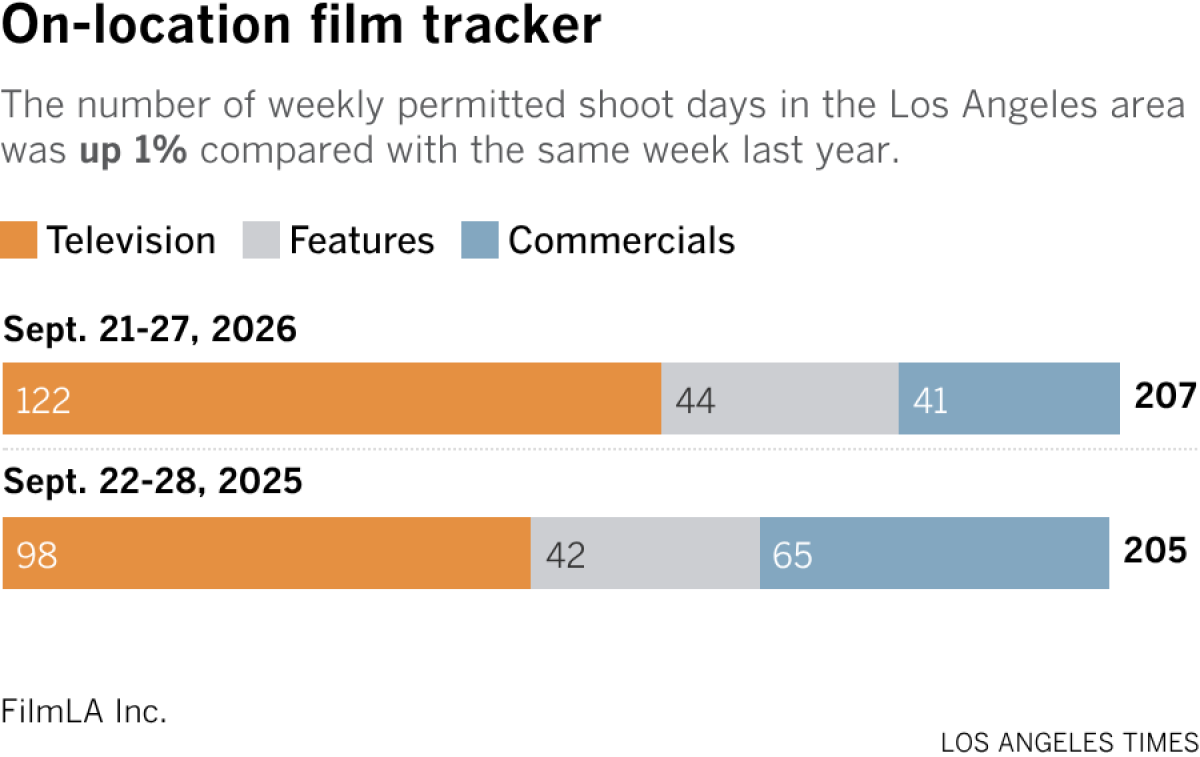
Film shoots

Number of the week

A bipartisan group of lawmakers formally introduced a bill last week to create a federal film and television tax credit.
The proposed legislation would provide a 20% credit on above-the-line and below-the-line U.S. labor costs for eligible productions, including postproduction and visual effects work — two industries that have increasingly moved overseas.
The uncapped credit could increase to 30% with several uplifts, including for independent productions or filming in a federally declared disaster area, such as Los Angeles County.
What I’m watching
It’s fall, which means I’m all in on “Dancing with the Stars,” as I have been since Season 2, when Drew Lachey won with pro partner Cheryl Burke back in 2006.
This season feels like it was made for millennials like me, with contestants such as Julia Stiles, Harry Shum Jr. and Jenna Dewan. But my favorite dance last week was actually Guillermo Rodriguez’s paso doble.