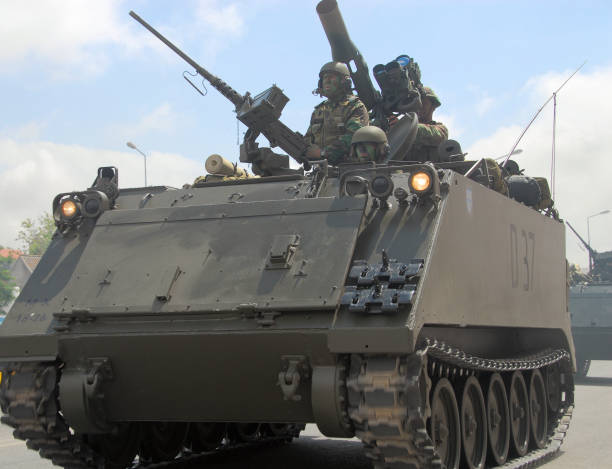
One of Europe’s largest military equipment producers, KNDS, rolled out long-awaited details of its initial public offering (IPO), aiming for a dual listing in Paris and Frankfurt in the coming weeks.
 ADVERTISEMENT
ADVERTISEMENT
The IPO could value KNDS, the maker of Leopard and Leclerc tanks, at between €12bn and €15bn, according to the Financial Times, potentially making it one of Europe’s largest defence listings in recent years.
The listing comes at a time when European military budgets are surging, driven by the war in Ukraine and doubts over the reliability of the US as a security guarantor.
The company declined to comment on the precise date, but CEO Jean-Paul Alary told reporters the offering was expected within weeks.
According to Alary, the move comes as the continent enters what he called a new era of defence and security, with armed forces modernising rapidly and rebuilding the land-warfare capabilities run down during decades of lower spending.
According to Reuters, the firm has now formally launched the IPO process, which is expected to take place in mid-July.
The announcement comes days after Germany unveiled plans to acquire a 40% stake in KNDS, saying the move would secure long-term influence over a company it considers strategically important to European security and defence.
France, which currently owns 50% of KNDS, is expected to reduce its stake to 40%.
The remaining 20% of the company is set to be floated on the stock market, with France and Germany each retaining 40% stakes following the transaction.
According to the Financial Times, the shares are expected to be marketed primarily to institutional investors amid strong demand for European defence stocks.
Once the listing is completed, KNDS shares will begin trading on Euronext Paris and the Frankfurt Stock Exchange, giving investors direct exposure to one of Europe’s largest land-defence manufacturers.
KNDS was created in 2015 through the merger of Germany’s Krauss-Maffei Wegmann and France’s Nexter.
A growing headache for Rheinmetall
The rapid emergence of the rival adds to the pressure on Rheinmetall, Europe’s largest ammunition maker and KNDS’s main competitor in subsectors such as land systems.
The Düsseldorf-based group, whose shares have shed roughly a quarter of their value this year, had itself reportedly hoped to buy into KNDS, only to be shut out by the governments’ intervention.
To make matters worse, Berlin announced it would scrap Rheinmetall’s multi-billion-euro F126 frigate programme, which would have been Germany’s largest warship order since the Second World War, in favour of smaller vessels from rival builder TKMS.
Rheinmetall, which had been poised to take over the project, fell 13% in early trading on Wednesday due to the news.
The squeeze also coincides with regulatory scrutiny at home.
Germany’s Monopolies Commission has warned that defence procurement is concentrated among a small number of suppliers, potentially weakening competition and driving up costs.
Calling for reforms to procurement rules, commission chairman Tomaso Duso said competition was “the fundamental pillar of Europe’s economic order” and should play a greater role in the defence sector.
A listed KNDS will give investors a direct yardstick against which to measure Rheinmetall’s order momentum and margins.