Rival S. Korea parties agree to launch parliamentary probe on election ballot shortage

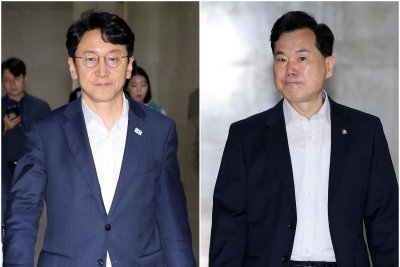
This composite photo, taken Tuesday, shows Rep. Cheon Jun-ho (L), deputy floor leader of the ruling Democratic Party, and Rep. Kim Seung-soo, deputy floor leader of the main opposition People Power Party, prior to their talks at the National Assembly in Seoul. Photo by Yonhap
The rival parties agreed Tuesday to conduct a 45-day parliamentary investigation into the National Election Commission (NEC) over ballot shortages reported during the recent local elections, party officials said.
In a meeting of their deputy floor leaders at the National Assembly, the ruling Democratic Party (DP) and the main opposition People Power Party (PPP) agreed to put the plan to a vote at a parliamentary plenary session on Thursday.
“We agreed to launch the parliamentary probe to swiftly uncover the truth behind the alleged infringement of voting rights of the citizens caused by the ballot shortages and to lay the groundwork for sweeping reforms of the NEC,” Rep. Cheon Jun-ho of the DP told reporters after the meeting.
According to officials from both parties, the special parliamentary committee will be chaired by the PPP and comprise 18 members — nine from the ruling party, seven from the PPP and two from non-negotiating parties.
Rep. Kim Seung-soo of the main opposition PPP said the rival parties agreed to set the investigation period at 45 days in an effort to conduct the probe as swiftly as possible, while leaving open the possibility of an extension if further investigation becomes necessary.
Ballot shortages were reported at more than a dozen polling stations in Seoul during the June 3 local elections, temporarily disrupting voting and prompting protests.
Last week, the DP and the PPP separately submitted requests for a parliamentary probe, though they differed over the scope of the investigation and the number of seats to be allotted to each party on the committee.
Copyright (c) Yonhap News Agency prohibits its content from being redistributed or reprinted without consent, and forbids the content from being learned and used by artificial intelligence systems.