
killing

‘Trainspotting’ is still peak ’90s, plus the week’s best films

Hello! I’m Mark Olsen. Welcome to another edition of your regular field guide to a world of Only Good Movies.

It seems odd that the biggest news of the week was the fact that tickets for a movie went on sale, but apparently Christopher Nolan’s upcoming “The Odyssey” is no typical movie. Having already made tickets available for some shows a full year in advance, Universal put more of them on sale for the July 17 opening weekend of the Oscar-winning filmmaker’s ancient epic. There were reports of long online wait times, crashing ticketing systems and the kind of problems more often associated with pop stars than movie nerds.

“The Odyssey” will be playing in a variety of formats, with the Imax 70mm screenings among the most coveted. More venues than usual have also been announced as playing the film in 70mm, including the Village Theatre in Westwood. (A handy visual guide to the different fomats is on the film’s website.) While there is a hint of the ridiculous to some of this mania — popcorn buckets in the shape of Imax cameras and movie tickets going on the resale market for hundreds of dollars — there is no denying how exciting it is to see this kind of anticipation building around any movie.

Back to a ’90s phenomenon

Four friends stand around waiting for life to happen.

Ewen Bremner, left, Ewan McGregor, Johnny Lee Miller and Robert Carlyle in the movie “Trainspotting.”

(Liam Longman / Sony Pictures Classics)

When it first came out in 1996, “Trainspotting” was an instant cultural phenomenon, capturing the vibes of the “Cool Britannia” moment with its sparkling soundtrack, inventive, high-energy style and cast that included up-and-coming talents such as Ewan McGregor and Kelly Macdonald. It was only the second feature directed by Danny Boyle, who would go on to be an Oscar winner, mount an Olympics opening ceremony and remain a reliably exciting filmmaker all the way to his recent “28 Years Later.”

“Trainspotting” is now back in theaters in a 4K restoration for its 30th anniversary, having lost none of its brash vigor. In his original review, Kenneth Turan said of the film, “Exuberant and pitiless, profane yet eloquent, flush with the ability to create laughter out of unspeakable situations, ‘Trainspotting’ is a drop-dead look at a dead-end lifestyle that has all the strength of its considerable contradictions.”

Appearing like magic

A trio of witches makes goofy expressions.

Kathy Najimy, left, Bette Midler and Sarah Jessica Parker in the 1993 comedy “Hocus Pocus.”

(Disney)

Directed by Kenny Ortega, “Hocus Pocus” is one of those movies that has seen its fanbase grow steadily over the years — it is now much more beloved than it ever was on initial release. (It even inspired a 2022 sequel.) Bette Midler, Sarah Jessica Parker and Kathy Najimi play the Sanderson sisters, 17th century witches who find themselves inadvertently brought to modern day by a group of teenagers messing around with casting spells.

The film will play Saturday at the Gardena Cinema, featuring a live commentary from cast members Omri Katz, Thora Birch, Larry Bagby, Tobias Jelinek and Vinessa Shaw followed by a Q&A. This is a rare appearance by Katz in particular, who has retired from acting. Fans of the movie should make the effort to attend.

The Gardena, the last family-owned single-screen theater in Los Angeles, suffered a blow last weekend when a burst pipe flooded the venue. Though they are operational, a campaign has been started to help them recoup repair costs.

Examining the life of the mind

An intense man in a suit and eye glasses sits on a beach.

John Turturro in the 1991 movie “Barton Fink.”

(20th Century Fox)

Ranking the films of Joel and Ethan Coen has become a cottage industry of its own. Personally, I go back-and-forth on where to place 1991’s “Barton Fink,” which won the Palme d’Or at Cannes, as well as prizes for director and actor. The movie is by turns funny, disturbing and inscrutable (all good things), with John Turturro in the title role as an intellectual New York playwright who goes to Hollywood to write screenplays — and slowly goes insane.

The movie will play Friday in 35mm at Vidiots with an introduction from Noah Segan, who directed Turturro in one of the breakout titles from this year’s Sundance, “The Only Living Pickpocket in New York.” Hopefully, this will turn into a year in which Turturro gets some long-deserved accolades.

Christmas in June

A man in a suit tenses for bad news.

Elliott Gould on the set of 1978’s “The Silent Partner.”

(Anwar Hussein / Getty Images)

There is something particularly charged about watching a Christmas movie at other times of year — an odd sense of dislocation and maybe even something a little naughty, a circuit-scrambling frisson. So it is particularly notable that as part of their salute to the independent studio Carolco Pictures (behind such films as “Basic Instinct,” “Terminator 2: Judgment Day” and “Reservoir Dogs”), the Vista will be showing 1978’s “The Silent Partner.”

Just the kind of tight and gripping thriller that people pine for all year round, “The Silent Partner” has a screenplay by Curtis Hanson, who would go on to make “L.A. Confidential.” Elliott Gould plays a Toronto bank teller who tries to rip off the thief (Christopher Plummer) who robs his branch wearing a Santa costume as a disguise. Soon they are both scheming against each other.

In his original review of the film, Kevin Thomas called it “tense and ingenious.” In a reconsideration of the film some months later, Charles Champlin called it “a stylish crime-suspense story, a cat-and-mouse game between Christopher Plummer as a clever, sadistic bank robber and Elliott Gould as a bored bank teller who sees a way out of his boredom and into riches.”

So much beauty

A woman approaches a farmhouse during twilight.

Brooke Adams and Sam Shepard in the 1978 movie “Days of Heaven.”

(Criterion Collection)

Terrence Malick’s 1978 “Days of Heaven” is still strikingly singular: a love story told with a stirring visual style. The film’s beauty — aside from its impossibly good-looking lead actors, Richard Gere and Brooke Adams — in part comes from gifted Spanish cinematographer Néstor Almendros, who made his American debut after a career in Europe that saw him working with filmmakers such as Eric Rohmer and François Truffaut. Almendros would win an Academy Award for the film.

The New Beverly will show “Days of Heaven” in 35mm Tuesday through Thursday as a double bill with Truffaut’s 1970 “The Wild Child,” shot by Almendros in black-and-white. Writing about “Days” in 1978, The Times’ Charles Champlin called it “an extraordinary and original visual experience and a movie which is thrilling in its uncompromised purity.”

Perverse fun

Two people speak in a drawing room.

Ha Jung-woo, left, and Kim Min-hee in the 2016 movie “The Handmaiden.”

(TIFF)

Korean filmmaker Park Chan-wook was just president of the Cannes jury and has become a much-beloved figure on the international circuit for his wicked sense of humor and sharp sense of style. Nowhere is that on better display than his 2016 film “The Handmaiden,” which is somehow at once a period drama, a con-man thriller and an erotic lesbian romance. Vidiots will be showing the movie Sunday.

As Justin Chang wrote when the film was released, “Without sacrificing his taste for psychosexual perversity or his flair for violent grace notes, Park has given us a teasingly witty and elegant puzzle-box of a thriller whose pleasures are rooted not in visceral shock but in narrative surprise, and which wisely opts to seduce rather than pulverize its audience.”

In an interview at the time, Park said the film’s unpredictability was part of the project’s appeal. “That’s the exact kind of fun to be had with this film and the reason why I chose to make this film. Everything becomes a game of perception. Rather than to say it’s a difficult thing to navigate, it is fun to deal with. Not only for me as a filmmaker but for the audience to see that and engage in that game.”

New this week

  • Amy Nicholson reviews the latest attempt to make a movie out of a popular Mattel toy with the lightly-tongue-in-cheek “Masters of the Universe.”
  • Amy also reviewed the revival of the satirical “Scary Movie” franchise, with original stars Anna Faris and Regina Hall returning to make fun of such recent hits as “Sinners,” “Weapons” and “The Substance.”
  • The documentary “Time and Water” looks at climate change through the life and work of Icelandic writer Andri Snaer Magnason as directed by Sara Dosa, who had a hit with her last film “Fire of Love.” Robert Abele reviews.

One last thing…

This week, our colleagues at De Los launched a podcast hosted by Fidel Martínez and Suzy Exposito. The interview-style video podcast will feature conversations with the people shaping Latino culture in the United States.

The first episode features singer and actor Leslie Grace, who talks about her experiences working on the film “In the Heights” as well as being the star of the canceled “Batgirl.”


Source link

All inclusives are killing one of the best parts of going on holiday

When it comes to jetting away after long months of hard work and parenting, the idea of flopping down on a sunlounger in between trips to the all-inclusive buffet or bar is undeniably tempting

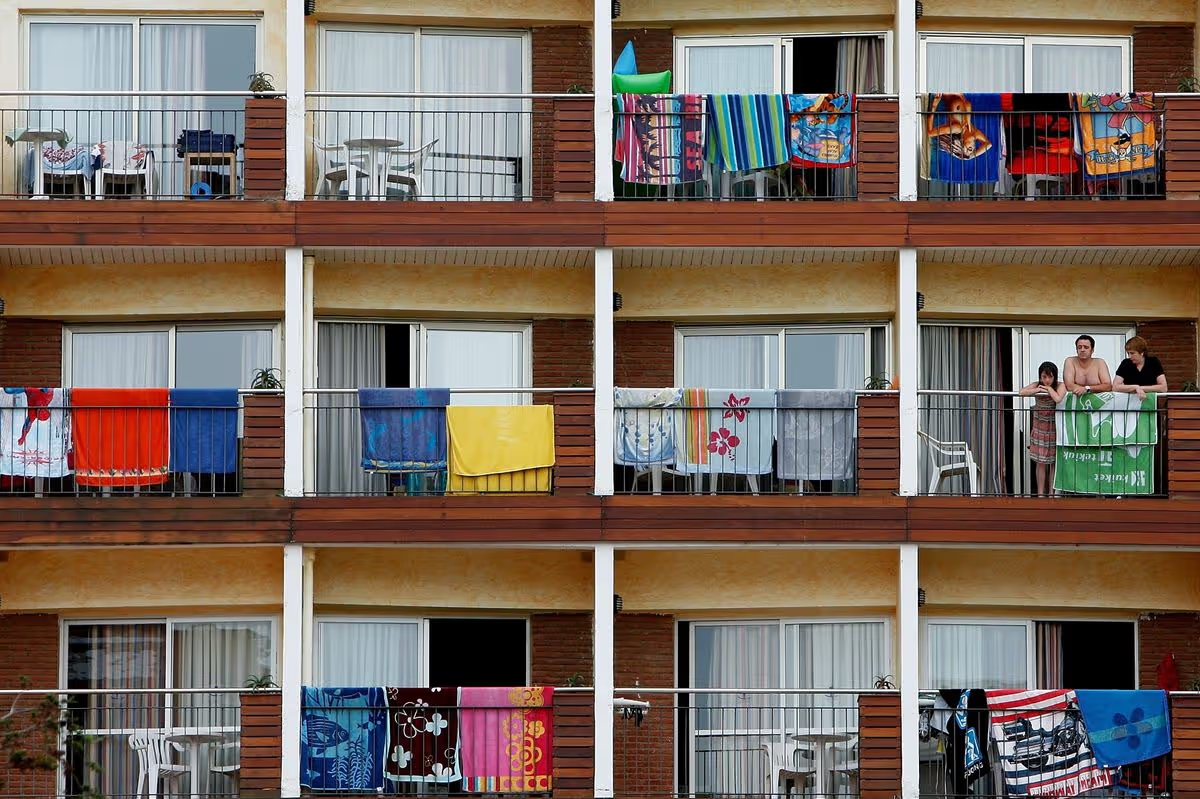
All-inclusive hotels and resorts are slowly killing one of the best parts about going away on holiday.

When it comes to jetting away after long months of hard work and parenting, the idea of flopping down on a sunlounger in between trips to the all-inclusive buffet or bar is undeniably tempting.

However, it’s this very action that is threatening something we all love. Food.

A recent poll of 2,000 holidaymakers found that cuisine is the main reason for choosing a holiday destination for 19 percent, with 25 percent even returning to the same place because of it. Nearly four in 10 always research restaurants and dining experiences, and 17 per cent will put together a wish list of foods they want to try.

But according to the responsible travel firm Intrepid, local delicacies, bars and restaurants are under threat because holidaymakers are increasingly staying in all-inclusive resorts run by large multinational companies, rather than exploring and spreading their cash around.

A survey of 2,000 Brits conducted on behalf of Intrepid by Censuswide found:

  • 51% won’t travel beyond their accommodation to find authentic food
  • 25% eat at a global fast-food chain within 48 hours of arrival
  • 55% of Gen Z say they find comfort in familiar brands like McDonald’s and Starbucks when travelling
  • Over two-thirds of Brits (67%) admit to packing food from home, with tea bags (32%), the most commonly packed item

Award-winning author, food and travel writer, Yasmin Khan, who collaborated on the research, told the Mirror what we risk losing if we stick to the hotel buffet.

“When a traditional dish disappears, we don’t just lose a recipe; we lose a piece of history and heritage,” she said.

Yamin believes that travellers have a responsibility to support the food cultures that make places distinctive and that “when we choose the safety of the familiar over food rooted in local tradition, we can inadvertently contribute to the loss of irreplaceable flavours, techniques and ingredients.”

“As someone who is a tired mum of a toddler, all-inclusives have their place. But I would push back on this idea that they’re the most affordable way to experience a holiday. While some have good food, the majority of the time you’re divorced from where you’re visiting. It could be anywhere. You feel disconnected,” she continued.

“So many of the local bakeries, or the lovely cake shops, the lovely tapas bars, if people aren’t leaving the hotels, they’re under threat. Some of my favourite meals abroad have been some of the spontaneous ones, you’ve eaten something you’ve not heard of before. I also make a point of asking for local recommendations.”

Intrepid has also partnered with Time Out to launch a series of immersive cookery workshops in London, giving people the chance to cook and experience a selection of the ‘endangered dishes’ firsthand. Tickets are on sale now.

Dan Saladino, author of Eating to Extinction, is concerned that less well-known dishes are being wiped out, in part due to the habits of holidaymakers.

“The research identified three primary threats including environmental loss from climate change, cultural dilution due to overtourism, and the disappearance of traditional artisanal skills. We chose dishes like the New York bagel and sushi from Japan because they are, in culinary terms, global icons, yet most people don’t realise the authentic versions of these are actually on the brink of vanishing due to modern shortcuts and mass-market pressures,” he said.

“Food is the most profound link we have to our history, our land, and our identity, yet we are currently witnessing a global collapse of culinary diversity.”

Noel Josephides, the chairman of family‑owned tour operator Sunvil, believes that all-inclusive hotels don’t just threaten food culture, but the very foundations of the sunny destinations loved by Brits.

He refuses to work with all‑inclusives “on principle” and argues that they suck money out of local communities and funnel it towards large multi‑nationals. Local, independent business owners simply can’t compete with the buying power of the big chains, which encourage holidaymakers to stay on‑site rather than going out into the community to spend their cash.

This is not only a major cause of resentment among locals, but it keeps holidaymakers from truly experiencing the destination they’re in, Mr Josephides argues.

“It’s a product that doesn’t really encourage access to local facilities. We know in places like Cyprus and Greece, restaurants have shut down because of all‑inclusives,” he told the Mirror.

“It is not the way to see a country like Greece, but it is perfect for mass‑market tourism from the company’s perspective. In Corfu, there’s a village called Dassia, which has a big all‑inclusive. If you go to that village, it’s dead. Small hoteliers in Paphos have told me, hundreds of restaurants have closed. It is not the right way to do tourism.”

Brian Carrigan has been travelling to sunny destinations such as Menorca, Grand Canaria, and Marjoca each year for the past quarter of a century. In his mind, the biggest problem is the rise of all‑inclusives.

“They starve the local economy of holiday spending. We have never done all‑inclusive due to the fact that the food is substandard and not as good as a locally prepared meal in a nice restaurant,” Brian said.

When I visited Rhodes in 2023 to see how the island was recovering from wildfires that had evacuated thousands of holidaymakers, a number of independent hoteliers and restaurateurs told me how hard times had come in the past decade. While they cited numerous factors, the biggest one in their minds was the arrival of several large all‑inclusive hotels.

The history of the wrap‑around holiday type stretches back to the 1950s, when Belgian sportsman Gerard Blitz pioneered the concept by using army surplus tents to house visitors in Majorca. He was the founder of Club Med, now one of the biggest travel brands in Europe.

The all‑inclusives of today are much more complex and provide so much more to guests than Mr Blitz’s straw hut village that opened in 1952 in Corfu. When I visited Club Med Tignes, I was amazed by not just the ski‑in, ski‑out nature of the property, but the staff on hand to get kids dressed and ready for a day on the slopes, and the incredible buffet on offer three times a day. We’re not just talking chips and pizza, we’re in the world of raclette, fresh fish, and omelets made to order as you watch on.

While Club Med may no longer be a bargain option, many brands offer such good deals that it’d be financially mad not to go all‑inclusive. At least, from the holidaymaker’s perspective.

According to Responsible Travel, all‑inclusive resorts are “usually owned by an overseas company,” and they “sequester most of the tourists’ cash, leaving little behind in the local community, which is impacted by the presence of the resorts.”

“Holidaymakers also use vast quantities of energy and water (significantly more per person than local people) and create large amounts of waste, which some feel is a high price to pay for little commercial return.”

Harold Goodwin, professor of Responsible Tourism at Manchester Metropolitan University, believes all‑inclusives can be forces for good, so long as they work alongside independents, rather than against them. That means building a loyal and skilled local workforce, reducing energy costs and waste, sourcing fresh local produce, and offering an exciting range of sensitively planned excursions.

“An impressive all-inclusive resort can provide employment for local people with a genuine chance of progression – with the right support and training – into managerial roles that are better paid. Indeed, an all-inclusive resort in a developing country could employ far more people locally than several ecolodges ever could,” he told Responsible Travel.

“Notorious for not sourcing locally, there is no reason why a responsible, sustainable all‑inclusive resort cannot support an ‘adopt a farmer’ scheme, or similar – sourcing delicious, fresh, quality produce for its catering needs at a local level.”

Source link