Candidates scramble after redistricting shakes up California congressional races
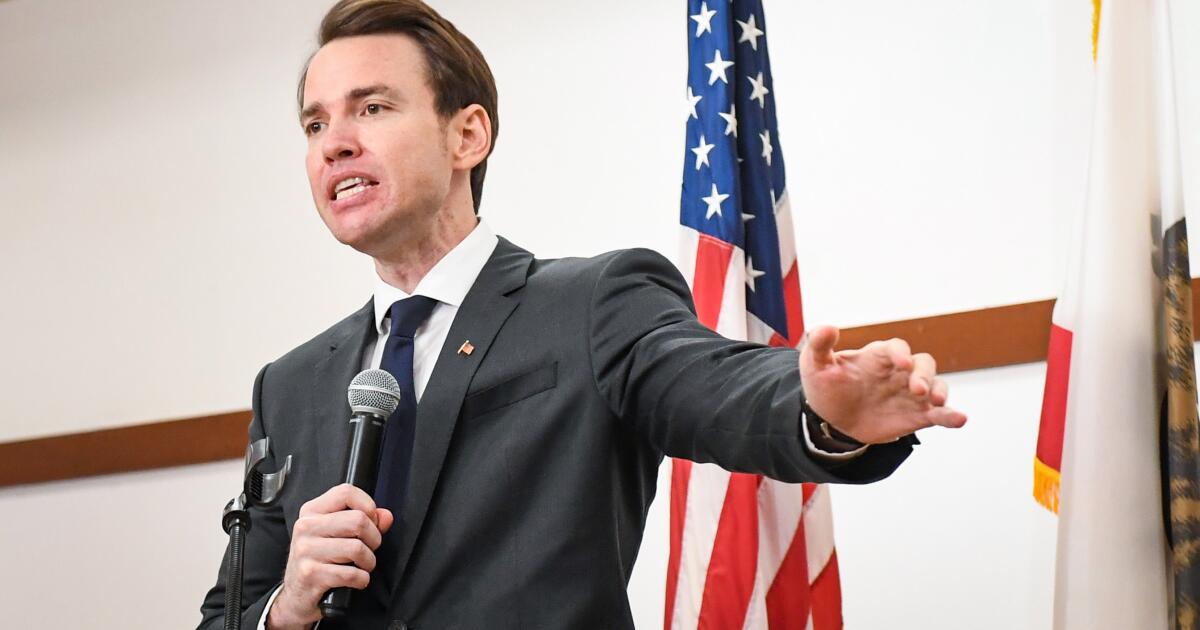
Two years after Huntington Beach residents voted to effectively ban Pride flags from being displayed on city property, the conservative coastal city could be represented by a gay member of Congress and outspoken critic of President Trump — Rep. Robert Garcia.
That twist of fate came after last year’s unprecedented mid-decade rejiggering of California’s congressional districts.
Voters in November overwhelmingly approved Proposition 50 — Gov. Gavin Newsom’s plan to neutralize Republican gerrymandering in Texas — to help Democrats win control of the House this November and put a meaningful check on the Trump administration.
The political tremors triggered by the ballot measure already have reshaped California’s political landscape.
Veteran Republican Rep. Darrell Issa of northern San Diego County, an incessant thorn in the backside of President Obama, has called it quits. Northern California Rep. Kevin Kiley has shed his GOP label to run as a political independent. And two Republican congressional incumbents find themselves in a political death match in a newly crafted district straddling Orange, Riverside and San Bernardino counties.
The new 42nd District remains anchored in Garcia’s home base of Long Beach. But under the new lines, it has swapped out Southeast L.A. communities such as Downey and Bell Gardens for the more MAGA-friendly cities of Huntington Beach and Newport Beach.
“I say that every time a district crosses the L.A.-Orange County border, a Democrat gets its wings,” said Paul Mitchell, the redistricting expert who drew the new lines for Democrats. “Drawing the Long Beach district to go down to Huntington Beach meant that you’re giving Robert Garcia a community that, in its elected City Council, has been real anathema to who he is as a person, being an out gay member of Congress.”
The change means Garcia’s district shifts rightward with a lot more Republican voters, but still has a Democratic majority. Former Vice President Kamala Harris would have still won the new district in the 2024 presidential race by 13 points, making Democrats confident that it’s still one where Garcia could win.
As the top Democrat on the House Oversight Committee, Garcia is poised to win more power in pushing back against the Trump administration if historical precedent holds and Democrats win back the House majority in November.
Garcia was unavailable for an interview, but many of the new voters he will have to court are represented by Rep. Dave Min (D-Irvine), who won the closely divided Orange County seat in 2024 and now faces a slightly bluer voting base in his newly configured district.
“I have a lot of voters to introduce myself to,” said Min, who described himself as “progressive for Orange County” because he cares about protecting civil rights but often aligns with law enforcement and small-business interests.
“The message [to new voters] is that you may not always agree with me, but that I will try my best to do what I say. I will fight to deliver on the promises I make, I will fight for the values that I represent myself as caring about. And I listen to my constituents,” he said, noting that he recently held his seventh town hall since he was elected.
In a neighboring Orange County district, Republican Reps. Young Kim and Ken Calvert are going to battle for control of the region’s only safe Republican seat post-Proposition 50. That district also crosses county lines — into Corona, Chino Hills and other parts of western Riverside and San Bernardino counties.
Republicans may be dismayed to see the two popular party leaders battling it out in what promises to be a brutal and expensive election.
Republican “primary voters are looking for how to distinguish between two of the same flavor,” said Rob Stutzman, a Republican political strategist. “Republican voters are going to like both of them, so how do you make that judgment?
“Often, it comes down to who their friends are,” he said, noting that endorsements from interest groups and other elected officials are usually more valuable in primaries than general elections.
A handful of Democratic candidates have also declared for the seat, which campaign strategists said could split the liberal vote and allow both Calvert and Kim to advance to the general election ballot.
Issa bids farewell, Kiley drops GOP label

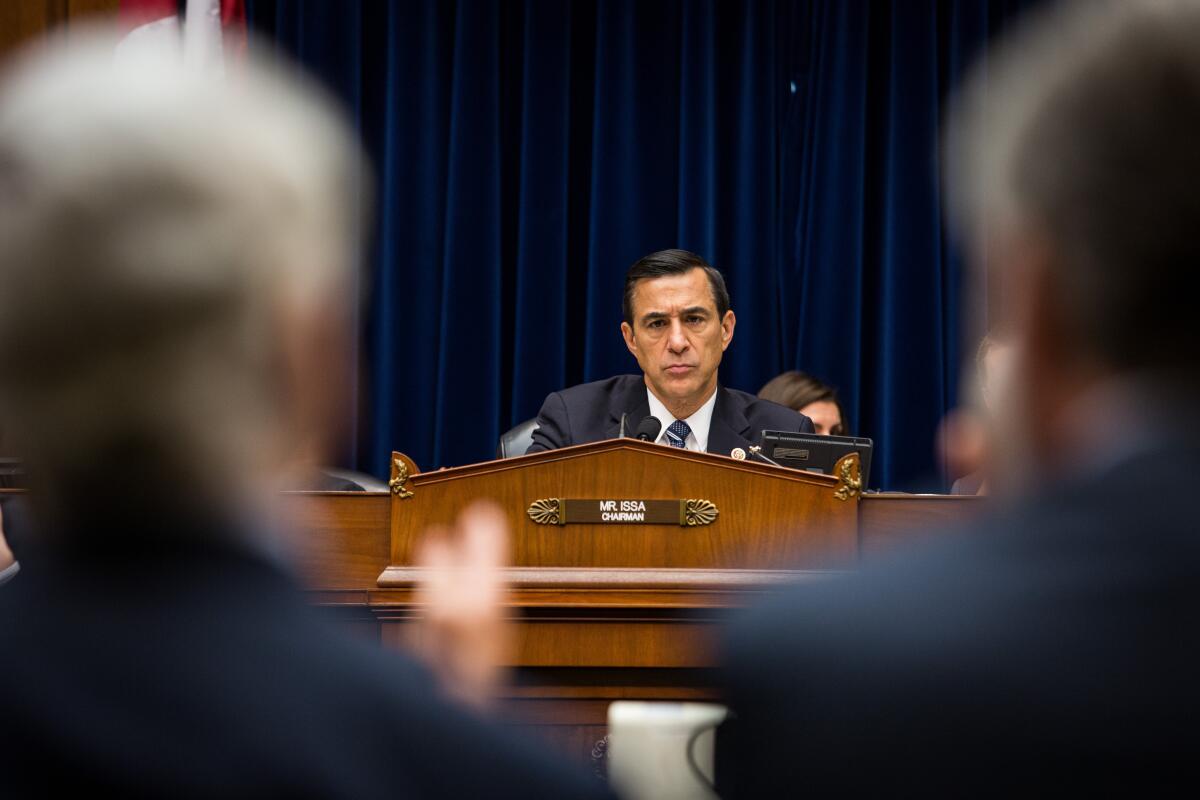
Chairman Darrell Issa (R-Bonsall) listens to testimony from witnesses during a House Oversight Committee hearing entitled “Reviews of the Benghazi Attack and Unanswered Questions,” in the Rayburn House Office Building on Capitol Hill in 2013 in Washington.
(Drew Angerer / Getty Images)
Issa’s decision to forgo a run for reelection came as a surprise Friday, even though speculation has swirled about his future after the newly drawn congressional districts put him in a seat where Democratic voters outnumber Republicans. That was a major downgrade from his current district, which swallows up right-leaning eastern San Diego County and the conservative pockets of Temecula and Murrieta.
“This decision has been on my mind for a while and I didn’t make it lightly,” Issa said in a statement. “But after a quarter-century in Congress — and before that, a quarter-century in business — it’s the right time for a new chapter and new challenges.”
Democrats celebrated the departure of Issa, who helped fund the successful 2003 recall of California Democratic Gov. Gray Davis, and led the congressional investigation of the 2012 attack on the U.S. diplomatic mission in Benghazi during the Obama administration.
“After over two decades of disastrous representation, Darrell Issa is once again running for the exits — and good riddance,” said Anna Elsasser, spokesperson for the Democratic Congressional Campaign Committee.
Several Democrats had already announced plans to challenge Issa, including San Diego City Councilmember Marni Lynn von Wilpert.
Proposition 50 also split the sprawling district held by Kiley, a Republican from Rocklin, into six pieces, leaving the Northern California congressman and frequent Newsom critic with few good options.
Over the following months Kiley posted on social media to announce — like the dating show “The Bachelor” — where he would not run until it came down to two districts: a safe Republican seat that would force Kiley into a primary with longtime Rep. Tom McClintock (R-Elk Grove) or a district with a 9-point Democratic registration advantage.
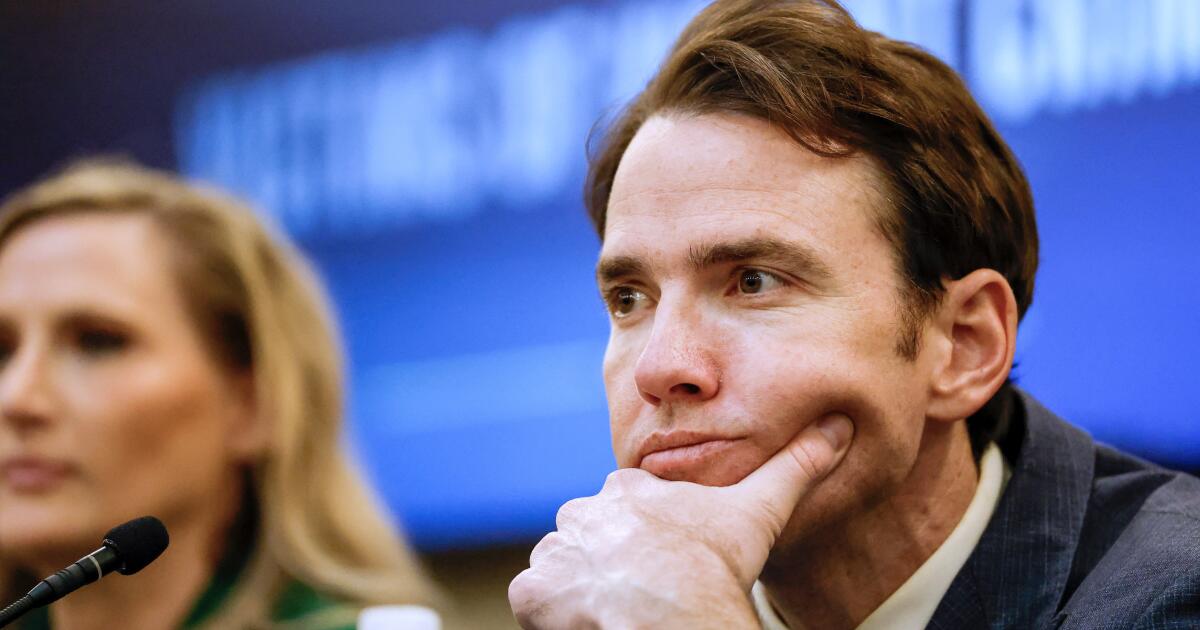
Kiley chose to avoid challenging McClintock and delivered his final rose to the new 6th District along with a twist: On Friday the congressman announced he would run as an independent candidate rather than a Republican.

Rep. Kevin Kiley (R-Rocklin) in his office in Washington in 2025.
(Richard Pierrin / For The Times)
In a lengthy social media post and accompanying video, Kiley said he has become “frustrated, sometimes disgusted, by the hyper-partisanship in Congress” and that he answers to constituents, “not party leaders.”
But without a political party behind him, Kiley’s campaign is “entirely his burden,” said Republican strategist Matt Rexroad. “He’s not going to get the party endorsement. He’s really on his own.”
Without a letter denoting a political party next to their name on the ballot, independent candidates have historically gotten lost in the mix.
One other candidate, a Christian author named Michael Stansfield, confirmed Friday that he filed to run for the seat as a Republican, giving Kiley automatic competition for conservative votes.
Several Democrats have already announced campaigns for the seat — which lumps conservative suburbs of Sacramento with liberal-leaning ones closer to the capital city — including former state Sen. Richard Pan, Sacramento Dist. Atty. Thien Ho, West Sacramento Mayor Martha Guerrero and Lauren Babb, a public affairs leader for Planned Parenthood clinics in California and Nevada.
The race could revive a pandemic-era rivalry between Kiley and Pan, who tussled over vaccine and public health rules while serving in the state Legislature.
New districts, new challengers
For some longtime Democrats such as Rep. Brad Sherman, the addition of new GOP voters could help them fend off challenges from younger progressive candidates.
Half a dozen Democrats, mostly younger progressives, have filed paperwork to challenge Sherman (D-Sherman Oaks), 71, who has represented parts of the San Fernando Valley for nearly 30 years.
The 32nd District remains solidly blue post-Proposition 50, but a nearly seven-point swing to the right “makes it less likely that two Democrats go to the general, which makes it less likely that [Sherman] would get beaten,” said Mitchell.
It’s a similar story for Reps. Doris Matsui (D-Sacramento), Mike Thompson (D-St. Helena) and John Garamendi (D-Walnut Grove), who are all in their 70s and 80s and facing younger, more progressive challengers.
While gaining more conservative voters may help some incumbents avoid facing another Democrat in November, the threat of such a faceoff is pushing them to be more active on the campaign trail, Rexroad said.
“You’re seeing more activity by Doris Matsui and Mike Thompson and John Garamendi as a result of them being challenged, because they like their seats and they’d like to hold on to them,” Rexroad said.
Times staff writer Seema Mehta contributed to this report.