
Keystone XL Pipeline

U.S., Canadian negotiators meet as deadline for new tariffs looms

Aug. 21 (UPI) — President Donald Trump‘s threatened 50% tariffs on $20 billion worth of Canadian goods hung in the balance Friday as U.S. and Canadian negotiators met in Washington with a midnight deadline looming.

Canadian Minister for Internal Trade Dominic LeBlanc, his country’s lead negotiator, arrived at the offices of U.S. Trade Representative Jamieson Greer shortly after noon as the two sides met to strike a deal ahead of Trump’s 12:01 a.m. Saturday deadline, the CBC reported.

The U.S. president signed orders in July to impose 50% tariffs on Canadian goods, including cement, hockey sticks and many other items, representing about 2% of the entire trade between the United States and Canada.

The tariffs were to go into effect at 12:01 a.m. Wednesday, but were delayed through the end of Friday by an announcement on social media issued about 90 minutes before the deadline in which Trump said the two sides “have a DEAL!” with final implementation to come.

Canadian Prime Minister Mark Carney, however, was much more cautious, saying only that “substantial progress has been made, although there is important work still to be done.”

Details of the touted agreement have been scarce. However, Trump teased the possibility that it could reinstate work on the abandoned proposed Keystone XL oil pipeline from Alberta, which was dropped by then-President Joe Biden in 2021 over climate concerns.

The U.S. president also intimated that U.S. tariffs on Canadian autos could be part of the deal, which Greer suggested that the United States could adjust its current tariffs on Canadian steel and aluminum.

Canadian negotiators, meanwhile, want to ease the tariffs already imposed on Canadian industries, including duties of up to 50% on steel, aluminum and autos. Some tariffs also affect Canadian softwood lumber.

On Wednesday, after Trump extended the deadline, Carney urged a “Team Canada” approach during a virtual meeting with provincial and territorial premiers as some of them have toed a hard line in refusing to stock American alcohol products, which is seen as a main irritant to the Trump administration.

Manitoba Premier Wab Kinew on Thursday told reporters if a new deal allows a return of U.S. beer and spirits to Canadian shelves, local consumers should “leave it there.

“Don’t buy it. Let it sit on the shelf … and buy the Canadian stuff instead,” he said.

Carney on Wednesday emphasized “continued collaboration with provincial and territorial governments as the federal government works to finalize a deal with the United States,” according to an official readout of the meeting.

He reiterated the government’s goal is to “secure the best deal for Canadians — one that provides the greatest possible U.S. market access for Canadian businesses,” and emphasized “the importance of remaining focused on Canada’s central economic strategy: building our economic strength at home and diversifying our partners abroad.”

NTT IndyCar Series Drivers Scott Dixon (R) and Graham Rahal (L) pose with first lady Melania Trump during an event in the Rose Garden of the White House on Thursday. The first lady announced that a $2 million donation from IndyCar and Fox Corporation will fund Fostering the Future scholarships at Indiana University and Purdue University to expand academic opportunities for individuals transitioning from foster care. Photo by Bonnie Cash/UPI | License Photo

Source link

Trump announces 3-day pause on Canada tariffs as deadline neared

Aug. 18 (UPI) — President Donald Trump late Tuesday announced a three-day pause on imposing 50% tariffs on Canada less than two hours before they were to go into effect, saying a trade deal has been made.

The tariffs were to go into effect at 12:01 a.m. Wednesday, but were delayed by Trump’s announcement on social media issued about 90 minutes before the deadline.

No specifics on what the deal entailed were offered, though Trump said the controversial Keystone XL Pipeline project, revoked by former President Joe Biden over climate change concerns, “may be awoke from the grave!”

The deal remains to be finalized, he said.

While congratulating Trump, U.S. Trade Representative Jamieson Greer added that the deal includes “comprehensive access for all American goods,” economic security commitments, digital trade alignment and other provisions protecting the U.S. market.

Prime Minister Mark Carney of Canada has yet to comment.

Greer had been leading negotiations with Canadian representatives ahead of the deadline. He said last week that the negotiators were reviewing options and that he expects Canada to drop certain measures it had already taken in response to the U.S. tariffs, The New York Times reported.

“If a country retaliates against us, we’re obviously not going to tolerate that,” Greer told reporters Friday. “We’ll take action. My sense is the Canadians want to have a more conciliatory approach, but we’ll see.”

Trump signed orders in July to impose 50% tariffs on $20 billion worth of Canadian goods, including cement and hockey sticks, representing about 2% of the entire trade between the United States and Canada, starting Wednesday.

“President Trump is taking action to hold Canada accountable for its continued discrimination against and unreasonable and unequal treatment of U.S. commerce that has burdened and disadvantaged hard-working Americans,” the White House said in a statement at the time.

On Aug. 5, he called Canada “nasty” in a Las Vegas speech.

“Canada’s nasty. They are. They’re nasty,” Trump said. “I love the people, but they’re nasty. Nasty leadership.”

Canadian Prime Minister Mark Carney and Trump spoke on the phone Monday, a Carney spokeswoman said. She didn’t give any details.

Canadian negotiators also want to ease the tariffs already imposed on Ottawa industries. There are tariffs of up to 50% on steel, aluminum and autos. Some tariffs also affect Canadian softwood lumber.

Canadian lumber manufacturing CEO John Brink told CTV that tariffs have devastated the lumber industry. He said, “most of the lumber industry in Canada is paying up to 45.16% in tariffs and duties combined. So the effect has been devastating.”

Brink said about half of British Columbia’s lumber manufacturing capacity has shut down.

“There used to be 800 secondary manufacturers in British Columbia alone. We are now down to about 50. Not all due to tariffs and duties, but due to a combination of [factors],” Brink added.

“I think the big question for the United States is: Are they even interested in securing an agreement, a deal, some kind of operational détente, or is Trump’s real objective just to flex? Is it just to demonstrate he’s in control? In which case, we’re chasing a phantom deal,” CTV News political commentator Scott Reid said.

He added that the deadline will be “the most important, most significant and most treacherous of Mark Carney’s political career.”

Greer has said he expects Canada to make concessions if a deal goes through. But not everyone in the Great White North wants that.

“Canadians elected Mark Carney to both stand up to Trump while also trying to negotiate a deal, or negotiate down the tariffs, and I don’t think those are mutually exclusive, but it is a narrow path for sure,” said Brian Clow, a former senior official in Prime Minister Justin Trudeau‘s government, The Times reported.

If no deal is made, expect the trade war to escalate, Clow said.

“If the U.S. decides to proceed with imposing these new tariffs tomorrow, Canada, although this current government has eased back on retaliation, will have to respond in some way,” he said.

Former senior White House trade adviser Kelly Ann Shaw told CTV that negotiations look “promising” for Canada.

“I’ve been involved in a number of international trade negotiations and other negotiations throughout my career, and the hardest issues always get resolved at the very last moment,” Shaw told CTV Tuesday.

“So I don’t expect any sort of announcement until later today, possibly as late as midnight,” Shaw said. “But the fact the two parties are still at the table, I take as a good sign.”

Trump has long used tariffs as a mechanism for both punishment and negotiation, and during his second term, he attempted to impose sweeping tariffs, including against Canada, but they were thrown out by the U.S. Supreme Court in February.

The tariffs paused late Tuesday were to join the 10% import duty on many Canadian goods, as well as previously imposed tariffs ranging from 10% to 50% on products, such as steel, aluminum, copper, automobiles and softwood lumber.

Canada responded by imposing a temporary 25% tariff on certain wood cabinets and vanities, as well as a 25% tariff on U.S. vehicles, as well as selected steel and aluminum products, among others.

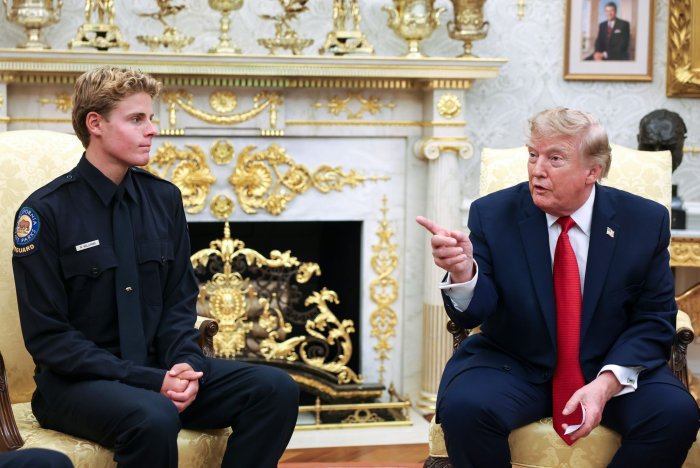
President Donald Trump hosts lifeguard Ryder Williams in the Oval Office of the White House on Monday. Photo by Samuel Corum/UPI | License Photo

Source link