MOCA acquires Kara Walker’s reimagining of a Stonewall Jackson statue
The Museum of Contemporary Art has acquired Kara Walker’s sculpture “Unmanned Drone,” a cornerstone of the museum’s groundbreaking “Monuments” exhibition.
It joins the 158 works by 106 artists that were added to MOCA’s permanent collection last year, including major works by Jacqueline Humphries, Mike Kelley, Shizu Saldamando, Mary Weatherford, Julie Mehretu and Nairy Baghramian. Fifty artists are new to the collection, including Jonathas de Andrade, Leilah Babirye, Meriem Bennani, Paul Chan, Cynthia Daignault and Ali Eyal.
“Unmanned Drone” — a towering testament to the power of transmogrification — commands a room of its own at the Brick, which co-presented the “Monuments” exhibition in October. Walker created the 13-foot-tall bronze sculpture out of a statue of the prominent Confederate Gen. Stonewall Jackson that was originally in Charlottesville, Va. The statue had been removed after serving as a significant gathering place for the infamous 2017 Unite the Right rally of white supremacists.

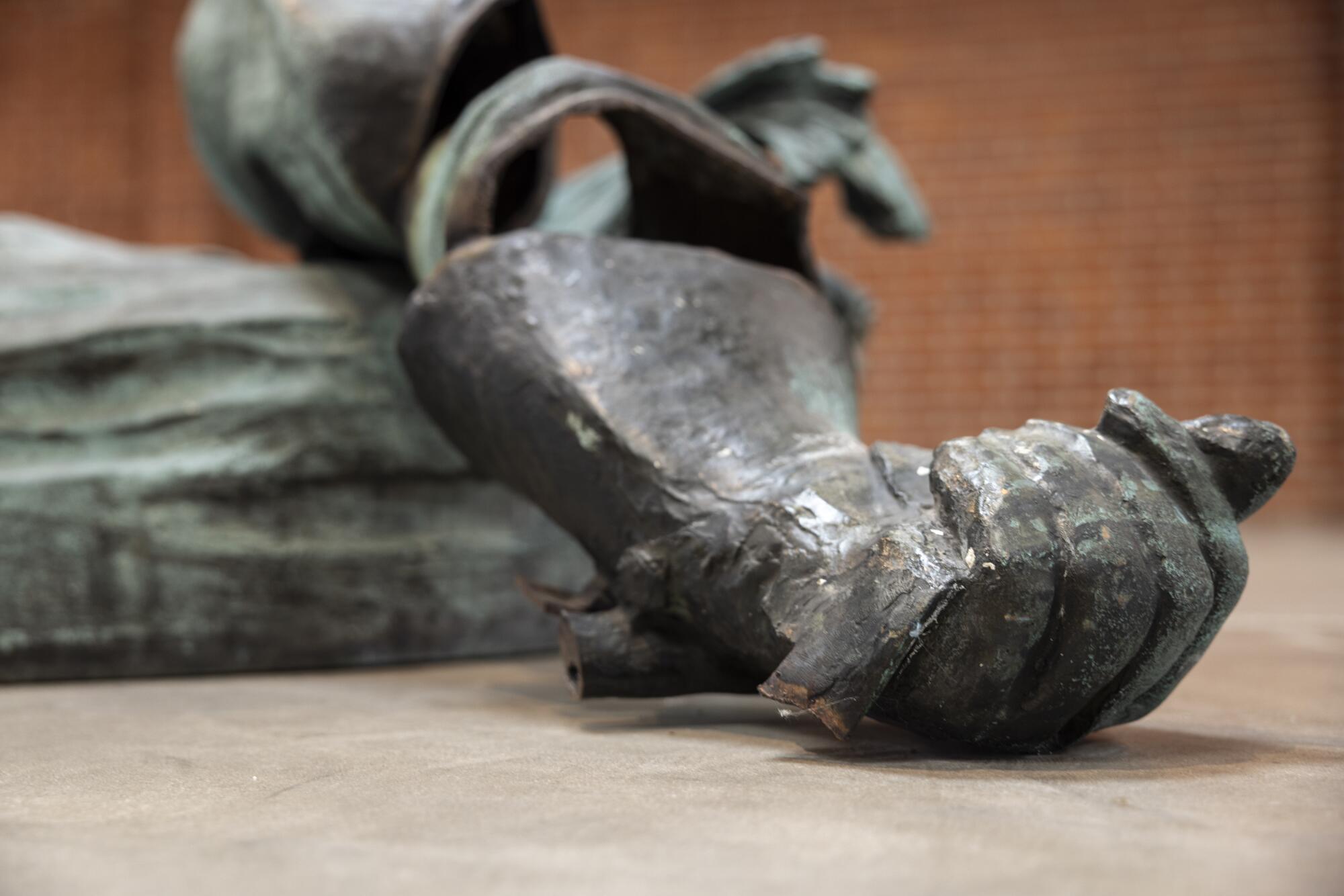
A detail of a severed arm — part of Kara Walker’s sculpture “Unmanned Drone,” which she created using a decommissioned statue of Confederate Gen. Stonewall Jackson.
(Etienne Laurent / For The Times)
In a review of “Monuments,” which declared the exhibition “the most significant American art museum show right now,” former Times art critic Christopher Knight called “Unmanned Drone” “devastating” and “brilliant.”
In an interview last fall, Brick director Hamza Walker explained to The Times that the city of Charlottesville issued a request for proposals from organizations interested in taking possession of the statue. The Brick applied and was deeded the statue, taking physical possession on Jan. 6, 2022. The gallery then gave the statue to Walker.
“They were getting rid of the Lee and the Stonewall Jackson statues, and they said, ‘We don’t want them put back up for further veneration,’” Hamza Walker said. “And so the idea of giving the statue to an artist fit that bill.”
Other applicants skipped over the line about not putting them up for further veneration, Hamza Walker said, noting that the Brick’s proposal was up against ones from Civil War battlefields and Laurel Hill, the birthplace of Confederate general J.E.B. Stuart.

A detail of the horse’s nostril in Kara Walker’s sculpture “Unmanned Drone,” which MOCA has acquired.
(Etienne Laurent / For The Times)
Kara Walker sliced apart the statue with a plasma cutter and welded it back together in an entirely new form. She did away with Jackson’s face and put much of the focus on his famous steed, Little Sorrel. The horse now stands upright with its head pushing out from the back of its saddle.
“She didn’t want you to be able to identify with him. She wanted the emphasis on Little Sorrel rather than the myth of the man,” Hamza Walker explained of Kara Walker’s intentions. “She wanted to reduce it to horse and rider.”
“The fiend has no head,” Knight commented in his review. “The folkloric Euro-American story of the ‘headless horseman’ comes to mind — a nightmarish, animated corpse who haunts the living. As a metaphor for obtuse white supremacy, still active today, that terror figure is hard to beat.”
Walker’s work was the only transformed statue out of the nearly dozen decommissioned statues related to the Confederacy featured in the “Monuments” exhibition. The others were all presented as they looked when they were removed, many during the protests that swelled in the summer of 2020 in the wake of the murder of George Floyd.

A detail of a sword on Kara Walker’s sculpture “Unmanned Drone.”
(Etienne Laurent / For The Times)
In addition to “Unmanned Drone,” MOCA announced several other acquisitions that were either featured in recent exhibitions or have significant connections to the museum. These include an environmental sculpture by Olafur Eliasson; work by Takako Yamaguchi; a media installation by Paul Pfeiffer titled “Red Green Blue” (2022), co-acquired with the Brooklyn Museum; and pieces by Cynthia Daignault, Shizu Saldamando and Henry Taylor.
“The expansion of MOCA’s collection this year reflects a sustained and deeply collaborative effort to think critically about what it means to build a museum collection in the twenty-first century,” Clara Kim, chief curator and director of curatorial affairs, said in a statement.