kamikaze

Russian Shahed-136 Kamikaze Drones Now Carrying MANPADS Missiles

Russia is continuing to adapt and evolve its copies of the Shahed-136 long-range one-way attack drone, known locally as the Geran, now arming it with a man-portable air defense system (MANPADS). These are more often referred to as shoulder-fired heat-seeking missiles. The development follows a previous version of the drone carrying a single R-60 air-to-air missile, which you can read more about here. It also emerges as Russia makes additional alterations to the drone, including improved line-of-sight control capabilities and self-protection systems.

Russian forces are mounting Igla MANPADS on Shahed drones to target Ukrainian helicopters that intercept them. The drones carry a camera and radio modem, and the missile is launched remotely by an operator in Russian territory. pic.twitter.com/T5TKPHyhVu

— WarTranslated (@wartranslated) January 4, 2026

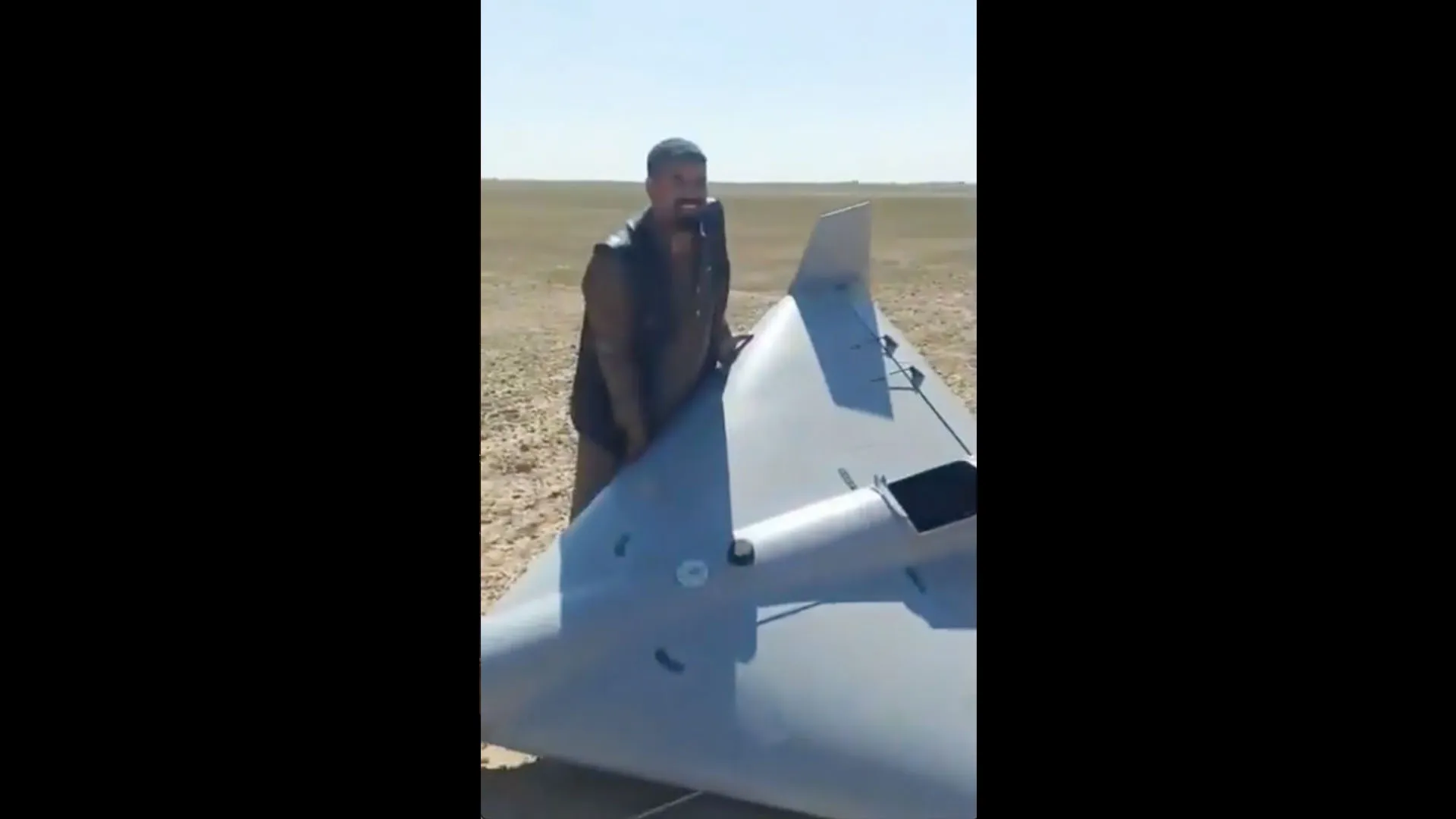
An example of a MANPADS-equipped Shahed/Geran is seen in recent imagery, including a video, that shows the drone lying in the snow, after it came down intact in Ukraine, reportedly in the Chernihiv region in the north of the country. According to Ukrainian accounts, as well as the rail-mounted missile on the top, the drone is equipped with a camera and a radio-frequency modem.

An overhead view of the Shahed/Geran lying in the snow with the (unused) Igla MANPADS mounted on top. via X

The missile itself has been widely reportedly as an Igla-S, among the latest models of this widespread MANPADS. Known in Russia as the 9K388, and to NATO as the SA-24 Grinch, the weapon has a maximum range of around 3.7 miles, and improvements over earlier Igla missiles include a more sensitive infrared seeker, a heavier warhead, and an improved fuze.

A member of the Bolivarian National Militia holds a Russian-made 9K338 "Igla-S" (SA-18) man-portable air-defense (MANPAD) surface-to-air missile launcher as he takes part in a rally against US military activity in the Caribbean, in Caracas on October 30, 2025. A US guided-missile destroyer that docked for four days in Trinidad and Tobago, within firing range of mainland Venezuela -- which called its presence a "provocation" -- departed as scheduled on Thursday, AFP witnessed. (Photo by Federico PARRA / AFP) (Photo by FEDERICO PARRA/AFP via Getty Images)
A member of the Venezuelan military holds a 9K338 Igla-S MANPADS launcher in Caracas on October 30, 2025. Photo by Federico PARRA / AFP FEDERICO PARRA

On the other hand, the inscription on the top of the launch tube appears to read 9K333, which would indicate it is the more modern Verba (SA-29 Gizmo), which was developed as a replacement for the Igla. Its primary advantage is its advanced multispectral seeker, operating in the ultraviolet, near infrared, and mid-infrared bands, for improved discrimination between targets and decoys.

Verba MANPADS


Adapting the MANPADS to the Shahed/Geran appears more straightforward than the R-60, with no need for the launch rail adapter; instead, the MANPADS is simply attached to the drone within its standard launch tube. The complete Igla, for example, is also much lighter: around 40 pounds in its tube, compared to close to 100 pounds for the R-60, minus the launch rail.

Russia started employing Shahed/Geran-type long-range UAVs equipped with air-to-air missiles for combating Ukrainian aviation assets, Ukrainian military radio technology expert Serhii Flash reports.

The remains of a Shahed/Geran-type drone with an R-60 short-range air-to-air… pic.twitter.com/NHBDQQqCK9

— Status-6 (War & Military News) (@Archer83Able) December 1, 2025

As for the drone, the original Shahed-136 is Iranian in origin. Multiple variants and derivatives of the Shahed-136, including a jet-powered type, are now produced in large numbers in Russian factories, where they are known locally by the name Geran, the Russian word for geranium. Steady improvements have been made to these drones, including a degree of dynamic targeting capability, as you can read about here.

As we have discussed in the past, adding a heat-seeking anti-aircraft missile to the Shahed/Geran in theory provides the drone with a means to engage Ukrainian fixed-wing aircraft and helicopters. At the very least, giving the drone the ability to hit back at these threats offers a deterrent capability. Overall, the effectiveness of this combination is questionable. Particular challenges include the need for a high degree of situational awareness, perhaps requiring cameras around the airframe, and the need to maneuver the drone to get it into a boresight location to achieve a lock-on. However, Russia clearly considers that the adaptation is worth exploring, even just as a deterrent strategy to keep drone hunting aircraft at bay.

A profile view of the MANPADS-armed Shahed/Geran lying in the snow. via X

For some time now, Russia has been working on a man-in-the-loop (MITL) control capability for the Shahed/Geran, a feature that was confirmed when they started to appear with cameras and cellular modems, something TWZ explored in detail at the time. These developments allow the drone to be connected to an operator. Standard Shaheds fly autonomous routes to pre-planned targets on autopilot with no man-in-the-loop control. They are ‘fire and forget’ weapons.

Meanwhile, the range at which MITL can be achieved has been steadily increased. At first, the drones were adapted to exploit patchy cellular networks to provide additional connectivity when available. More recently, Shaheds have been flying with antennas allowing for direct line-of-sight control close to the front lines. This allows them to hit targets dynamically like an FPV drone, while packing a much heavier punch and being able to loiter for long periods of time. You can read all about this development here. Now, the datalink range is being extended using airborne signal relays, possibly creating a mesh network with multiple line-of-sight links. We are also now seeing Russian drones will Starlink terminals, which could provide a vastly superior beyond-line-of-sight capability and could prove to be a big problem for Ukraine if Russia can produce such a configuration in large volumes. These developments are now blurring the classification of the Shahed/Geran from its original long-range one-way attack drone to a loitering munition, with an onboard imaging capability.

Potentially, a Shahed/Geran armed with a MANPADS or an R-60 could use beyond-line-of-sight capabilities to operate the missile. But bearing in mind we know Russia is using the drones closer to the front lines, this would need only a line-of-sight link with operators near the front, or at least by receivers/transmitters placed there. Drone controllers behind the lines could also ‘pick them up’ once in the area, but such an operation is far more complex and fraught with additional risks.

Nevertheless, target acquisition and engagement of a missile-armed drone is still far from straightforward. It’s likely that the modern seeker used by the Igla-S or Verba makes it easier to engage aerial targets, compared to the R-60, with a reduced need to ‘point’ the drone directly at the target. Still, the operator would have to trigger the launch of the missile after receiving the signal indicating a lock-on has been achieved.

A close-up of the front end of the MANPADS, with an actuator fitted to open the protective cap that covers the front of the tube before the missile is fired. via X

At the same time, the Shahed/Geran remains a slow and not particularly agile launch platform, and certainly not one that was designed with air-to-air combat in mind. Adding a top-mounted missile likely also degrades its maneuverability and affects its stability, but less than would be the case with an R-60.

When it comes to finding aerial targets, the most likely scenario involves operating entirely reactively to what is seen visually on cameras around the drone or otherwise searching for targets of opportunity. Another option would involve the drone operator receiving target information from offboard assets, where applicable, but this seems less likely.

Bearing in mind the performance of the Shahed/Geran and the range of the MANPADS, the most likely targets would be the Mi-8/Mi-17 Hip series armed transport helicopters and the Mi-24 Hind series gunships that are routinely tasked with counter-drone missions. We have already seen that lower and slower-flying helicopters face a notable risk from relatively small kamikaze drones that simply fly into them. Ukrainian F-16s, MiG-29s, Su-27s and Mirage 2000s have also been tasked heavily as ‘Shahed hunters,’ but engaging fighters with these weapons would be even tougher. Still their very existence would add a credible threat to fighters approaching them.

Footage showing the door gunner on a Mil Mi-8 Multirole Helicopter with the Ukrainian Air Force using his M134 Minigun to shoot down a Russian Shahed-136 Attack Drone. pic.twitter.com/UWBd8QUXEf

— OSINTdefender (@sentdefender) November 12, 2025

While it remains to be seen just how effective the combination of Shahed/Geran with a MANPADS (or R-60) is, these developments reflect a previous precedent for arming drones with air-to-air missiles. The deterrent effect of this can be seen in at least one instance from 2002, when a U.S. Air Force MQ-1 Predator drone fired a Stinger heat-seeking anti-air missile at an Iraqi MiG-25 Foxbat fighter that was trying to shoot it down, which can be seen in the video below.

Dogfight between MQ-1 Predator drone and Mig-25 Foxbat.mp4


These measures are also indicative of efforts being made by Russia to better defend the Shahed/Geran drones. Another recent development involves the apparent addition of infrared countermeasures to defeat drone interceptors and possible missiles fired by fighters. Attached to the rear of the drone’s stabilizing endplates, these appear to employ electrically heated cylindrical blocks to generate blooming infrared energy, like the Hot Brick system.

Ukrainian military radio technology specialist and consultant Serhii “Flash” Beskrestnov reported that Russian Geran-2 drones are now capable of blinding interceptor drones and aircraft.

According to him, the Russians are equipping their strike UAVs with infrared searchlights.… pic.twitter.com/dtpnbKIklE

— OSINTWarfare (@OSINTWarfare) January 3, 2026

For now, we have no evidence of a missile-equipped Shahed/Geran attempting to engage a Ukrainian aircraft, let alone bringing one down. However, having long-range one-way attack drones fitted with air defense missiles provides another complicating factor for Ukraine and illustrates the continued modifications being made to these weapons.

Contact the author: thomas@thewarzone.com

Thomas is a defense writer and editor with over 20 years of experience covering military aerospace topics and conflicts. He’s written a number of books, edited many more, and has contributed to many of the world’s leading aviation publications. Before joining The War Zone in 2020, he was the editor of AirForces Monthly.


Source link

Did The U.S. Use Kamikaze Drones To Strike Venezuela?

Multiple video clips offer strong evidence that kamikaze drones were among the capabilities the U.S. military brought to bear during the operation to capture Venezuelan dictator Nicolas Maduro over the weekend. This may have been the first real-world use of a new slate of U.S. long-range one-way attack drones and loitering munitions. After years of being outpaced by lower-end drone developments overseas, there is now a significant new push across America’s armed forces, and the special operations community in particular, to dramatically step up the acquisition and fielding of various tiers of uncrewed one-way strike aircraft.

Bystanders on the ground in Venezuela captured various videos of the U.S. assault on Saturday, which was officially dubbed Operation Absolute Resolve. In multiple clips, as seen in the social media post below, distinctly terrorizing high-pitched buzzing can be clearly heard, which are then followed immediately by explosions and/or other visual or auditory signs of munitions impacting the ground, all consistent with the use of one-way attack drones.

U.S. Special Operations Command (SOCOM) declined to offer any comment when asked for additional details about the use of drones, in general, during Operation Absolute Resolve. TWZ has reached out to U.S. Southern Command (SOUTHCOM) and the White House for more information.

Similar high-pitched buzzing sounds, which were followed by impacts and detonations, are featured in a mountain of existing confirmed videos of various types of kamikaze drones powered by small piston engines driving single pusher propellers hitting their targets. The distinctive acoustic signature, in particular, has been consistently present in footage of attacks involving these kinds of uncrewed aerial systems that have emerged from multiple conflict zones globally in the past five years or so. Ukrainian forces have even established a network of acoustic sensors to help spot incoming Russian drone attacks across their country to capitalize on this acoustic signature.

This is the footage of the russian Shahed drone attacking an oil mill belonging to the American company Bunge.

As the result, more than 300 tons of oil was spilled, causing serious damage to the mill and environment. pic.twitter.com/JflSn2NkBd

— Oleksiy Goncharenko (@GoncharenkoUa) January 5, 2026

Footage released by Ukraine’s military show electronic warfare units disabling a Russian Shahed attack drone and forcing it to descend intact into the Black Sea, rather than detonating on impact. pic.twitter.com/PQfVscqBIM

— Open Source Intel (@Osint613) December 14, 2025

In 2021, Azerbaijan’s Border Guard even released a video, seen below, focused on the sounds produced by the Israeli-made Harop loitering munitions that it had actively employed in a conflict with Armenia the previous year. At that time, TWZ highlighted the knock-on psychological effect this would have. Direct comparisons have also been drawn to the iconic sound of World War II-era dive bombers, and Nazi Ju-87 Stukas, in particular, swooping down onto their targets.

Qarabağ Azərbaycandır!


As mentioned, the U.S. military finally launched a new, concerted effort to expand the use of various types of one-way attack drones last year. The special operations community, which was front and center in this weekend’s operation in Venezuela, has been heavily involved in executing this initiative and has already been at the forefront of fielding other kinds of kamikaze drones within America’s armed forces for years now.

Just last October, U.S. Central Command (CENTCOM) disclosed the first known operational fielding of long-range one-way attack drones by a task force in the Middle East led by special operations forces. That unit, officially named Task Force Scorpion Strike (TFSS), is equipped with multiple versions of the Low-Cost Uncrewed Combat Attack System (LUCAS), a design notably reverse-engineered from the Iranian-designed Shahed-136. However, LUCAS drones can operate collaboratively in a fully networked swarm and beyond-line-of-sight links that enable them to attack targets, including ones that might suddenly pop up, in real time and far from their operators. This makes them far more capable than Iran’s original design, as well as variants and derivatives that Russia is now actively using against Ukraine.

CENTCOM

In December, TFSS, together with the U.S. Navy, also demonstrated the ability to launch LUCAS drones from ships. Other elements of the U.S. military have at least been experimenting with LUCAS, and those drones and/or other similar designs may already be in wider service within America’s armed forces.

“Bravo Zulu. U.S. Navy forces in the Middle East are advancing warfighting capability in new ways, bringing more striking power from the sea and setting conditions for using innovation as a deterrent.” – Adm. Brad Cooper, CENTCOM Commander https://t.co/TgQ4WLbph3 pic.twitter.com/WUiAVojTht

— U.S. Central Command (@CENTCOM) December 18, 2025

The extent to which other relevant developments are ongoing in the classified realm is unknown, but this is certainly something that has been occurring in recent years. This includes the Phoenix Ghost kamikaze drones that emerged publicly after examples were delivered to Ukraine, but which trace back to a classified project under the Air Force’s Big Safari special projects office.

The AEVEX Disruptor kamikaze drone seen here is one of the designs now known to be part of the Phoenix Ghost family. Jamie Hunter

It is worth noting that the Shahed-136 was itself directly influenced by Israeli kamikaze drones like the Harop, which were originally designed with an explicit focus on targeting enemy air defenses. Iran has shown Shaheds being employed in this role in exercises, as seen in the video below, though the drones have now proven themselves in real-world attacks on a much wider array of targets on land and at sea.

Баражуючий іранський боєприпас «Shahed 136»


In Venezuela this past weekend, U.S. forces could well have used long-range one-way attack drones, launched from ships off the coast or forward locations on land in the region, as part of the broader suppression and destruction of enemy air defenses (SEAD/DEAD) mission, which we know was central to the operation.

“As the force began to approach Caracas, the Joint Air Component began dismantling and disabling the air defense systems in Venezuela, employing weapons to ensure the safe passage of the helicopters into the target area,” Chairman of the Joint Chiefs of Staff U.S. Air Force Gen. Dan “Razin” Caine said during a press conference on Saturday. “The goal of our air component is, was, and always will be to protect the helicopters and the ground force and get them to the target and get them home.”

Caine also said that “numerous remotely piloted drones” were among the U.S. assets employed during Operation Absolute Resolve.

Long-range kamikaze drones would have also offered a way to stimulate enemy air defenses, helping to expose their exact locations and provide emissions to hone in on, after which they could then be struck by other platforms or avoided entirely. The U.S. spent months cataloging Venezuela’s electronic order of battle from standoff distances, but road mobile systems are something of a wild card. If they radiate, they could be rapidly geolocated and destroyed. Similar drones could have been employed purely as decoys or for stand-in (close proximity) jamming of key radars and communications systems, depending on their exact configuration.

Strikes on other targets in Venezuela during the operation that were clearly intended to prevent or disrupt the country’s security forces from responding effectively could also have involved the use of long-range kamikaze drones. Light armored vehicles and other assets on the ground at the sprawling Fuerte Tiuna base in Caracas were destroyed in the course of the mission. This is reportedly where Maduro and his wife were captured. Key communications nodes in the country were also unsurprisingly targeted.

Damaged Venezuelan Dragoon 300 APC at Fort Tiuna following US airstrikes, January 3, 2026.

Note that the vehicle has been modified into similar configuration to Cadillac Gage V-100 Commandos.

2026 United States strikes in Venezuela pic.twitter.com/ThfPnqdC5m

— Buschlaid (@BuschModelar) January 3, 2026

The 312th “Ayala” Armored Cavalry Battalion of the Venezuelan Army appears to have had all of its equipment and most of its armored vehicles entirely destroyed in last night’s strike operation by the United States, which heavily targeting the Fuerte Tiuna Military Complex in the… pic.twitter.com/VXmVHRK4ha

— OSINTdefender (@sentdefender) January 3, 2026

Parte de los sistemas de telecomunicaciones destruídos en la zona del Cerro El Volcan a las afueras de Caracas, en la vía Oripoto de Los Guayabitos, Sector El Volcán, Baruta –Edo. Miranda 🇻🇪
Coordenadas 10.416374,-66.849306 pic.twitter.com/Iyo8UObH42

— 𝘼𝙧𝙧𝙚𝙘𝙝𝙤 (@Arr3ch0) January 3, 2026

There is the additional possibility that what is seen and heard in the videos are smaller loitering munitions, which U.S. forces could have utilized more dynamically in response to threats as they approached their objectives. The U.S. military now commonly uses the term “launched effect” to refer to these munitions, as well as other uncrewed aerial systems configured for other tasks, all of which are designed to be fired from aircraft, as well as ground and maritime platforms.

The U.S. Army’s elite 160th Special Operations Aviation Regiment (SOAR), better known as the Night Stalkers, elements of which were at the very core of the operation to capture Maduro, have at least been experimenting with employing launched effects from their MH-60 Black Hawk helicopters for years now, though this is not an operational capability, at least that we know of at present. This is a capability also planned for the Army’s conventional Black Hawk fleet, but it would not be surprising for the Night Stalkers to receive it first. With launched effects, MH-60s, or other platforms the 160th operates, would have a new way to react to air defenses, either striking them if they pop up along the way or jamming them. They could also strike small mobile targets if need be.

The video below, which the Army released in 2021, includes footage at around the 0:34 mark in the runtime of one of 160th SOAR’s MH-60 Black Hawk helicopters carrying a tube for a ‘launched effect’ under its right stub wing.

The U.S. Army Futures Command’s Future Vertical Lift Cross-Functional Team (FVL-CFT)


At the Association of the U.S. Army’s (AUSA) main annual conference last October, the current head of the 160th SOAR, Col. Stephen Smith, also talked explicitly about the current and future use of uncrewed systems, including launched effects, to lead the way for crewed helicopters, especially in higher-threat environments.

Other elements of SOCOM have been touting the expected importance of air and surface-launched effects in future operations in recent years. These are capabilities that conventional forces across the U.S. military have been working to field, as well.

A graphic giving a broad “operational view” (OV) of a concept Air Force Special Operations Command (AFSOC) calls the Adaptive Airborne Enterprise (A2E), which has envisioned multiple types of drones and other capabilities able to operate across permissive, contested, and denied environments. Air and surface ‘launched effects’ are shown here. USAF

All this being said, the sounds and subsequent impacts heard and seen in the videos from Venezuela do seem to point more to the use of kamikaze drones that are larger than the ones that typically fall into the category of launched effects, especially air-launched types.

Regardless, the video clips do offer clear evidence of a possible first-of-its-kind use of U.S. kamikaze drones during Operation Absolute Resolve, and more details about their employment may emerge as more becomes known about the mission overall.

Contact the author: joe@twz.com

Joseph has been a member of The War Zone team since early 2017. Prior to that, he was an Associate Editor at War Is Boring, and his byline has appeared in other publications, including Small Arms Review, Small Arms Defense Journal, Reuters, We Are the Mighty, and Task & Purpose.


Source link

Littoral Combat Ship Launches Shahed-136 Kamikaze Drone Clone

The U.S. Navy personnel in the Middle East have test-launched a Low-Cost Uncrewed Combat Attack System (LUCAS) long-range kamikaze drone from the Independence class Littoral Combat Ship (LCS) USS Santa Barbara. Described as a first-of-its-kind achievement, this comes two weeks after the U.S. military announced it had established Task Force Scorpion Strike (TFSS) in the region, armed with the LUCAS drones from SpektreWorks. Being able to employ the one-way attack drones from the sea, as well as from sites on land, opens the door to new operational possibilities on top of what was already a major new addition to the U.S. military’s long-range strike arsenal.

TWZ has previously explored in great depth the arguments for arming Navy ships with various types of uncrewed aerial systems to provide additional layers of defense, as well as enhanced strike, electronic warfare, intelligence-gathering, and networking capabilities, which you can find here. Just earlier this year, we also laid out a detailed case for why America’s armed forces should be heavily investing in rapidly-producible long-range kamikaze drones — Shahed-136 clones primarily — just like LUCAS, as you can read here.

Personnel from U.S. Naval Forces Central Command’s (NAVCENT) Task Force 59 conducted the rocket-assisted launch of the LUCAS drone from the stern flight deck of the USS Santa Barbara on December 16, according to an official release. The ship was operating in the Arabian Gulf, more commonly known as the Persian Gulf, at the time. Established in 2021, Task Force 59 has been leading efforts to expand the Navy’s operational use of uncrewed platforms, as well as new artificial intelligence (AI) capabilities, in the Middle East. The LUCAS drone itself had been provided by TFSS, which falls under the auspices of U.S. Special Operations Command Central (SOCCENT), the regional headquarters for special operations activities under U.S. Central Command (CENTCOM).

“Bravo Zulu. U.S. Navy forces in the Middle East are advancing warfighting capability in new ways, bringing more striking power from the sea and setting conditions for using innovation as a deterrent.” – Adm. Brad Cooper, CENTCOM Commander https://t.co/TgQ4WLbph3 pic.twitter.com/WUiAVojTht

— U.S. Central Command (@CENTCOM) December 18, 2025

The official release from NAVCENT does not provide specific details about capabilities demonstrated during the test, such as how far the LUCAS drone flew, how it was controlled or directed, and whether it hit a mock target of some kind at sea or on land at the end of its flight.

TWZ reached out to CENTCOM, which declined to provide more granular information. We have also reached out to NAVCENT and SpektreWorks.

The LUCAS drone seen right after launch from the stern flight deck of the USS Santa Barbara. NAVCENT/C5F/U.S. Army Spc. Kayla Mc Guire

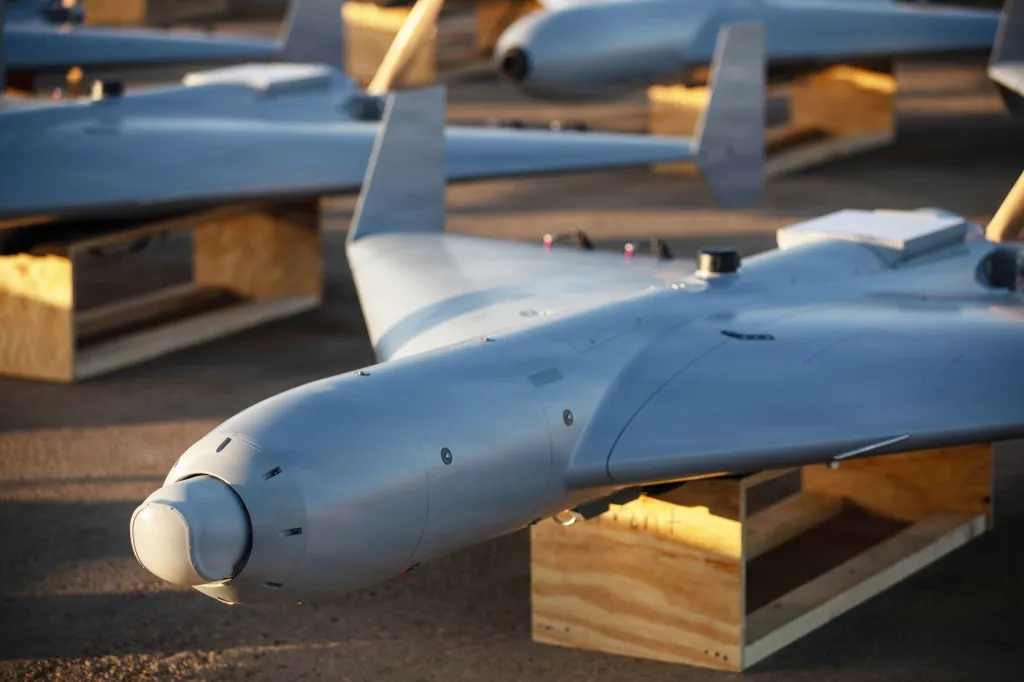
General details about the LUCAS drones the U.S. military now has deployed in the Middle East remain limited. It is known that SpektreWorks directly reverse-engineered the design from Iran’s Shahed-136, and initially with an eye toward its use as a threat-representative target for training and test purposes. At some 10 feet long and with a wingspan of around eight feet, LUCAS is slightly smaller than the Iranian drone. SpektreWorks has also publicly provided specifications for the related target drone, called the FLM 136, which has roughly half the range and payload capacity as the Shahed-136. However, it is unclear whether this reflects the capabilities found on operationalized configurations. LUCAS is also said to have a unit cost of around $35,000.

Iran and its regional proxies have employed a growing number of variants and derivatives of the Shahed-136 design in recent years, including in attacks on targets in Israel and on ships sailing in and around the Red Sea. Russia also now produces its own still-expanding array of Shahed-136-based drones domestically, which it regularly employs in attacks on Ukrainian cities, as well as forces around the front lines.

The video below includes a montage of clips from Iranian state media showing Shahed-136s being employed during an exercise.

Баражуючий іранський боєприпас «Shahed 136»


Pictures of the LUCAS drones the U.S. military has released so far show a modular, reconnaissance design that could also be used for surveillance and reconnaissance missions, as well as in the decoy role. As TWZ has previously written:

“We see two variants of LUCAS. One is not of particular note, it seems geared to strike the static targets we have become accustomed to for this type of weapon. The other features two very interesting details. It has what appears to be a gimbaled camera system mounted on its nose and, most importantly, a miniature beyond-line-of-sight satellite datalink mounted on its spine. This is a major development that would allow these weapons to not only be controlled dynamically after launch at great distances, but also to hit moving targets and targets of opportunity.”

A previously released picture showing LUCAS drones at a base within the CENTCOM area of operations. Both of the known configurations of the LUCAS drone deployed in the Middle East are visible here. Courtesy Photo

“In addition, this capability would help enable swarm tactics, where the drones work to attack targets cooperatively with their progress monitored and altered in real-time by human operators, regardless of whether they have the satellite terminal or not. This is made possible by providing simpler, lighter line-of-sight datalinks on the drones equipped with warheads only, which then connect line-of-sight to the drone carrying the satellite communications terminal, acting as a force-multiplying networking hub. This also means you can have many simple drones paired with a much smaller number of more costly ones equipped with cameras and networking equipment, but achieve the same overall effect as if they all had the more advanced capabilities. This modularity which is ‘greater than the sum of its parts’ is a central tenet of emerging drone warfare TWZ highlighted a decade ago.

A closer look at the more advanced camera and networking-equipped variant of LUCAS. Courtesy Photo

“Seeing as swarms can be tailored to various objectives, with mixing and matching BLOS networking enabled units with strikers, and placing them in real time to minimize risk and maximize effect, America’s Shaheds should be significantly more survivable and effective. The ability to work together, reacting to their environment, and leverage real-time intelligence gathered by the full gamut of U.S. and allied assets, are even larger advantages. This is in addition to pairing them with combined arms tactics, from electronic warfare to kinetic strikes, to ensure they get to their target areas. Even if some die to air defenses, that can be viewed as a win, depending on what engages them. Consuming costly and finite effectors is a feature, not a bug, for these relatively cheap weapons, as you can read all about in our larger feature.

All of this is further magnified by the ability to employ LUCAS drones from any ship with sufficient deck space, as well as launchers on land, which could be semi-fixed or mobile. This is something TWZ highlighted explicitly in our past feature on the prospect of integrating drone swarms onto Navy ships.

Observations for years now of how Iran and its proxies, as well as Russia, have been employing variants and derivatives of the Shahed-136 have underscored their ability to be sent along often circuitous routes to attack targets from unexpected vectors. Even without the addition of more dynamic targeting and fully networked swarming capabilities, this creates immense challenges for defenders. This is only further compounded by the breadth of areas targeted simultaneously and the sheer volume of drones that can be launched in mass barrages, owing in large part to their relatively low cost.

Iran has also notably fielded a number of one-off sea base-like ships with aviation and other capabilities, including the ability to launch long-range kamikaze drones, as well as cruise and ballistic missiles. Iranian forces have also made use of commercial vessels modified as covert motherships to coordinate attacks, including by regional proxies, and to gather intelligence.

U.S. officials have themselves been quick to highlight the new operational capabilities LUCAS offers, especially in light of the newly announced test launch from the USS Santa Barbara.

Another picture of the LUCAS drone being test-launched from the USS Santa Barbara. NAVCENT/C5F/U.S. Army Spc. Kayla Mc Guire

“A cutting-edge, low-cost attack drone asset, launched from a naval vessel that can sail and operate wherever international law allows, is a tremendous new capability to employ in the region,” Navy Capt. Timothy Hawkins, CENTCOM’s top spokesperson, told TWZ.

“U.S. Navy forces in the Middle East are advancing warfighting capability in new ways, bringing more striking power from the sea and setting conditions for using innovation as a deterrent,” Navy Adm. Brad Cooper, commander of CENTCOM, also said in a statement.

“This first successful launch of LUCAS from a naval vessel marks a significant milestone in rapidly delivering affordable and effective unmanned capabilities to the warfighter,” Vice Adm. Curt Renshaw, commander of NAVCENT and U.S. Fifth Fleet, added in his own statement accompanying the official release. “This achievement demonstrates the power of innovation and joint collaboration in this critical region.”

“This platform will undoubtedly enhance regional maritime security and deterrence,” Renshaw added.

Conducting the test in the Arabian Gulf also underscores previous statements from CENTCOM about how the deployment of LUCAS in the Middle East specifically offers a new way to challenge Iran.

USS Santa Barbara seen sailing in the Arabian Gulf (Persian Gulf) around the time of the LUCAS test. NAVCENT/C5F

“We are now at a point where not only are we building them in mass, but we have already based them in [the] Middle East for the first time,” a U.S. official told TWZ earlier this month when the establishment of TFSS was announced. “In essence, we are able to flip the script on Iran.”

As we mentioned at the time, the benefits that kamikaze drones like LUCAS offer to U.S. forces also extend well beyond the Middle East. Separate U.S. Marine Corps testing of LUCAS drones at the U.S. Army’s Yuma Proving Ground (YPG) in Arizona points to plans to field long-range kamikaze drones more broadly across America’s armed forces.

A LUCAS drone seen being tested at Yuma Proving Ground. US Army/Mark Schauer

As an aside, using an Independence class LCS for the recent maritime LUCAS test launch highlights another potential mission for these ships, as well as the Navy’s Freedom class LCSs. Both types of LCS have chronically underdelivered for the Navy, and the service has spent considerable energy searching for ways to get more operational utility out of the vessels. Last year, then-Navy Secretary Carlos Del Toro announced plans to arm “many” Independence and Freedom class LCSs with new containerized missile launchers as a new way to boost their firepower, as you can read more about here. Giving these ships the ability to launch waves of low-cost, long-range kamikaze drones would be another way to approach this goal.

In general, the market space for Shahed-136-like long-range one-way attack drones is already growing in the United States, with Griffon Aerospace having also been pitching its own design called the MQM-172 Arrowhead to America’s armed forces. This is a trend that has also been emerging elsewhere globally, especially in China, where multiple Shahed-esque designs have appeared in recent years. Russia is also said to be helping North Korea set up its own domestic capacity to produce Shahed-136s, or derivatives thereof, in exchange for Pyongyang’s help in fighting Ukraine.

American Shahed 2? You bet! Meet the MQM-172 “Arrowhead”, an enhanced US copy of the Iranian Shahed-136 kamikaze drone. This is apparently the second Shahed clone; the first, called LUCAS (Low-Cost Uncrewed Combat Attack System), was developed by Arizona-based SpektreWorks and… pic.twitter.com/ptI5iq9vk9

— Air Power (@RealAirPower1) August 8, 2025

This is 🇨🇳China’s version of the Geran-2 Drone, The Feilong-300D Suicide Drone, a low cost-High performance drone, and the future of combat.

It carries a High-explosive warhead, and has a range of over 1000km in just a cost of $10,000 USD. pic.twitter.com/XZBEGW1AoK

— PLA Military Updates (@PLA_MilitaryUpd) November 2, 2025

China is testing the LOONG M9, a new loitering munition from LOONG UAV that closely resembles the Iranian Shahed-136.

The drone reportedly carries a 50 kg payload, has a 200 kg takeoff weight, and reaches speeds up to 223 km/h with a range of 1,620 km and 8–9 hours of endurance.… pic.twitter.com/cFBe1ElJRS

— OSINTWarfare (@OSINTWarfare) December 2, 2025

Whatever plans the rest of the U.S. military may have now for drones like LUCAS, the recent at-sea test launch from the USS Santa Barbara shows that American forces in the Middle East are already working to expand their ability to employ this already important new capability at least in that region.

Contact the author: joe@twz.com

Joseph has been a member of The War Zone team since early 2017. Prior to that, he was an Associate Editor at War Is Boring, and his byline has appeared in other publications, including Small Arms Review, Small Arms Defense Journal, Reuters, We Are the Mighty, and Task & Purpose.


Source link