Kaan

Turkey’s Latest Kaan Fighter Prototype Begins Taxi Tests

Turkish Aerospace has released new footage showing the second airworthy prototype of its next-generation TF Kaan fighter conducting powered taxi tests, marking the latest milestone in the aircraft’s flight-test campaign and signaling that its maiden flight is now approaching.

The aircraft, designated P1, follows the original P0 prototype that made Kaan’s first-ever flight in February 2024. Unlike that initial demonstrator, P1 is intended to be a far more representative development aircraft. It is expected to play a central role in expanding the fighter’s development program as Turkey pushes toward production later this decade.

The newly released video shows P1 taxiing under its own power at increasing speeds, confirming that it has entered the final stages of ground testing before its first flight. Powered taxi tests verify engine operation, braking, steering, flight-control systems, and other critical functions before an aircraft is cleared to leave the ground.

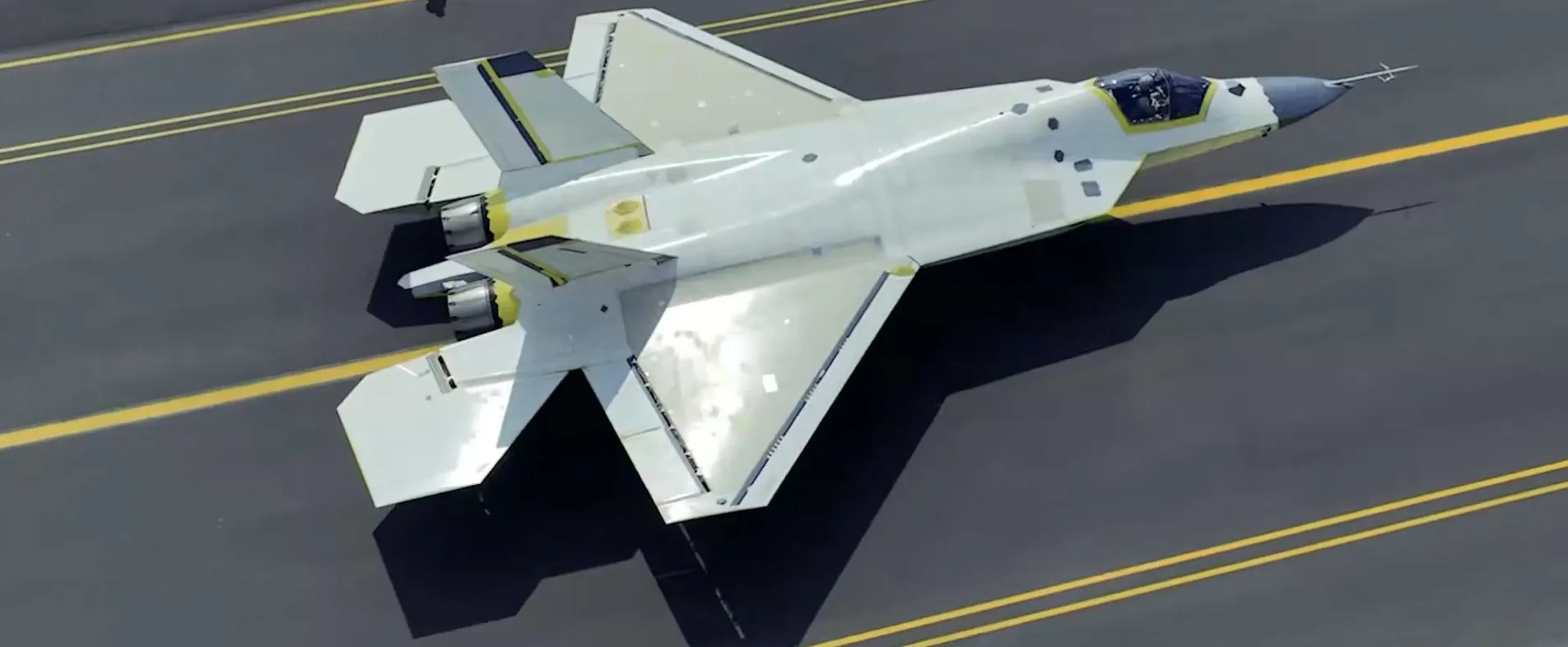
The appearance of P1 also provides the clearest indication yet of how the Kaan design is evolving beyond the original demonstrator. While the overall stealthy twin-engine configuration remains unchanged, the new prototype incorporates several visible refinements that are in line with the move toward a more production-representative aircraft. Compared with P0, the control surfaces have been revised, there are subtle changes around the engine intakes and cockpit areas, and a cleaner external finish.

An overhead view of the P1 during taxi tests. TUSAS

Standard (non-stealthy) exhaust nozzles remain for the twin GE Aerospace F110 turbofans.

The first prototype had a distinctive forward sensor installation, including what appears to be multi-purpose electro-optical and infrared search and track, or IRST, sensors in front of the cockpit and beneath the nose, respectively. These features remain present on the newer aircraft. The faceted sensor enclosures were both removed for the first flight of the P0. You can read more about the aircraft’s intriguing sensor setup here.

Infrared search and track, or IRST sensor on the P1. TUSAS

Turkish Aerospace has not detailed every modification, but P1 is widely expected to feature substantially more representative avionics, flight-control software, and mission systems than the P0, which is largely a proof-of-concept aircraft.

The P1 represents the Kaan program’s transition from a technology demonstrator to a developmental test fleet. Additional prototypes are expected to incorporate further structural, aerodynamic, and systems improvements before the aircraft reaches its final production configuration.

A head-on view of the P1 (above) compared to the P0 (below) reveals a different configuration for the actuators for the aerodynamic surfaces below the wings, a larger sensor aperture above the nose, and landing gear that is both more robust-looking and with main units set wider apart:

Head-on view of the P1 Kaan. TUSAS
Head-on view of the P0 Kaan. SSB

Turkish Aerospace has indicated that P1’s maiden flight is expected within the next couple of months. A third prototype, designated P2, is also under assembly, with the company aiming to have both aircraft flying before the end of this year. That would significantly accelerate the program by allowing multiple aircraft to conduct different elements of the flight-test campaign simultaneously. Initial deliveries to the Turkish Air Force continue to be targeted for 2028 — an ambitious schedule, to say the least.

The P1 Kaan on the runway. TUSAS

The Kaan program was launched back in 2010 as the Milli Muharip Uçak (MMU), or National Combat Aircraft. Early on in its development, the aircraft was known as the TF-X. Now named TF Kaan, it is very much the jewel in the crown of Turkey’s burgeoning aerospace industry.

ANKARA, TURKIYE - MAY 06: (----EDITORIAL USE ONLY MANDATORY CREDIT - 'PRESIDENCY OF DEFENCE INDUSTRIES OF TURKIYE / HANDOUT' - NO MARKETING NO ADVERTISING CAMPAIGNS - DISTRIBUTED AS A SERVICE TO CLIENTS----) The second flight of the national combat aircraft KAAN, which was initiated by the Turkish Defence Industries Presidency (SSB) in order to meet the combat aircraft requirement of the Turkish Air Forces Command and developed by Turkish Aerospace Industries (TAI), is carried out successfully in Ankara, Turkiye on May 06, 2024. According to the statement made by SSB, KAAN stayed in the air for 14 minutes, reaching an altitude of 10 thousand feet and a speed of 230 knots. (Photo by TUR Defence Industries Presidency/Anadolu via Getty Images)
The second flight of the first prototype Kaan, on May 6, 2024. According to the statement made by SSB, it stayed in the air for 14 minutes, reaching an altitude of 10,000 feet and a speed of 230 knots. Photo by TUR Defence Industries Presidency/Anadolu via Getty Images Anadolu

However, it is also worth keeping expectations in perspective. Kaan’s stated objective is to deliver a reduced-radar-signature fighter with high performance, advanced avionics, and modern mission systems. Achieving the same degree of sensor integration, data fusion, networking, and low-observable performance as a fifth-generation fighter, such as the F-35, represents a much higher bar. Even so, a meaningful reduction in radar signature — particularly from the frontal aspect — combined with modern sensors and weapons, would still represent a significant step-up in capability, at least in some respects, over Turkey’s existing fighter fleet, which is dominated by the 1970s-era F-16.

Reportedly, Turkey plans to complete three pre-production prototypes, to be followed by 250 series-production aircraft, incorporating yet more refinements.

A top view of the P1 Kaan. TUSAS

Last month, a contract was reportedly signed for 20 examples of the initial Block 10 versions of the Kaan.

One of the biggest questions surrounding the Kaan program has been its powerplant.

Although Turkey ultimately intends to equip the fighter with an indigenous engine, the prototypes and the first production aircraft will instead rely on the U.S.-built F110 turbofan. Export approval for those engines had emerged as one of the program’s most significant schedule risks. F110s are assembled under license in Turkey but are still governed by U.S. export restrictions.

That uncertainty eased after the Trump administration moved to approve the sale of dozens of F110 engines to Turkey in a deal reportedly worth more than $700 million, ensuring propulsion for the prototype fleet and early production aircraft while development of the indigenous TF35000 engine continues. The domestic engine is expected to arrive only in later production blocks, making continued access to the F110 critical to maintaining the current development timeline.

The engine nozzles on the P1 Kaan. TUSAS

The Kaan’s fortunes have also been entwined with Turkish plans to buy the Lockheed Martin F-35. In 2019, Turkey was kicked out of the Joint Strike Fighter program, in which it had been deeply involved, including at an industrial level, with plans to buy around 100 of the stealth fighters. Washington took that decision after Turkey refused to give up its plans to purchase Russian-made S-400 air defense systems. Since then, there have been signs that the United States might reverse its decision and offer Ankara F-35s again, a development that would surely have knock-on effects for the Kaan.

Once in service, it is anticipated that the Kaan will be used alongside one or more domestically developed drones. Chief among these are the ANKA-3, a low-observable flying-wing uncrewed combat air vehicle (UCAV), and the fighter-like Bayraktar Kizilelma. Again, should these prove successful, Ankara may opt for larger fleets of drones at the expense of more costly crewed fighters. The Kizilelma has already completed the first live trials of the K-SWARM concept, demonstrating collaborative operations between crewed and uncrewed aircraft as part of an effort to develop next-generation autonomous air combat capabilities.

A top view of a Kizilelma UCAV. Baykar

It was announced only yesterday that the Kizilelma had successfully used its internal weapons bays to deploy air-to-ground munitions — in the shape of glide bombs — for the first time. The UCAV had already demonstrated surface-strike and air-to-air capabilities using conventional underwing hardpoints.

Export potential is another important consideration. The Kaan enters an increasingly competitive segment of the global fighter market alongside other medium-weight, low-observable designs, including China’s FC-31 and South Korea’s KF-21, both of which are positioned as more affordable alternatives to Western fifth-generation fighters. Turkey is likewise expected to pursue export customers to help sustain production and reduce program costs. Until the TF35000 engine comes online, any Kaan export sales would also be governed by U.S. restrictions on its engines.

The latest taxi-test footage signals that Turkey is moving into the next phase of Kaan development with a more mature prototype and an expanding flight-test fleet. If P1 flies on schedule and P2 follows later this year, Turkish Aerospace will have multiple aircraft collecting flight data in parallel, an essential step if it hopes to meet its questionably ambitious objective of new fighters being handed over to the Turkish Air Force in 2028.

Contact the author: thomas@thewarzone.com
Thomas Newdick is a staff writer at TWZ, where he covers military aviation, defense technology, weapons systems, and international security. Based in Berlin, Germany, he reports on conflicts, military modernization efforts, and emerging aerospace technologies around the world, with a particular interest in airpower and its role in contemporary warfare. His reporting is informed by deep expertise in modern and historical airpower, particularly in Europe, with a focus on military aviation, air campaigns, and aerospace developments across the continent and beyond.


Source link

Trump Set To Clear Critical F110 Turbofan Engine Sale For Turkey’s Kaan Fighter

The Turkish Air Force looks set to receive a major boost to its fighter fleet, with the delivery of dozens of F110 engines required to power the homegrown TF Kaan combat jet. This would be one of the most significant positive developments in U.S.-Turkish defense relations since Turkey was ejected from the F-35 program in 2019, and may even pave the way for Ankara to rejoin that effort.

Citing four sources familiar with the matter, Reuters reports that President Donald Trump’s administration plans to go ahead with the engine sale, said to be worth more than $700 million, despite some resistance from Congress.

Ahead of his July trip to a NATO summit in Turkey, Trump was asked by a reporter whether Turkish President Tayyip Erdogan would be provided with a “big gift” in the form of F110 engines and potentially F-35 fighter jets.

“He’s a member of NATO,” Trump replied. “He really is a strong member of NATO. Yeah, I’m going to probably do something that’s going to make him very happy.”

Speaking alongside Trump, Vice President JD Vance said a review was underway to see if Turkey could receive the F-35.

“Pete and the entire team are reviewing this right now, because there are certain things that we have to certify have happened … in order to comply with American law,” Vance ⁠said, referring ​to Secretary of Defense Pete Hegseth.

The question of whether Turkey might receive F-35s has long been a fraught one, with Ankara kicked out of the program back in 2019, a development we will return to later.

For now, however, Turkey’s priority seems to be securing F110 engines.

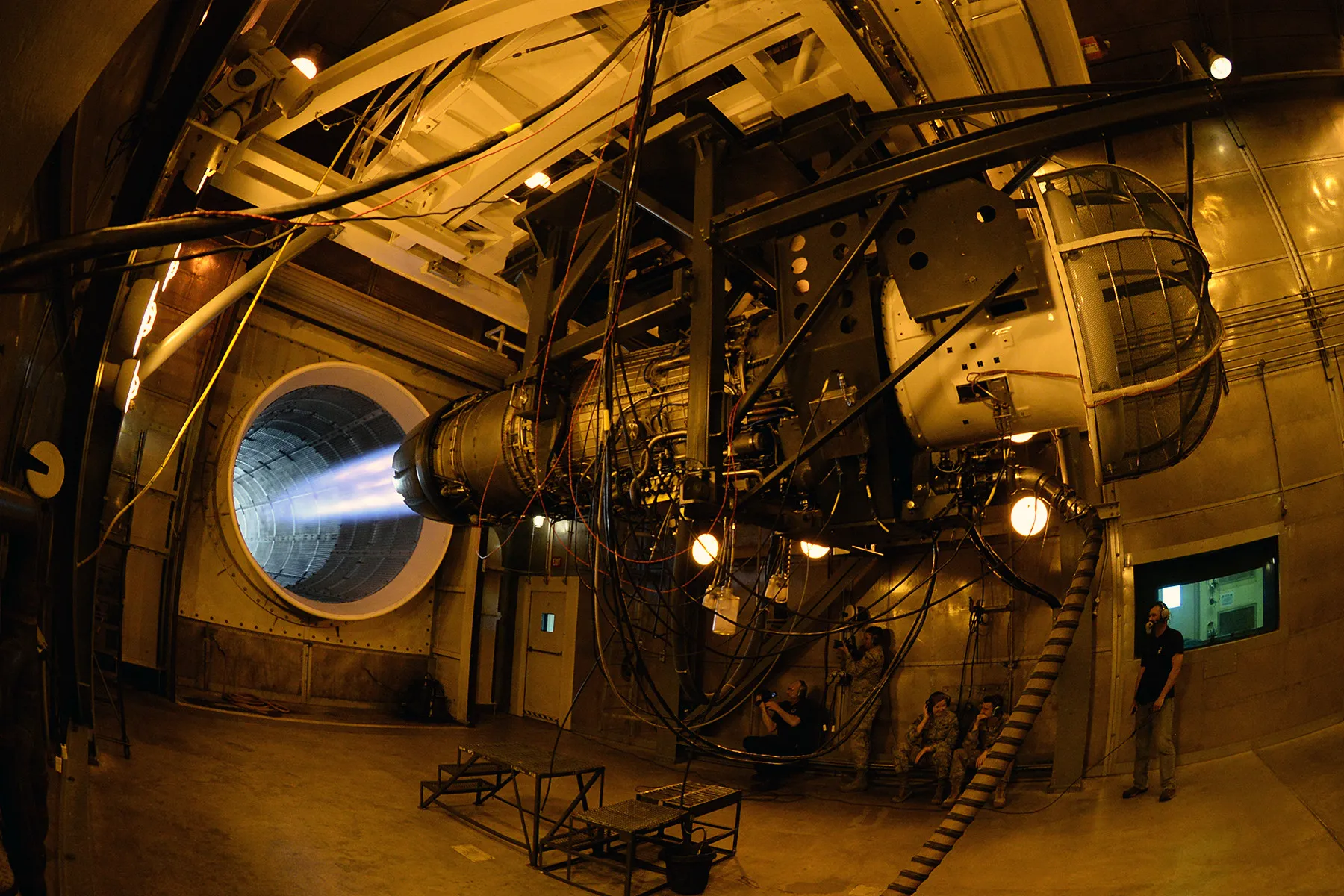
Airmen from 2nd Audiovisual Squadron film an F-16 jet Fighting Falcon engine in max power during a test in the 576th Aircraft Maintenance Squadron’s hush house engine facility at Hill Air Force Base, Utah, June 5, 2019. The shop is responsible for performing organizational level maintenance on more than 200 engines per year. The shop’s maintenance tasks include engine inspections, external engine component removal and replacement, repairs and troubleshooting during flightline and test cell operations. (U.S. Air Force photo by Alex R. Lloyd)
The F110 engine for an F-16 at max power during a test in the hush house engine facility at Hill Air Force Base, Utah. U.S. Air Force photo by Alex R. Lloyd

Turkey’s TF Kaan next-generation fighter is a flagship program of the country’s burgeoning aerospace industry. The program was launched in 2010, and the first prototype took to the air in early 2024.

Reportedly, Turkey plans to complete three pre-production prototypes, to be followed by 250 series-production aircraft, incorporating various refinements.

Last month, a contract was reportedly signed for 20 examples of the initial Block 10 versions of the Kaan.

The twin-engine Kaan was developed with a reduced radar signature in mind, as well as a high level of performance and modern avionics and other systems. As a result, it doesn’t offer the same level of low observability as the F-35, while its sensor fusion, electronic warfare capabilities, and other ‘fifth-generation’ features lag behind the U.S.-designed jet.

One of the F-35s that was completed for Turkey before its ejection from the program. Lockheed Martin

Critically, the Kaan is powered by U.S.-supplied General Electric F110 turbofans.

F110s are assembled under license in Turkey by TUSAS Engine Industries (TEI) but are still governed by U.S. export restrictions. These engines are already used in significant numbers by the Turkish Air Force F-16 fleet, the third-largest in the world. Outside of the F-16, the F110 is also used in the F-15E Strike Eagle and F-15EX Eagle II, among other F-15 variants. An F110 comes with a typical flyaway unit cost of $10 to $15 million.

The Kaan program has long been overshadowed by the question of whether Washington will make available in larger numbers the F110 turbofans used in the prototype. Reportedly, an initial batch of 80 engines is required.

While Turkish officials have expressed hope of ultimately switching to a domestically produced engine type for the Kaan, TEI’s TF35000, it’s unclear how realistic this is, at least in the near term. Turkey has also looked at acquiring alternative engines, too, including those from Russia or Rolls-Royce in the United Kingdom.

In the meantime, the importance of the Kaan to the Turkish Air Force increased significantly in 2019, when it became clear that Ankara would be kicked out of the F-35 program, in which it had a considerable industrial stake, and a plan to buy around 100 of the fighters. Washington took that decision after Turkey refused to abandon its purchase of Russian-made S-400 long-range air defense systems.

ANKARA, TURKEY - JULY 12 : (----EDITORIAL USE ONLY MANDATORY CREDIT - " TURKEY'S NATIONAL DEFENCE MINISTRY / HANDOUT" - NO MARKETING NO ADVERTISING CAMPAIGNS - DISTRIBUTED AS A SERVICE TO CLIENTS----) Russian Ilyushin Il-76, carrying the first batch of equipment of S-400 missile defense system, arrives at Murted Air Base in Ankara, Turkey on July 12, 2019 as S-400 hardware deployment started. Following protracted efforts to purchase an air defense system from the U.S. with no success, Ankara signed the supply contract in April 2017 to purchase the Russian S-400s. (Photo by Turkeys National Defense Ministry / Handout/Anadolu Agency/Getty Images)
A Russian Ilyushin Il-76, carrying the first batch of equipment for the Turkish S-400 missile defense system, arrives at Murted Air Base in Ankara on July 12, 2019. Photo by Turkish National Defense Ministry / Handout/Anadolu Agency/Getty Images

As well as the S-400, U.S. lawmakers were unhappy with Turkey’s worsening relations with Greece, its other connections with Russia and Azerbaijan (which included the deployment of F-16s to the latter country), its conduct in the Syrian civil war, and human rights abuses. Turkey’s opposition to Sweden joining NATO also proved to be a significant hurdle.

In the wake of all this, the chances of Turkey receiving F110 engines were dramatically reduced. At the same time, Turkey’s request to buy additional F-16 fighters was also turned down. Turkey reportedly also began stockpiling spare parts for its F-16 back in 2019, fearing the effects of U.S. sanctions.

BALIKESIR, TURKIYE - MAY 22: Turkish Air Force F-16 fighter aircrafts are seen during test flight in Balikesir, Turkiye on May 22, 2022. The 161st Fleet Command, the only fleet of the Turkish Air Force with two call names - coded as "Eagle" during the day and "Bat" at night - takes an active role in both the protection of the airspace in Aegean Region and the combat against terrorism. (Photo by Ali Atmaca/Anadolu Agency via Getty Images)
Turkish Air Force F-16 fighters at Balikesir, Turkey, in May 2022. Photo by Ali Atmaca/Anadolu Agency via Getty Images

Toward the end of the Biden administration, U.S.-Turkish relations began to improve, and Washington moved to push through sales of new F-16s and upgrade kits for older jets to Turkey. There also began to be suggestions that the F-35 was potentially back on the table for Turkey.

Under the Trump administration, Washington’s relationship with Ankara has become closer, with Erdogan frequently praised by the U.S. leader.

In early 2024, the U.S. State Department finally approved a possible Foreign Military Sale to Turkey of 40 new F-16C/D Block 70 fighters, plus the upgrade of 79 existing aircraft to F-16V configuration.

At the same time, the issue surrounding the S-400 and the sanctions that followed that acquisition remains.

As it stands, U.S. law does not permit Turkey to operate or possess the S-400 system if it wishes to rejoin the F-35 program, as a result of security concerns around the Russian-made system.

TEXAS, USA - JUNE 21: A F-35 fighter jet is seen as Turkey takes delivery of its first F-35 fighter jet with a ceremony at the Lockheed Martin in Forth Worth, Texas, United States on June 21, 2018. (Photo by Atilgan Ozdil/Anadolu Agency/Getty Images)
The first F-35 for Turkey was rolled out during a ceremony at the Lockheed Martin plant in Fort Worth, Texas, on June 21, 2018. Photo by Atilgan Ozdil/Anadolu Agency/Getty Images

During a visit to Turkey in early 2024, the U.S. Acting Deputy Secretary of State Victoria Nuland reportedly suggested that the United States might be willing to offer Patriot air defense systems if it were to give up its S-400s, which could also clear the way to re-entering the F-35 program.

“Frankly, if we can resolve this S-400 issue, which we want to do, the United States would be pleased to welcome Turkey back into the F-35 family,” Nuland said. “But we must solve this other issue first, and while we solve it, we must also ensure that Turkey has a strong air defense.”

The apparent decision to clear the F110 sale certainly represents a further softening of Washington’s stance, and it could be a stepping-stone to Ankara eventually being readmitted to the F-35 program.

Turkey’s desire for F-35s has only been intensified by the fact that Greece, its major strategic rival, has been approved for a purchase of the jets. You can read all about how tensions between Greece and Turkey are reflected in the countries’ respective air forces in this previous feature.

ANKARA, TURKIYE- MAY 1: Presentation ceremony of the National Combat Aircraft KAAN on May 1, 2023 in Ankara, Türkiye. According to the President's statements, the National Combat Aircraft (MMU) or TF-X "Kaan" project, which will enter the inventory of the Turkish Armed Forces, is considered an important step in Turkey's aviation and defense industry. (Photo by Yavuz Ozden/ dia images via Getty Images)
Presentation ceremony of the Kaan on May 1, 2023, in Ankara. Photo by Yavuz Ozden/ dia images via Getty Images

Even regarding the F110 transfer, some opposition to defense sales to Turkey remains in Washington.

In particular, Representative Gregory Meeks of New York, the leading Democrat on the House of Representatives Foreign Affairs Committee, has reportedly stood in the way of the engine sale during an informal review process.

However, according to the four sources who spoke to Reuters, the F110 deal should be “finalized in the coming days, followed by a formal notification from the State Department to Congress.”

While lawmakers can use the congressional review process to raise their concerns over big-ticket defense exports, the administration can override these.

According to the Wall Street Journal, the Trump administration is expected to override Meeks’ effort to block the engine deal.

For the Kaan program, the F110 is vital.

Denied the F-35 and with F-16 deals moving forward only slowly, Turkey has been forced to look elsewhere to meet its short-term fighter needs. Most significantly, it signed a deal for 20 Eurofighter Typhoon jets last October.

U.K. Prime Minister Keir Starmer and Turkish President Tayyip Erdogan sign the Typhoon deal in Ankara in October 2025. Eurofighter 

Turkey has also been investing heavily in drones, including the ANKA-3, a low-observable flying wing uncrewed combat air vehicle (UCAV), and the fighter-like Bayraktar Kizilelma. Still, these are viewed as adjuncts to advanced crewed fighters, like the Kaan.

Whether securing the F110 engines means the Kaan meets its target of service entry around the 2030 timeframe remains questionable.

However, it is a major step in that direction.

As well as being fielded by the Turkish Air Force, the Kaan could have significant potential for export, although sales would be governed by U.S. restrictions on its engines. It is one of a number of medium-weight fighters that feature low-observable characteristics and advanced avionics. These include China’s FC-31 and South Korea’s KF-21.

The Chinese Shenyang FC-31 fighter prototype. via Chinese internet

Reportedly, Indonesia already signed a contract for 48 Kaan fighters last June.

Perhaps most importantly, the F110 deal would get back on track what is very much the flagship of Turkey’s military aerospace industry. At the same time, a U.S. decision to provide Ankara with these engines will also be welcomed by those in Turkey who still wish for a way back into the F-35 program.

Contact the author: thomas@thewarzone.com

Thomas Newdick is a staff writer at TWZ, where he covers military aviation, defense technology, weapons systems, and international security. Based in Berlin, Germany, he reports on conflicts, military modernization efforts, and emerging aerospace technologies around the world, with a particular interest in airpower and its role in contemporary warfare. His reporting is informed by deep expertise in modern and historical airpower, particularly in Europe, with a focus on military aviation, air campaigns, and aerospace developments across the continent and beyond.


Source link