‘Gladiator fight’ cases against L.A. juvenile hall staffers fall apart
More than a year after California Atty. Gen. Rob Bonta announced indictments against 30 probation officers accused of coordinating or allowing so-called “gladiator fights” between youths inside L.A. County juvenile halls, almost half of the criminal cases are falling apart.
In recent weeks, state prosecutors dismissed charges against at least 10 of the 30 officers from the initial indictment, according to court documents and interviews with defense attorneys. An additional four officers entered into plea deals Tuesday that will end with their cases dropped after completing community service.
Attorneys for the officers and probation union officials said the prosecutions were an overreaction to a video — first published by The Times in 2024 — that showed officers standing by as several youths pummeled a fellow inmate at Los Padrinos Juvenile Hall in Downey.
“I believe the case was a reactionary case that was overcharged,” said attorney Adam Koppekin, who represents an officer whose case was dismissed. “They swept in a bunch of truly innocent probation officers who were following directives and doing their jobs.”
Two officers at the center of the Los Padrinos fight video — identified in court filings as Taneha Brooks and Shawn Smyles — remain charged with multiple counts of child abuse and conspiracy to commit willful cruelty against children. In the security video, the two officers can be seen laughing and shaking hands with the assailants. The 17-year-old who was attacked in the video suffered a broken nose and a concussion, according to a summary of his grand jury testimony contained in a motion filed in the case.
Brooks has repeatedly declined to speak to Times reporters. She showed up in court Tuesday in support of the other officers. E-mails to her attorney and a lawyer representing Smyles were not immediately returned.

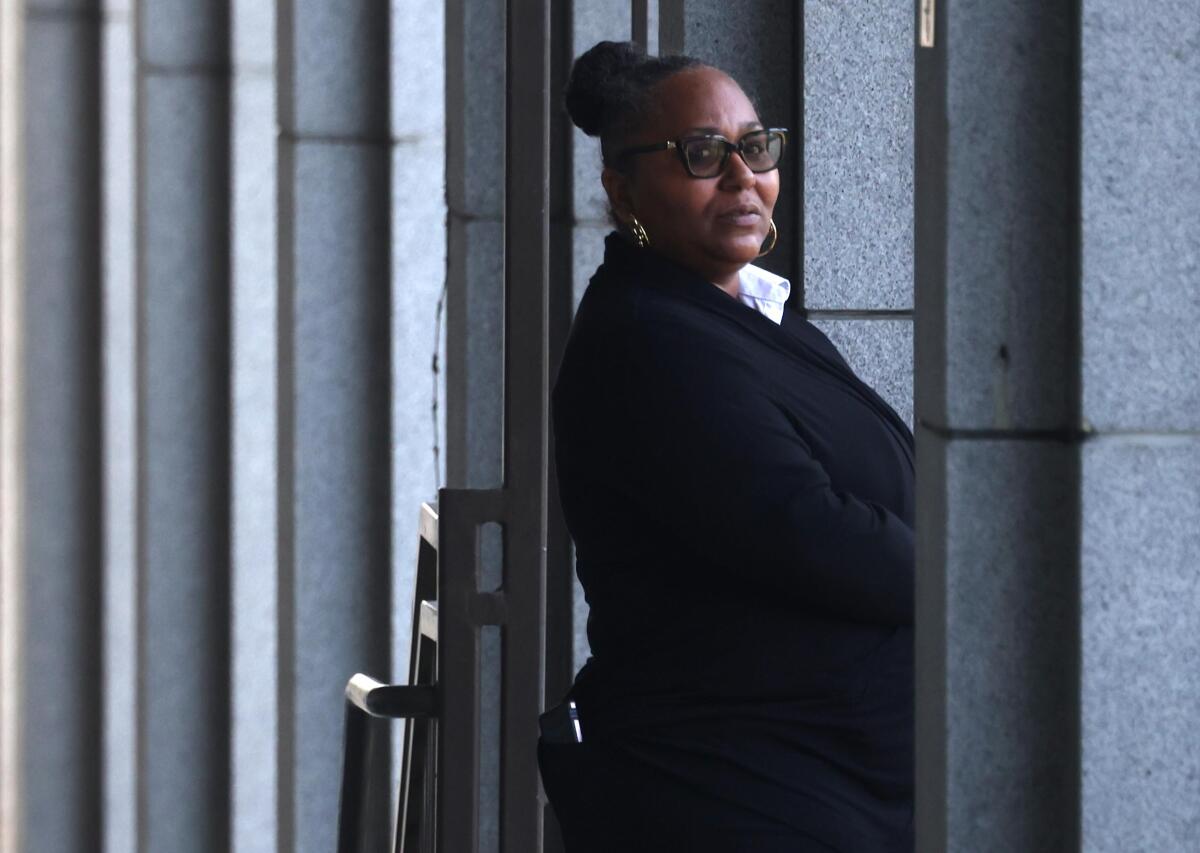
Taneha Brooks, an L.A. County probation officer listed as the top defendant in the “Gladiator Fight” case, leaves the Clara Foltzridge Criminal Justice Center on Tuesday, April 7, 2026 in Los Angeles, CA. Brooks has been accused of orchestrating and allowing many of the fights between juveniles in L.A. County detention centers that sparked the California Department of Justice’s investigation. Her case will be heard in May.
(Genaro Molina/Los Angeles Times)
Bonta said when announcing charges last year that his office had identified 69 other fight incidents involving nearly 150 youths between the ages of 12 and 18. The 30 officers were indicted on 71 counts of conspiracy, battery and child abuse.
But many of those other fights were different from the 2023 video in that they lasted only seconds, involved minimal injuries and ended after probation officers intervened, according to defense motions and video reviewed by The Times.
The Times confirmed that state prosecutors dismissed charges against 10 officers in recent weeks through interviews with attorneys and two law enforcement sources who spoke on the condition of anonymity to discuss an ongoing investigation.
Court documents reviewed by The Times showed that some of the cases were dismissed “in the interest of justice” after motions filed by the state attorney general’s office. Records of those officers’ arrests were then ordered sealed, the documents show.
In a statement Tuesday, the attorney general’s office said it adjusts its treatment of defendants “based on our continued consideration of all evidence developed before, during and after criminal charges were initiated.”
“Some defendants were appropriately dismissed from the case based on the law as applied to their factual circumstances,” the statement said.
Amid the dismissals and plea deals, Bonta’s critics questioned his fitness to take over the probation department to enforce needed reforms, a move the attorney general has been seeking court permission to make since last year.
“What we are seeing raises real questions about a rush to judgment, one that has already had the effect of maligning an entire profession without the facts being fully vetted,” Curtis Chambers, president of the union that represents rank-and-file probation officers, said in a statement. “When cases begin to fall apart after being advanced so publicly, it is fair to ask whether the process itself was flawed from the outset.”
Motions to dismiss charges in the case paint some of the officers as rookies deferring to their superiors. Defense attorneys for others questioned why state prosecutors charged officers who failed to intervene in fights that were in effect over before they began.
The Times reviewed video of one incident that showed a fistfight between two youths that lasted 20 seconds. In the brief dust-up, the teens throw a series of wild hooks at each other with few of the punches actually making contact. The officer charged in that incident briefly paused before joining a crowd of other officers who pulled the two apart. That officer, whose case has since been dismissed, was charged with two counts of willful cruelty to a child.
The indictments — along with a civil lawsuit and grand jury testimony referenced in motions to dismiss the charges — portray Brooks and Smyles as the main drivers of the fights.
They told other officers who were present, all of them rookies in the juvenile halls, “not to say anything, write down anything, and just watch when youth fights occurred,” according to the charges.
One juvenile told grand jurors he was “incentivized to fight” by Brooks and claimed both officers “rewarded him for fighting by giving him extra snacks,” according to a motion to dismiss filed on behalf of one officer.
According to the court filing, the juvenile told the grand jury that Brooks awarded special jobs to kids she favored.
“He testified Ms. Brooks would pick the ‘KP’ or kitchen patrol person based upon that person’s fighting prowess,” the motion said.
A Times investigation last year found the practice of probation officers rewarding teens who beat up other youths in custody was a problem that predated the “Gladiator Fight” scandal, with one attorney calling it an “open secret.”
Jonathan Evans, who represents Officer Isaiah Goodie, said his client was specifically told by Brooks and Smyles not to break up fights.
“They were seeing that these kids from different neighborhoods were going to fight anyway and they were finding a way to get it out of their system,” Evans said of the senior officers’ training of his client.
Two law enforcement officials told The Times that Brooks and Smyles had been investigated for allowing fights to happen years earlier while assigned to Central Juvenile Hall. It was unclear what, if any, discipline they faced.
One of the cases that will be dismissed after a plea agreement involved a high-ranking officer, 54-year-old Ramses Patron. He was charged with child abuse for failing to stop a fight that lasted less than 10 seconds, according to a motion to dismiss. His attorney, Tom Yu, argued that the state had wrongly accused many officers of planning fights that either occurred spontaneously or were arranged by Brooks and Smyles.
Patron must serve 40 hours of community service and then his case will be dismissed. Yu said his client has served the Probation Department for 30 years with a “spotless record” and the indictment upended his life.
“There’s no words to describe what my client and his family went through,” Yu said.

Indicted probation officer Ramses Patron, center, stands with his attorney Tom Yu, right, pleading no contest in the “Gladiator Fights” case.
(Genaro Molina/Los Angeles Times)
Advocates for the officers whose cases were dismissed said they had suffered serious harm to their finances and reputations, with each placed on leave without pay for more than a year.
“County employees are entitled to due process. To the extent that charges are reduced or dismissed, employees may have the right to seek reinstatement or back pay,” said Vicky Waters, communications director for the Probation Department.
Several defense attorneys credited the state prosecutors for scrutinizing the charges more thoroughly and ultimately deciding that some of the cases did not pass the smell test.
“Everybody would love an apology letter,” said defense attorney Bart Kasperowicz. “They did this giant witch hunt sweep and effectively changed the lives of 30 people and all the people that depend on them.”