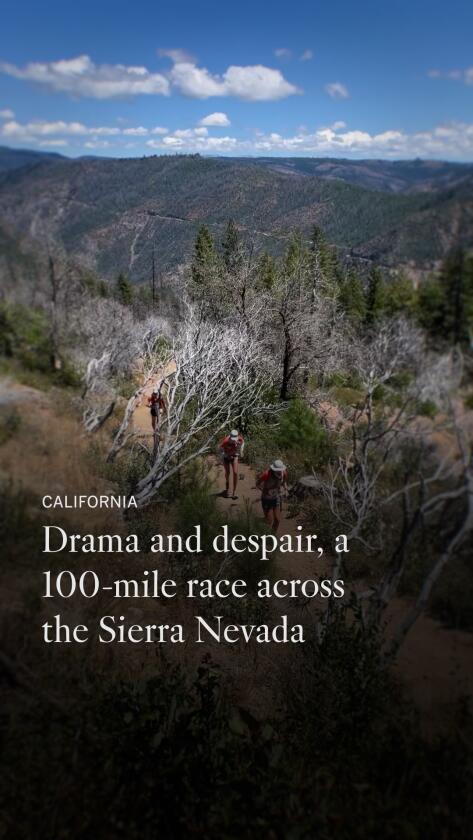
100 miles of agony and hope: A cancer survivor’s ultramarathon journey
OLYMPIC VALLEY, Calif. — In the pre-dawn chill of the Sierra Nevada, Christina Klayko bounced on the balls of her feet, trying to keep warm and calm before one of the planet’s most punishing competitions.
Surrounding her at the starting line for the Western States Endurance Run — a lung-busting 100-mile race over towering mountain ridges and through deep, sun-scorched canyons — were some of the most elite athletes in the world, including former champions, record holders and an Olympic marathon medalist.

-
Share via
Klayko, a 48-year-old mother of three, had no illusions about winning — she was just relieved to be there. She is a two-time cancer survivor, and a year earlier, she was lying on an operating table enduring a full hysterectomy, followed by months of radiation treatment. She was terrified she might die.

Spectators trekked to Emigrant Pass before dawn to cheer at the first significant milestone the Western States Endurance Run.
“I was in a very dark place,” she said. “I would have given anything just to be able to walk my dog around the block.”
But Klayko, a former software engineer from Los Altos, has never been a quitter. In her twenties, following a breast cancer diagnosis and a full mastectomy, she finished an Ironman triathlon. Last Saturday, she was hoping to complete an even more miraculous comeback.
To do so, she would have to run almost half the width of California, from the shores of Lake Tahoe to Auburn, a former mining town in the foothills above Sacramento, along remote, rock-strewn paths that rise and fall like a roller coaster.
In all, she would have to propel herself up more than 18,000 vertical feet, or three times the elevation hikers climb to the summit of Mt. Whitney, the tallest peak in the contiguous U.S. And she’d have to endure relentless jack-hammering from nearly 23,000 feet of descent.
Hard things are nothing new to her, Klayko said. And unlike cancer, running is a choice. You can walk away when you’ve had enough.
There’s no prize money for doing well in the Western States 100, but finishers get a commemorative belt buckle and, more importantly, membership in one of the most exclusive clubs in all of sports. More than 11,000 runners entered a lottery for fewer than 400 spots this year. Many had waited for more than a decade for their chance.
But there’s a cruel twist — not everyone who crosses the finish line wins the bragging rights.
There’s a strict 30-hour time limit. Which means, most years, dozens of competitors struggle over snow-capped mountains, push themselves to the brink of heat stroke in the sweltering canyons and endure a long, dark night in the wilderness, only to show up at the finish line a few minutes late.

Eric Strand, 65, of Wildwood, MO, center, runs in front of the Granite Chief Wilderness at the start of the Western States Endurance Run.
They’re not acknowledged as finishers. As far as the official record is concerned, they didn’t make it.
So as Klayko waited for the ceremonial shotgun blast that signals the start, she wasn’t worrying about cancer, or mortality, or even the hours of torture that lay ahead — she was dreading the cutoff.
“I knew I could just push and push as long as I had to,” Klayko said. But she couldn’t escape the looming fear of “running out of time.”
The first major obstacle was Emigrant Pass, a high ridge that is four miles, almost straight uphill, from the start at the Palisades Tahoe ski resort.
Half an hour after the start, the sun peeked over distant summits, turning the horizon orange, and the first runners approached the top.
In the lead pack was Jim Walmsley, a four-time Western States champion and holder of the course record — an astonishing 14 hours, 9 minutes and 28 seconds. Spaniard Kilian Jornet, arguably the greatest ultra runner of all time, was right there with him. That was no surprise. In addition to having won Western States and almost every other notable ultramarathon, Jornet famously summited Mt. Everest twice in one week — without supplemental oxygen.
Among the women was Molly Seidel, perhaps the most recognizable name after Jornet. Seidel had been a 27-year-old barista and babysitter before the COVID-delayed Olympics in 2021, when she shocked the running world by winning the bronze medal in the marathon. It was only the third marathon she had ever run.
These battle-hardened pros barely flinched when they crested the ridge and ran headfirst into bitter, gale-force winds gusting to 65 mph. Their bare, muscled legs kept pumping steadily and carried them down the other side, where the gusts quickly subsided.
The rest of the pack didn’t make it look so easy.

Spectators watch the sunrise before the start of the Western States Endurance Run.
Many were hunched and gasping as they struggled toward the crest. One woman bent over and started retching violently. Locking eyes with a reporter, she shouted, “I’M OK!” — apparently unaware that she was screaming over the wind and whatever was playing in her headphones. “I JUST SWALLOWED TOO MUCH SPIT!”
Then she straightened and staggered into the howling gale: only 96 more miles to go.
Seven hours later, at mile 56, the lead runners climbed out of the course’s deepest and hottest canyon, onto a dusty promontory called Michigan Bluff.
The first few looked almost as fresh and fast as they had at the ridge. But the punishment was starting to show on everyone else.
Jornet, who had been nursing a knee injury before the race, was concerned about the canyons. He didn’t make it through them, dropping out at mile 38.
Walmsley, who had been among the leaders for the first 30 miles, was fading by Michigan Bluff. Persistent hip pain would force him from the race at the next aid station. At this point, most of the other runners, including Klayko, were hours behind.
Justin Grunewald, a 40-year-old Colorado doctor, who some picked as a dark horse contender to finish in the top ten, looked exasperated as he emerged from the canyon. He went straight to his support team, who started dumping water down the back of his shirt and tying an ice bag around his neck.
“I’m totally fine,” he told them, “but my knee is killing me because I keep eating s—.” That’s runner shorthand for falling.
His knee was bleeding, but the real problem was his vision. He pulled off his sunglasses, and his eyes were a scary shade of red. He leaned his head back while a friend squeezed drops into them and reminded him to keep wearing his glasses. Obvious advice — but what else do you say to someone hellbent on running another 44 miles?
“Ultra runners are a strange breed,” said Amanda Basham, Grunewald’s wife. She was on his support team this year, but she has twice finished the race in fourth place.

Jacob Banta, of Mill Valley, pushes up the trail near Michigan Bluff during the Western States Endurance Run.
As Grunewald composed himself and trotted off into the distance, it seemed like a good time to ask the obvious: why does anyone put themselves through such an ordeal?
Basham laughed and said most people would probably brush the question aside with something safe and trite, like, “I just love running!” But the truth, she said, is that “almost everyone here has an intense story.”
Grunewald’s first wife and running partner, Gabe, died after fighting a rare cancer for 10 years, Basham said. Other competitors have lost a child, struggled with mental health or battled addiction. Running long distances on secluded trails can be a coping mechanism. For some, showing up at big races to commune with their tribe is like group therapy.
“We all come together for this common thing, and it doesn’t really matter if you went to rehab 10 times,” Basham said. “You’re here trying to get better, and it’s cool.”
Minutes later, Seidel hobbled out of the canyon clutching her thighs. When her crew offered her a chair, she tried to settle but started panting in pain, apologizing that she was in too much agony to sit.
This was her first attempt at 100 miles. She would explain later that she hadn’t eaten enough during the race and had developed excruciating skin lesions from chafing. It looked like her day was done, but she refused to quit.
The women’s winner, Jennifer Lichter, might have the most intense story of them all. Born in Bogota, Colombia, she was a nine-year old orphaned by cartel violence when a couple from Wisconsin adopted her.
In her first 100-mile race, she shaved a minute off the women’s course record, finishing in 15 hours, 28 minutes and five seconds.
The men’s winner, Vincent Bouillard, smashed the overall course record by more than 20 minutes, sprinting across the line in 13 hours, 46 minutes and 15 seconds.
Klayko, who never imagined herself involved in the chase for records, emerged from the canyon eight hours behind the leaders.
For most of the race, she hovered between hiking fast and running slow. She subsisted mostly on energy chews and gels, indulging in a baked potato sprinkled with salt at one point, and luxuriating in a cup of broth with rice at another.
Was attempting the race wise, given her health? Had she told her doctors she was planning to do this?
“That’s, um, a good question,” she said with a chuckle. “They know I’m a serious runner but … I don’t think I actually told them I was running the Western States.”
Probably for the best.
Like a lot of the runners, Klayko said she got a jolt of much needed energy at mile 78, on the bank of the American River, where the run suddenly turns into an obstacle course.
Racers grab a thin nylon rope and gingerly wade into the freezing water. Volunteers offer life vests and stay close to prevent drownings, but offer no assistance.

A racer crosses the American River during the Western States Endurance Run.
Near the middle of the crossing, the water got so deep that many runners submerged completely, pulling on the rope to haul themselves to the far bank.
“It definitely woke me up,” Klayko said of her crossing in the dark at 3 a.m. “It was a lot colder than I expected.”
On the other side — soaked to the bone, with wet clothes and shoes — she crawled back onto the dusty trail and started running again. Soon after, the trouble set in.
It began with a burning sensation on the bottom of her left foot. As the pain intensified, she started hobbling, leaning on the trekking pole in her right hand to take pressure off the blister that was growing bigger than a golf ball.
With just miles to go, her husband, Chris, who ran beside her — after the halfway point, competitors are allowed to have a companion for safety — kept checking the time. They were falling behind.
What do you say to someone you love in such a situation? You don’t want them to suffer, but you don’t want them to fail.
“We need to hustle,” he told her.
In the last few hundred yards, the race enters the football stadium at Placer High School. Seidel had finished hours earlier, at 5:29 a.m., when the stadium was relatively empty.
But the last 60 minutes before the notorious cutoff — known as Golden Hour — attracts a huge crowd.
Cameras film from every angle as one battered body after another circles the track. Some jog, some hobble, some openly sob. Whatever they do, it’s fully public and likely to go viral on social media.

Christina Klayko pushes for the finish at Placer High School with just minutes to spare in the Western States Endurance Run..
Klayko said she was coached to visualize her finish during training. In her head, it looked nothing like this.
When she came around the final bend with the clock ticking down, gasps arose from the media gaggle behind the finish line.
Desperate to compensate for the enormous blisters on both feet now, she leaned forward and to the right at almost 90 degrees — wobbling and weaving on her heels, relying on trekking poles to stay upright and claw forward.
It was hard to watch but impossible to look away.
When she was finally in stumbling distance of the line, Chris bounced up and down and thrust his arms in the air. The crowd roared.
She finished with 18 minutes to spare.

Christina Klayko nearly collapsed after crossing the finish with minutes to spare in Western States Endurance Run.