justices

Expanding Supreme Court justices and risk to judicial independence

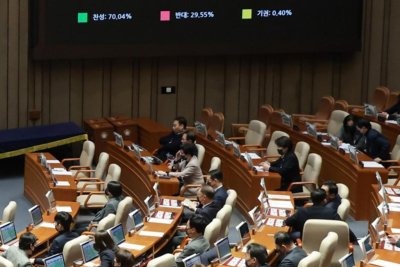
Lawmakers pass a bill to increase the number of Supreme Court justices during a plenary session of the National Assembly in Seoul, South Korea, 28 February 2026. Photo by YONHAP / EPA

March 4 (Asia Today) — In U.S. history, only one president served four terms: Franklin D. Roosevelt. Facing the unprecedented economic crisis of the Great Depression, Roosevelt pushed forward sweeping New Deal legislation to revive the economy. With Congress controlled by his Democratic Party, the political environment initially seemed favorable.

However, Roosevelt’s New Deal soon faced a major obstacle: opposition from the conservative-leaning U.S. Supreme Court. Several core New Deal laws were struck down as unconstitutional.

After winning re-election in 1936 with 61% of the vote, Roosevelt proposed a plan to expand the Supreme Court. Under the proposal, the president could appoint additional justices if sitting justices over the age of 70 years and six months did not retire. Because six justices were already over that age, the court could have expanded from nine members to as many as fifteen.

The proposal became known as “court packing” – an attempt to add justices favorable to the administration.

Opposition emerged from unexpected quarters. Not only Republicans but also members of Roosevelt’s own Democratic Party objected. Even Vice President John Nance Garner opposed the plan, warning it could create a dangerous precedent by allowing a president to reshape the judiciary for political purposes.

The proposal was ultimately withdrawn without a vote.

Another leader who reshaped the judiciary was Venezuelan President Hugo Chávez. After taking power, Chávez expanded the number of Supreme Court justices and appointed individuals loyal to his government. Once the executive branch gained control over the judiciary, the court largely lost its ability to check the administration.

The consequences were severe. Venezuela’s political system deteriorated, and the power structure Chávez built has remained firmly in place under his successor, Nicolás Maduro.

In South Korea, a revision to the Court Organization Act aimed at expanding the number of Supreme Court justices passed the National Assembly on Feb. 28 with 173 votes in favor, 73 against and one abstention. The legislation now awaits promulgation by the president.

If enacted, the number of Supreme Court justices will increase from 14 to 26. President Lee Jae-myung would have the authority to appoint not only the 12 newly added justices but also replacements for 10 justices whose terms are set to expire, including Chief Justice Cho Hee-dae. In total, the president could appoint 22 of the court’s 26 justices during his term.

Expanding the number of justices is not simply a matter of increasing seats.

In Venezuela, Chávez filled the court with allies and during his tenure the Supreme Court issued virtually no rulings against the government. The judiciary effectively lost its role as an independent check on executive power.

Even Roosevelt – widely admired in American history – saw his attempt to expand the Supreme Court become one of the most controversial episodes of his presidency.

History offers clear lessons about the consequences of governments attempting to dominate the judiciary. Once the independence of the courts is compromised and the balance of powers between branches of government is weakened, any leader risks being viewed as moving toward authoritarian rule.

— Kim Chae-yeon, Asia Today

The views expressed in this column are those of the author and do not necessarily reflect the position of the publication.

— Reported by Asia Today; translated by UPI

© Asia Today. Unauthorized reproduction or redistribution prohibited.

Source link

Trump, JD Vance vilify ‘lawless’ Supreme Court justices over tariff ruling | Trade War News

President Trump calls Supreme Court justices an ’embarrassment to their families’ in 45-minute address to the media.

United States President Donald Trump and his vice president, JD Vance, have launched personal attacks on the justices of the US Supreme Court and their families, after the country’s top court struck down trade tariffs imposed by the White House.

In a 45-minute address to reporters at the White House, the US president heaped criticism on the six justices who ruled against his signature tariff policy in the 6-3 decision by the court on Friday, including Neil Gorsuch and Amy Coney Barrett, whom Trump appointed to the court during his first term.

Recommended Stories

list of 4 itemsend of list

“I think it’s an embarrassment to their families, you wanna know the truth, the two of them,” Trump said, referring to Justices Gorsuch and Barrett.

“I’m ashamed of certain members of the court – absolutely ashamed – for not having the courage to do what’s right for our country,” Trump added.

Shockingly, Trump also claimed that the Supreme Court “has been swayed by foreign interests”, without providing any evidence.

US President Donald Trump takes question from reporters during a press conference in the Brady Press Briefing Room of the White House in Washington, DC, on February 20, 2026.
US President Donald Trump takes questions from reporters during a news conference at the White House in Washington, DC, on February 20, 2026 [Mandel Ngan/AFP]

Trump then warmly praised the three members of the court who dissented in the ruling.

“I’d like to thank and congratulate Justices [Clarence] Thomas, [Samuel] Alito, and [Brett] Kavanaugh for their strength and wisdom and love of our country, which is, right now, very proud of those justices,” Trump said.

“When you read the dissenting opinions, there’s no way that anyone can argue against them,” he said.

Vice President Vance also sharply criticised the justices for their ruling, accusing them of “lawlessness” in a post on X.

“Today, the Supreme Court decided that Congress, despite giving the president the ability to ‘regulate imports’, didn’t actually mean it,” Vance wrote in a post on X.

“This is lawlessness from the Court, plain and simple,” said Vance, whose political profile rose to prominence after writing a memoir about his time at Yale Law School.

Trump and Vance’s comments mark a rare rebuke of the nine-member Supreme Court, which currently has six members appointed by Trump’s Republican Party and has often ruled in favour of his administration’s policies.

Source link

Trump lashes out at justices, announces new 10% global tariff

President Trump on Friday lashed out at Supreme Court justices who struck down his tariffs agenda, calling them “fools” who made a “terrible, defective decision” that he plans to circumvent by imposing new levies in a different way.

In a defiant appearance at the White House, Trump told reporters that his administration will impose new tariffs by using alternative legal means. He cast the ruling as a technical, not permanent setback, for his trade policy, insisting that the “end result is going to get us more money.”

The president said he would instead impose an across-the-board 10% tariff on imports on global trade partners through an executive order.

The sharp response underscores how central tariffs have been to Trump’s economic and political identity. He portrayed the ruling as another example of institutional resistance to his “America First” agenda and pledged to continue fighting to hold on to his trade authority despite the ruling from the nation’s highest court.

Trump, however, said the ruling was “deeply disappointing” and called the justices who voted against his policy — including Justices Neil M. Gorsuch and Amy Coney Barrett, whom he nominated to the court — “fools” and “lap dogs.”

“I am ashamed of certain members of the court,” Trump told reporters. “Absolutely ashamed for not having the courage to do what’s right for our country.”

For years, Trump has insisted his tariffs policy is making the United States wealthier and giving his administration leverage to force better trade deals, even though the economic burden has often fallen on U.S. companies and consumers. On the campaign trail, he has turned to them again and again, casting sweeping levies as the economic engine for his administration’s second-term agenda.

Now, in the heat of an election year, the court’s decision scrambles that message.

The ruling from the nation’s highest court is a rude awakening for Trump at a time when his trade policies have already caused fractures among some Republicans and public polling shows a majority of Americans are increasingly concerned with the state of the economy.

Ahead of the November elections, Republicans have urged Trump to stay focused on an economic message to help them keep control of Congress. The president tried to do that on Thursday, telling a crowd in northwest Georgia that “without tariffs, this country would be in so much trouble.”

As Trump attacked the court, Democrats across the country celebrated the ruling — with some arguing there should be a mechanism in place to allow Americans to recoup money lost by the president’s trade policy.

“No Supreme Court decision can undo the massive damage that Trump’s chaotic tariffs have caused,” Sen. Elizabeth Warren (D-Mass.) wrote in a post on X. “The American people paid for these tariffs and the American people should get their money back.”

California Gov. Gavin Newsom called Trump’s tariffs an “illegal cash grab that drove up prices, hurt working families and wrecked longstanding global alliances.”

“Every dollar your administration unlawfully took needs to be immediately refunded — with interest,” Newsom, who is eyeing a 2028 presidential bid, wrote in a post on X addressed to Trump.

The president’s signature economic policy has long languished in the polls, and by a wide margin. Six in 10 Americans surveyed in a Pew Research poll this month said they do not support the tariff increases. Of that group, about 40% strongly disapproved. Just 37% surveyed said they supported the measures — 13% of whom expressed strong approval.

A majority of voters have opposed the policy since April, when Trump unveiled the far-reaching trade agenda, according to Pew.

The court decision lands as more than a policy setback to Trump’ s economic agenda.

It is also a rebuke of the governing style embraced by the president that has often treated Congress less as a partner and more as a body that can be bypassed by executive authority.

Trump has long tested the bounds of his executive authority, particularly on foreign policies, where he has heavily leaned on emergency and national security powers to impose tariffs and acts of war without congressional approval. In the court ruling, even some of his allies drew a bright line through that approach.

Gorsuch sided with the court’s liberals in striking down the tariffs policy. He wrote that while “it can be tempting to bypass Congress when some pressing problems arise,” the legislative branch should be taken into account with major policies, particularly those involving taxes and tariffs.

“In all, the legislative process helps ensure each of us has a stake in the laws that govern us and in the Nation’s future,” Gorsuch wrote. “For some today, the weight of those virtues is apparent. For others, it may not seem so obvious.”

He added: “But if history is any guide, the tables will turn and the day will come when those disappointed by today’s result will appreciate the legislative process for the bulwark of liberty it is.”

Trump said the court ruling prompted him to use his trade powers in different ways.

In December, Treasury Secretary Scott Bessent asserted has the administration can replicate the tariff structure, or a similar structure, through alternative legal methods in the 1974 Trade Act and 1962 Trade Expansion Act.

“Now the court has given me the unquestioned right to ban all sort of things from coming into our country, to destroy foreign countries,” Trump said, as he lamented the court constraining his ability to “charge a fee.”

“How crazy is that?” Trump said.

Source link