judge

Judge allows Kilmar Abrego Garcia to remain free through Christmas

Kilmar Abrego Garcia delivers remarks during a rally before his check in at the ICE Baltimore Field Office in Baltimore Maryland, on August 25. On Monday, a federal judge allowed the Salvadoran native to remain free through Christmas, after he was released earlier this month, as he awaits trial on human smuggling charges in Tennessee. File Photo by Shawn Thew/EPA

Dec. 22 (UPI) — A federal judge on Monday allowed Kilmar Abrego Garcia to remain free through Christmas as she barred Immigration and Customs Enforcement from re-detaining the Salvadoran native.

U.S. District Judge Paula Xinis in Maryland extended a temporary restraining order to keep federal officials from deporting Abrego Garcia, after the U.S. Supreme Court ruled he was deported and imprisoned in March without legal authority to El Salvador.

“This is an extremely irregular and extraordinary situation,” Xinnis told attorneys Monday, as she pressed the government on whether it would detain Abrego Garcia if there were no restraining order.

“Show your work, that’s all,” Xinis said. “Give it to me and we don’t have to speculate.”

Abrego Garcia was released from ICE detention on Dec. 11, following efforts to deport him to an African nation where he has no connection.

“Because Abrego Garcia has been held in ICE detention to effectuate third-country removal absent a lawful removal order, his requested relief is proper,” according to Xinis.

The U.S. Department of Homeland Security called Xinis’ rulings “naked judicial activism by an Obama-appointed judge.”

Abrego Garcia, who illegally entered the United States nearly 15 years ago, has accused the White House of vindictive prosecution. The administration has called him an MS-13 gang member, which he denies.

Abrego Garcia had been living in Maryland with his wife and children before being deported to El Salvador’s CECOT mega-prison in March. He was returned to the United States in June and is awaiting trial on human smuggling charges in Tennessee. He has pleaded not guilty.

On Monday, Abrego Garcia’s attorneys said he is prepared to go to Costa Rica, which the judge said the government refuses to consider.

The “persistent refusal to acknowledge Costa Rica as a viable removal option, their threats to send Abrego to African countries that never agreed to take him and their misrepresentation to the court that Liberia is now the only country available to Abrego, all reflect that whatever purpose was behind his detention, it was not for the ‘basic purpose’ of timely third-country removal,” Xinis wrote.

Source link

Ex-CIA Director John Brennan wants ‘favored’ Trump judge kept away from Justice Department inquiry

Lawyers for former CIA Director John Brennan want the Justice Department to be prevented from steering an investigation of him and other former government officials to a “favored” judge in Florida who dismissed the classified documents case against President Trump.

The request Monday is addressed to U.S. District Judge Cecilia Altonaga, the chief judge in the Southern District of Florida, where federal prosecutors have launched a criminal investigation related to the U.S. government assessment of Russian interference in the 2016 presidential election. Brennan and other officials have received subpoenas, and his lawyers say Brennan has been advised by prosecutors that he’s a target of the investigation.

Brennan’s lawyers say the Justice Department is engaged in “judge shopping” and trying to arrange for the case to be handled by U.S. District Judge Aileen Cannon, who issued favorable rulings to Trump during the classified documents case and dismissed it last year. The letter asks Altonaga to exercise her “supervisory authority” as chief judge to ensure that the Justice Department is unable to steer the current election interference investigation into her courtroom.

“In short, we are seeking assurance that any litigation arising out of this grand jury proceeding will be heard by a judge who is selected by the court’s neutral and impartial processes, not by the prosecution’s self-interested maneuvering contrary to the interests of justice,” wrote Brennan’s attorneys, Kenneth Wainstein and Natasha Harnwell-Davis. The New York Times earlier reported on the letter.

It remains unclear what crime prosecutors in Florida believe was committed, but the subpoenas issued last month to Brennan and other former law enforcement and intelligence officials sought documents related to the preparation of the Obama administration’s intelligence community assessment, made public in January 2017, that detailed how Russia waged a covert influence campaign to help Trump defeat Democratic nominee Hillary Clinton.

Trump was investigated but not charged during his first term over whether his campaign conspired with Russia to tip the outcome of the election. He has long sought retribution over the Russia investigation and the officials who played a key part in it.

His Justice Department in September secured a false-statement and obstruction indictment against James Comey, the FBI director at the time the Russia investigation was launched, though the case was dismissed and its future is in doubt because of a judge’s ruling that blocked prosecutors from accessing materials they considered to be key evidence.

Brennan’s lawyers say the Trump administration’s Justice Department tried to “forum-shop” the investigation into Brennan to multiple jurisdictions, including Pennsylvania, before settling in Florida. But they say prosecutors have been unable to answer basic questions about why Florida is a proper venue for the investigation given that the intelligence community assessment at issue was produced by officials in the Washington, D.C., area.

The grand jury investigation is based in the Miami division of the Southern District of Florida, but Brennan’s lawyers say they’re concerned that the Trump administration may be poised to transfer the case to the smaller Fort Pierce division, where Cannon is the only judge. They cited as a basis for that alarm a Justice Department decision to seek an additional grand jury in Fort Pierce even though there’s no apparent caseload need.

“The United States Attorney’s efforts to funnel this investigation to the judge who issued this string of rulings that consistently favored President Trump’s positions in previous litigations should be seen for what it is,” Brennan’s lawyers wrote.

Tucker writes for the Associated Press.

Source link

Federal judge weighs Trump’s claim he is immune from civil litigation over Capitol attack

Attorneys for President Trump urged a federal judge on Friday to rule that Trump is entitled to presidential immunity from civil claims that he instigated a mob’s attack on the U.S. Capitol to stop Congress from certifying the results of the 2020 election.

U.S. District Judge Amit Mehta didn’t rule from the bench after hearing arguments from Trump attorneys and lawyers for Democratic members of Congress who sued the Republican president and allies over the Jan. 6. 2021, attack.

Trump spoke to a crowd of his supporters at the “Stop the Steal” rally near the White House before the mob’s attack disrupted the joint session of Congress for certifying Democratic President Joe Biden’s electoral victory.

Trump’s attorneys argue that his conduct leading up to Jan. 6 and on the day of the riot is protected by presidential immunity because he was acting in his official capacity.

“The entire point of immunity is to give the president clarity to speak in the moment as the commander-in-chief,” Trump attorney Joshua Halpern told the judge.

The lawmakers’ lawyers argue Trump can’t prove he was acting entirely in his official capacity rather than as an office-seeking private individual. And the U.S. Supreme Court has held that office-seeking conduct falls outside the scope of presidential immunity, they contend.

“President Trump has the burden of proof here,” said plaintiffs’ attorney Joseph Sellers. “We submit that he hasn’t come anywhere close to satisfying that burden.”

At the end of Friday’s hearing, Mehta said the arguments gave him “a lot to think about” and he would rule “as soon as we can.”

Rep. Bennie Thompson, a Mississippi Democrat who chaired the House Homeland Security Committee, sued Trump, his personal attorney Rudolph Giuliani and members of the Proud Boys and Oath Keepers extremist groups over the Jan. 6 riot. Other Democratic members of Congress later joined the litigation.

The civil claims survived Trump’s sweeping act of clemency on the first day of his second term, when he pardoned, commuted prison sentences and ordered the dismissal of all 1,500-plus criminal cases stemming from the Capitol siege. Over 100 police officers were injured while defending the Capitol from rioters.

Halpern said immunity enables the president to act “boldly and fearlessly.”

“Immunity exists to protect the president’s prerogatives,” he said.

Plaintiffs’ lawyers argue that the context and circumstances of the president’s remarks on Jan. 6 — not just the content of his words — are key to establishing whether he is immune from liability.

“You have to look at what happened leading up to January 6th,” Sellers said.

Kunzelman writes for the Associated Press.

Source link

Jury finds Judge Hannah Dugan guilty of obstruction for helping an immigrant evade federal agents

A jury found a Wisconsin judge accused of helping a Mexican immigrant dodge federal authorities guilty of obstruction Thursday, marking a victory for President Trump as he continues his sweeping immigration crackdown across the country.

Federal prosecutors charged Milwaukee County Circuit Judge Hannah Dugan with obstruction, a felony, and concealing an individual to prevent arrest, a misdemeanor, in April. The jury acquitted her on the concealment count, but she still faces up to five years in prison on the obstruction count.

The jury returned the verdicts after deliberating for six hours. Dugan faces up to five years in prison when she’s sentenced, but no date had been set as of late Thursday evening.

The case inflamed tensions over Trump’s immigration crackdown, with his administration branding Dugan an activist judge and Democrats countering that the administration was trying to make an example of Dugan to blunt judicial opposition to the operation.

Dugan and her attorneys left the courtroom, ducked into a side conference room and closed the door without speaking to reporters. Steve Biskupic, her lead attorney, later told reporters that he was disappointed with the ruling and didn’t understand how the jury could have reached a split verdict since the elements of both charges were virtually the same.

U.S. Atty. Brad Schimel denied the case was political and urged people to accept the verdict peacefully. He said courthouse arrests are safer because people are screened for weapons and it isn’t unfair for law enforcement to arrest wanted people in courthouses.

“Some have sought to make this about a larger political battle,” Schimel said. “While this case is serious for all involved, it is ultimately about a single day, a single bad day, in a public courthouse. The defendant is certainly not evil. Nor is she a martyr for some greater cause.”

U.S. Deputy Atty. Gen. Todd Blanche praised the verdict on X, saying nobody is above the law, even judges.

According to court filings that include an FBI affidavit and a federal grand jury indictment, immigration authorities traveled to the Milwaukee County courthouse on April 18 after learning 31-year-old Eduardo Flores-Ruiz had reentered the country illegally and was scheduled to appear before Dugan for a hearing in a state battery case.

Dugan learned that agents were in the corridor outside her courtroom waiting for Flores-Ruiz. She left the courtroom to confront them, falsely telling them their administrative warrant for Flores-Ruiz wasn’t sufficient grounds to arrest him and directing them to go to the chief judge’s office.

While the agents were gone, she addressed Flores-Ruiz’s case off the record, told his attorney that he could attend his next hearing via Zoom and led Flores-Ruiz and the attorney out a private jury door. Agents spotted Flores-Ruiz in the corridor, followed him outside and arrested him after a foot chase. The U.S. Department of Homeland Security announced in November he had been deported.

Prosecutors worked during Dugan’s trial to show that she directed agents to the chief judge’s office to create an opening for Flores-Ruiz to escape.

An FBI agent who led the investigation testified that after agents left the corridor, she immediately moved Flores-Ruiz’s case to the top of her docket, told him that he could appear for his next hearing via Zoom and led him out the private door.

Prosecutors also played audio recordings from her courtroom in which she can be heard telling her court reporter that she’d take “the heat” for leading Flores-Ruiz out the back.

Her attorneys countered that she was trying to follow courthouse protocols that called for court employees to report any immigration agents to their supervisors and she didn’t intentionally try to obstruct the arrest team.

Richmond writes for the Associated Press.

Source link

Wisconsin GOP tells Judge Hannah Dugan: Resign or be impeached

Dec. 19 (UPI) — Wisconsin’s Republican leaders will begin impeachment proceedings against Milwaukee County Circuit Judge Hannah Dugan if she does not resign after her felony obstruction conviction.

State Assembly Speaker Robin Vos and Assembly Majority Leader Tyler August, both of whom are Republicans, issued the ultimatum in a joint statement, the Milwaukee Journal Sentinel reported on Friday.

“Judge Hannah Dugan, while wearing judicial robes of the state of Wisconsin, attempted to impede the lawful work of federal Immigration and Customs Enforcement (ICE) agents,” Vos and August said.

“The last time a Wisconsin judge was impeached was in 1853,” they said. “If Judge Dugan does not resign from her office immediately, the Assembly will begin impeachment proceedings.”

A jury of 12 on Thursday found Dugan guilty of obstructing federal agents as they attempted to arrest a man who was scheduled to appear on an unrelated matter in her courtroom in April.

The jury found her guilty of one count of obstruction, which is a felony punishable by up to five years in prison and a $250,000 fine. The jury acquitted her on one count of concealment.

Dugan’s legal team said they will appeal her felony conviction.

Vos cited the Wisconsin Constitution’s Article XII, Section 3(2), which says no individual who has been convicted of a felony is eligible to serve in “any office of trust” in the state, unless that person is pardoned according to WISN.

Federal prosecutors tried Dugan in the U.S. District Court for Eastern Wisconsin in Milwaukee after she interfered with ICE agents’ efforts to arrest Eduardo Flores-Ruiz for illegally being in the United States on April 18.

Court records show Dugan engaged the ICE agents in the court’s hallway after she helped Flores-Ruiz and his attorney use an entrance for jurors to exit the courthouse.

ICE agents arrested Flores-Ruiz after chasing him on foot.

Former President Joe Biden presents the Presidential Citizens Medal to Liz Cheney during a ceremony in the East Room of the White House in Washington, on January 2, 2025. The Presidential Citizens Medal is bestowed to individuals who have performed exemplary deeds or services. Photo by Will Oliver/UPI | License Photo

Source link

Jury convicts Milwaukee County Judge Hannah Dugan with mixed verdict

Dec. 19 (UPI) — A 12-person jury has found Milwaukee County Judge Hannah Dugan guilty of obstructing federal agents attempting an immigration arrest near her courtroom in April.

The jury deliberated for more than six hours before delivering its guilty verdict on one count of obstruction, but acquitted her on a second count of concealment.

She could face up to five years’ imprisonment and a $250,000 fine when sentenced. A sentencing date has not been set.

The ruling is a victory for President Donald Trump and his administration, who have portrayed Dugan as an example of judges interfering with their immigration enforcement policies.

Dugan was arrested by FBI agents in late April and charged with knowingly concealing a person whose arrest warrant had been issued in order to prevent their apprehension, and corruptly endeavoring to influence, obstruct and impede the administration of law enforcement.

Federal prosecutors said she misdirected federal agents on April 18 to allow undocumented migrant Eduardo Flores-Ruiz to evade arrest.

Court documents state that she confronted federal agents in the court’s hallway after escorting Flores-Ruiz and his counsel out of her courtroom.

Flores-Ruiz was arrested by immigration enforcement agents following a foot chase.

The arrest came amid the early stages of Trump’s immigration crackdown, part of which was the rescinding of a Biden administration policy prohibiting immigration enforcement action in or near courthouses.

Critics and justice advocates — including nearly 150 former state and federal judges — rebuked the arrest as an effort to intimidate the judiciary, warning it threatened judicial independence and the Constitution.

Interim U.S. Attorney Brad Schimel for the Eastern District of Wisconsin told reporters following the jury verdict that while some have sought to make the case about a larger political battle, “it’s ultimately about a single day — a single bad day in a public courthouse.”

“The defendant is certainly not evil, nor is she a martyr for some great cause. It was a criminal case, like many that make their way through this courthouse every day,” he said.

“And we all must accept the verdict.”

Steven Biskupic, Dugan’s lead attorney, told reporters the defense was “obviously disappointed” with the verdict and that it does not make sense for his client to be found guilty on one count and acquitted on the other since they are based on the same elements.

“I would just say the case is a long way from over,” he said.

Norm Eisen, executive chair of the nonpartisan Democracy Defenders Fund, issued the same sentiment in a statement emailed to UPI.

“This case is far from over. Substantial legal and constitutional issues remain unresolved, and they are exactly the kinds of questions appellate courts are meant to address,” Eisen said.

“Higher courts will have the opportunity to determine whether this prosecution crossed the lines that protect the judiciary from executive overreach.”

Republicans and members of Trump’s administraiton swiftly celebrated the ruling, with Deputy Attorney General Todd Blanche remarking that “nobody is above the law” and Rep. Tom Tiffany of Wisconsin stating, “Now, lock her up.”

Source link

Judges quiz California and GOP attorneys in Prop. 50 redistricting case

A trio of federal judges questioned attorneys for Gov. Gavin Newsom and the California Republican Party on Wednesday in a legal case that will decide the fate of California’s new voter-approved congressional districts for the 2026 midterm elections.

Attorneys for the California Republican Party and the Trump administration’s Department of Justice during the hearing recapped the argument they made in their legal complaint, accusing Democratic legislators and redistricting experts of racial gerrymandering that illegally favored Latinos.

The state’s legal representatives, meanwhile, argued their primary goal was not racial but political — they worked to weaken Republicans’ voting power in California to offset similar gerrymandering in Texas and other GOP-led states.

But Wednesday was the first time the public got to hear the three federal judges of the Central District of California challenge those narratives as they weigh whether to grant the GOP’s request for a temporary injunction blocking the reconfigured congressional districts approved by voters in November under Proposition 50.

The GOP has repeatedly seized on public comments from Paul Mitchell, a redistricting expert for California’s Democratic-led Legislature who designed the Proposition 50 congressional districts, that “the No. 1 thing” he started thinking about was “drawing a replacement Latino majority/minority district in the middle of Los Angeles.”

On Wednesday, District Court Judge Josephine Staton suggested that GOP attorneys focused too much on the intent of Mitchell and Democratic legislators and not enough on the voters who ultimately approved Proposition 50.

“Why would we not be looking at their intent?” Staton asked Michael Columbo, an attorney for California Republicans. “If the relative intent is the voters, you have nothing.”

Nearly two-thirds of California voters approved the new Proposition 50 congressional district map in a Nov. 4 special election after Newsom pitched the idea as a way to counter partisan gerrymandering after President Trump pressed Texas to redraw maps to shore up the GOP’s narrow House majority.

The stakes for California and the nation are high.

If the new map is used for the 2026 midterms, it could give California Democrats up to five additional U.S. House seats. That could allow them to push back against the gains Republicans make due to redistricting in staunchly GOP states and increase Democrats’ chance of seizing the House and shifting the balance of power in Congress.

A win for Democrats could also boost Newsom’s national clout and help him pitch himself as the nation’s strongest and most effective Trump critic as he enters his final year as California governor and weighs a White House bid.

During closing arguments Wednesday, an attorney for the U.S. Department of Justice argued that the race-based aspect of the redrawn districts started with the drafting of the Assembly bill that led to Proposition 50 being placed on the ballot.

Staton, however, seemed unconvinced.

“These maps have no effect,” she said, “until the voters give them effect.”

The GOP cannot challenge the map on grounds of political gerrymandering: The Supreme Court decided in 2019 that such complaints have no path in federal court. That leaves them focusing on race.

But proving that race predominated over partisanship is a challenge, legal scholars say, and paying attention to race is not, in itself, prohibited under current law. To prove that race was the key motivation, plaintiffs have to show there is another way for map makers to achieve their desired political result without a racial impact.

During the hearing, Staton stressed that the burden was on the challengers of Proposition 50 to prove racial intent.

To that end, the GOP brought to the stand RealClearPolitics elections analyst Sean Trende, who said the new 13th Congressional District in the San Joaquin Valley had an “appendage” that snaked northward into Stockton. Such contorted offshoots, he said, are “usually indicative of racial gerrymandering.” Trende produced an alternative map of the district that he said retained Democratic representation without being driven by race.

But Staton questioned whether Trende’s map was substantially different from Mitchell’s, noting they both seemed to fall within a similar range of Latino representation.

U.S. District Judge Wesley Hsu lambasted Columbo over what he called the “strawman” attempt to pick out one district, the 13th Congressional District, to make the case that there was a race-conscious effort in the attempt to flip five seats in the Democrats’ favor.

Jennifer Rosenberg, an attorney for the state, also argued that Trende’s analysis was too narrow.

“Dr. Trende failed to conduct a district by district analysis,” Rosenberg said. “And as we can see, he only addressed two tiny portions of District 13 and really only focused on one of the subparts.”

U.S. District Judge Kenneth Lee questioned Rosenberg on how much she believed Mitchell’s public statements about wanting to create a Latino district in Los Angeles influenced his redrawing.

“He was talking to interested groups,” Rosenberg said. “He did not communicate that intent to legislators.”

However, Lee said that Mitchell’s closeness to Democratic interest groups was an important factor. Mitchell “delivered on” the “wants” of the Latino interest groups he interacted with, Lee said, based on his public statements and lack of testimony.

Lee also took issue with Mitchell not testifying at the hearing and the dozens of times he invoked legislative privilege during a deposition ahead of the hearing.

Abha Khanna, who represented the Democratic Congressional Campaign Committee, argued there was no racial predominance in Mitchell’s statements.

She showed judges the text of Proposition 50, an official voter guide and statements from Newsom, arguing they were overt declarations of partisan intent. She also pointed out instances in which Republican plaintiffs discussed Proposition 50 in exclusively partisan terms.

If the federal judges grant a preliminary injunction, California would be temporarily blocked from using the newly drawn map in the 2026 election. Attorneys for the state would probably appeal to the U.S. Supreme Court.

Just two weeks ago, the nation’s highest court allowed Texas to temporarily keep its newly drawn congressional districts — which also faced complaints of racial gerrymandering — after a federal court blocked the Texas map, finding racial considerations probably made it unconstitutional.

The U.S. Supreme Court indicated it viewed the Texas redistricting as motivated primarily by partisan politics. In its ruling, it explicitly drew a connection between Texas and California, noting that several states, including California, have redrawn their congressional map “in ways that are predicted to favor the State’s dominant political party.”

Source link

Trial begins for Milwaukee judge accused of obstructing ICE agents

Dec. 15 (UPI) — The trial for Milwaukee County Circuit Court Judge Hannah Dugan began Monday, with prosecutors playing audio of the judge saying she’ll “get the heat” by showing an undocumented defendant how to leave her courtroom to avoid immigration officials.

Dugan pleaded not guilty earlier this year to federal charges including one count of obstructing and official proceeding and concealing a person from arrest and another of concealing an individual to prevent his discovery and arrest.

The case stems from an incident on April 18, when Immigration and Customs Enforcement officials came to her courtroom and notified her they planned to arrest undocumented immigrant Eduardo Flores-Ruiz. They said she sent the agents to the chief judge’s office before going back to her courtroom, pushing Flores-Ruiz’s case to the front of her docket, then helped him and his lawyer leave from a private jury door.

The ICE agents ultimately found and arrested Flores-Ruiz.

During Monday’s trial, Assistant U.S. Attorney Keith Alexander played audio from the day appearing to depict Dugan speaking with the court reporter, Joan Butz, who offers to show Flores-Ruiz the private door. Dugan says, “I’ll do it. I’ll get the heat.”

Alexander said Dugan’s actions were tantamount to formulating an escape plan for Flores-Ruiz, according to the Milwaukee Journal Sentinel.

“The judicial robe the defendant wore that morning did not put her above the law,” Alexander said in his opening statements.

Dugan’s lawyer, former U.S. Attorney Steven Biskupic, said the private jury door Dugan showed Flores-Ruiz wasn’t hidden and was less than 12 feet away from the public doors of the courtroom. He said she didn’t seek to thwart ICE agents.

“Not even as far as your jury box,” he said. “There was a federal agent to the left and to the right.”

Biskupic said that instead of arresting Flores-Ruiz, the federal agents chose to follow him outside and arrest him after a foot chase, NBC News reported.

“Now, after the fact, everyone wants to blame Judge Dugan,” he said.

Source link

Justice Department faces hurdle in seeking case against Comey

The Justice Department violated the constitutional rights of a close friend of James B. Comey and must return to him computer files that prosecutors had hoped to use for a potential criminal case against the former FBI director, a federal judge said Friday.

The ruling from U.S. District Judge Colleen Kollar-Kotelly not only represents a stern rebuke of the conduct of Justice Department prosecutors but also imposes a major hurdle to government efforts to seek a new indictment against Comey after an initial one was dismissed last month.

The order concerns computer files and communications that investigators obtained years earlier from Daniel Richman, a friend of Comey’s and Columbia University law professor, as part of a media leak investigation that concluded without charges. The Justice Department continued to hold onto those files and conducted searches of them this fall, without a new warrant, as they prepared a case charging Comey with lying to Congress five years ago.

Richman alleged that the Justice Department violated his 4th Amendment rights by retaining his records and by conducting new warrantless searches of the files, prompting Kollar-Kotelly to issue an order last week temporarily barring prosecutors from accessing the files as part of its investigation.

The Justice Department said the request for the return of the records was merely an attempt to impede a new prosecution of Comey, but the judge again sided with Richman in a 46-page order Friday that directed the Justice Department to give him back his files.

“When the Government violates the Fourth Amendment’s prohibition on unreasonable searches and seizures by sweeping up a broad swath of a person’s electronic files, retaining those files long after the relevant investigation has ended, and later sifting through those files without a warrant to obtain evidence against someone else, what remedy is available to the victim of the Government’s unlawful intrusion?” the judge wrote.

One answer, she said, is to require the government to return the property to the rightful owner.

The judge did, however, permit the Justice Department to file an electronic copy of Richman’s records under seal with the Eastern District of Virginia, where the Comey investigation has been based, and suggested prosecutors could try to access it later with a lawful search warrant.

The Justice Department alleges that Comey used Richman to share information with the news media about his decision-making during the FBI’s investigation into Hillary Clinton’s use of a private email server. Prosecutors charged the former FBI director in September with lying to Congress by denying that he had authorized an associate to serve as an anonymous source for the media.

That indictment was dismissed last month after a federal judge in Virginia ruled that the prosecutor who brought the case, Lindsey Halligan, was unlawfully appointed by the Trump administration. But the ruling left open the possibility that the government could try again to seek charges against Comey, a longtime foe of President Trump. Comey has pleaded not guilty, denied having made a false statement and accused the Justice Department of a vindictive prosecution.

The Comey saga has a long history.

In June 2017, one month after Trump fired Comey as FBI director — while the agency was investigating Russia’s interference in the 2016 presidential election and its ties to the Trump campaign — he testified that he had given Richman a copy of a memo he had written documenting a conversation he had with Trump and had authorized him to share the contents of the memo with a reporter.

After that testimony, Richman permitted the FBI to create an image, or complete electronic copy, of all files on his computer and a hard drive attached to that computer. He authorized the FBI to conduct a search for limited purposes, the judge noted.

Then, in 2019 and 2020, the FBI and Justice Department obtained search warrants to obtain Richman’s email accounts and computer files as part of a media leak investigation that concluded in 2021 without charges. Those warrants were limited in scope, but Richman has alleged that the government collected more information than the warrants allowed, including personal medical information and sensitive correspondence.

In addition, Richman said the Justice Department violated his rights by searching his files in September, without a new warrant, as part of an entirely separate investigation.

“The Court further concludes that the Government’s retention of Petitioner Richman’s files amounts to an ongoing unreasonable seizure,” Kollar-Kotelly wrote. “Therefore, the Court agrees with Petitioner Richman that the Government has violated his Fourth Amendment right against unreasonable searches and seizures.”

Tucker writes for the Associated Press.

Source link

L.A. City Councilman John Lee violated gift laws on lavish Vegas jaunt, judge says

Los Angeles City Councilman John Lee repeatedly violated the city’s gift laws in 2016 and 2017, accepting freebies during a lavish trip to Las Vegas and at multiple restaurants in L.A., a judge said in a filing released Friday.

In a 59-page proposed decision, Administrative Law Judge Ji-Lan Zang concluded that Lee committed two counts of violating a law governing the size of gifts a city official can receive and three counts of violating a law requiring that such gifts be publicly disclosed.

Zang recommended a $43,730 penalty for Lee, who represents the northwest San Fernando Valley and was chief of staff to then-City Councilmember Mitchell Englander at the time of the alleged violations. However, the judge did not agree with allegations by city ethics investigators that Lee misused his position or helped Englander misuse his position.

In 2020, federal prosecutors accused Englander of accepting $15,000 in cash from businessman Andy Wang, lying to FBI agents and obstructing their investigation into the 2017 Vegas trip. Englander ultimately pleaded guilty to a single count of providing false information to the FBI and was sentenced to 14 months in prison.

The five-member Los Angeles City Ethics Commission is scheduled to make a determination on Wednesday, deciding both the number of violations Lee committed and any financial penalties to impose on him.

The commission has the power to accept or reject Zang’s recommendations. Ethics investigators have recommended that the commission take a more punitive approach by fining Lee about $138,000 and holding him responsible for all 10 counts.

The Lee case revolves around gifts — mostly food and alcohol but also hotel stays, transportation and $1,000 in gambling chips — provided by three men who have sought to do business with City Hall: Wang, who peddled Italian cabinets, “smart home” technology and facial recognition software; architect and developer Chris Pak; and lobbyist Michael Bai.

The judge issued her report six months after a multi-day hearing on the allegations against Lee, who replaced Englander on the council in 2019.

During those proceedings, Lee denied that he improperly accepted gifts, saying he made a good faith effort to pay his own way and, in some cases, declined to eat during meals. For example, he testified that he did not remember eating during his meetings at Yxta and Water Grill, both of which are in downtown L.A.

Zang, in her report, called those denials “not credible,” describing his testimony as “evasive and self contradictory.” She said Lee’s testimony also was in conflict with information he gave the FBI during its investigation into Englander, as well as testimony from other witnesses.

“It strains credulity to believe that [Lee] would join Englander, Bai, and Wang for lunch at Yxta and dinner at Water Grill without eating any food during the meals,” she wrote.

Ethics investigators have accused Lee of receiving an assortment of gifts during the 2017 Vegas trip with Englander and several others. Lee and a group of friends stayed at the Aria hotel and spent an evening at the Hakkasan Nightclub, according to the city’s allegations.

At the hotel restaurant, Blossom, Wang ordered a dinner worth nearly $2,500 for the group, which included Englander, Lee and several others, sending out servings of shark fin soup, Peking duck and Kobe beef, according to the judge’s summary of events.

Lee testified that he arrived at the restaurant in time for a dessert of bird’s nest soup, tasting it and deciding he did not like it, the judge said in her filing.

At Hakkasan later that night, Wang purchased three rounds of bottle service for the group for around $8,000 apiece, while Pak paid for a fourth round at a cost of $8,418.75.

“Each round of bottle service was served with fanfare, as female VIP hostesses brought bottles of alcohol to the table with flashing lights,” the judge wrote.

That night, at least 20 other club patrons went to Wang’s booth and drank alcohol at the table, according to the judge’s filing.

Lee was never charged by federal prosecutors and has said he was unaware of wrongdoing by Englander. In a filing submitted last week, his attorneys said that investigators incorrectly calculated the value of the gifts, including the bottles of alcohol, whose contents were distributed among many people.

Lee gave Wang $300 in cash as reimbursement for his drinks, withdrawing money from an ATM in Las Vegas to cover those expenses, his lawyers said.

In their reply to the city, Lee’s attorneys contend that the statute of limitations has expired on the city ethics counts. They have also pushed back on the recommendation from city ethics investigators that Lee pay a $138,000 penalty.

“Such inflated numbers are not grounded in reason, have no basis in the record, no support in the governing law, and no place in a fair and impartial enforcement system,” they wrote in their filing.

Englander previously agreed to pay $79,830 to settle a similar Ethics Commission case over the gifts he received.

Ethics investigators have accused Lee of committing 10 counts of violating city laws — two counts of accepting gifts in excess of the legal limit, three counts of failing to report those gifts on his public disclosure forms, four counts of misusing his position and one count of aiding and abetting Englander’s misuse of his position.

In 2016, the legal limit on gifts to city officials was $460 per donor. The following year, it was $470.

In Englander’s 2020 federal indictment, Lee was mentioned not by name, but instead referred to as “City Staffer B.” Despite his legal troubles, he won reelection in 2024.

Source link

Justice Department asks appeals court to block judge’s contempt inquiry in mass deportation case

The Justice Department on Friday asked an appeals court to block a contempt investigation of the Trump administration for failing to turn around planes carrying Venezuelan migrants to El Salvador in March.

The department also is seeking Chief Judge James Boasberg’s removal from the case, which has become a flashpoint in an escalating fight between the judiciary and the White House over court orders blocking parts of President Trump’s sweeping agenda.

The department wants the U.S. Court of Appeals for the District of Columbia Circuit to rule on its requests before Monday, when Boasberg is scheduled to hear testimony from a former government attorney who filed a whistleblower complaint.

Department officials claim Boasberg is biased and creating “a circus that threatens the separation of powers and the attorney-client privilege alike.”

“The forthcoming hearing has every appearance of an endless fishing expedition aimed at an ever-widening list of witnesses and prolonged testimony. That spectacle is not a genuine effort to uncover any relevant facts,” they wrote.

Boasberg, who was nominated to the bench by Democratic President Obama, has said that a recent ruling by the appeals court gave him the authority to proceed with the contempt inquiry. The judge is trying to determine whether there is sufficient evidence to refer the matter for prosecution.

Boasberg, who has been chief judge of the district court in Washington since March 2023, has said the Trump administration may have “acted in bad faith” by trying to rush Venezuelan migrants out of the country in defiance of his order blocking their deportations to El Salvador.

The Trump administration has denied any violation, saying the judge’s March 15 directive to return the planes was made verbally in court but not included in his written order.

Boasberg has scheduled a hearing on Monday for testimony by former Justice Department attorney Erez Reuveni, whose whistleblower complaint claims a top department official suggested the Trump administration might have to ignore court orders as it prepared to deport Venezuelan migrants.

The judge also scheduled a hearing on Tuesday for testimony by Deputy Assistant Atty. Gen. Drew Ensign. The Justice Department has said Ensign conveyed Boasberg’s March 15 oral order and a subsequent written order to the Department of Homeland Security.

“This long-running saga never should have begun; should not have continued at all after this Court’s last intervention; and certainly should not be allowed to escalate into the unseemly and unnecessary interbranch conflict that it now imminently portends,” department officials said in Friday’s court filing.

Kunzelman writes for the Associated Press.

Source link

Judge rules Trump unlawfully ended FEMA disaster prevention programme | Donald Trump News

Twenty states had challenged the end of the programme, meant to make localities more resilient to natural disasters.

A federal judge has said the administration of United States President Donald Trump acted unlawfully in ending a programme aimed at helping communities become more resilient to natural disasters.

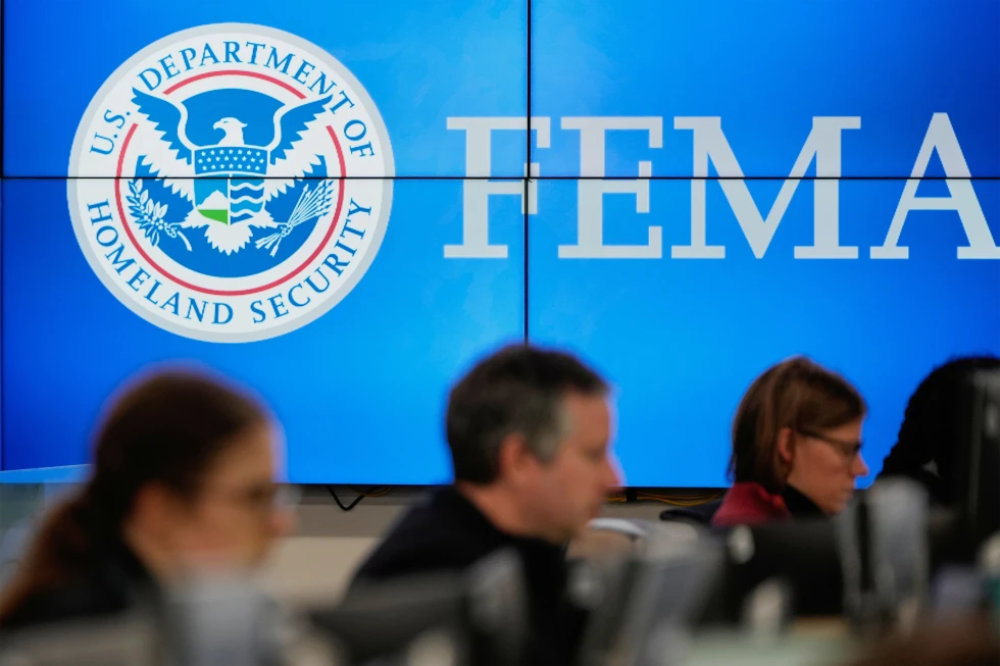
The Trump administration had targeted the Building Resilient Infrastructure and Communities (BRIC) programme as part of a wider effort to overhaul the Federal Emergency Management Agency (FEMA).

Recommended Stories

list of 3 itemsend of list

But on Thursday, US District Judge Richard Stearns ruled that the administration lacked the authority to end the grant programme. The decision came in response to a lawsuit filed by 20 states, the majority led by Democrats.

Stearns said the administration’s action amounted to an “unlawful executive encroachment on the prerogative of Congress to appropriate funds for a specific and compelling purpose”.

“The BRIC program is designed to protect against natural disasters and save lives,” Stearns wrote, adding that the “imminence of disasters is not deterred by bureaucratic obstruction”.

Stearns had previously blocked FEMA from diverting more than $4bn allocated to BRIC to other purposes.

Massachusetts Attorney General Andrea Joy Campbell was among the plaintiffs praising the decision.

“Today’s court order will undoubtedly save lives by preventing the federal government from terminating funding that helps communities prepare for and mitigate the impacts of natural disasters,” she said in a statement.

BRIC is the largest resiliency programme offered by FEMA, designed to reduce disaster-related risks and bolster efforts to recover quickly.

The programme is emblematic of efforts under FEMA to take preventive measures to prepare for natural disasters, as climate change fuels more extreme weather across the country.

According to the lawsuit, FEMA approved about $4.5bn in grants for nearly 2,000 projects, primarily in coastal states, over the last four years.

Upon taking office for his second term, Trump initially pledged to do away with FEMA, with the agency sitting at the crossroads of the president’s climate change denialism and his pledge to end federal waste.

Trump has since softened on his position amid pushback from both Republican and Democratic state lawmakers. He has said he plans to reform the agency instead.

In November, acting FEMA head David Richardson stepped down from his post. That came amid internal pushback over Richardson’s lack of experience and cuts to the agency.

In a letter in August, nearly 200 FEMA staffers warned the cuts risked compounding future disasters to a devastating degree.

Upon taking on the role in May, Richardson threatened he would “run right over” anyone who resisted changes to the agency.

Source link

Justice Department again fails to re-indict New York Atty. Gen. Letitia James, AP source says

A grand jury declined for a second time in a week to re-indict New York Attorney General Letitia James on Thursday in another major blow to the Justice Department’s efforts to prosecute the president’s political opponents.

The repeated failures amounted to a stunning rebuke of prosecutors’ bid to resurrect a criminal case President Trump pressured them to bring, and hinted at a growing public leeriness of the administration’s retribution campaign.

A grand jury rejection is an unusual circumstance in any case, but is especially stinging for a Justice Department that has been steadfast in its determination to seek revenge against Trump foes such as James and former FBI Director James Comey. On separate occasions, citizens have heard the government’s evidence against James and have come away underwhelmed, unwilling to rubber-stamp what prosecutors have attempted to portray as a clear-cut criminal case.

A judge threw out the original indictments against James and Comey in November, ruling that the prosecutor who presented to the grand jury, Lindsey Halligan, was illegally appointed U.S. attorney for the Eastern District of Virginia.

The Justice Department asked a grand jury in Alexandria, Va., to return an indictment Thursday after a different grand jury in Norfolk last week refused to do so. The failure to secure an indictment was confirmed by a person who was not authorized to publicly discuss the matter and spoke on the condition of anonymity.

It was not immediately clear Thursday whether prosecutors would try for a third time to seek a new indictment. A lawyer for James, who has denied any wrongdoing, said the “unprecedented rejection makes even clearer that this case should never have seen the light of day.”

“This case already has been a stain on this Department’s reputation and raises troubling questions about its integrity,” defense attorney Abbe Lowell said in a statement. “Any further attempt to revive these discredited charges would be a mockery of our system of justice.”

James, a Democrat who infuriated Trump after his first term with a lawsuit alleging that he built his business empire on lies about his wealth, was initially charged with bank fraud and making false statements to a financial institution in connection with a home purchase in 2020.

During the sale, she signed a standard document called a “second home rider” in which she agreed to keep the property primarily for her “personal use and enjoyment for at least one year,” unless the lender agreed otherwise. Rather than using the home as a second residence, prosecutors say James rented it out to a family of three, allowing her to obtain favorable loan terms not available for investment properties.

Both the James and Comey cases were brought shortly after the administration installed Halligan, a former Trump lawyer with no previous prosecutorial experience, as U.S. attorney amid public calls from the president to take action against his political opponents.

But U.S. District Judge Cameron McGowan Currie threw out the cases last month over the unconventional mechanism that the Trump administration employed to appoint Halligan. The judge dismissed them without prejudice, allowing the Justice Department to try to file the charges again.

Halligan had been named as a replacement for Erik Siebert, a veteran prosecutor in the office and interim U.S. attorney who resigned in September amid Trump administration pressure to file charges against both Comey and James. He stepped aside after Trump told reporters he wanted Siebert “out.”

James’ lawyers separately argued the case was a vindictive prosecution brought to punish the Trump critic who spent years investigating and suing the Republican president and won a staggering judgment in a lawsuit alleging he defrauded banks by overstating the value of his real estate holdings on financial statements. The fine was later tossed out by a higher court, but both sides are appealing.

Comey was separately charged with lying to Congress in 2020. Another federal judge has complicated the Justice Department’s efforts to seek a new indictment against Comey, temporarily barring prosecutors from accessing computer files belonging to Daniel Richman, a close Comey friend and Columbia University law professor whom prosecutors see as a central player in any potential case against the former FBI director.

Prosecutors moved Tuesday to quash that order, calling Richman’s request for the return of his files a “strategic tool to obstruct the investigation and potential prosecution.” They said the judge had overstepped her bounds by ordering Richman’s property returned to him and said the ruling had impeded their ability to proceed with a case against Comey.

Richer and Kunzelman write for the Associated Press. Richer reported from Washington. AP reporter Eric Tucker in Washington contributed to this report.

Source link

Trump must end National Guard deployment in L.A., judge rules

A federal judge ruled Wednesday that the Trump administration must immediately end the deployment of the National Guard in Los Angeles, the latest legal blow to the president’s embattled efforts to police American streets with armed soldiers.

Senior U.S. District Judge Charles R. Breyer said in his ruling that command of the remaining 300 federalized National Guard troops must return to Gov. Gavin Newsom, who sued the administration in June after it commandeered thousands of troops to quell protests over immigration enforcement in Los Angeles.

On June 12, Breyer ruled that deployment illegal — a decision that was challenged and ultimately reversed by the 9th Circuit Court of Appeals. The court said the esoteric statute Trump invoked to wrest command of the Guard from the governor afforded him “a great level of deference” to determine whether a rebellion was underway in Los Angeles, as the Justice Department claimed at the time.

The same sequence repeated this autumn in Oregon, where 200 California Guard troops were sent to help quash demonstrations outside an ICE facility.

Unlike in California, the Oregon decision was vacated amid claims the Justice Department inflated the number of federal protective personnel it said were detailed to Portland and misrepresented other facts to the court.

The decision is now under review by a larger panel of the 9th Circuit, while the Supreme Court weighs an almost identical challenge to the deployment in Illinois.

In both cases, conservative judicial appointees have signaled skepticism about the president’s authority to order boots on the ground, and to keep troops federalized indefinitely.

“States are not only owed protection by the federal government, they are owed protection from it,” Judge Jay Bybee wrote in a lengthy filing Tuesday in support of the 9th Circuit review. “There is no greater threat to the sovereignty of the states than an assertion of federal control over their domestic affairs.”

The “domestic violence” clause of the Constitution was part of a careful compromise between its framers allowing the president to deploy armed soldiers against citizens “only as a last resort,” the judge argued. The president should be compelled to provide some proof of his claims and the states should be empowered to test it — “particularly in the face of contrary evidence.”

That position earned him a sharp rebuke from the court’s newest member, Trump appointee Judge Eric Tung, who echoed the administration’s claim that its deployments were “unreviewable” by the courts.

A demonstrator interacts with US marines and national guards standing in line

A demonstrator interacts with U.S. Marines and National Guard troops standing in line at the entrance of the Metropolitan Detention Center following federal immigration operations in July.

(Etienne Laurent / AFP via Getty Images)

Their exchange reflects a deepening rift on the 9th Circuit, once the most liberal appellate division in the United States.

Trump remade the 9th Circuit in his first term, naming 10 judges to the bench. Those picks were largely curated by Leonard Leo of the libertarian-leaning Federalist Society.

But Leo has since lost favor to Tung’s longtime friend Mike Davis of the Article III Project, whose recommendations tack well to the right of his predecessor, experts said.

Still, infighting on the appellate bench is far from the only hurdle facing Trump’s domestic deployments.

In October, the Supreme Court ordered both the administration and the state of Illinois to address a theory by Georgetown University law professor Martin S. Lederman, who argued the statute only allows presidents to federalize the National Guard after they send in the army.

“If the court wants to rule against Trump on this, that’s the least offensive way,” said Eric J. Segall, a professor at Georgia State College of Law. “It’s a way to avoid all factual determinations for the moment.”

But such a ruling could open the door to even more aggressive military action in the future, he and others warn.

“If the Supreme Court comes in and says, ‘you have to use the active duty military before you can use the National Guard,’ it has the effect of saying everything that happened until now [was illegal],” said David Janovsky from the Project on Government Oversight. “But then you have the prospect of more active duty troops getting deployed.”

Congress, too, is taking a fine-toothed comb to Trump’s troop cases. The Senate Armed Services Committee is set to hear testimony Thursday from military top brass about repeated domestic deployments.

“Across the United States, Donald Trump has illegally deployed our nation’s servicemembers into American cities under unclear and false pretexts and despite the costs to our military and civil rights,” Sen. Tammy Duckworth (D-Ill.) said in a statement announcing the hearing. “The American people and our troops deserve answers.”

Meanwhile, the Trump administration has continued to broaden its claims of executive power in court.

In recent weeks, Department of Justice lawyers have argued that, once federalized, state Guard troops would remain under the president’s command in perpetuity. Breyer called that position “contrary to law” in his ruling Wednesday.

“Defendants’ argument for a president to hold unchecked power to control state troops would wholly upend the federalism that is at the heart of our system of government,” Breyer wrote.

California leaders cheered Wednesday’s ruling as a turning point in what until now has been an uphill legal battle to constrain the president’s use of state troops. The order was set to take effect on Monday, though it was all but certain to be appealed to the 9th Circuit.

“The President deployed these brave men and women against their own communities, removing them from essential public safety operations,” Newsom said in a statement Wednesday morning. “We look forward to all National Guard servicemembers being returned to state service.”

Atty. Gen. Rob Bonta called it “a good day for our democracy and the strength of the rule of law.”

Still, some legal scholars and civil liberties experts warn repeated deployments — and the slogging court battles that attend them — could inure the public to further politicization of the military around the midterms.

“The sense of normalization is probably part of the plan here,” Janovsky said. “Having troops trained for war on the streets of American cities puts everyone at more risk. The more we normalize the blurring of those lines, the higher the risk that troops will be used for inappropriate purposes against the American people.”

Times staff writers Kevin Rector and Jenny Jarvie contributed to this report.

Source link

Justice Department can unseal records from Epstein’s 2019 sex trafficking case, judge says

Secret grand jury transcripts from Jeffrey Epstein’s 2019 sex trafficking case can be made public, a judge ruled on Wednesday, joining two other judges in granting the Justice Department’s requests to unseal material from investigations into the late financier’s sexual abuse.

U.S. District Judge Richard M. Berman reversed his earlier decision to keep the material under wraps, citing a new law that requires the government to open its files on Epstein and his longtime confidant Ghislaine Maxwell. The judge previously cautioned that the 70 or so pages of grand jury materials slated for release are hardly revelatory and “merely a hearsay snippet” of Epstein’s conduct.

On Tuesday, another Manhattan federal judge ordered the release of records from Maxwell’s 2021 sex trafficking case. Last week, a judge in Florida approved the unsealing of transcripts from an abandoned Epstein federal grand jury investigation in the 2000s.

The Justice Department asked the judges to lift secrecy orders in the cases after the Epstein Files Transparency Act, passed by Congress and signed into law by President Trump last month, created a narrow exception to rules that normally keep grand jury proceedings confidential. The law requires that the Justice Department disclose Epstein-related material to the public by Dec. 19.

The court records cleared for release are just a sliver of the government’s trove — a collection of potentially tens of thousands of pages of documents including FBI notes and reports; transcripts of witness interviews, photographs, videos and other evidence; Epstein’s autopsy report; flight logs and travel records.

While lawyers for Epstein’s estate told Berman in a letter last week that the estate took no position on the Justice Department’s unsealing request, some Epstein victims backed it.

“Release to the public of Epstein-related materials is good, so long as the victims are protected in the process,” said Brad Edwards, a lawyer for some victims. “With that said, the grand jury receives only the most basic information, so, relatively speaking, these particular materials are insignificant.”

Questions about the government’s Epstein files have dominated the first year of Trump’s second term, with pressure on the Republican intensifying after he reneged on a campaign promise to release the files. His administration released some material, most of it already public, disappointing critics and some allies.

Berman was matter of fact in his ruling on Wednesday, writing that the transparency law “unequivocally intends to make public Epstein grand jury materials and discovery materials” that had previously been covered by secrecy orders. The law “supersedes the otherwise secret grand jury materials,” he wrote.

The judge, who was appointed by President Clinton, a Democrat, implored the Justice Department to carefully follow the law’s privacy provisions to ensure that victims’ names and other identifying information are blacked out. Victim safety and privacy “are paramount,” he wrote.

In court filings, the Justice Department informed Berman that the only witness to testify before the Epstein grand jury was an FBI agent who, the judge noted, “had no direct knowledge of the facts of the case and whose testimony was mostly hearsay.”

The agent testified over two days, on June 18, 2019, and July 2, 2019. The rest of the grand jury presentation consisted of a PowerPoint slideshow and four pages of call logs. The July 2 session ended with grand jurors voting to indict Epstein.

Epstein, a millionaire money manager known for socializing with celebrities, politicians, billionaires and the academic elite, killed himself in jail a month after his 2019 arrest. Maxwell was convicted in 2021 by a federal jury of sex trafficking for helping recruit some of Epstein’s underage victims and participating in some of the abuse. She is serving a 20-year prison sentence.

Maxwell’s lawyer told a judge last week that unsealing records from her case “would create undue prejudice” and could spoil her plans to file a habeas petition, a legal filing seeking to overturn her conviction. The Supreme Court in October declined to hear Maxwell’s appeal.

Maxwell’s grand jury records include testimony from the FBI agent and a New York Police Department detective.

Judge Paul A. Engelmayer sought to temper expectations as he approved their release on Tuesday, writing that the materials “do not identify any person other than Epstein and Maxwell as having had sexual contact with a minor.”

“They do not discuss or identify any client of Epstein’s or Maxwell’s,” wrote Engelmayer, an appointee of President Obama, a Democrat. “They do not reveal any heretofore unknown means or methods of Epstein’s or Maxwell’s crimes.”

Sisak writes for the Associated Press.
Source link

Judge: Epstein grand jury files can be released

A demonstrator holds a poster during a press conference on the Epstein Files Transparency Act on Nov. 18 in Washington, D.C. On Wednesday, a New York federal judge ruled that the grand jury files in the case against Jeffrey Epstein can be released. File Photo by Bonnie Cash/UPI | License Photo

Dec. 10 (UPI) — A federal judge in New York said Wednesday that the 2019 grand jury files in the case against convicted sex offender Jeffrey Epstein can be released.

U.S. District Judge Richard Berman had denied a previous request by the Department of Justice. Grand jury proceedings are normally sealed. But the Epstein Files Transparency Act — signed into law on Nov. 19 — now allows for the release, Berman said.

“The Court hereby grants the Government’s motion in accordance with the Epstein Files Transparency Act and with the unequivocal right of Epstein victims to have their identity and privacy protected,” he said in the four-page ruling.

A federal judge in Florida on Dec. 5 ordered the release of grand-jury transcripts from the investigation against Epstein from 2005 to 2007. That investigation was abandoned.

The ruling comes one day after a similar ruling in which a judge allowed the release of grand jury files in the case of Epstein’s accomplice, Ghislaine Maxwell, who is serving 20 years for child sex trafficking. Epstein died by suicide in prison in 2019.

Congressional Democrats recently released photos of Epstein’s private island, Little St. James, in the U.S. Virgin Islands.

President Donald Trump walks on the South Lawn of the White House after arriving on Marine One in Washington on Tuesday. Trump said people were “starting to learn” the benefits of his tariff regime. Photo by Graeme Sloan/UPI | License Photo

Source link