Rarely would Sam Neill, who died Monday, carry a film on his own, but what he did in several of them, modestly and dependably, was equally as important. His nuanced supporting work allowed some of the greatest actresses of their moment attain their first fireworks. And even though he starred in one of Hollywood’s hugest blockbusters, it takes a certain kind of confidence to share the spotlight with a dinosaur. Here are Neill’s highlights, all worth rewatching for the sake of better appreciating a sophisticated presence often on the sidelines.
‘My Brilliant Career’ (1979)
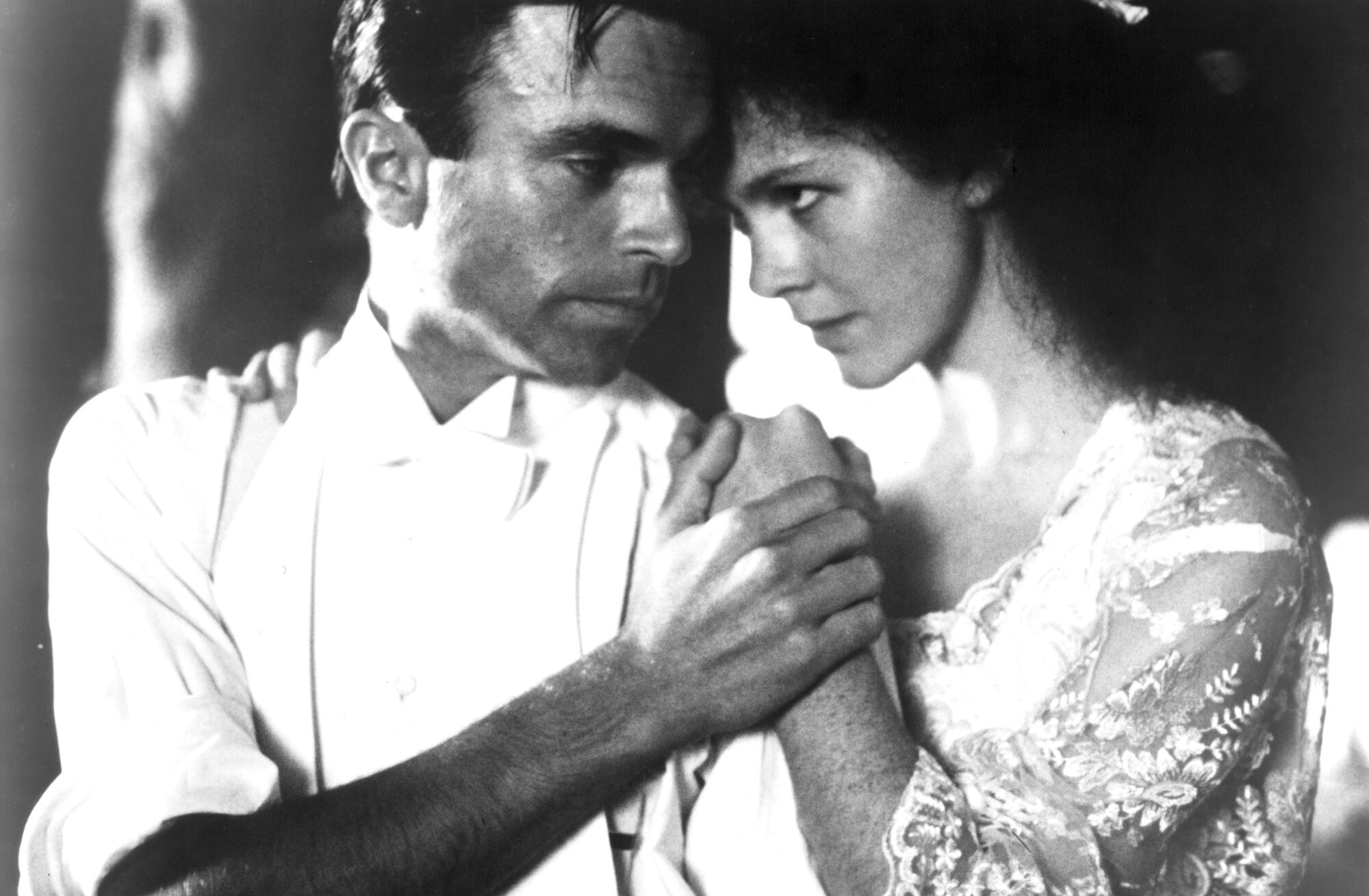
Sam Neill and Judy Davis in the movie “My Brilliant Career.”
(Michael Ochs Archives / Getty Images)
Gillian Armstrong’s first feature is a landmark of the Australian New Wave and feminist cinema, signaling the arrival of the great Judy Davis and containing the most erotically charged (and quite possibly the longest) pillow fight in movie history. It works splendidly for countless reasons, not the least of which is Neill’s presence as the charming suitor of Davis’ headstrong heroine. Set in 1897 in rural Australia, the film follows Davis’ Sybylla, who dreams of becoming a writer, an unconventional aspiration given her family’s poverty and societal norms. Then she meets a wealthy charmer, played by Neill, and he proposes. It should be an easy decision, particularly since Sybylla loves him and Neill makes him so irresistible. That Sybylla does, in fact, resist, choosing independence over love and the possibility of perennial pillow fights, makes “My Brilliant Career” so daring and thrilling. — Glenn Whipp
‘Possession’ (1981)
Isabelle Adjani and Sam Neill in the movie “Possession.”
(Metrograph Pictures)
It’s being remade with Margaret Qualley and the main reason for the movie’s notoriety remains Isabelle Adjani’s unhinged, incantatory performance, a collection of freak-outs that’s still unmatched. But one can argue that Adjani couldn’t have gotten there without the slightly milquetoast banality of her character’s husband, played by Neill as one of the least exciting on-screen spies of the 1980s. (She’s already cheating on him when the movie begins.) He doesn’t seem cut out to be a family man either, but Neill’s cuckolded complaining, hard to pull off this confidently, may be what’s driving her to self-harm in the first place. — Joshua Rothkopf
‘The Final Conflict’ (1981)
More than a decade before his “Jurassic Park” role, Neill delivered a chilling turn as the Antichrist in “The Final Conflict,” better known as the third film in “The Omen” franchise, about a couple that unwittingly adopts the son of Satan. In this second sequel, Neill plays an adult Damien Thorn, now a U.S ambassador to the United Kingdom who is determined to stop the second coming of Christ. With sinister smiles and steely glares, Neill makes Damien his own, waging a murderous campaign against a group of priests, his voice dripping with contempt as he vows to slay “the Nazarene” when he is born. — Greg Braxton
‘Dead Calm’ (1989)
Sam Neill and Nicole Kidman on the set of the movie “Dead Calm.”
(Michael Ochs Archives / Getty Images)
We remember Philip Noyce’s claustrophobic cat-and-mouse thriller primarily as Nicole Kidman’s big-screen breakthrough. But, and you may be noticing a theme here, the movie would not work without Neill, who had a gift for playing opposite strong-minded women. Kidman and Neill are a married couple embarking on an ocean adventure to work through the loss of their child. They happen upon a crazy-eyed stranger (Billy Zane) on a sinking schooner, take him aboard and things go south from there. Part Cary Grant, part MacGyver, Neill gives a great physical performance, which he parlayed into well-paying Hollywood action roles for the rest of his career. None came close, though, to his flare-gun theatrics here. — Glenn Whipp
‘Jurassic Park’ (1993)
You go for the dinosaurs and there’s no shame in that. But credit Neill for both understanding the assignment and not quite settling for those awed stares of Spielbergian wonder. His Alan Grant is distinct enough to register as prickly and a little inside himself. He absolutely hates children, even as the whole plot, somewhat obviously, steers him in the opposite direction. He’s not Jeff Goldblum-level rascally, but he’s confident enough to go his own way and make a killer joke at a high-voltage fence. Acting-wise, Neill has already held his own opposite several forces of nature (see above). Raptors were nothing. — Joshua Rothkopf
‘The Piano’ (1993)
Sam Neill in the move “The Piano.”
(The Criterion Collection)
So many of Neill’s most memorable movies feature him supporting the singular vision of great directors, as is the case with Jane Campion’s 1993 landmark. Neill plays the awkward, ignorant Scottish farmer who arranges for a mail-order marriage with Holly Hunter’s mute pianist and then becomes possessive and driven to jealous despair. We hate him. Which was fine by Neill, as he wrote in his 2023 memoir: “There is honour to be found in the second fiddle. Or fourth. No one notices you much, you don’t get nominated for things. But you served. I was there in an important feminist film. It’s a work of art. And look, that tiny little figure in the fabric — see down there on the right — that’s me. It’s a film that will always have a place in cinema history. And I served in it.” — Glenn Whipp
‘In the Mouth of Madness’ (1994)
Finally, a leading role. Granted it’s one in which Neill, strapped in a straitjacket, screams things like “I’m not insane!” But if you’re a fan of his brand of slightly unconvinced heroism, John Carpenter’s horror movie — about an insurance investigator on the hunt for a missing Stephen King-like author — is an enjoyable watch. Carpenter was never one to overexplain things to his actors (it’s why you find so many rich, self-directed performances in his movies) and Neill’s snoop definitely goes through the looking glass, from disbelieving cynic to true believer. Genre movies thrive on his kind of total commitment. — Joshua Rothkopf
Not every summer movie needs to be a mystery that unfolds hallway after hallway, with a creature hiding around every corner ready to pop out. But maybe the best one is: “Backrooms,” opening May 29 and directed by 20-year-old phenom Kane Parsons. We chatted with him about how he got to make his big debut for A24. Apart from that inspiring story, what can we hope for at the multiplex? We asked our staffers for their dreamiest expectations and they didn’t hold back: space epics, Matt Damon in a helmet and, yes, a “Jackass” movie. Read on and let this be your guide.
‘The Mandalorian and Grogu’
(May 22)
Pedro Pascal, left, and Sigourney Weaver in the movie “The Mandalorian and Grogu.”
(Lucasfilm)
TV’s “The Mandalorian” premiered in 2019 and was the first live-action series in “Star Wars” history. Now, the next adventure of the fierce bounty hunter and his adorable young charge will be the franchise’s first big-screen installment since the sequel trilogy wrapped with “Episode IX — The Rise of Skywalker.” I, for one, am excited that Grogu, with all his snackish charm, has been promoted to title-character status along with Pedro Pascal’s more stoic Din Djarin. The movie will also introduce Sigourney Weaver as Col. Ward, a former Rebellion pilot turned New Republic leader, and Jeremy Allen White as grown-up Rotta the Hutt, Jabba’s son, who debuted as an infant in the animated “Star Wars: The Clone Wars.” — Tracy Brown
‘Masters of the Universe’
(June 5)
Nicholas Galitzine in the movie “Masters of the Universe.”
(Giles Keyte / Amazon MGM Studios)
Our opinions of Hollywood’s dip into the nostalgia well may vary, but it’s easy to want to feel the kind of joy that a game or toy brought us when the world felt less complicated. He-Man’s best stories so far may have been on animated TV, but I have enough childhood memories of smashing the character’s action figure against others that I’m curious about how he’ll play in the big-screen sandbox. Starring Nicholas Galitzine as a wayward Prince Adam trapped on Earth, “Masters of the Universe” adds a contemporary twist and some modern sensibilities to the lore. With Laika Studios vet and “Bumblebee” director Travis Knight at the helm, I’m expecting a sweet balance of humor and heart. — Tracy Brown
‘Disclosure Day’
(June 12)
Emily Blunt in the movie “Disclosure Day.”
(Niko Tavernise / Universal)
Nearly half a century after “Close Encounters of the Third Kind” and decades on from “E.T.” and “War of the Worlds,” Steven Spielberg is still looking to the skies — and we still want to know whether to be excited or terrified by what he sees. His latest brings extraterrestrial life into the realm of ’70s conspiracy thrillers. (Screenwriter David Koepp has compared it to paranoia pieces like “Three Days of the Condor.”) Emily Blunt plays a Kansas City meteorologist who begins receiving a signal from beyond Earth, while Josh O’Connor is a government employee on the run with information that powerful people are trying to keep hidden. If Spielberg’s earlier UFO movies gave us awe, comfort and catastrophe, this one feels like an encounter of a fourth kind: What happens when the cover story breaks? — Josh Rottenberg
‘The Death of Robin Hood’
(June 19)
Hugh Jackman in the movie “The Death of Robin Hood.”
(A24)
Go to the beginnings of Hollywood and there are Robin Hood movies: Douglas Fairbanks, Errol Flynn, some shorts from even earlier. And it’s a safe bet that, as long as there’s pull to the idea of stealing from the rich and giving to the poor, there will be more to come. Quietly, writer-director Michael Sarnoski has made a niche for himself as a storyteller of regrets, of roads not taken. His 2021 restaurant memory drama “Pig” gave Nicolas Cage his subtlest dialogue in years, while “A Quiet Place: Day One” had no business being as believably haunted as it was. Sarnoski is the perfect person to do a retelling tilted toward the end of a rampager’s life. Hugh Jackman embodies the role with a rough dignity. — Joshua Rothkopf
‘Leviticus’
(June 19)
Stacy Clausen, left, and Joe Bird in the move “Leviticus.”
(Neon)
Unlike many tales of demonic possession, Adrian Chiarella’s feature debut lingers in the mind for being so recognizably close to home; it doesn’t need to crab-walk into the room, spin its head 360 degrees and announce itself as evil. In a small, backwards Australian community, coming of age and coming out evince fear in the Christian townsfolk. Two teenage boys (Stacy Clausen and “Talk to Me’s” writhing standout Joe Bird) keep their attraction to themselves. Even so, a violent curse bedevils them, a sophisticated feat of careful writing and directorial sensitivity that sets Chiarella apart from the gorehounds. Let’s also cheer the return of Mia Wasikowska, stepping back confidently. — Joshua Rothkopf
‘Maddie’s Secret’
(June 19)
John Early in the movie “Maddie’s Secret.”
(Magnolia Pictures)
An affectionate throwback to overly earnest TV movies (and a knowing send-up of over-the-top bad-girl flicks), this film marks the feature debut as writer-director for comedian John Early, who also stars. With a cast drawn from comedy-scene friends such as Kate Berlant and Conner O’Malley all tuned into a very specific wavelength, the movie somehow surpasses conventional notions of camp and irony to exist in a genuinely unique space all its own. As Maddie, an aspiring L.A. food influencer battling a secret eating disorder, Early’s performance will undoubtedly remain one of the most distinctive and original of the year, by equal turns outrageously funny and tenderly vulnerable, often in the same moment. — Mark Olsen
‘The Invite’
June 26
Olivia Wilde, Seth Rogen, Penélope Cruz and Edward Norton in the movie “The Invite.”
(A24)
Olivia Wilde’s dinner-party dramedy made good on its considerable promise when it premiered at Sundance in January, earning a standing ovation and tears (of relief? joy?) from Wilde as she took the stage. Wilde and Seth Rogen play longtime marrieds harboring a laundry list of resentments who host their upstairs neighbors (Penélope Cruz, Edward Norton) for an evening of fun. At least it starts off that way, but of course, the gathering quickly sours, leaving us rubbernecking the damage. Wilde navigates the tonal shifts with authority, delivering surprises along the way, including an ending that somehow delivers hope for the institution of wedlock. Am I overselling it? Would I cry Woolf to you? — Glenn Whipp
‘Jackass: Best and Last’
(June 26)
Johnny Knoxville, right, in the movie “Jackass: Best and Last.”
(Paramount Pictures)
Johnny Knoxville and his band of professional bad decision-makers are calling this one their final hurrah and, really, can you blame them? The original “Jackass” crew are now in their 50s, long past the point when being shot out of cannons and zapped with tasers seems like a sensible career plan. Knoxville himself was hospitalized with a brain injury after being flipped by a bull during the filming of 2022’s “Jackass Forever” and has said he can’t risk another concussion. This send-off mixes new stunts with archival footage, promising the usual outlandish pranks and blunt-force impacts to sensitive bodily regions. If this really is the end for the franchise, it’s hard to argue they didn’t push it as far as it would go. — Josh Rottenberg
‘Supergirl’
(June 26)
Milly Alcock in the movie “Supergirl.”
(Warner Bros.)
No diss to last summer’s charmingly square “Superman,” but the funniest scene in the movie was Milly Alcock’s 45-second cameo as Kal-El’s cousin Kara, who stumbled into his Fortress of Solitude to collect her dog Krypto still hungover from an outer-space bender. (“This is why he has behavioral issues,” Superman said with a sigh.) Now, she and the mutt have their own movie and zero pressure to represent truth, justice and a better tomorrow. Ana Nogueira’s script appears to be a riff on the 2021 comic-book miniseries “Supergirl: Woman of Tomorrow,” in which the blond‘s birthday bacchanal takes a U-turn after Kara aligns with an alien child (young Eve Ridley from “3 Body Problem”). It’s basically an intergalactic “True Grit.” My one concern is that director Craig Gillespie made the too-squishy “Cruella.” Here’s hoping “Supergirl’s” tone is more sour than sweet. — Amy Nicholson
‘The Odyssey’
(July 17)
Matt Damon in the movie “The Odyssey.”
(Melinda Sue Gordon / Universal Pictures)
As the follow-up to his “Oppenheimer” — which won Oscars and made nearly $1 billion — Christopher Nolan has gone from an ambitious story about the creation of the nuclear bomb to an even more ambitious story rooted in the origins of literature. Adapting Homer’s ancient Greek saga, Nolan has created an epic to end all epics: the tale of a king struggling to return home after years away at war. With an absolutely stacked cast and told at a massive scale, “The Odyssey” indicates that Nolan seems to trust that modern audiences will respond to a 3,000-year-old tale, and that some aspects of the human experience truly are eternal. — Mark Olsen
‘I Want Your Sex’
(July 31)
Cooper Hoffman and Olivia Wilde in the movie “I Want Your Sex.”
(Lacey Terrell / Magnolia Pictures)
A new Gregg Araki movie loaded with sex and bad choices? What a rare and wonderful summer treat. (It’s the indie provocateur’s first feature in more than a decade.) An unhinged Olivia Wilde as the ultimate bad boss — an art star hoping to recapture some edge — gets you in the door. But Araki has shaded in the margins masterfully, with vivid supporting turns by Chase Sui Wonders, Daveed Diggs and the now-ubiquitous Charli XCX. And it’s Cooper Hoffman, in a performance as flustered as his impresario in “Licorice Pizza” was confident, who commands the movie, topping from the bottom. Araki’s sensibility is, if anything, wiser now, though he’d probably flinch at the word. Brace for inappropriateness. — Joshua Rothkopf
‘Spider-Man: Brand New Day’
(July 31)
An image from the movie “Spider-Man: Brand New Day.”
(Sony Pictures)
It’s been five years since our friendly neighborhood webslinger’s last big-screen adventure and a lot has changed in the Marvel Cinematic Universe. But it appears things have pretty much stayed the same for Peter Parker (Tom Holland). His last adventure involved him staving off a multiversal crisis by making everyone in the world forget him, including his best friends MJ (Zendaya) and Ned (Jacob Batalon). “Spider-Man: Brand New Day” picks up a few years later, with Peter still protecting the streets of New York as a masked superhero while his friends continue to live their lives unaware of what he once meant to them. Can some mutating DNA be the catalyst for a happy reunion? I hope so. — Tracy Brown
‘One Night Only’
(Aug. 7)
Monica Barbaro and Callum Turner in the movie “One Night Only.”
(Nicole Rivelli / Universal Pictures)
“The Purge”… but hot? That’s the pitch behind Will Gluck’s high-concept romantic comedy in which singles are eager to hook up on the one night a year when premarital sex is legal. The original story by Travis Braun was ranked No. 1 on the 2024 Black List of the best unproduced screenplays. While “that Gluck magic” doesn’t have quite the flow of the “Lubitsch touch,” he’s already directed one of the best modern rom-coms (“Easy A”) and one of the most lucrative (“Anyone but You”). Those films crowned Emma Stone and Sydney Sweeney as official movie stars. I’d love to see this film’s ingenue, Monica Barbaro, ascend to their ranks. Barbaro excelled in the Bob Dylan biopic “A Complete Unknown,” where her hard-to-impress Joan Baez earned her an Oscar nod for supporting actress. This is her chance to seduce the audience as well as her onscreen co-star Callum Turner. I’m eager to commit. — Amy Nicholson
‘Teenage Sex and Death at Camp Miasma’
(Aug. 7)
Hannah Einbinder, left, and Gillian Anderson in the movie “Teenage Sex and Death at Camp Miasma.”
(Ryan Plummer / Mubi)
Jane Schoenbrun has become one of the freshest new voices in American independent filmmaking with 2021’s “We’re All Going to the World’s Fair” and 2024’s “I Saw the TV Glow,” transforming pop-culture obsessions into emotional explorations of identity and self-discovery. Promising to turn the summer camp slasher movie inside-out, their latest effort is about an up-and-coming director (“Hacks” star Hannah Einbinder) who entreats a faded scream queen (Gillian Anderson) to return to the horror franchise that once made her a star. Einbinder and Anderson locked into a psychosexual transference story already feels plenty potent. Put that setup in the anything-goes hands of Schoenbrun and it should make for a combustible combination of genre, persona, desire and fun. — Mark Olsen
‘The End of Oak Street’
(Aug. 14)
From left, Ewan McGregor, Christian Convery, Maisy Stella and Anne Hathaway in the movie “The End of Oak Street.”
(Warner Bros. Pictures)
Do you ever look out your window and, tired of the same old view, long that you could just pick up and live somewhere else? I don’t know if Anne Hathaway’s character in David Robert Mitchell’s “The End of Oak Street” has ached for that kind of change, but it sure seems to have found her and her family in this tale of a suburbia transported to … prehistoric times? To another dimension, a dimension of sound, a dimension of sight, a dimension of mind? I do not know. I do not want to know. I do know that there is a dinosaur giving chase. And Ewan McGregor looks alarmed. And Mitchell is the weirdo writer-director behind “It Follows” and “Under the Silver Lake.” That’s all I need. — Glenn Whipp
‘The Dog Stars’
(Aug. 28)
Jacob Elordi in the movie “The Dog Stars.”
(Fabio Lovino / 20th Century Studios)
Director Ridley Scott long ago secured his place in film history with “Alien,” “Blade Runner” and “Gladiator.” The fact that he’s still at it at 88 makes each new film feel like an event. His latest adapts Peter Heller’s 2012 novel set in the aftermath of a pandemic that’s nearly wiped out humanity. Jacob Elordi, hot off “Frankenstein,” plays Hig, one of the few immune survivors, a pilot living at an abandoned airfield with his dog and a heavily armed survivalist (Josh Brolin). Hig’s days are spent flying perimeter patrols, scanning for signs of life — or trouble — until he encounters Margaret Qualley’s Cima, a medic guarding her own small foothold in the ruined world. Scott has called the film hopeful, which may be the most intriguing part: a post-apocalyptic story about why anyone bothers to keep going. — Josh Rottenberg
After 10 days of crazed moviegoing at the Cannes Film Festival, Times film critic Amy Nicholson and Times film editor Joshua Rothkopf are all but spent. They leave with 10 recommendations (listed below in alphabetical order), including several titles you’ll be hearing about during awards season, but also, admittedly, more reservations than usual.
Amy Nicholson: There are worse ways to spend your life than watching four movies a day in the south of France. For a week and half, we ran in and out of the dark theaters, blinking at the shock of the sun and bickering about what we just saw with the highest concentration of film lovers anywhere — most of us jacked up on espresso or rosé. Yet, we’re flying home miffed that the movies themselves were mediocre. Cannes is meant to launch ambitious, prickly works by grandmasters and next-generation talents. This year, the programming looked like a party with an impressive invite list — Nicolas Winding Refn, Asghar Farhadi, Hirokazu Kore-eda — but upon arrival, all the guests felt like old acquaintances tapped out of anything interesting to say.
I’m being harsh. Cannes had good movies, too. But I needed this year’s Cannes to be great. Audiences trickling back into theaters deserve to see something fantastic. Instead, too many filmmakers took the crowd’s attention span for granted; even the strongest films in competition could delete a half-hour of dead air. Fittingly, the majority of my favorites came from Cannes’ kookier programming sections, Directors’ Fortnight and Un Certain Regard — and I suspect many of yours did, too, oui?
Joshua Rothkopf: I did find a handful of films from the main competition that impressed me, but point taken: Nobody is served if we can’t admit that this year’s edition was weaker than others. We could blame screenwriting or pacing (though paradoxically I was impressed by both the longest and the shortest movies in competition). Maybe it’s an overall lack of boldness. When a restored version of Ken Russell’s salacious 55-year-old “The Devils” eclipses virtually everything else shown at the festival, a certain timidity is hard to deny. There were too many “nice” films: perfectly respectable but not what I want Cannes to be.
Fortunately, we saw enough to sharpen up a list of favorites. Here’s what stirred us.
‘All of a Sudden’
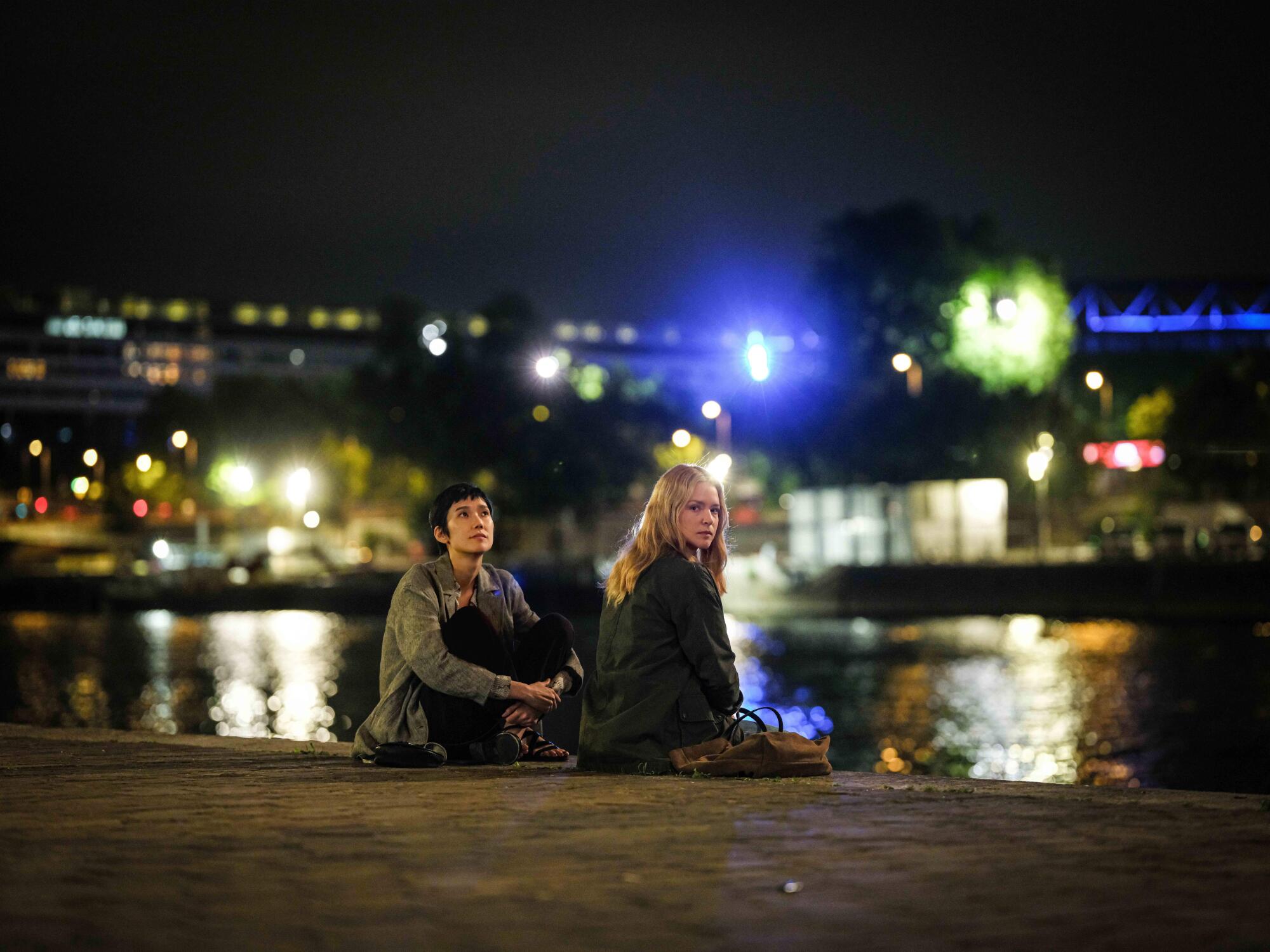
I’m not convinced that the utopian vision of end-of-life care presented in Ryusuke Hamaguchi’s drama has a fighting chance in America, but we deserve the opportunity to grapple with its compassionate turns and have that discussion. The director of “Drive My Car” continues his process-centric exploration of workplace relationships in this quietly revelatory movie, one with a centerpiece conversation that merits comparison to the long walks of Richard Linklater’s “Before” movies. Virginie Efira and Tao Okamoto let a day’s stroll linger into profundity, the twilight dimming and human connection brewing in all its possibilities. Is it too late for them? It doesn’t need to be. — Joshua Rothkopf
‘The Beloved’
Esteban (Javier Bardem), a renowned bad boy Spanish filmmaker, returns to his homeland from New York to shoot a period picture in the desert. Off-screen, he’s gifted one of the four leading roles to his estranged daughter (Victoria Luengo), an aspiring actor who hasn’t seen her father in 13 years. Esteban failed as Emilia’s dad. Can he succeed as her director, especially when her big break packs this much pressure? Not likely, especially as Emilia has inherited his disastrous boozing habits. “The Beloved’s” actual director, Rodrigo Sorogoyen, unleashes his leads to become a tag team of destruction, each blaming the other for what’s going wrong on set. They’re both mired in clashing narratives of their relationship. Sorogoyen shows us the truth, as well as the visible frustrations of the film-within-a-film’s cast and crew that risk shutting down this too-passionate passion project. — Amy Nicholson
‘Bitter Christmas’
(Iglesias Mas / Sony Pictures Classics)
Pedro Almodóvar’s self-flagellating film about his artistic process has a Charlie Kaufman-lite structure that I’d rather let audiences discover on their own. In brief: Almodovar’s avatar, a filmmaker named Raúl (Leonardo Sbaraglia), gets dragged over the artistic coals by the dramatic female characters he’s been writing for decades, one of whom dares him to simply coast on his legacy. Too many veteran filmmakers in his year’s Cannes competition seem to have accepted that bargain, so when Raúl got to the end of a new script and decided it wasn’t up to his standards, I nearly shouted “Bravo!” Navel-gazing cinema about the creative process isn’t usually my bag, but Almodóvar doesn’t take his own misery that seriously, even inserting a manic pixie dream hunk, a male stripper-slash-firefighter played by Patrick Criado, for a little bump and grind. — Amy Nicholson
‘Clarissa’
It’s been 101 years since Virginia Woolf first published “Mrs Dalloway,” a novel about persnickety party hostess Clarissa Dalloway colliding with her former lovers, one male and one female. The plot seems simple, but every glare and sigh tells a whole story about modernization, capitulation, cynicism and violence. Twin brothers Arie and Chuko Esiri have transplanted the tale to present-day Nigeria and stacked the cast with Sophie Okonedo, Ayo Edebiri, Nikki Amuka-Bird, David Oyelowo and the staggeringly talented India Amarteifio as the diva in her captivating youth before she married a tedious oilman and started bullying the help. “Clarissa” makes several smart adjustments, swapping in a traumatized Boko Haram soldier for a shell-shocked veteran of the Great War, and cocking an eyebrow at the shiny new yoga studios and coffee shops littering Lagos’ once-lush waterfront. Better still, it’s sexy as heck — the flashbacks are one swimsuit party after another. — Amy Nicholson
‘Club Kid’
The one-sentence pitch of Jordan Firstman’s debut dramedy — a gay nightclub promoter sobers up when he discovers he has a 10-year-old boy — sounded as fun as snorting a line of aspartame. I stand corrected. “Club Kid” is a blast: a spicy, surprising and irreverent comedy that rarely peddles the audience anything artificially sweet. Firstman stars as Peter, a debauched millennial aging out of a New York scene that never cared about him as a person in the first place. His business partner Sophie (Cara Delevingne) is a horror; his selfish squatter-roommate Nicky (Eldar Isgandarov) is even worse and so hilarious I’d watch a spin-off sequel just about him. Peter’s shock son Arlo (Reggie Absolom) has a casual charm that pickpockets your heart, but it’s the script’s sour quips that will have you urging people to get past the treacly set-up and go see “Club Kid” themselves. — Amy Nicholson
‘The Diary of a Chambermaid’
Art punk Radu Jude’s latest satire is about a Romanian immigrant with a burlesque double life. By day, Gianina (Ana Dumitrașcu, fantastic) is the live-in housemaid of a daft Parisian family; by night, she’s an actress in a turn-of-the-20th century slapstick farce about a housemaid whose master suckles her patent leather boots. In neither world can she openly say what she thinks (although in her native tongue, she curses her employers and their young son plenty). Fast, crisp and snide, “The Diary of a Chambermaid” gives equal weight to the monotony and the absurdity of Gianina’s grind. And Jude isn’t above including a mocking slow-motion shot of a spoiled French boy totally whiffing a soccer kick. — Amy Nicholson
‘Fatherland’
The tension at the heart of Paweł Pawlikowski’s period piece, set in a ravaged, fallen Germany after the end of World War II, is one that goes unresolved. All that’s left are defensive denials, evasions of Nazi collaboration and the faint hope that something higher has survived. I could watch this kind of guilt-ridden post-apocalyptic movie for hours; instead, this lasts a scant 82 minutes. The conclusion, a wordless moment between father and daughter set to the strains of Bach played on a broken pipe organ, was the most devastating passage of the entire festival. “Fatherland” shows off Pawlikowski’s exquisite way with black-and-white evocations of European tragedy, but he’s never summed them up as poetically. — Joshua Rothkopf
‘Fjord’
People at the festival called this one complex; I found myself disagreeing. It’s actually a fairly straightforward story about a religious but mostly level-headed family flung into conflict with an overly sensitive branch of child protection services — and maybe with the whole of agnostic Norwegian progressivism. As reactionary as that sounds, I was totally rapt. Partly that’s due to a beautifully plotted courtroom scenario and the immersive performances of Sebastian Stan and Renate Reinsve, reuniting after “A Different Man,” as parents increasingly out of their depths. But mainly, I credit Romanian director Cristian Mungiu, who knows a good story when he sees one, crystallizing its potency with every camera choice. — Joshua Rothkopf
‘Minotaur’
The ice-chilled return of Russian filmmaker Andrey Zvyagintsev (after a multiyear battle with long COVID) is worth the wait: a condensation of everything he does well into something so purely distilled, it should come with a proof warning. The movie kicks off as a casual portrait of the vacant nouveau riche lifestyles of the mini-oligarchs: fancy dinners, divorces, bathroom gossip. Then it becomes an erotic thriller (it’s based on Claude Chabrol’s 1969 “The Unfaithful Wife,” as was Diane Lane’s “Unfaithful”). But the best comes last, as the situation gets fixed in broad daylight with breathtaking brutality. The war in Ukraine? Someone else’s problem. “Minotaur” takes on the whole of Putin’s dissociative society and puts its winners above the blackened clouds, looking down at the rest of us. — Joshua Rothkopf
‘Teenage Sex and Death at Camp Miasma’
I am growing to love Jane Schoenbrun’s exfoliation of ’80s horror obsessions, especially for the movie’s nonjudgmental embrace: Let these movies be free in all their “problematic” badness and let them work on you. The fact that “Teenage Sex” sometimes plays like a bottle episode of “Hacks” doesn’t hurt. Hannah Einbinder brings vulnerability to a project that needs her brand of self-excoriating fearlessness. Points, too, for not turning this into yet another celebration of some forgotten male director reclaimed as a genius. Rather, the opposite: It’s about an abused scream queen (Gillian Anderson, gamely campy), a liminal, wintry campground and the exhilaration of running in the woods in your pajamas. — Joshua Rothkopf