England wicketkeeper Jos Buttler found some form with 52 from 27 balls for Gujarat Titans against Delhi Capitals in the Indian Premier League.
Buttler had gone 18 innings without a fifty, including a difficult run at the T20 World Cup where he averaged 10.87 across eight matches.
Buttler had made 38 from 33 balls and a 14-ball 26 in his previous innings at this year’s IPL but looked far closer to his best form in Delhi.
His first runs came with a six over long-on and he followed by hitting India spinner Axar Patel for four over extra cover and another six over long-on.
He then played a trademark scoop over fine leg and another towering straight hit off seamer Mukesh Kumar as Gujarat took 63 from the first five overs.
The 35-year-old reached his fifty, his first since 97 not out in the SA20 in early January, in 24 balls, by which time he had hit five sixes.
He was then dismissed in the eighth over when he bowled by a ball from India wrist-spinner Kuldeep Yadav which skidded low.
It was still an encouraging return for former captain Buttler – one of England’s greatest white-ball players but whose place in the national side came under scrutiny during the World Cup.
His tournament included a run of five single-figure scores but England stuck with him throughout their run to the semi-finals.
After the IPL, Buttler will play in the T20 Blast for Lancashire before England’s first white-ball matches of the summer against India in July.
England’s focus switches to the 50-over format this summer with the next World Cup the one-day international edition in the autumn of 2027.
Buttler has not scored a 50-over fifty since February 2023. He averaged 17.88 across 30 international innings across formats this winter.
It was just past 10:30 p.m. on Sunday, Sept. 14, 2025, when Allwell Nelson was abducted from her family residence in Dong, a community in Jos North Local Government Area (LGA), Plateau State, North Central Nigeria.
She and her niece had just finished bathing and were in their pyjamas, settling down to watch a film before bed, when her brother-in-law burst into the room.
“Armed robbers! Armed robbers! Call the police!” he shouted.
Her heart leapt. She grabbed her phone and called a friend who works at a nearby police station, barely ten minutes away, then tried to alert the neighbours. No one came out. Outside, the attackers struggled to break the front doors.
At the time, Allwell was serving with the National Youth Service Corps (NYSC) in Bauchi, northeastern Nigeria. She had returned home to prepare for her wedding, scheduled for the following Saturday.
The attackers, armed with handguns, cutlasses, an axe, and a digger, operated for over 45 minutes, she recounted. They first went to the master bedroom, which was empty. Her brother-in-law had fled through the back door, jumping over the fence to get help. From there, they moved to the children’s room, where the children were sleeping, before arriving at Allwell’s room.
“We were five in my room,” she said. “Me, my sister, my one-year-old niece, my older niece, and my cousin. We ran into the bathroom and locked ourselves in.”
When the attackers found them, they asked after her brother-in-law, insisting they had heard his voice, but they told them that he wasn’t around. After firing a gunshot, the four kidnappers moved the family to the living room and continued questioning them. “They eventually asked my cousin and me to follow them,” Allwell said.
Before leaving, they went to the kitchen and packed foodstuffs such as noodles and garri. One of them never spoke; his face was covered, and he carried the food. They forced the victims through the fence and across a nearby river, pausing at one point to make a phone call.
“The question here is, who were they calling?” she asked. “The person who sent them [informant], or the security agency?”
A spreading pattern across Jos
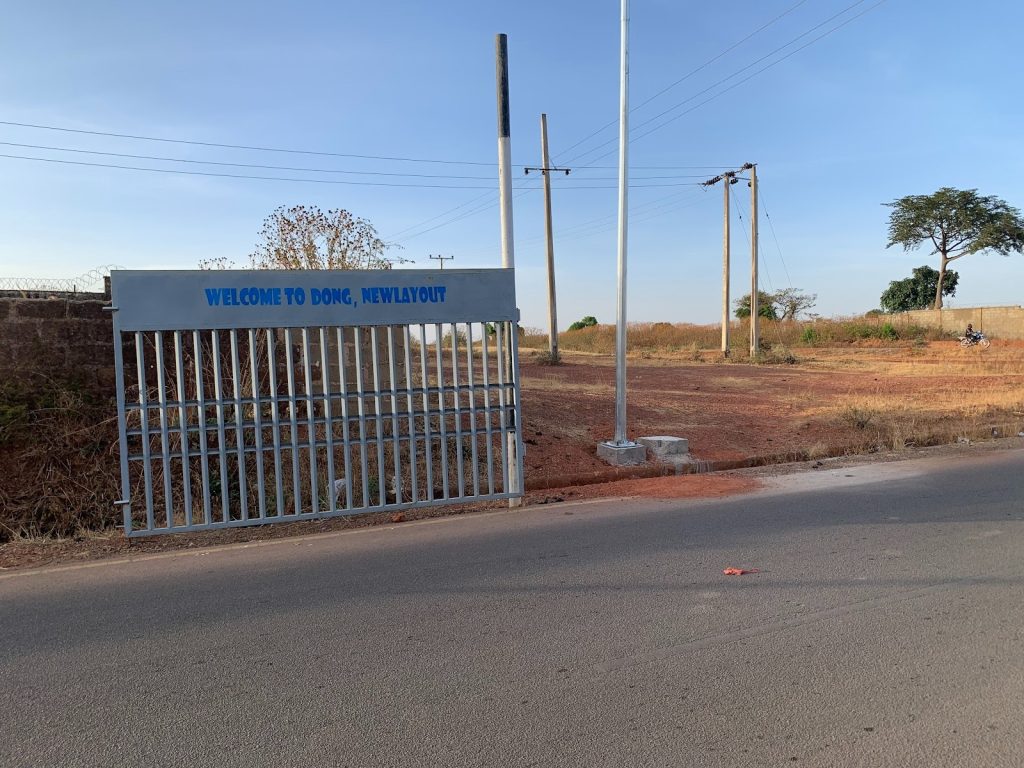
Welcome to Dong. Photo: Johnstone Kpilaakaa/HumAngle.
Dong is a fast-growing neighbourhood, bordering the conflict-hit Bassa Local Government Area and the Jos Wildlife Park. Despite nearby security posts and military checkpoints positioned at both ends of the route into the community, kidnappings have continued. Notably, these measures were already in place as the attacks persisted.
But the pattern seen in Dong is not confined to a single neighbourhood. Across the Jos-Bukuru metropolis, which includes Jos North and Jos South LGAs, similar incidents have emerged, suggesting a far-reaching threat.
Dong borders the Jos Wildlife Park and Bassa LGA. Map illustration: Mansir Muhammed.
On March 24, Sunday Agang, chairperson of the Board of Trustees of Evangelical Church Winning All (ECWA), was abducted from his residence in the Faringada area of Jos North. Earlier, in January 2026, three daughters of the Managing Director of the Plateau State Water Board, Apollos Samchi, were abducted during an attack on his residence in Rantya, in Jos South, about a fifteen-minute drive away from Dong.
In the same month, a retired Nigerian Army colonel was kidnapped in Rukuba Road, not far from Dong, and he was later rescued by security operatives. Barely weeks after Allwell’s abduction, Laven Jacob, a member of the Plateau State House of Assembly, was abducted in Dong.
These incidents, alongside others that often go unreported, reinforce the sense that kidnapping in Jos has evolved into a citywide crisis rather than a series of isolated events. Between September 2025, when Allwell was abducted, and March 2026, at least four reported kidnapping incidents were recorded in the Jos-Bukuru metropolis.
Similar incidents stretch back years. For instance, in 2022, a retired naval officer, Hellen Godos, was killed in her home in Dong by kidnappers, who were attempting to abduct her son.
The role of informants
Many of these incidents, residents and officials say, are driven by insiders within the communities themselves.
“The people work with informants,” said Peter, a community elder in Dong who gave only his first name. “They target specific people, who they believe are doing well.”
He added that during a security meeting held in the community in December 2025, the role of informants was discussed as one of the major factors responsible. “These criminals don’t know the communities; they depend on people from within.”
Generally, kidnappers often rely on information from inside communities to identify their targets, quietly shaping who is taken and when. A recent HumAngle investigation in Kano State found how kidnappers targeted a man after local knowledge of his movements and finances was passed on to criminals.
Get our in-depth, creative coverage of conflict and development delivered to you every weekend.
Subscribe now to our newsletter!
In December 2025, troops of the Joint Task Force, Operation ENDURING PEACE, neutralised a suspected kidnapper and arrested three alleged informants who were targeting Dong. In October 2025, the Plateau Police Command also arrested suspected kidnappers, including an informant who supplied foodstuffs to kidnappers in the mountainous Mazah community in Jos North.
Even so, the sense that local knowledge is being used to enable abductions persists.
Chris Iyama, an influential civil society leader in the state, described a similar pattern after he was abducted on March 8 in front of his residence in Rayfield-Guratopp.
“One of them, I presumed to be the leader of the [kidnappers], called my name and wanted to be sure if my name was Chris. I immediately affirmed. That was the beginning of my ordeal as we walked through different forests, mountains…,” he said.
He added that they took him to a forest somewhere between Bokkos and Barkin Ladi.
Captivity, ransom, and survival
A fact-finding committee set up by the Plateau State government reported that at least 420 communities across 13 local government areas – particularly in Bokkos, Barkin Ladi, and Riyom – were attacked between 2001 and 2025, with more than 11,000 people killed.
“They have been taken over, renamed, and people are living there conveniently on lands they pushed people away to occupy,” said Governor Caleb Mutfwang. “For those who think that the current situation is a farmer-herder issue, let me disabuse your mind from that perception; it is a product of organised crime by malicious elements who do not want peace to reign in the state.”
Allwell’s abduction unfolded within that wider landscape. She and her cousin were taken towards Bassa LGA, another hotspot. In April 2025, terrorists killed 52 people overnight in Zike village, in the Kimakpa/Kwall District of Bassa.
She said they were forced to walk through nearby Dong Kassa towards the Rafiki-Miango axis in Bassa. Along the way, they saw a police truck, and the kidnappers made them squat in the bush. “We trekked for over an hour,” she said.
The region where Allwell and her abductors went through. Illustration: Mansir Muhammed/HumAngle.
When they arrived in Bassa, the abductors, who she said did not speak Hausa properly but Fulfulde, led them towards an area where herders kept cattle. At the time, she was serving in the country’s North East, and she said she was able to identify the language.
“When we got nearby, the people tending the cattle started shining torchlights at us and asked who we were and why we were in their territory,” she said. The kidnappers shot two of the herders who questioned them. “At that point, I felt like I was dying.”
Hannah Silas, a development worker in the region, said incidents like this can feed into cycles of violence. “For instance, when the herders wake up and see someone dead, they will assume it was the locals who killed them, and it will lead to reprisals that should not happen,” she said.
The Miyetti Allah Cattle Breeders Association of Nigeria (MACBAN) has stated that “bad elements” and criminals have infiltrated their ranks, masquerading as herders to commit kidnappings and violent crimes. Misidentification, in this context, risks reinforcing the very cycles of violence residents are trying to survive.
They continued walking until they reached the captors’ den.
Allwell and her cousin spent more than three nights in captivity. Unlike Chris Iyama, who said he “was beaten black and blue and at some point they wanted to pull the trigger on my head”, Allwell told HumAngle that they were not physically assaulted and were given food, but she described intense fear and psychological pressure.
“I remember I was sick at that time, and one of them went to town to get medication for me,” she recounted. “I couldn’t take it because I was scared.”
The abductors demanded ₦50 million. “I told them that I am a civil servant and I don’t have [such an amount of money],” said Solomon Dansura, her brother-in-law.
As the incident gained attention on social media, NYSC officials visited the family.
“The authorities knew about the incident, but nothing was done,” Allwell said.
While negotiations continued, the abductors threatened to kill her cousin if the ransom was not paid. The family tried to raise funds without assistance from authorities.
A ransom was eventually paid, and they were released on Wednesday, Sept. 14, 2025.
Allwell does not know the exact amount, but the last figure she overheard was about ₦5 million. “The security did not rescue us,” she said.
A security post at the entrance of Dong. Photo: Johnstone Kpilaakaa/HumAngle.
Chris Iyama also said his family paid a ransom, and that his release was arranged in a forested, mountainous area in Bokkos.
Security gaps and fading trust
For residents, these experiences are rarely reflected in official communication.
Kidnap-for-ransom remains one of Nigeria’s most persistent security crises. Although ransom payments are illegal, families often treat them as the only viable option, citing slow responses from authorities. In some cases, influential public figures, including government officials, have openly crowdfunded ransom payments.
Between July 2024 and June 2025, at least 4,722 people were abducted across nearly 1,000 incidents nationwide, according to SBM Intelligence. Kidnappers demanded about ₦48 billion in ransom during that period, while families paid an estimated ₦2.57 billion. At least 762 people were killed in abduction-related violence.
Earlier in January, the Jos North Local Government Council launched a police outpost in Dong to improve security.
“This police outpost is not just a structure of blocks and mortar; it is a symbol of our resolve to protect lives and property,” said John Christopher, the local government chairperson, at the launch. “For the people of the Dong community who have endured the trauma of insecurity and kidnapping, this facility represents hope, reassurance, and a renewed sense of safety.”
A police post beside the Jos Wildlife Park, near the entrance of Dong. Photo: Johnstone Kpilaakaa/HumAngle
When HumAngle visited the facility, which is five minutes on foot from the main entrance to Dong, in March, it was deserted. Dry weeds filled the compound, the gate was locked, and no officers were present.
An 8 p.m. curfew imposed in Dong in 2025 was later relaxed in January, according to a security officer at a local church. “But once it is 10 p.m., you will not see people outside,” he said. “Some of the local hunters, who protect the community, recently engaged in a gun battle and killed a suspect, so the incidents have reduced.”
Even with that, some residents say they still feel unsafe.
Sunday evenings are usually a beehive of commercial activity at Angwan Rukuba Junction, but it turned deadly on March 29, at around 7:45 p.m., when assailants opened fire on people at random in the area, located in Jos North Local Government Area (LGA), Plateau State, in North Central Nigeria.
Eyewitnesses gave differing accounts of the attackers’ arrival, with some saying they came in a red Sharon van, while others reported they arrived on motorcycles. They were described as dressed in black camouflage, with their faces covered, and armed with guns and cutlasses. The motive and identity of the assailants remain unknown, and no group has claimed responsibility.
At least 27 people were killed, including a pregnant woman, while others were injured, according to Dalyop Mwantiri, President of the Berom Youth Moulders Association.
Sunday Akintola, a resident, said the high number of casualties was due to people being caught unawares, as residents initially assumed the gunshots were stray bullets from officers of the National Drug Enforcement Agency, which “usually come to harass young men in the area”. “Once people stepped in, they were shot at close range, while others were chased and struck with machetes,” he noted.
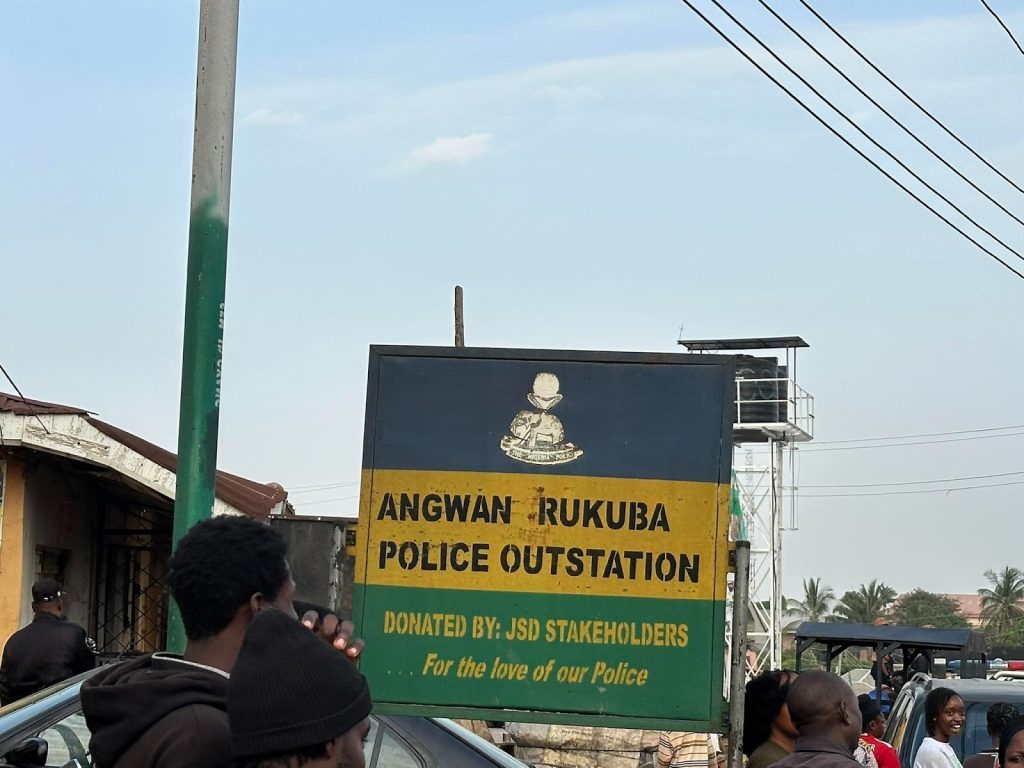
Although there is a police station at the junction where the incident occurred, residents said the response was slow, alleging that some officers on duty fled when the attack began, before reinforcements later arrived from the state headquarters.
The police outpost at Angwan Rukuba. Photo: Matthew Tegha.
Alfred Alabo, the spokesperson of the Plateau Police Command, says they “are currently combing the nearby bushes to ensure that the suspects are arrested or dislodged”.
Angwan Rukuba is located just 10 minutes from both the Jos Main Market and University of Jos facilities, including the Senior Staff Quarters, Main Campus, and Permanent Site, as well as private housing for university staff and students. It also borders a large stretch of hills, including the popular Gog and Magog.
Notably, it is not a rural farming settlement or a mining community, but a densely populated, urban residential area with a diverse mix of residents, including students, civil servants, and traders. As such, the incident does not fit the typical pattern of farmer–herder clashes often reported in Plateau State.
Residents at the Angwan Rukuba junction. Photo: Matthew Tegha.
“This is right inside Jos. It is a mixed community; it is really a melting pot because everybody is here, and an injury to one is an injury to all,” said Julie Sanda, Director General of the Plateau Peace Building Agency (PPBA). “It was an unprovoked attack.”
Violence in Plateau State is multidimensional, involving terror attacks, conflict between farmers and herders in rural communities, and ethno-religious tensions that have rocked the city since 2001. However, one thing is common about these incidents in the Jos–Bukuru metropolis: they often lead to revenge attacks among ethno-religious groups, driven by deep-seated mistrust, which has in turn contributed to polarised settlements.
“If you know anything about Jos, if this incident had happened ten years ago, I don’t think we would be here today. It shows the resilience of the people and their courage,” Julie said.
Shortly after the attack on Sunday, the Plateau State Government imposed a dusk-to-dawn curfew in Jos North LGA until Wednesday, April 1. However, residents took to the streets in protest, displaying the bodies of the deceased. Additionally, the University of Jos has rescheduled its ongoing semester examinations. Caleb Mutfwang, the state governor, also visited the community on Monday, March 30.
Governor Mutfwang addressing residents in Angwan Rukuba, Jos Metropolis. Photo: Matthew Tegha.
“I assure you that those responsible for this evil act will not go unpunished,” he said.
The state government has also reiterated its ban on commercial motorcycles in the Jos–Bukuru metropolis, which covers Jos North and Jos South LGAs. “Meanwhile, the hours of operation for tricycle riders (keke) still remain 6:00 a.m. to 7 p.m.,” according to Davou Gyang Jatua, the state Commissioner of Transport.
Residents who spoke to HumAngle said that, in recent months, unfamiliar motorcyclists — some of whom do not know locations within the metropolis — have been moving around. “Whenever I see keke and okada (motorcycles) out very late, I know there’s a risk of evil acts being perpetrated using them,” said Zoe Machunga, a Jos resident.
In the weeks leading up to the attack, some social media accounts had posted videos inciting violence in Jos, although it remains unclear whether such messaging contributed to the incident. The governor said the social media users responsible for the posts have been apprehended, a claim confirmed by Alfred, the police spokesperson, during a radio interview on Monday.
“Injustice has made healing difficult in Plateau State,” said Joseph Lengmang, a peace and security expert and former Director General of PPBA. “Peacebuilding efforts remain incomplete, and some underlying issues still need to be addressed.”
A sudden armed attack occurred on March 29 at Angwan Rukuba Junction in Jos North, Plateau State, Nigeria, resulting in the death of at least 27 people, including a pregnant woman.
Assailants, dressed in black camouflage, attacked the area with guns and machetes, and despite being near a police station, the initial response was slow.
Get our in-depth, creative coverage of conflict and development delivered to you every weekend.
Subscribe now to our newsletter!
The local community, comprising a mix of students, civil servants, and traders, organized protests following the incident, which was described as an unprovoked attack, distinct from the farmer-herder clashes common in the region.
In response, the Plateau State Government imposed a curfew and affirmed the ban on commercial motorcycles. It also took steps against violence incited by social media, with some arrests made. The attack reflects the ongoing ethnic and religious tensions in Plateau State, with peacebuilding efforts criticized for being incomplete. The incident underscores the broader challenges in achieving lasting peace and addressing deep-seated mistrust among various groups in the region.