‘Every Brilliant Thing’ review: The interactive Daniel Radcliffe
NEW YORK — What makes life worth living? For hard-core “Harry Potter” fans with money to burn, it might be getting Broadway tickets to interact fleetingly with Daniel Radcliffe in “Every Brilliant Thing,” an ingenious and touching solo performance piece written by Duncan Macmillan with Jonny Donahoe on the subject of suicide — or more precisely, on the ordinary joys that militate against such a drastic step.
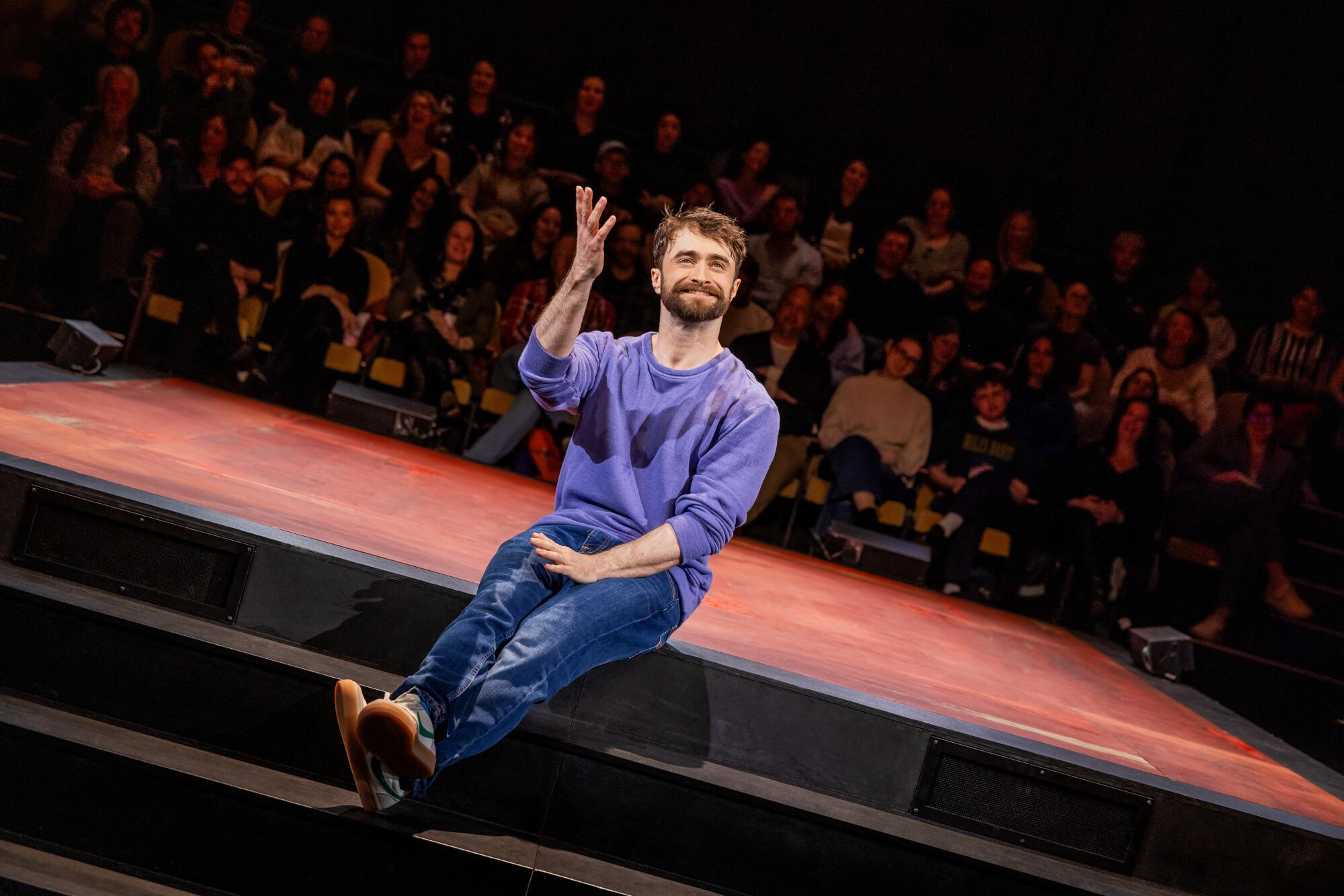
Radcliffe was breathlessly scampering up and down the aisles of the Hudson Theatre before the show began, enlisting audience members to be participants in the play. Having seen “Every Brilliant Thing” twice before, once at the Edye (the black box at Santa Monica’s BroadStage) starring Donahoe in 2017 and once at the Geffen Playhouse’s intimate Audrey Skirball Kenis Theater starring Daniel K. Isaac in 2023, I knew exactly what he was up to.
The play revolves around a list that the narrator began at the tender age of 7 after his mother first attempted suicide. While she was still in the hospital, he started compiling, as much for her benefit as for his own, sources of everyday happiness.
Ice cream, water fights, kind people who aren’t weird and don’t smell unusual. These items are given a number, and audience members assigned a particular “brilliant thing” are expected to shout out their entry when their number is called.
The list gradually grows in complexity as the narrator gets older. Miss Piggy, spaghetti bolognese and wearing a cape give way to more sophisticated pleasures, such as the way Ray Charles sings the word “You” in the song “Drown in My Own Tears” or the satisfaction in writing about yourself in the second person.
Music plays a prominent role in “Every Brilliant Thing,” which was adapted from a monologue/short story Macmillan wrote called “Sleeve Notes.” The narrator’s terribly British father takes refuge from the emotional storms of his household by listening to jazz records in his office. John Coltrane, Cab Calloway, Bill Evans, Nina Simone are favorite artists, and the narrator can tell his father’s mood simply by the record he’s decided to play.
The production, directed by Jeremy Herrin and Macmillan, involves every level of the Hudson Theatre. I assumed I would be safe, occupying an aisle seat in the murderously expensive prime orchestra during a press performance attended by critics. But I wasn’t flashing a pad as my colleague across the aisle from me was doing to ward off any intrusions. And just before the show was about to start, Radcliffe was suddenly kneeling beside my seat asking if the person I was sitting with was my partner.
I told him that we weren’t a couple, just friends, and that I would be the worst person he could possibly ask to perform anything. But Radcliffe wasn’t so easily put off. “Let’s just say that you’re an older couple who have been together for some time,” he whispered. “And all you have to do is hand me this box of juice and candy bar when I refer to the older couple.”
OK, what harm could there be? Little did I know that “older couple” was to become “old couple,” a term that seemed to be repeated incessantly, at least to my Gen X ears not yet accustomed to scurrilous millennial attacks! I composed myself by pretending that we were in the world of anti-realism. But in truth, I would like to be the kind of person who would offer an anxious kid in a hospital waiting room a juice box and a candy bar, so maybe the casting wasn’t so far-fetched after all.

Daniel Radcliffe in the Broadway production of “Every Brilliant Thing.”
(Matthew Murphy)
A theatergoer was called upon to play the vet who euthanized the narrator’s childhood pet, a dog named Indiana Bones that was symbolized by a coat someone volunteered from the audience. It was the boy’s first experience of death, a difficult concept for a young mind but an important precursor for a boy not given the luxury of existential innocence.
Other audience members, particularly those seated on the stage, played much more elaborate roles. One man, first invited to serve as a stand-in for the narrator’s father, was asked instead to play the boy. He was given one word to say in reply — “Why?” — as his father tries to explain the reason his mother is in the hospital. This same enlisted actor was later called upon to play the dad giving a toast at his son’s wedding, one of the rare occasions when he was able to summon language for the kind of deep feeling he would normally only be able to express through his records.
One kind and patient spectator conscripted to play the school counselor had to remove her shoe to improvise a sock puppet, one of the tools of her empathetic practice. Another audience member sensitively played Sam, the narrator’s love of his life, a relationship that reveals the long-term toll of being raised by a parent suffering from suicidal depression.
Radcliffe’s audience wrangling was as intuitively sharp as his deeply felt performance. He has the comfort of a good retail politician, who’s not afraid of making direct contact with crowds. Two-time Tony winner Donna Murphy, in the house at the reviewed performance, gamely went along when Radcliffe briefly enlisted her luminous services.
Obviously, Radcliffe is the main reason “Every Brilliant Thing” is on Broadway. The show, which began at Britain’s Ludlow Fringe Festival in 2013, is a gossamer piece, a 70-minute curio best experienced in close quarters without the high expectations and ludicrous prices of New York’s turbo-charged commercial theater. The Hudson Theatre lends a mega-church vibe to the proceedings, but the spirits of theatergoers are nonetheless moved.
A scruffy-faced Radcliffe, twinkling accessible geniality in jeans and a sweatshirt, zips up and down the cavernous theater as though waging a one-man campaign against the isolation epidemic. There’s no denying that Harry Potter has matured into an assured stage actor. His Tony-winning performance in “Merrily We Roll Along” should have put to rest any doubts, but the glare of his fame can still obscure his serious chops.
Sincere yet never smarmy, ironic without ever being cynical, well-groomed though far from swank, he’s a more glamorous version of the character than the one originated by Donahoe, the British comedian with an everyman demeanor whose portrayal seemed so genuine at the Edye that I mistakenly thought that the play was his personal story.
Donahoe’s performance was filmed for HBO, but “Every Brilliant Thing” is meant to be experienced in a theater. The whole point of the show is to transform the audience into an impromptu ensemble, a group of strangers emotionally united through the story of one young man’s intimate knowledge of suicide, a subject that Albert Camus called the “one truly serious philosophical problem.”
I’m of two minds about “Every Brilliant Thing.” I was moved once again by the piece, but I’m grateful I didn’t have to wreak havoc on my credit card to pay for my seats. I love the interactive, gentle humanity of the play, but I was also acutely aware of how the work has been commodified. I applaud Radcliffe’s willingness to carve an independent path as an actor, but I might have been more impressed by his adventurousness had he decided to perform in a pocket venue that didn’t have the tiers of pricing I associate with airlines.
Yet launching a conversation around mental health with an audience magnet as powerful as Radcliffe is on balance an excellent thing. And Radcliffe’s compassionate portrayal of a survivor recognizing that he’s not out of the woods just because he made it into adulthood is one of those things that makes a theater lover just a little more appreciative of the humanity at the center of this art form.