The Recording Academy announced the new category in June, saying it would recognise “artistic excellence in Asian pop music performances originating from or widely recognized within Asian markets”.
The prize had been under discussion for years. It was finally introduced after Golden, from the movie K-pop Demon Hunters, became the first K-Pop song ever to win a Grammy this February.
“As Asian pop’s influence has continued to grow within our process, our members and trustees felt this was the right moment to create a category that more accurately reflects the genre’s scale, artistry and global impact,” organisers said at the time.
But the award received a decidedly mixed reception. Many felt it would stop Asian artists from receiving recognition in the main categories.
Others were upset by a stipulation that nominated songs should make “meaningful use” of an Asian language.
That requirement ruled out the two most recognisable Korean acts in America, BTS and Blackpink, whose latest releases are primarily sung in English.
The arguments against the Asian pop award are similar to those made by Latin artists about Grammy categories such as best música urbana.
While the intent is to recognise music of a certain geographic or linguistic origin, some musicians feel it ends up being exclusionary, with their music segregated from mainstream prizes like album or song of the year.
That perception was challenged this year, when Bad Bunny’s Debí Tirar Más Fotos became the first Spanish-language album to win album of the year. Rosalía’s Lux is also expected to feature heavily in the nominations for next year’s awards.
TEAM GB stars Katarina Johnson-Thompson and Keely Hodgkinson looked on track for fashion golds at Burberry’s London Fashion Week event yesterday.
Daring heptathlete Katarina, 33, wore nothing under her blazer while 800m hero Keely, 24, teamed a silk shirt with velvet flares.
Track star Keely Hodgkinson, 24, teamed a silk shirt with velvet flaresCredit: GettyHeptathlete Katarina Johnson-Thompson, 33, wore nothing under her blazerCredit: Getty
They rubbed shoulders at the bash, held at Chelsea College of Arts, with models including Iris Law, 25, and Lila Moss, 23.
Iris opted for a denim two-piece while Lila wore a sparkling tweed minidress.
Rosie Huntington-Whiteley, 39, teamed a black Burberry mac with a £6,900 price tag, with a diamond necklaceCredit: GettyIris Law opted for a denim two-pieceCredit: Getty
Actress Jodie-Turner Smith, 40, turned heads in a purple all-leather outfit with long boots.
Also at the do — which coincided with Burberry celebrating its 170th anniversary — were Romeo Beckham, 24, and girlfriend Kim Turnbull.
Kim, 25, is a rising star of the catwalk and was sent Burberry items to show off including a £1,295 handbag and £1,460 cropped trench coat.
Runner Keely recently put on a leggy display as she celebrated her 400m win at Athlos.
Lila Moss wore a sparkling tweed minidressCredit: GettyMarvel star Chiwetel Ejiofor and Jason Statham at the bashCredit: Getty
WASHINGTON — Thousands of people joined outside the John F. Kennedy Center for the Performing Arts on Friday evening to protest President Trump’s plans for the facility, lending their voices to a chorus of organizations and individuals who have been horrified that he might make good on his threat to close and tear down the storied institution.
The crowd streamed in from the nearest subway stop, crowding streets in the Foggy Bottom area of Washington and locking down traffic as they walked, many carrying signs, as they joined in an event dubbed “Hands Around the Kennedy Center.” At one point some held hands, forming a human chain around the center.
Chris Raleigh, co-founder of Hands Off the Arts, which set up the gathering, said in an interview that he hoped it would show that people are willing to fight to keep Trump’s plans for the building at bay.
One of the most iconic buildings on the Potomac River waterfront, the Kennedy Center has been a focus of Trump’s remake of Washington since 2025, when he began installing his loyalists on its governing board. Late last year, he had his named placed on the center in front of that of President Kennedy. A judge ruled that Trump’s name was illegally added and ordered it removed.
The Kennedy Center board, which remains aligned with the president, voted Tuesday to close the center indefinitely for repairs hours after U.S. District Judge Christopher Cooper blocked their plans to return Trump’s name to the building. On Thursday, the judge ordered the Kennedy Center to provide 30 days’ notice before making any major physical changes to the building, including demolishing it.
Raleigh said he, like others, is concerned that Trump could take the step without notifying the court. “Look at the East Wing,” he said, referring to the demolished portion of the White House. “We got up one morning and there was a giant hole there.”
Raleigh said the Kennedy Center is more in the public eye than the East Wing was. He added that he doesn’t believe the president fully understands why people are so upset, “but that’s our job, right? This may be the line that no one expected, but this is where the line is going to be.”
Protesters talked about the importance of the center as the pinnacle of the nation’s performing arts world.
Bud Wilkinson, a local member of the arts community, set up a chalkboard with Trump’s name written on it hundreds of times. Protesters flocked to him to erase the names and replace them with hearts.
“The Kennedy Center is vital to the arts in Washington. We need it. We need this,” Wilkinson said. “This is not just about putting the president’s name on the Kennedy Center. It’s about censoring the performances and the programming. That’s what started all this. So that’s what the nitty-gritty really is about this. So I want to replace all of this with love. That’s why there’s a heart.”
Alina Baciu talked about the opportunities and relationships that students at the Duke Ellington School of the Arts have with the center and how those relationships might be affected by what’s going on.
Her daughter had opportunities to take advantage of all the center had to offer as a student at the Ellington school, she said. “I mean, they borrowed the beautiful costumes and the beautiful dresses from the Washington National Opera for their performances at Duke Ellington,” she said. They also performed on the center’s Millennium Stage.
“All of those things have gone away because of this craziness. And it just hurts my heart,” Baciu said.
Laura Steinberg, a volunteer for the last 10 years, said the loss of performances has already been heart-wrenching. “This reminds me of that picture from Tiananmen Square, where that young man stood in front of the tank,” she said of the throngs present. “This was my visceral response to this. I’ll stand in front of the wrecking ball if it’s going to come to that. My guess is many of these people would come down because we saw what he did to the East Wing. Nobody thought he would actually do it. So I think the shock has mobilized people.”
Friday’s event followed a tumultuous week in federal courts in Washington, where filings and counter-filings flooded the courts as the administration continues pushing for the president’s vanity projects. The administration has made substantive steps to begin work on a number of projects, despite the fact they are still being litigated. Such projects include Trump’s triumphal arch and the administration’s takeover of East Potomac Golf Links and the U.S. Institute of Peace.
Speaking from the Oval Office, Trump said he was willing to save the center, which he said was losing money. He did not address a question about demolishing it.
“We have a lot of people working very hard on it to save it,” he said. “I can save it easily, but why should we be doing that and then raise money for the rest of our lives to keep it afloat? Because that’s what you have to do, if we get no recognition. I think the Trump administration should be recognized as having saved the Kennedy Center.”
Senior U.S. Air Force leaders in Europe say NATO allies are increasingly looking to participate in the development and employment of collaborative combat aircraft (CCAs), even as several of those same countries pursue their own indigenous fighter and drone programs. American commanders say they are looking forward to CCAs expanding the alliance’s overall capacity, and are already pushing for such systems to work together from the outset.
Speaking yesterday at the Air & Space Forces Air, Space and Cyber Symposium that TWZ is attending, Lt. Gen. Jason T. Hinds, commander of U.S. Air Forces in Europe, U.S. Air Forces Africa, and NATO’s Allied Air Command, and Chief Master Sgt. Joshua J. Wiener, USAFE-AFAFRICA’s command chief, discussed how the command is preparing for an eventual European role in the U.S. Air Force’s planned fleet of hundreds of CCAs.
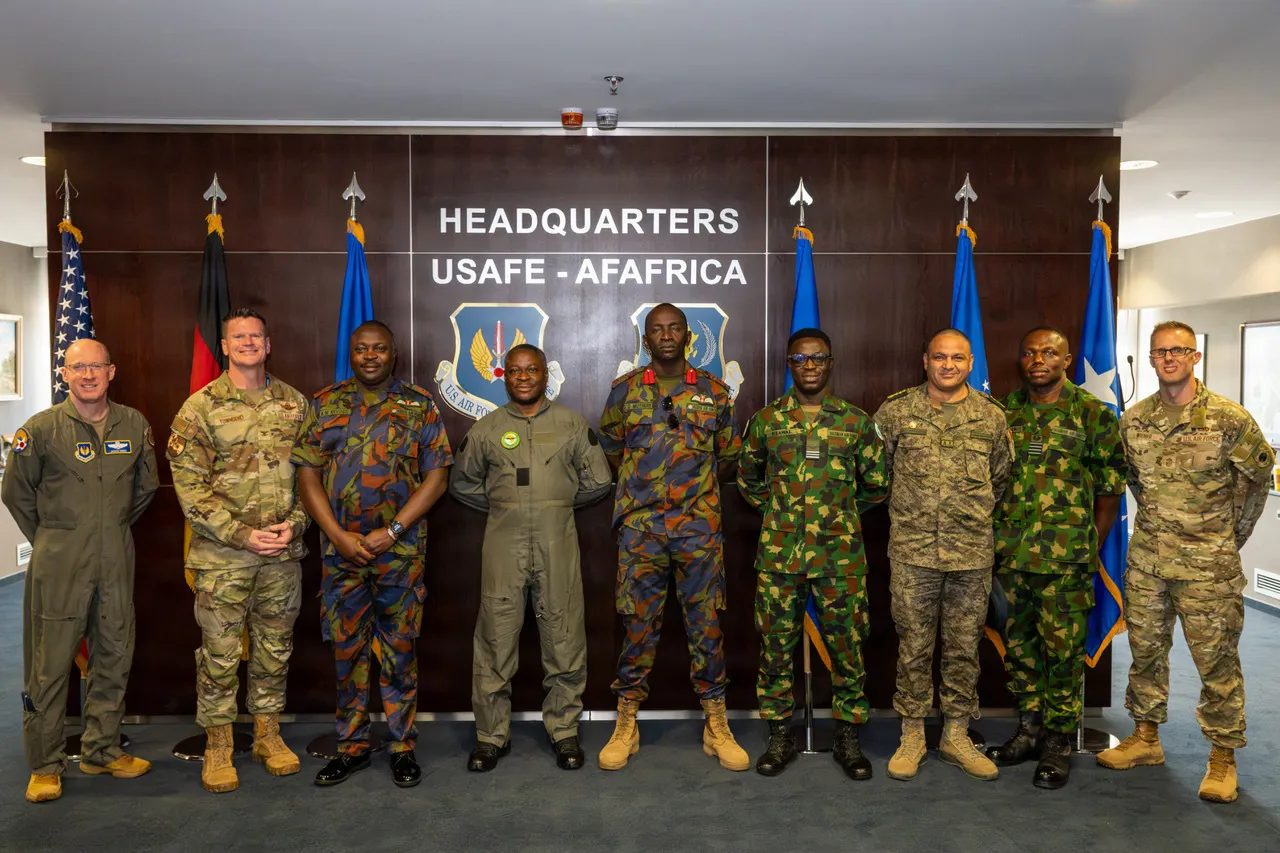
U.S. Air Force Lt. Gen. Jason T. Hinds, U.S. Air Forces in Europe – Air Forces Africa commander (far left), and U.S. Air Force Chief Master Sgt. Joshua J. Wiener, USAFE-AFAFRICA command chief (second from left), pose for a group photo with the Association of African Air Forces representatives from Kenya, Nigeria, and Tunisia at Ramstein Air Base, Germany, earlier this month.
The issue is particularly significant for USAFE, which operates a fraction of the fighter force it maintained in Europe during the Cold War, even as many of its NATO allies contend with shrinking fleets of crewed combat aircraft. This comes against a backdrop of deepening tensions with Russia and the emergence of new kinds of threats. Autonomous aircraft that can augment crewed fighters could provide the alliance with additional combat mass without requiring a corresponding increase in the number of crewed aircraft and personnel permanently based in Europe.
“I’m excited about what CCAs have in store for the Air Force,” Hinds said, pointing to recent comments from the Secretary of the Air Force Troy Meink, including the aim of having at least 500 CCAs in service by 2032.
He added that European interest in these kinds of platforms is already growing.
“I think you’re going to see a lot more interest from other nations inside Europe about what is America doing with CCAs and how they can join this party, if you will,” Hinds said.
Germany is “heavily involved,” he said, while Scandinavian countries and the Netherlands are also showing interest.
In the case of Germany, we have previously explored how that country is looking to procure CCAs by 2029. Sweden, too, recently unveiled a concept for a high-end, stealthy CCA-type drone, while the Dutch are looking to become more closely alligned with U.S. Air Force CCA efforts.
Saab has produced a full-scale concept model of a future uncrewed combat air system, known as aircraft A3. Saab
USAFE is currently using two broad operational scenarios to explain to allies how CCAs could fit into NATO’s force structure.
The first is defensive. A CCA could operate as part of an integrated air and missile defense network, potentially engaging one-way attack drones or cruise missiles without the need for expensive crewed fighters.
The second is offensive. In that scenario, autonomous aircraft could help suppress or destroy integrated air defense systems and potentially attack fielded forces during an effort to repel a hostile incursion into NATO territory.
Allies are interested in both missions, Hinds said, and want the ability to incorporate CCAs into their own force designs. Interestingly, only yesterday, Anduril shared photos of its YFQ-44A Fury configured with air-to-ground weapons, underscoring the fact that the CCA could take on an air-to-ground role in the future in addition to its current air-to-air focus.
A YFQ-44A carrying pods for 2.75-inch rockets and 500-pound Joint Direct Attack Munitions (JDAM) under the wings. Anduril
That kind of interest has already prompted work at the NATO level. Hinds pointed to a study by the Joint Air Power Competence Center, the alliance’s airpower think tank based in Kalkar, Germany, examining how NATO members could employ CCAs in a modular fashion, including issues such as sustainment, training, and exercises.
“It was a pretty long paper, but the nations wanted it,” Hinds said.
Initial experimentation is expected to take place in the United States, but European experimentation could follow, including by Sweden and potentially other NATO members.
At the same time, European countries are not simply waiting for an American CCA to arrive.
The United Kingdom has launched its own Storm Fighter CCA program. Germany is pursuing a separate loyal-wingman effort, while the United Kingdom, Italy, and Japan are meanwhile jointly embarked on the Global Combat Air Program, or GCAP, which is intended to produce the Tempest next-generation crewed fighter and associated uncrewed systems.
A rendering of a CCA concept released at the launch of the U.K. Royal Air Force Storm Fighter program, earlier this year. BAE Systems
The proliferation of national programs raises an obvious question: How does NATO prevent a growing fleet of autonomous aircraft from becoming a collection of incompatible national systems?
Hinds said the answer starts with commonality.
“The first and foremost thing is we want to strive for commonality,” he said. “Commonality means we don’t even have to worry about interoperability.”
Where common equipment is not possible, however, USAFE wants interoperability built into national systems from the beginning.
“Interoperability by design” is the preferred approach, Hinds said, with NATO data standards and other requirements incorporated before a system enters service rather than retrofitted later.
The good news for USAFE is that NATO already has extensive experience establishing common standards for interoperability, covering everything from tactics and procedures to communications, datalinks, weapons employment, and other technologies. That existing framework gives the alliance a foundation for integrating increasingly diverse national systems without requiring every member to field identical equipment.
F-35A from the U.S. Air Force’s 48th Fighter Wing and the Royal Norwegian Air Force fly tandem after a formation flight near Lofoten, Norway, March 10, 2026. The formation flight was intended to symbolize the partnership and degree of interoperability displayed between participating NATO militaries during Exercise Cold Response 26. U.S. Marine Corps photo by Cpl. Mya Seymour Cpl. Mya Seymour
Hinds did warn that some countries have previously acquired equipment that was not compatible with NATO systems, leaving them with the choice of paying to modify their own equipment or forcing the alliance to adapt its systems around it.
That problem becomes particularly important as autonomous aircraft are connected to increasingly complex sensor and weapons networks. Even more important is the requirement for a baseline command-and-control network for CCAs themselves, allowing different platforms to manage them seamlessly.
The ability to share and control CCAs across a complex battlespace is already emerging as both a major opportunity and a significant integration challenge. The U.S. Air Force and Navy, for example, have made clear that their respective CCAs are being developed with the ability to be controlled seamlessly across services, pointing toward a future in which autonomous aircraft need not remain tied to the service or platform that launched them.
In such an architecture, the aircraft, sensor, command-and-control network, and weapon do not necessarily have to belong to the same country.
As an example, Dutch F-35s, operating in Europe, have used a data-exchange system to transmit targeting coordinates to Israeli-made PULS (Precise and Universal Launch System) rocket artillery. The system, developed by Lockheed Martin is known as Keystone, and you can read more about it here.
A Dutch F-35A brandishing its AIM-120 AMRAAM missiles during a NATO air policing drill. Bartek Bera
USAFE is making “significant advances” in areas including cross-servicing, cross-loading, and cross-flying allied aircraft, Hinds said, all of which are intended to make multinational operations more seamless.
A U.S. Air Force F-35 crew chief conducts post-flight checks at Pirkkala Air Base, Finland, during the tactical exercise, Ramstein Flag 26. U.S. Air Force photo by 2nd Lt. Sarah Hedgman
The same philosophy applies to weapons.
“We want to have all the fires, right? Whether it’s U.S. built or built inside European nations,” Hinds said.
That could prove increasingly important as European countries expand domestic production of missiles, drones, and other weapons alongside their aircraft programs.
The growth of GCAP and other European defense programs comes amid broader debate over how much Europe should depend on U.S. military equipment.
But Hinds rejected the idea that allies developing indigenous aircraft and autonomous systems necessarily signals a move away from American equipment.
“No, I don’t,” he said when asked whether allies were moving away from U.S. systems.
Instead, Hinds characterized the trend as an expansion of the transatlantic defense-industrial base.
Sweden was one example he cited. The country, which recently joined NATO, continues to produce new military equipment, including Gripen fighters, while those aircraft are already being operated by NATO members.
Swedish Gripens are currently leased to Hungary, and other countries are considering the aircraft, Hinds said.
A Hungarian Air Force JAS 39C Gripen participating in NATO Exercise Ramstein Flag 24 flies over the west coast of Greece, in 2024. U.S. Air Force photo by Tech. Sgt. Emili Koonce
The broader trend toward co-manufacturing and co-production is also something he welcomed.
“I’m seeing a lot of discussions about co-manufacturing and co-production, and I welcome those discussions as well,” Hinds said.
That approach could become increasingly important as NATO tries to expand its available combat power without relying exclusively on additional U.S.-built platforms.
For USAFE, the objective is to ensure that whatever aircraft NATO countries develop or purchase can plug into a common architecture, sharing data, receiving targeting information, drawing on common logistics networks, and contributing weapons effects across national boundaries.
For a U.S. Air Force command that has spent decades trying to cover Europe with far fewer fighters than it once had, hundreds of autonomous wingmen, whether American-built or allied, could provide a significant way to generate additional combat mass.
Senior U.S. Air Force officials are now working to ensure that the networking, weapons integration, logistics, and command-and-control architecture will be in place once those aircraft start to come online.
For a third time, the US House approved a war powers resolution, halting Trump’s ability to continue military action.
For a third time, the US House has voted to end the war in Iran, approving a war powers resolution that would halt President Donald Trump’s ability to continue military action without congressional approval.
The roll call late Tuesday, 220-204, was similar to earlier efforts this summer, with a few more Republicans joining all Democrats voting to bring an end to the conflict.
Seven House Republicans backed the resolution, including three voting in favour for the first time.
Iowa congressman Zach Nunn, a Republican, explained his vote saying that “with the negotiating window closed, sustained combat operations now require congressional authorization.”
“I will not support another open-ended war,” Nunn said.
None of the resolutions has made it to the president’s desk, where Trump would almost certainly veto the measure.
Republican Representative Brian Mast of Florida, the chairman of the House Foreign Affairs Committee, questioned which military resources Democrats would want to remove from the region where he said Iran remains a threat.
Mast said Trump is against “forever wars, and that is what he is ending” – the decades of hostilities from Iran.
“They are a continuous ongoing threat to the United States,” Mast said. “Enough is enough.”
The run-up to the midterms
The action is likely to be the last House vote on the Iran war ahead of the midterm elections, where the conflict overseas is playing a substantial role in the political campaigns. The war that Trump launched on February 28 has dragged on, with on-again, off-again deadly missile strikes being exchanged and causing havoc in the region for nearly seven months.
Lawmakers are heading home at the end of the week to campaign nearly full-time, with fewer than 50 days to go before the elections that will determine control of Congress as Democrats try to wrest power from Republicans.
US war on Iran
The US war on Iran is worsening inflation and straining the country’s munitions stockpiles, a report from the nonpartisan Congressional Budget Office (CBO) has found.
The report, released on Tuesday, found that the cost of the six-month war has reached $38bn and is expected to rise by $3bn per month. The war is projected to increase inflation by 0.5 percentage points in the first three months of 2027.
Trump himself had promised not to involve the US in foreign wars when he won a second term in the White House, and his actions against Iran are weighing on the Republican Party that controls the House and Senate.
Most Americans say the war in Iran has not been worth fighting, according to an AP-NORC poll in July.
Previous war resolutions
Congress has tried repeatedly to alter the trajectory of the war against Iran, but efforts to limit the Trump administration’s military action remain a long shot so long as the president can fend off or veto the measures.
The House first approved a war powers resolution in June, and followed up with another one in July, both seeking to halt US action in Iran. The Senate on its 10th try also approved a war powers resolution to end the conflict, but Republican senators quickly reversed course the next day after Trump berated them during a closed-door lunch.
While the Constitution gives Congress the authority to declare war, it also gives the president authority as the commander-in-chief to engage in some military actions. The War Powers Act, created after the Vietnam conflict, sought to impose a more specific time limit on the president’s power, requiring congressional approval for sustained military actions after 60 or 90 days.
CINCINNATI — Dodgers left-handed pitcher Kris Bubic is scheduled to meet the team in Cincinnati, according to people with knowledge of the plans who weren’t authorized to discuss it publicly.
Bubic made his last rehab appearance for Triple-A Oklahoma City on Sunday, so the Dodgers are not expected to activate him off the 60-day injured list right away.
The Dodgers acquired Bubic from the Royals at the trade deadline this year. He’d been on the IL since May, first with a low-grade flexor strain in his left forearm, and then a shoulder impingement setback.
Bubic reported to the Dodgers’ Arizona complex, where the 2025 All-Star began working back as a reliever due to the time constraints of the season.
In six Triple-A rehab appearances (5 2/3 Innings) this month, Bubic didn’t allow a run, and he limited opponents to two hits and two walks.
Because Bubic is on the 60-day IL, the Dodgers will need to clear spots on the active and 40-man rosters to reinstate him.
MIS-TEEQ sent fans wild at their reunion gig on Saturday night, as original member Zena McNally joined the girl group on stage to perform their debut single.
The highly-anticipated show saw Alesha Dixon, Sabrina Washington and Su-Elise Nash regroup for a comeback performance at London’s OVO Wembley Arena.
Mis-Teeq fans went wild as original member Zena McNally joined the band for an epic reunion at WembleyCredit: The SunThe highly-anticipated show saw Alesha Dixon, Sabrina Washington and Su-Elise Nash regroup for a comeback performance at London’s OVO Wembley ArenaCredit: The Sun
And fans were treated to an extra hit of noughties nostalgia as OG member Zena took to the stage as a special surprise guest.
Zena was only part of Mis-Teeq for the band’s first year, just appearing on their debut single, Why?
Sign up for the Showbiz newsletter
Thank you!
She left in 2001 and attempted to launch a solo career, only releasing two songs, before becoming a DJ for Radio 1 Xtra and eventually moving to the US with her then beau, US soccer [football] player, Cory Gibbs, who she married in 2008 but split from in 2014.
The group welcomed her to the stage and their excitement to be back together as a four-piece was palpableCredit: The SunThe ladies then sat in a line on four stools and delivered their track Why? for the adoring crowdCredit: The SunZena was only part of Mis-Teeq for the band’s first year, just appearing on their debut single (pictured in 2000)Credit: GettyZena left in 2001 and attempted to launch a solo career, only releasing two songs, before becoming a DJ for Radio 1 and eventually moving to the US with her footballer husbandCredit: Instagram / @zena.anez_
But as the group welcomed her to the stage at Wembley on Saturday night, their excitement to be back together as a four-piece was palpable.
Zena looked stunning in a black leather ensemble and hugged the other three ladies as she arrived on stage, with Alesha seen jumping up and down at the reunion in The Sun’s exclusive video.
“How beautiful is Zena?” she exclaimed, before telling the crowd: “You didn’t see that one coming did you?”
Alesha went on the explain that they didn’t want to perform the song that launched them unless Zena sang it with them.
She said: “We could not sing this song without our girl, who, as the day one’s know, is in the video.
“Her vocals are still on the record – she had a sweet voice!”
Alesha turned to Zena and said: “The fans are always talking about you!
“I don’t think they think we like each other – we love each other!”
Zena affirmed that there was no bad blood between the girls, saying: “It’s all love!”
She added: “I want to thank you for having me here tonight – such a special moment.
“I’m hoping you’ll have fun with this – let’s do it!”
The ladies then sat in a line on four stools and delivered their track Why? for the adoring crowd.
The reasons behind Zena’s abrupt 2001 departure have been widely speculated, and the former Mis-Teeq queen has kept relatively tight-lipped.
The only occasion she seemed to shed any light on the split was in an 2010s blog post by writer and speaker Anika Allen where Zena spoke of her initial joy of being in a group before things soured.
She said: “Everything was fine in the beginning and it fun. But as time went on, I began to notice an imbalance in the group as the other members [Sabrina and Alesha] had been their first.”
Sabrina continued: “I felt they were focused on a bit more by the production team, who were suppressing my ideas. I write a lot also. We’re a team, but there was no compromising. I became unhappy.”
The 2026 reunion show has been nine months in the making, since the group announced their comeback at the start of 2026, with The Sun revealing this week that it would be an extraordinary gig for the fans.
Celebrating the 25th anniversary of their debut album Lickin’ On Both Sides, the Scandalous singers locked themselves inside Soundstage Studios in North London in the days leading up to the gig.
“This concert means everything to Alesha, Su-Elise and Sabrina and they have been working so hard to put on the performance of a lifetime,” an insider explained.
The trio performed live together in May, delivering a medley of their hits at the final of Britain’s Got Talent, and sang again as the surprise guests during Capital’s Summertime Ball, thrilling the 80,000-strong crowd.
The insider continued: “When they reunited at BGT and Summertime Ball, they loved being back performing together but they have taken it up a notch for their Wembley concert.
“This past week they’ve been pushing themselves in rehearsals to make sure their moves are flawless.”
The noughties group had seven consecutive top-10 singles and two top-ten albums across US, Europe, Asia and Australia, including their double platinum second album Eye Candy which was released in March 2003.
In spite of this success, the group would disband 2005 while recording their never-released third album, with all three members turning their focus on their respective solo careers.
SAO PAULO: Former Liverpool playmaker Philippe Coutinho has joined Santos, team-mate Neymar announced on Saturday, although his new club has yet to officially confirm the move.
Coutinho, 34, has been without a club since leaving Vasco da Gama in February, citing mental burnout.
“We’re very happy that you’re here,” Neymar said on social media, with a video showing Coutinho alongside Santos players and coaches.
“Our squad and our fans will welcome you with arms wide open.”
According to local media, former Brazil international Coutinho needs to pass his medical before Santos can confirm his arrival on a contract that runs until the end of the season.
Fans had travelled from across the UK and the world to see the rapper, including Prince Dean Sithole, who hailed Jay-Z as one of his role models.
“I think he’s very impacting, especially for us black people because we don’t get a lot of recognition,” the 19-year-old from Leeds told BBC Newsbeat.
“Seeing him today shows that dreams are possible and you can be that person that you want to be.”
Jay-Z, real name Shawn Carter, broke through with his 1996 debut album, but it was his third record, Vol. 2: Hard Knock Life, in 1998 which landed him the top spot in the US charts for the first time and a best rap album Grammy.
He went on to establish himself as one of the most influential figures in hip-hop, releasing 13 solo studio albums and several collaboration records, which have secured him 25 Grammy Awards.
He was also the first rapper inducted into the Songwriters Hall of Fame in 2017, as well being inducted into the Rock & Roll Hall of Fame in 2021.
Over the years, he has also become one of the most prominent music mogul’s in the world, with his company Roc Nation representing a host of top talent and, in recent years, it has been behind the Super Bowl half-time show.
In 2019, he was declared hip hop’s first billionaire by Forbes, having built an empire based on music, property, fashion and investments alongside his wife Beyoncé.
The power couple have three children, daughter Blue Ivy, 14, and 9-year-old twins, Rumi and Sir.
U.K. artificial intelligence cloud computing firm Nscale is looking to raise $3.5B in new financing, with Nvidia (NVDA) and hedge fund Third Point likely participating, Bloomberg reported.
Nscale could sell as much as $1.5B in convertible notes, and Third Point, which is run
By the time I reached the top, my shoulders were burning, my calves were screaming and I could no longer say exactly how many steps I’d climbed.
On the way down, I had counted 223. On the way back up, balancing a sack across my back, I arrived at 225. I chalked the discrepancy up to exhaustion.
The route at Thousand Steps Beach in South Laguna gains roughly 250 feet in elevation within a quarter mile from the sand to the highest point of the Ninth Avenue hill. And I was one of around 60 people making the climb again and again with sandbags weighing anywhere from 5 to 50-plus pounds.
Co-creator Joey Finiguerra sets out some gear before the workout begins.
A participant fills a bag with sand.
This was Sandbag Saturday, a free training session founded by brothers Dante and Joey Finiguerra. There’s no registration required — attendees just show up and grab one of the heavy-duty, polypropylene sacks the brothers provide and fill it with as much beach sand as they want. A portable luggage scale allows the more serious athletes to keep track of their progress week after week.
My quads and I were intimidated. But it turned out to be one of the friendliest workouts I’ve ever done.
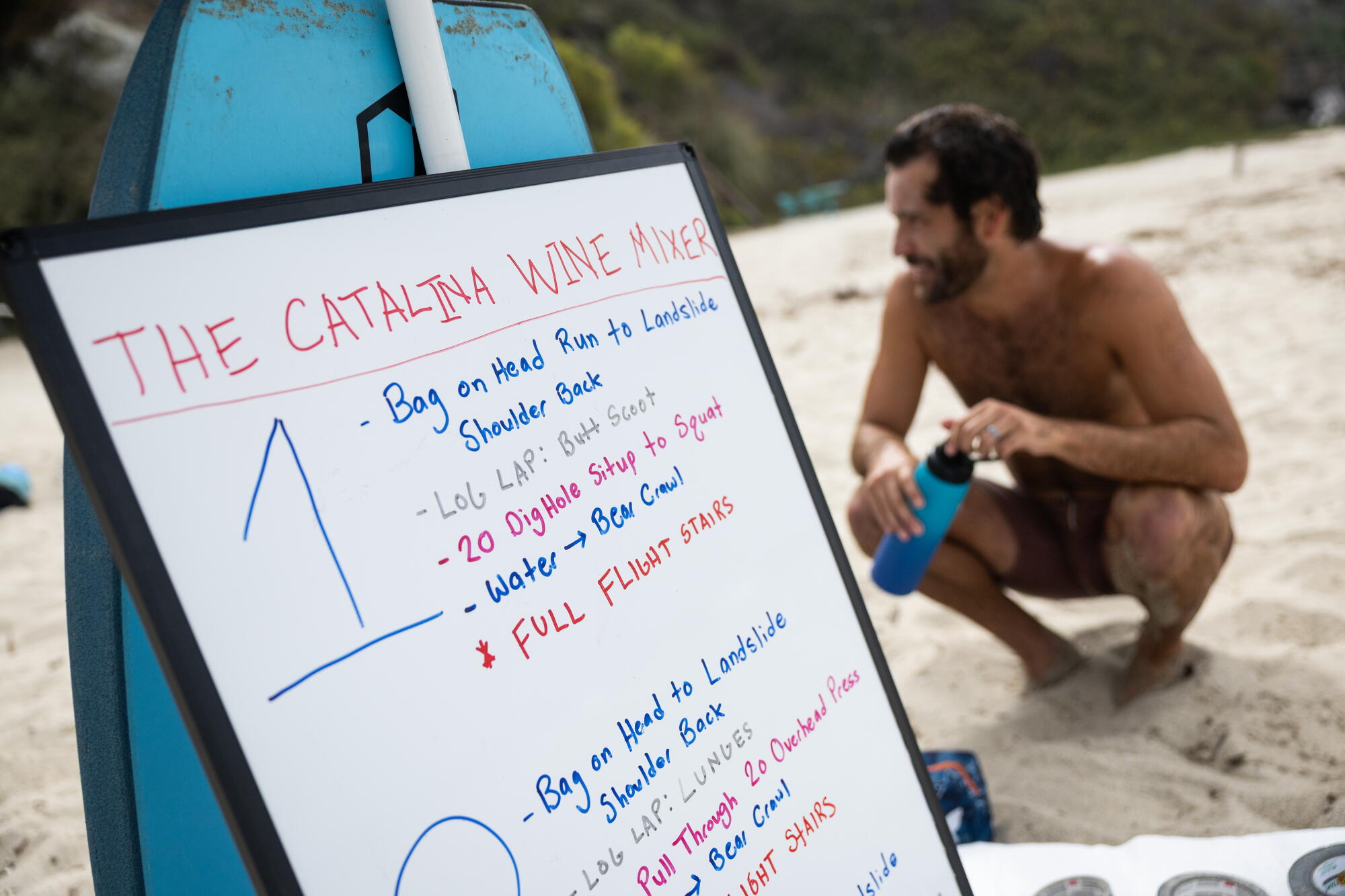
The workout got its start in December 2023, when Dante, a former Navy SEAL and fitness coach, posted an invitation on Instagram for what was originally supposed to be “Water Jug Saturday.” He encouraged his followers to fill 5-gallon jugs and join him and Joey, a triathlete, for military-style drills on the sand, in the water and up the stairs and adjacent hill.
When a friend pointed out some weighted bags lining the path at the bottom of the staircase one day, the siblings quickly abandoned the water jug idea. Sandbags were easier to sling over shoulders and balance on heads. And perhaps just as importantly, “Sandbag Saturday” rolled off the tongue a lot better.
Long before Dante joined the military and Joey started running marathons, Thousand Steps Beach was always where they got their best workouts. As teenagers growing up in the area, they climbed the staircase barefoot, sprinted the hill overlooking the Pacific and stretched their limbs on the shoreline. They spent nights camping on the sand after long days of surfing. Joey later proposed to his now-wife there.
1
2
3
1.Participants prepare to walk down a hill. 2.A close-up of a sandbag.3.The workout consists of hundreds of steps.
“The beach really has meaning to us,” Dante told me when asked about the workout’s origins. “From 18 to 22, I trained for the Navy here almost every day. I always wanted to come back and give this to the community and to anyone who I felt would appreciate it.”
After serving for nine years, Dante’s military background is evident in the fitness sessions he designs for Sandbag Saturdays. Participants perform duck walks, suitcase carries, bear crawls and overhead holds reminiscent of the log and boat carries in Marine boot camps. But despite its inspiration, the atmosphere couldn’t be further from the “Full Metal Jacket”-esque training days that might come to mind.
“We don’t do the typical hardcore yelling at you,” Joey told me before leading the group on a recent Saturday. “Everyone can go as slow or fast as they want.”
Participants run while carrying sandbags on their heads.
Among the regular participants are active-duty firefighters, lifeguards, professional boxers, National Guard personnel, yoga teachers and locals just looking for a fun way to get their cardio in. For some, the gatherings are family affairs. When I was there, Dante and Joey’s mother and sister joined in, and a handful of young children carried tiny sacks too.
“I think people see us and it looks like there’s a barrier of entry with the sandbags and all,” said Anthony Gudenau, who joins Sandbag Saturdays regularly. “But I’m amazed at the different types of people that show up regardless.”
The group’s growth might be due to the sense of inclusiveness that becomes especially noticeable on the staircase. While doing the steps myself, I noticed participants regularly inviting curious, inquiring beachgoers to join in the following weekend.
Running in sand adds to the challenge.
Everyone is encouraged to move at their own pace.
“I love how we all pump each other up when we pass one another going up and down,” said Carmen Benedick, a local who has attended every Saturday for the past six weeks. “It’s not unusual for strangers who aren’t even part of it to also encourage you. The sense of community is amazing.”
Perhaps that’s why so many people keep coming back. Sandbag Saturday has evolved into a kind of outdoor third place, where the endorphin-releasing workout is only part of the draw. For all the sore glutes and calves, what lingers most is the appeal of turning this into a weekend ritual.
“I just want to keep doing it for free every Saturday,” Dante told me. “As long as it’s bringing a positive force to people’s lives and making them feel proud for doing something extremely hard.”
When the morning finally wrapped up and the temperature started to climb, participants stacked their sandbags into a towering formation. A few climbed onto the pile to practice gymnastics-style balances while others headed into the water.
The workout includes bear crawls after running into the water.
Then, one by one, the bags were sliced open, and the sand spilled back onto the beach where it had come from. I grabbed my belongings and headed up those 223 — or maybe 225 — stairs one last time.