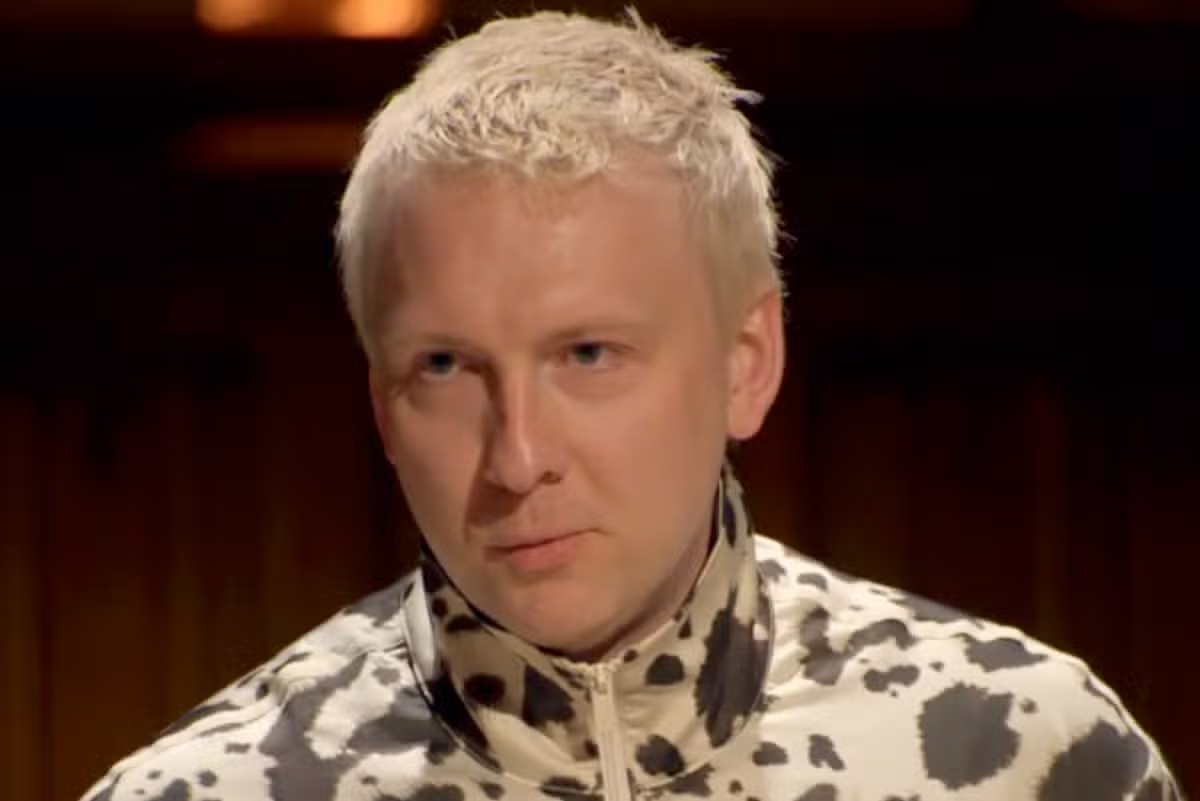
Joe Lycett was voted off after telling the Faithful he was desperate to become a Traitor, admitting afterwards ‘I’ve done this to myself’

Joe was the architect of his own downfall – and he knows it
Banished Faithful Joe Lycett was so desperate for a green cloak that after being voted out of The Celebrity Traitors he called for a rule change allowing dumped players to return as baddies.
His exit last night came after he loudly proclaimed he wanted to be recruited into the turret – which didn’t happen – but nobody believed him when he truthfully announced his disappointment the next morning.
“I’d like to motivate the Traitors to find an unknown clause in the contract that can bring back a Faithful that’s been banished to recruit because I’m there if they want me,” he laughed.
The comedian, 38, received 11 of the 14 votes after what seemed like a big slip-up at the round table in which he said that if he went, the Traitors would need to recruit again. Afterwards he acknowledged that he only had himself to blame. “I sort of didn’t play being a Faithful or a Traitor right. I tried to straddle both, and I was being greedy and I was rightly punished for it.
“I’m a silly billy – it was a combination of me begging for recruitment and then the Faithful being thick as mince. I concede I’ve done this very much to myself, but I was too hungry to be recruited. And you know, if being passionate is a crime, then banish me from the castle.”
Joe, who was instrumental in exposing Richard E Grant as a Traitor by asking him what he was on the first day, said the experience of being kept separate from friends and family during filming had been enjoyable. Asked to explain what he’d learned about himself by taking part in the game, he said: “The word that comes to mind for this whole experience is gratitude. It’s made me really grateful for my life. I’m really grateful that I am in a position that I get to experience this, because I’m famous enough to be in the mix. I loved having my phone taken away from me, and I’m really grateful for the fact that I have a lovely life to miss.”
Admitting that the game was sometimes “infuriating”, but also “joyous and thrilling”, Joe said he thinks the most likely winner is Romesh Ranganathan. “I think Romesh is a front runner,” he said. “I think he’s kind of unreadable but may get heat just on that basis. Then I think there could be a real curve ball, like Jerry or Joanne, someone who’s playing it in a way that’s out there.”
But he said it was hard to stick to strategies when you were inside the castle. “I’ve gone to Round Tables not knowing who I was going to vote for, and I don’t know who’s a Traitor – any of them could win at this stage.”
Miranda Hart formed such a close bond with Joe during their time filming together that she wept when he left – having refused to put his name on her slate and writing Ross instead. During the programme she explained: “Three or four years ago, due to illness, I thought that I might not ever have a gentle walk around a park again. Now I find myself on a Scottish Highland wheelbarrowing along a very large head. It’s really exciting.”
Miranda, 53, has been suffering from chronic fatigue syndrome for many years, which she believes was caused by having Lyme disease as a teenager. Having recently recovered enough to sign up for the programme, she has joined in with the missions wholeheartedly. In last night’s effort she grew tired carrying the statue parts at one point so swapped to transport a giant head in a wheelbarrow towards the plinth where it could be erected on top of its body, earning money for the prize pot. The current fund stands at £46,000, after the players successfully constructed five out of the six statues.
The comedy star tearfully told James Acaster that having fun outside with Joe had made her feel the happiest she’d felt in a long time. “I can’t believe how emotional I’m getting,” she said, as the floodgates opened. “Connection and laughter and joy are bigger than this game and to meet someone and to just play and laugh, it’s all us humans need.”
The good news is that she is proving so popular in the castle that many fans are calling for a return of her BBC sitcom Miranda, which last aired with a Christmas special in 2015. Another suggestion is that she stars in a different show. “A Miranda detective series like Jonathan Creek would be… such fun!” one fan said.
Joe felt that he would miss her too. “Miranda is someone that I’ve met briefly in the past and I’ve always loved. I’m really pleased that I got a chance to play with her, do some sort of an improv, essentially, and kind of mess about. I got very close with her.”
He said that – against his expectations – he’d got on well with everyone. “I really, really liked them all – and didn’t expect to when I saw the lineup. I thought, well, there’s going to be some people I’m going to find difficult, or are divas or whatever. And the reality was completely different.”
Joe’s high point came right at the start when he asked the question that sparked Richard E Grant’s astonishing outburst. The comic said he was glad he hadn’t been persuaded to ignore it. “I know lots of people tried to steer me away from it, but I was like, there’s no game around that, he absolutely meant it when he said it to me. God knows what was going through his head. It was an absolutely superb, classic, Richard E. Grant way of responding to this game. It’s one of the most iconic performances I’ve ever seen.”
Like this story? For more of the latest showbiz news and gossip, follow Mirror Celebs on TikTok, Snapchat, Instagram, Twitter, Facebook, YouTube and Threads.