L.A. Labor Day rally: Union workers warn of automation, job losses
Thousands of union workers, their family members and supporters marched through the streets of industrial Wilmington on Monday, taking part in a Labor Day parade whose festive mood overshadowed their serious concerns about the future.
Jesse Munoz, a 63-year-old longshoreman, who belongs to International Longshore and Warehouse Union Local 13, talked of how automation has eliminated more than 2,000 jobs over the last 15 years or so and worries that foreign-owned companies will do more to shrink the workforce and worsen working conditions.
“The concern is the future,” Munoz said. “I have a son that’s on a list to become a casual worker, which is a worker that will accumulate his hours, and then hopefully within time become a regular member of the union. But the future is not as promising as we would like it to be.”
“If you eliminate the workforce, you eliminate taxes. You eliminate pensions,” he said.

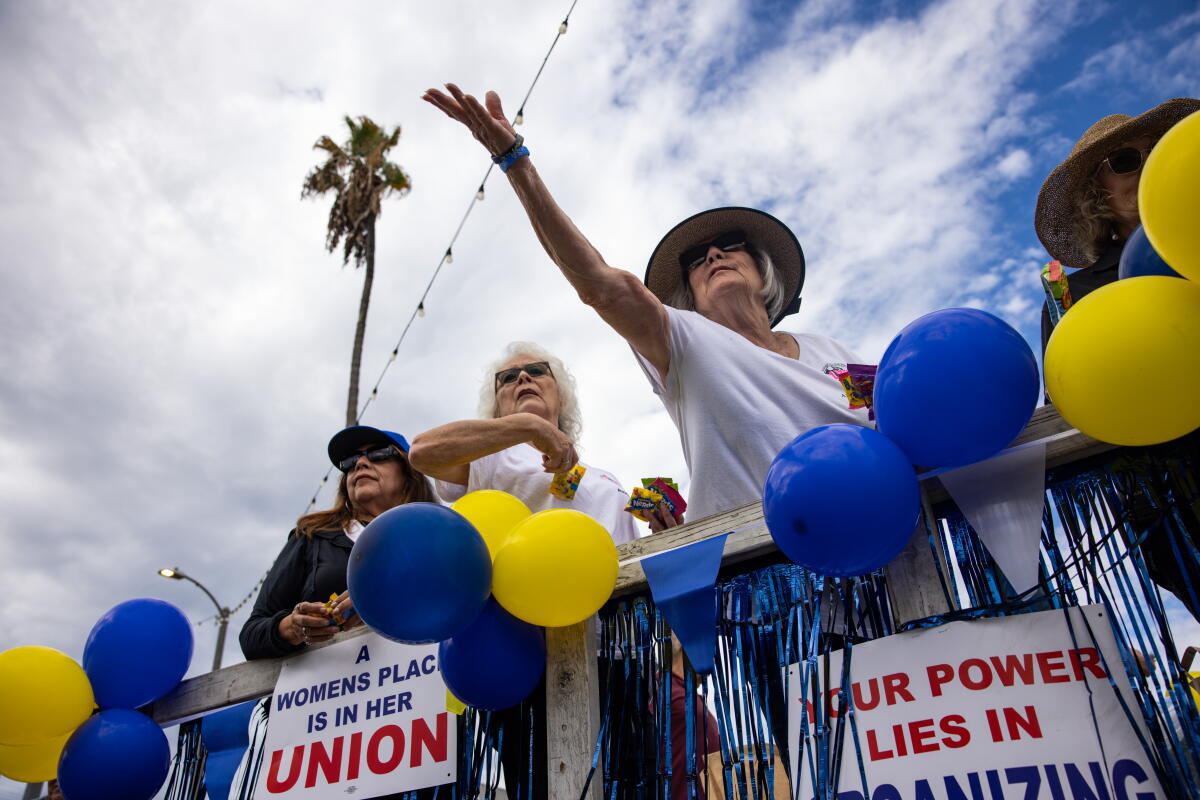
International Longshore and Warehouse Union members throw candy to onlookers at Monday’s Labor Day parade.
(Kayla Bartkowski / Los Angeles Times)
The Wilmington rally joined Labor Day events throughout the nation Monday, a holiday that also marks a prime campaign opportunity for candidates in midterm elections and other political races.
The first U.S. Labor Day celebration took place in New York City on Sept. 5, 1882, with 10,000 marchers. In 1894, President Cleveland signed a congressional act establishing the first Monday of September as a legal holiday, which has become known for promotional sales as well as a day off for many.
The holiday has particular resonance in Southern California, where the labor movement remains large in numbers and powerful in political influence. Across the nation, that’s far from a given.
The number of workers represented by unions rose by 463,000 in 2025, according to data collected by the pro-labor American Prospect, and national density — meaning the number of U.S. workers who are unionized — edged from 9.9% to 10.0%. However, private-sector union density stayed at 5.9%, meaning the numerical gain came chiefly from government employment.
Munoz said he has a message for President Trump, who has used steep tariffs on foreign-made goods in an attempt to return more manufacturing to the United States, leading to price increases domestically.
“Stop those tariffs and stop this automation,” Munoz said. “Just get the people back to work. Help the economy build itself up again with the workers, not with politicians.”

Giovanna Mendez, right, hugs her sibling’s elementary school teacher during the Labor Day parade in Wilmington.
(Kayla Bartkowski / Los Angeles Times)
While the Wilmington crowd was heavily Democratic, one longshoreman in his early 60s showed it was possible to be pro-labor and pro-Trump.
“We’re a lot better than when [President] Biden was in, way better,” said the worker, who also spoke of his union as “wonderful.”
Jordan Gonzales, a 20-year longshoreman, expressed worries about the future of trade work.
“A lot of people would rather be in the office and in the AC,” said Gonzales. “We’ve lost our workers that are outside of an office.”
He was enjoying a hearty free breakfast at a union hall and looking forward to his 12-year-old’s marching band performance in the parade, where she played a glockenspiel.
Participating school bands included San Pedro High, Banning High, Harry Bridges Middle, Port of Los Angeles High and Garfield High.
Delegations from many unions marched with their local chapters and a procession of restored and souped-up cars completed the picture. L.A. Mayor Bass was front and center behind the banner of the shore workers.
Politicians at work on Labor Day
In the pre-parade free breakfast inside the Longshoremen’s & Warehousemen’s Memorial Assn. cavernous meeting hall, a parade of elected and aspiring politicians introduced themselves, straining to be heard and noticed in brief remarks over a sometimes inattentive din.
Xavier Becerra, the Democratic candidate for California governor spoke briefly, thanking union members for their daily labors and campaign support.
“None of us should forget where we came from,” Becerra said. “Let us work hard,” he said, referring to election day. “November 3rd belongs to us just the way Labor Day belongs to us.”
Also on hand were both Los Angeles mayoral candidates: incumbent Bass and challenger Nithya Raman.


1. L.A. Mayor Karen Bass speaks to security during the Labor Day parade in Wilmington. 2. L.A. mayoral candidate Nithya Raman greets parade watchers. (Photographs by Kayla Bartkowski / Los Angeles Times)
Bass praised the city and union movement for positive strides “even in the midst of Donald Trump, who has done everything he can do against working people, including invading our city, but we are back, and we stay united, and we’re going to continue to do that,” she said. “L.A. is a labor city, and I am there with you 100%.”
Labor leaders also are almost 100% behind her in terms of endorsements. One exception is the Western States Regional Council of Carpenters, which endorsed Raman. The union represents about 65,000 members across 10 states.
“We need more housing in L.A.,” said Doug Hicks, the union’s vice president and director of organizing. “How many cranes are there in downtown Los Angeles today?”
In her brief breakfast remarks, Raman, an L.A. City councilmember, said that “automation, AI, are taking away jobs all over this country, and it is up to us to step up and fight back, and that is why I’m here to stand alongside the workers of this country.”
Master carpenter Joseph W., who did not want to give his last name, declined to speak about endorsements, focusing instead on the challenges of workers.
“We build the houses, but we can’t buy them,” he said. In 1977, his dad bought a house in Norwalk in 1977 for less than $50,000. Now that property is worth close to a million dollars.
“That’s 20 times what my dad paid for it,” said Joseph, who is 55 and rents his own home. “I don’t make 20 times what my dad got paid.”
The younger workers included members of ILWU Local 56, the “ship scalers” union, which cleans up hazardous materials and provides environmental remediation both in the ports and beyond. Its members were involved in wildfire cleanups and removing waste from the hazardous Lineage warehouse fire in Boyle Heights in June.

Two members of the Western States Regional Council of Carpenters bump fists after Monday’s Labor Day parade.
(Kayla Bartkowski / Los Angeles Times)
Evan Briseno, 18, would like to move on to safer work before his health is potentially affected. But fellow union member Francisco, 21 — who declined to give his last name, wants to move up in the trade, while noting that some areas are so dangerous that every patch of skin needs to be covered.
Neither follows politics, but they’re both concerned with workplace safety issues.
Other unions included Teamsters, Service Employees International, SAG-AFTRA (for performers) and teachers — along with their students.
Mark Ramos wore multiple hats as chair of the Los Angeles County Democratic Party and president of the United Food and Commercial Workers International Union Western States Council and UFCW Local 1428.
Ramos said one current union battle is to make self-serve checkout lines manageable for the workers who must supervise them.