If you’ve made a purchase in duty-free, you may want to check ahead of time to see if you’re actually able to use it on board, as there’s one item strictly prohibited
People travelling to and from holidays need to know this rule(Image: Miragest via Getty Images)
Brits travelling abroad need to stay alert to the items they can and cannot take onboard, but do they know about the rules regarding items they buy at the airport?
Travelling with bottles in any shape or form usually comes with its restrictions, as many airports ask for you to pack liquids in measurements only up to 100ml. However, there are some far stricter rules when it comes to the liquid you’re buying in duty-free – particularly alcohol.
At most airports, you can buy bottles of wine, spirits, beers, and more; sometimes up to a liter of each is sold at discounted prices. And yet, despite being able to make the purchase at the airport, you are strictly prohibited from drinking it or even opening it on the plane.
Duty-free alcohol is generally allowed on board, passing as a form of carry-on luggage, when purchased after getting your security checks. Although it is almost always placed inside a sealed Security Tamper-Evident Bag, paired with the receipt.
Within aviation law, this bag must remain sealed throughout the whole duration of the flight, a rule that is consistent across all airlines. Passengers must not consume their own duty-free alcohol on the plane, as all alcohol must be purchased from the cabin crew.
If there’s anything else you’ve purchased from duty-free, you will need to ensure it is placed in a separate bag or in your carry-on luggage to avoid it being trapped inside the sealed bag for the duration of the flight.
The rule is consistent, yet each airline may handle people consuming this alcohol differently, with potential fines for those who break the rules.
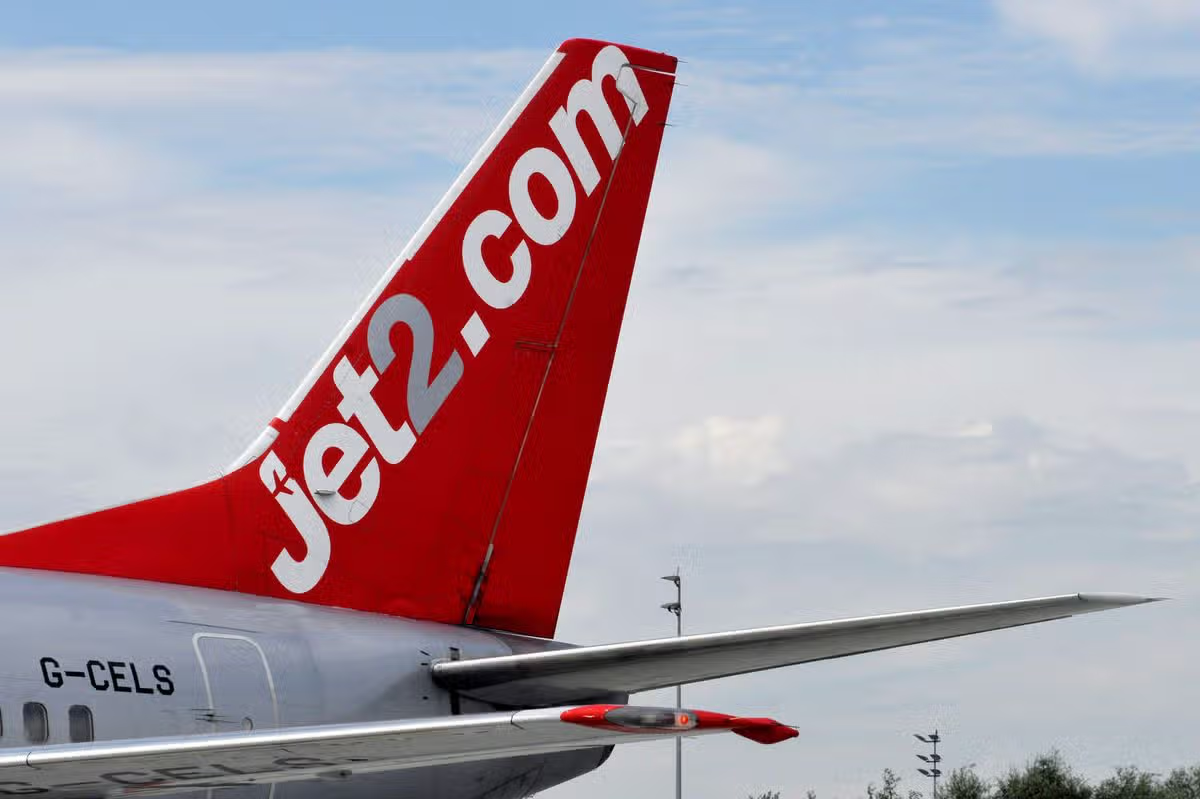
Jet2 states: “You may not bring on board alcohol for the purposes of consumption whilst on the aircraft. For safety reasons, we restrict the consumption of alcohol on board. Only alcoholic drinks purchased on board may be consumed during the flight. It is an offence to be drunk on any aircraft. Jet2.com reserves the right to serve alcoholic drinks to customers at our absolute discretion.”
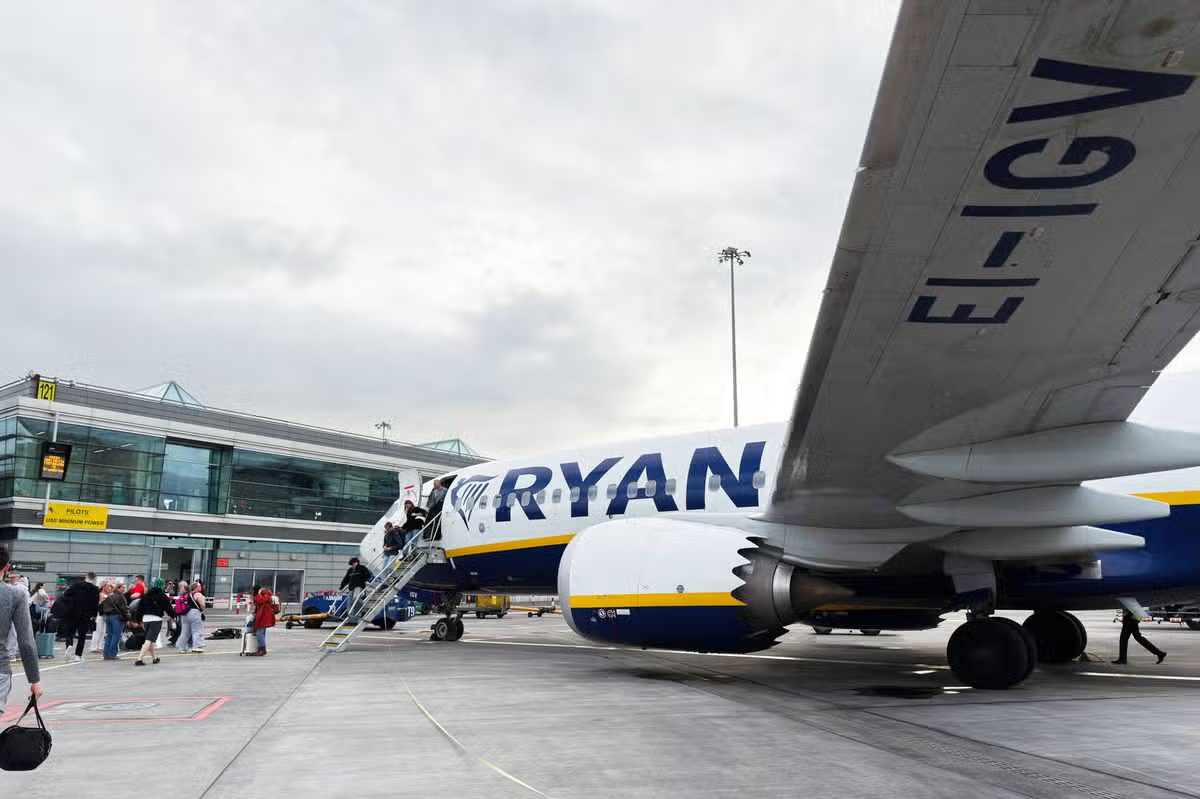
After some recent confusion with passengers boarding Ryanair flights, a spokesperson made it clear where they stand when it comes to drinking on board. They said: “We are not ‘banning’ or ‘confiscating’ duty-free alcohol at boarding gates. As per Ryanair’s T&Cs, passengers can carry duty-free alcohol onboard but must not consume it during the flight.”
Across the majority of airlines, when it comes to alcohol consumption, they have a zero-tolerance policy on ‘disruptive behaviour’ and have the right to reject drunken and disorderly passengers from boarding the flight.
Meaning, even if you’re yet to take a swig of your duty-free bottle, you should be wary of how much alcohol you’re drinking within airport bars and restaurants.
As for the duty-free bag itself, this is often allowed as an extra courtesy to take on the flight, provided that it fits under your seat. However, this is typically limited to one bag per person and does not encourage passengers to hop on board with multiple additional bags after a huge shopping spree.
Anyone with holidays planned needs to know the rules before they fly
Boarding passes might need to be in a certain form, or passengers are not getting past check-in desks(Image: Getty | Franziska & Tom Werner)
Getting your boarding pass sorted is one of the first things to clear before jetting off on holiday, but some Brits risk being caught out at the check-in desk by overlooking a rule certain airlines have introduced. It is essential to know whether your documents need to be in a specific format to pass through the airport smoothly.
Previously, most UK carriers left it up to passengers to choose between printing boarding passes at home or having them on smartphones at the airport. However, it’s important to understand what your airline now allows, as failing to do so could put your entire trip in trouble.
Paper boarding passes are steadily being phased out in favour of digital options. Most airlines now issue tickets via email, apps, or other methods rather than paper.
In many instances, travellers can still print their passes at home or at the airport. It’s advisable to verify your airline’s specific policies (both outbound and return) beforehand, according to the Express.
Ryanair
Budget airline Ryanair has switched entirely to digital as of November 2025. Passengers travelling with the carrier will receive their boarding pass electronically via the Ryanair app once check-in is complete.
On its website, the airline states that its digital boarding passes “get rid of 300 tonnes of paper annually” and contribute to “lower airport costs and fares for all Ryanair passengers”.
Discussing check-in, Ryanair say that all “passengers will still receive email reminders to check-in online 48 and 24 hrs pre-departure. If any passenger arrives at the airport but hasn’t checked in online (having ignored these reminders), they will still be required to pay the airport check-in fee.”
Ryanair added that “special assistance is available at all airports” for travellers requiring support with digital passes and check-in. Full details can be found here.
EasyJet and WizzAir
For most flights, airlines such as easyJet accept digital tickets. EasyJet does not accept PDF scans displayed on phones, and all digital tickets must be presented via the free EasyJet app. Certain non-UK airports continue to require printed passes.
As of 2026, 21 airports in the easyJet network do not currently accept mobile boarding passes. If you are returning to the UK from any of these locations, you will need to print your boarding pass on paper:
Egypt: Hurghada (HRG), Luxor (LXR), Marsa Alam (RMF), Cairo Sphinx (SPX), Sharm El Sheikh (SSH)
Other Regions: Aqaba, Jordan (AQJ), Belgrade, Serbia (BEG), Pristina, Kosovo (PRN), Tirana, Albania (TIA), Ivalo, Finland (IVL) and Sitia, Greece (JSH)
A handful of airports that handle Wizz Air flights also do not support mobile passes, though there are just five such destinations, as of 2026:
Agadir (AGA)
Marrakesh (RAK)
Cairo Sphinx (SPX)
Zaragoza (ZAZ)
Tirana (TIA)
What about other major UK airlines?
For those flying with other carriers, it is best to check your airline’s website to determine whether a specific policy applies. Rules are larely the same but may vary from location to location.
British Airways: Allows printing at home or at airport kiosks. Digital passes are available via the BA app.
Jet2: Supports both physical and digital tickets. You can print from “Manage My Booking” or use the Jet2 app.
TUI: Both printed and digital passes are accepted.
Virgin Airways: Although the airline “highly recommends” digital, printed copies are accepted, and kiosk printing remains available at major hubs like London Heathrow and Manchester.
When it comes to the major UK airlines, the rules aren’t so strict. However, there are limits on how many batteries and gadgets of a certain kind you’re allowed to take on board
Lithium batteries are causing issues on planes(Image: Getty Images)
Jet2, BA and easyJet all have strict limits on how many gadgets passengers can bring with them on a flight.
The rise of tech powered by lithium-powered batteries, such as mobile phones, electric toothbrushes and vapes, as well as transport devices including ebikes, has caused some big issues.
Fire brigades across the UK are tackling lithium-ion battery fires at a rate of one every five hours, new figures show this week.
Concerns about fires have caused some airlines to ban certain devices. In recent years, numerous airlines have barred passengers from carrying power banks on flights amid fears they could ignite. Vietnam Airlines, Vietjet Air, and most recently Emirates have all prohibited power banks on flights, whilst Cathay Pacific introduced a similar ban last April. Other airlines have introduced prohibitions on AirPods.
When it comes to the major UK airlines, the rules aren’t so strict. However, there are limits on how many batteries and gadgets of a certain kind you’re allowed to take on board.
Each customer is allowed to carry a maximum of 15 lithium battery-powered PEDs, such as mobile phones, laptops, tablets, watches and toothbrushes, providing the capacity of each battery doesn’t exceed:
for lithium-ion batteries: 160Wh, or
for lithium-metal batteries: 2g lithium content.
These devices should be carried in your hand luggage and in all cases, must be packaged in a way that protects against damage.
Customers are permitted to carry no more than 20 spare/loose lithium batteries, providing they are each individually protected against short circuit, the capacity of each battery doesn’t exceed 100Wh for lithium-ion batteries and for lithium-metal batteries, 2g lithium content.
Additionally, customers are also permitted to carry no more than two spare/loose lithium batteries with a watt-hour rating exceeding 100Wh, but not exceeding 160Wh, providing they are each individually protected against short circuit.
Customers may carry no more than two power banks per person, not exceeding 160Wh, providing they are individually protected against short circuit. In all cases these must not be charged whilst onboard the aircraft, and should not be used in-flight.
British Airways
British Airways limits lithium-ion batteries to 100Wh or less for general travel, with up to four spare batteries allowed per person in cabin baggage, provided they are protected from damage. Power banks are restricted to carry-on only, with a maximum of two, and batteries between 100-160Wh require airline approval.
Capacity Limits: Under 100Wh: Allowed in carry-on (up to 4 spares) or installed in devices (checked or carry-on). 100Wh – 160Wh: Requires special approval. Usually limited to two spares. Over 160Wh: Forbidden on board.
Carry-on Requirements: Spare batteries and power banks must be in hand luggage only. They must be in original packaging, or have terminals insulated with tape to prevent short circuits.
EasyJet
EasyJet requires all lithium-ion batteries, spare batteries, and power banks to be carried in cabin hand luggage only, with a general limit of 100Wh per battery (roughly 27,000mAh). Batteries above 160Wh are prohibited, while those between 100-160Wh require airline approval. Items must be protected from short circuits.
Capacity Limit: Maximum 100Wh (or 160Wh with approval).
Power Banks: Maximum 100Wh (~27,000mAh at 3.7V).
Quantity: Generally up to 15-20 spare batteries/devices per person.
Carry-on only: Absolutely no spare lithium batteries/power banks in checked luggage.
Ryanair
Ryanair strictly permits lithium batteries and power banks up to 100Wh (or ~27,000mAh) in carry-on luggage only; they are strictly prohibited in checked baggage. Passengers may carry up to 20 spare batteries/power banks (under 100Wh) that must be individually protected against short circuits.
Capacity Limit: Batteries > 100Wh are generally not permitted.
Carry-On Only: Spare batteries and power banks must be in your carry-on bag or on your person.
Wizz Air
Wizz Air restricts spare lithium batteries and power banks to carry-on baggage only, with a maximum capacity of 100 Wh (typically ~27,000 mAh) per unit without special approval. Batteries between 100 Wh and 160 Wh require prior approval, while those over 160 Wh are prohibited. A maximum of 2 spare batteries per person is allowed.
Location: All spare batteries, power banks, and e-cigarettes must be in cabin baggage only. They are forbidden in checked bags.
Standard Limit: Lithium-ion batteries up to 100 Wh are permitted for personal use without prior approval.
Large Batteries (100–160 Wh): Batteries or power banks between 100 Wh and 160 Wh require prior approval from Wizz Air.
Excessive Batteries (>160 Wh): Prohibited in both carry-on and checked luggage.
Quantity Limit: Maximum of 2 spare batteries per person.
easyJet, TUI and Jet2holidays are some of the UK’s biggest package holiday providers
05:07, 10 May 2026Updated 08:57, 10 May 2026
Jet2holidays, TUI and easyJet all make passengers aware in advance(Image: Ceri Breeze via Getty Images)
Travellers planning to book holidays with easyJet, Jet2, and TUI are being cautioned by the travel firms that they could face additional charges they may not have previously been aware of.
With summer now just around the corner, millions of Brits are eagerly looking forward to a well-deserved break in the sun. easyJet, TUI, and Jet2holidays rank among the UK’s biggest package holiday providers, with countless travellers turning to them to arrange all manner of trips overseas – and 2026 is set to be a busy one.
When browsing the respective websites, customers can explore a vast range of holidays and will be presented with a price for their chosen trip. Each of these operators helpfully outlines why these holidays may carry extra costs, and how much travellers might be expected to fork out.
It all comes down to tourism taxes. The amount you’ll pay depends on your destination, the length of your stay, and whether you’re travelling during peak season.
Alongside the quoted price for your holiday, whether booked through TUI, easyJet, or Jet2holidays, you’ll also find an estimated tourism tax figure for the full duration of your trip. This is typically payable directly at your accommodation upon arrival.
In any destination where a tourism tax applies, all holidaymakers will be required to pay a standard rate – regardless of which airline or travel operator they have chosen to book with.
Phoenix Rose and his dad James intervened to calm a disruptive passenger whose behaviour threatened to divert the Jet2 plane, which was travelling from Izmir, Turkey to the UK
Phoenix Rose was praised for calming a disruptive passenger on a plane
An eight-year-old boy praised for calming a disruptive passenger on a plane has been showered with gifts from around the country and even overseas.
Phoenix Rose and his dad James have even been rewarded with free flight vouchers after their actions on the Jet2 plane prevented it from being diverted. Since James, 42, insisted his son is the “real hero”, the little boy has received thank you cards and presents from strangers.
James, of Salford, Greater Manchester, has been gifted with a games console from a stranger in The Netherlands, a Lego set, football kits and vouchers for toys among other presents. He said he thought it “was like Christmas Day” when he saw the gifts.
When a woman began shouting on the flight from Izmir, Turkey, Phoenix leapt into action, speaking to her, sitting next to her and then spending hours showing her his football cards, singing and asking about her family. It calmed her and the holiday flight did not need to divert.
Speaking about the reaction to his intervention, Phoenix said: “It has been brilliant.” His dad told BBC Radio Manchester Phoenix now intends to give the presents away to children less fortunate than him.
James added: “When the first gift came, we thought it was nice for someone to do that, but since then it’s been parcel after parcel.
“One of the things he wants to do is give the stuff away, so if people are in financial hardship or they know someone who might want one of these presents then they can get in touch. What Phoenix now would like is for people to stop sending things, and if you’ve got money just donate it to charity.”
Phoenix wants his story to help others. He encouraged others to be kind if they experience similar issues on aircrafts. His father said the woman was “almost trying to smack the stewardesses”. However, at James’ request, cabin staff moved the passenger to a seat between him and his son, where Phoenix “bounced into action”.
Phoenix, a Manchester United fan, was thanked personally by the pilot. Jet2 praised the boy’s actions. In a statement, the company, which flies 120 carriers to 80 destinations, said: “I want to say a massive thank you to you both on behalf of everybody at Jet2. What you did was absolutely fantastic.”
A Jet2 survey has shown a shift in how people are booking their holidays amid concerns over jet fuel supplies
13:30, 09 May 2026Updated 13:30, 09 May 2026
Jet2 said passengers concerned about cancellations are booking their trips differently(Image: Getty)
Jet2 has revealed that passengers are making a major change to how they book holidays amid concern over major jet fuel problems this year due to teh Middle East Crisis. As the Middle East crisis deepens, mounting concerns suggest Britain could face a jet fuel shortage that may disrupt holiday flights.
Goldman Sachs has cautioned that Britain is the country “most exposed” to jet fuel shortages triggered by the Iran conflict, stoking fears of further flight cancellations and ruined summer getaways. Analysts at one of the world’s largest investment banks warned that the UK is heavily dependent on imports routed through the closed Strait of Hormuz, with “critically low levels” of supplies and inadequate refining capabilities.
And personal finance expert Martin Lewis has spoken out about the issue – highlighting people who book their flights and hotels separately might not get compensation if flights are cancelled. Jet2 said package holidays are now the top choice for travellers, with 51% opting for this booking method – a 5% rise since February. During the same timeframe, those preferring to book through separate providers has fallen by six percentage points to 20%, while ‘accommodation only’ bookings have plummeted to just 2%.
Jet2 said the results showed main attractions of package holidays have remained consistent, with value (36%) and convenience (36%) leading the way. However, the appeal of ‘added security with one provider, ATOL/ABTA protection’ has climbed by four percentage points since February to reach 26%, according to the survey.
This protection ensures customers are safeguarded against any alterations to their bookings, including the possibility of refunds should travel plans be scrapped, while guaranteeing holidays meet the highest standards for customer service, booking amendments, and health and safety.
Jet2 has pledged not to impose surcharges on any confirmed flights or holidays to offset rising costs, such as jet fuel, giving customers peace of mind that the price they book is the final price they’ll pay.
Steve Heapy, CEO of Jet2, commented: “Consumers want assurance during times of uncertainty and package holidays provide that assurance. On top of all the protection that our package holidays guarantee, Jet2 is well known as being a consumer champion that goes above and beyond to look after customers. Ahead of a busy summer season, this means new and existing customers know that their well-deserved holidays are in the very best hands with us, and we are very excited about welcoming everyone onboard and taking them on their breaks.”
As millions of Jet2 customers gear up for a bustling summer season, the firm has confirmed it intends to run its scheduled services as planned.
Martin Lewis gave a warning for anyone who has already booked their holiday for this summer. In an update the personal finance guru gave an alert to people who have already paid for breaks from the main holiday firms and airlines like TUI, Jet2, Ryanair, Wizz, easyJet and British Airways.
During his Money Show Live on ITV, the financial expert responded to an audience member who asked: ‘If my flight’s cancelled due to no jet fuel will you definitely receive all your money back even for your hotel booking as well.’
Mr Lewis made clear that travellers would lose their hotel booking costs if they had arranged accommodation independently from flights booked with airlines such as Jet2, TUI, Wizz, Ryanair or easyJet – as they would not be protected under consumer regulations.
He stated: “No. And I think this is what people need to be very aware of. If you booked a package holiday where you booked everything in one, then under the package holiday regulations and rules and protections generally if your flight went you would get everything back.”
He went on to say: “And so actually at the moment package holidays give you a certain level of extra security that you wouldn’t get if you did a DIY booking where you bought your hotel and flight separately.” The reason behind this, he explained, is that the hotel booking itself remains valid: “Because the point is if you lose your flight and you’ve DIY booked, there’s nothing wrong with your hotel.
“The issue is you can’t get there. Your hotel is still there. It’s not faulty. It’s not cancelling. So, you don’t have those consumer rights.” If the hotel hasn’t done anything wrong, then guests might look at how they’ve made their booking – but that route offers no solution either.
He said: “So, you would then say, ‘What about using a credit card or debit card protection?’ It won’t work because there’s nothing faulty. And that’s just giving you the same replica rights that you would have with the retailer.”
Meanwhile, holiday giant TUI has issued a direct message to those with May bookings. TUI Managing Director Neil Swanson in a message on Facebook, pledged that May half-term flights would proceed as scheduled: “We know you may be feeling a little uneasy after recent headlines, and we want to reassure anyone travelling over May half term that they can look forward to their holiday with confidence with TUI. We have good visibility on fuel supplies and are operating our holiday programme as planned, with no flights being cancelled due to fuel shortages.
“Our careful planning across fuel, flying and hotel capacity means we’re able to continue offering great value and stable prices – with no fuel surcharges added by TUI. The price you see is the price you pay, and all TUI package holidays are ABTA & ATOL protected, giving peace of mind from booking right through to returning home.”
On TUI’s Facebook page, holidaymakers reported seeing significant price hikes. Marie said: “We booked our August holiday nearly 18 months ago and paid 5.2K. Just checked it to book now and it’s 6.7K. Glad we booked so far in advance. Already booked August 2027 holiday for same price as we paid this year.”
Lynn replied: “Marie Tomes we’re the exact same. Been going to the same hotel for 7yrs. They renegotiated the contract last year. For us to book for next year its going to be nearly 1k each more for our 2weeks. We’re going to make the most of this year as our last visit.”
One concerned traveller, Rno, raised worries about upcoming summer trips: “What about those who have already booked a hotel and flight for the entire month of August? I have a booking for my family and I’m worried Note that the plane is a TUI and the flight is to Egypt.”
TUI responded: “Hi there. We’re monitoring the situation closely. Right now, we don’t expect any disruption to flights or holidays, but we’ll keep this under review and contact customers directly if anything changes that affects their booking. “
Meanwhile, Jet2 revealed it too is witnessing a notable shift in booking behaviour amongst travellers. Experts such as Martin Lewis have urged travellers to book holidays as a package deal, warning that purchasing flights and accommodation separately could leave them without full compensation should anything go awry.
The money-saving guru has urged those who have paid for trips with major holiday firms and airlines to avoid the DIY approach
15:04, 08 May 2026Updated 15:15, 08 May 2026
Martin Lewis gave advice for anyone booking holidays amid the Iran conflict(Image: ITV)
Martin Lewis has delivered a stark warning to anyone who has already booked a holiday for this summer – and explained why people could be making a big mistake getting flights and hotels separately. In a recent update, the money-saving guru has urged those who have paid for trips with major holiday firms and airlines, including TUI, Jet2, Ryanair, Wizz, easyJet and British Airways, to pay close attention.
It was suggested this week that the UK could be worst hit by jet fuel shortages because it has ‘critically low levels’ of supplies and poor refining tools, by Goldman Sachs. The giant investment bank Goldman Sachs said in a research note to clients: “The UK is the largest net importer of jet fuel in Europe, and it holds no strategic reserves, leaving commercial inventories as the primary buffer.”
During his Money Show Live on ITV, the financial expert responded to an audience member who asked: ‘If my flight’s cancelled due to no jet fuel will you definitely receive at the moment package holidays give you a certain as well.’ Mr Lewis explained that holidaymakers would lose their hotel booking costs if they had arranged accommodation independently from flights reserved with airlines such as Jet2, TUI, Wizz, Ryanair or easyJet – as they would not be protected under consumer regulations.
He said: “No. And I think this is what people need to be very aware of. If you booked a package holiday where you booked everything in one, then under the package holiday regulations and rules and protections generally if your flight went you would get everything back.”
He added: “And so actually at the moment package holidays give you a certain level of extra security that you wouldn’t get if you did a DIY booking where you bought your hotel and flight separately.” The reason for this, he explained, stems from the fact that the hotel reservation itself remains entirely valid: “Because the point is if you lose your flight and you’ve DIY booked, there’s nothing wrong with your hotel.
“The issue is you can’t get there. Your hotel is still there. It’s not faulty. It’s not cancelling. So, you don’t have those consumer rights.” If the accommodation provider hasn’t violated any terms, then guests might examine how they’ve paid for their booking – but that route offers no solution either. He said: “So, you would then say, ‘What about using a credit card or debit card protection?’ It won’t work because there’s nothing faulty. And that’s just giving you the same replica rights that you would have with the retailer.”
For those still seeking a solution, travel insurance may seem like the next logical port of call. Mr Lewis revealed: “So, you’ then say, ‘What about travel insurance?’ This is the bad bit. We were checking 40 travel insurance policies. Of those, only a few would have covered you for the knock-on eventuality of your flight being cancelled due to jet fuel and then your hotel costs.
“Only about three or four and most of those were package bank accounts where it’s linked to your bank account. Only one standalone provider. So we need to be blunt at the moment. There is a big risk in those circumstances. If you’re booking, you want something with free or limited cancellation quite short before. So you could just cancel it. You should always talk to the provider.
“Government are saying there isn’t one at the moment and they’re working on consolidating flights and doing things so there won’t be one, but people’s hotel costs if they book separately and other knock-on costs are potentially at risk.”
Speaking on his ITV programme, he also cautioned that neglecting to take one vital step after booking could leave holidaymakers with absolutely nothing if their plans fall through. With the ongoing turmoil in the Middle East sparking serious worries over jet fuel supplies, Mr Lewis warned that those who book a holiday and put off arranging insurance could risk losing everything should something go wrong in the interim.
Mr Lewis emphasised that travel insurance ought to be bought the instant a holiday is booked: “The reason you do that is because half of the cover you’re paying for is in case something happens that stops you going before the trip. And if you don’t have the travel insurance place, you’ve got no cover. So, you may as well have it in place. But at this time of year when many people have already booked, I have a slight adaptation, which is this. If you’ve booked and you don’t have it yet, just get it now.
“Get it done as soon as possible.” A Money Show Live viewer named David said: “I booked flights to Australia for a family group of seven to travel in March next year. I took out insurance immediately. One of our group is now pregnant and can’t travel on the dates planned. It costs £5,000 to reschedule, which I’m happy to report the insurance covered.”
Mr Lewis also commented on the complexities facing larger groups: “Very quick aside on that, think of who you’re booking for. So, if it’s a family group and one can’t go, they’ll often cover you. But if there’s a large group of friends going, you often all get independent travel insurance. Well, then if one can’t go or and you can’t all go on the trip, it’s only the person who’s who’s got that cover. So, you’d need a group insurance policy so that if one can’t go, you all can’t go.”
Jet2 today said now people choosing a package holiday as their preferred method of booking is up 5% to 51% since February. In the same period, the number of people preferring to book through different providers has dropped by six percentage points to 20%. Those choosing ‘accommodation only’ has dropped to 2%.
The primary reasons for choosing a package holiday have remained steady, with value (36%) and ease (36%) the main drivers, however the benefit of ‘added security with one provider, ATOL/ABTA protection’ has increased by four percentage points since February to 26% the poll said.
This protection means that customers are covered should any changes happen to their bookings, including the option of receiving refunds if their travel plans are cancelled, and that those holidays are held to the highest standards when it comes to customer service, changes to bookings, and health & safety.
Jet2 has confirmed it will not introduce surcharges on any booked flights or holidays to cover cost increases, for example jet fuel, assuring customers that the price they book with Jet2 is the price they will pay.
Steve Heapy, CEO of Jet2 said: “Consumers want assurance during times of uncertainty and package holidays provide that assurance. On top of all the protection that our package holidays guarantee, Jet2 is well known as being a consumer champion that goes above and beyond to look after customers. Ahead of a busy summer season, this means new and existing customers know that their well-deserved holidays are in the very best hands with us, and we are very excited about welcoming everyone onboard and taking them on their breaks.”
Jet2 customers are being reminded of a rule the airline has that does not allow passengers to bring on board an item that is commonly available in airports. The popular airline reiterated its blanket ban for customers this week – and there are no exceptions.
Holidaymakers are advised not to bring the item with them beyond the gate leading to the aircraft. Most airlines have their own rules, which vary depending on which one you fly with, though many share the same for health and safety reasons.
Jet2 has a strict rule in place about bringing hot drinks on board, including teas, coffees and hot chocolates. The rule also applies to any hot food – even if it was purchased from a shop, cafe or restaurant in the airport terminal.
Jet2 reiterated the rule online to a passenger who asked whether they could bring a drink with them. The airline said: “You are able to bring any snacks or soft drinks on board bought in the terminal (after security).” However, it added: “Hot drinks are not permitted to be brought on board.”
People who are due to board flights will need to finish their hot food or drinks before being allowed on board. This rule applies to other airlines as well, like Ryanair, but some are more relaxed, like easyJet.
Content cannot be displayed without consent
What is the reason for this Jet2 rule?
On its website, Jet2 states: “You can’t bring hot food or hot drinks onboard our planes for safety reasons.” The Jet2 ban applies only to drinks customers bring on board.
Usually, passengers can purchase a variety of hot foods, as well as teas, coffees, and hot chocolates, on board Jet2 flights. Customers must remember the payment rule that applies to all flights.
Elsewhere, certain airlines, like easyJet, will allow hot drinks bought in the airport on board. This is provided the cup has a secure lid.
In other Jet2 news, the airline announced two new routes to a ‘stunning’ island with ‘sandy beaches‘, ‘aquamarine waters’, ‘cobbled streets’ and ‘rolling hills’. The new routes follow Jet2’s claims of continued customer demand and independent travel agents booking holidays for the short hop to the island.
Jet2 has confirmed significant expansion to its Jersey programme for summer 2027, by putting two new routes and additional capacity on sale, as well as extending the season. The airline has introduced flights and holidays from Birmingham and Bristol for Summer 2027.
In addition to the new routes, extra capacity to Jersey has been added from Manchester, and the summer season to the destination has been extended. It means Jet2 will operate to Jersey right through to the end of October.
Each airline has set rules about when to arrive at the airport to avoid delays – check which apply to you before you make your way to the airport this May half-term
Different airlines have different check-in guidelines
If your family is headed abroad in May, it might be wise to pay attention to the latest airport arrival advice from airlines including Ryanair, easyJet, Jet2 and TUI.
Airports are expected to be packed during the school holiday period, and with fluctuating jet fuel prices concerns, many travellers want to be extra prepared for potential delays, longer queues and last-minute schedule changes.
The rules have remained mostly the same in recent months, but some airlines have specific requirements for different types of passengers or groups.
Ryanair
Ryanair advises passengers to arrive at the airport at least two hours before departure to allow enough time for check-in, bag drop and security, and also says passengers must be at the boarding gate at least 30 minutes before departure time.
Even if you’ve booked through an online travel agent, you’ll still need to verify your booking at the airport, and you’re also told to arrive at least two hours early.
Passengers flying easyJet are warned on their website that airports can become especially busy during school holidays, and to allow extra time for traffic, train disruptions and queues.
The airline warns that bag drop at most UK airports closes 40 minutes before departure, although some airports and destinations may close earlier at 60 minutes. Twilight bag drop services are available the evening before flights that are scheduled for the morning.
Jet2
For Jet2, you should arrive at the airport at least two hours before the scheduled departure, or earlier, since the airline’s check-in desks generally open around two-and-a-half hours before flights.
Jet2 closes check-in desks 40 minutes before departure. Traveller are urged to check its latest travel information page at least 12 hours before flying for updates on delays or disruptions.
Like some others, the airline also offers its Twilight Check-in service at selected UK airports, allowing customers on morning flights to drop off bags the night before.
TUI
TUI’s standard check-in opens at least 2.5 hours before short- and mid-haul flights, but for long-haul flights you can check in 3.5 hours before departure.
The company warns that arriving earlier than this will not allow passengers to pass through security sooner, and that those travelling with hand luggage only and who have already checked in online can go straight to security after arriving at the airport.
For groups travelling together on the same booking, TUI advises that only one person needs to go to the bag drop with all passports, visas, boarding passes, and luggage.
For all airlines, general advice is to keep travel documents easily accessible, check flight updates online before leaving for the airport and prepare for longer queues during peak travel periods such as the May half-term.
Jet2 has launched new direct flights with the CEO saying the destination will be a ‘popular’ one for customers seeking culture and sunshine
Robert Rowlands Deputy editor, money and lifestyle, content hub
17:43, 06 May 2026
(Image: NurPhoto, NurPhoto via Getty Images)
Jet2 has launched a new service as it vows to offer passengers a slice of ‘sunshine paradise’. The UK airline’s first service to Palermo has taken off from Manchester Airport – with more to follow shortly from other UK airports.
The launch signals the start of Jet2’s operations to the Sicilian capital for the very first time this summer 2026, opening up the stunning island of Sicily to British holidaymakers. Jet2 will run twice-weekly services (Tuesdays and Fridays) from Manchester Airport to Palermo through to 3rd November 2026 in a piece of good news for passengers after weeks of headlines about the war in Iran and its possible impact on UK airlines.
Jet2 has also confirmed that travellers in the Midlands and Northeast will be able to get in on the action, with flights and holidays set to launch from Birmingham Airport on Wednesday 6th May and from Newcastle International Airport on Tuesday 26th May. From Birmingham, Jet2 will operate weekly Wednesday flights until 28th October 2026, while weekly Tuesday services will also be available from Newcastle Airport through to 3rd November 2026. The airline says all routes to Palermo are exclusive to Jet2.
Palermo marks Jet2’s latest expansion into Italy, bringing the total number of Italian airports served by the carrier to nine, including two in Sicily. Altogether, Jet2 has 12 weekly flights on sale to Sicily for summer 2026.
In a statement, the firm said: “The introduction of this new destination gives customers great access to the resorts of Campofelice Di Roccella, Cefalu and Pollinia on the island of Sicily, a sunshine paradise on the north-western coastline that offers stunning scenery, city sights and dramatic landscapes. From the beautiful beaches to the outstanding architecture, there is also the capital’s rich ancient history where there are myths and legends weaved into every captivating corner.”
Jet2 says it was the first UK airline and tour operator to confirm it will not introduce surcharges on any booked flights or holidays to cover cost increases, such as jet fuel, assuring customers that the price they book with Jet2 is the price they will pay. Jet fuel shortages caused by the Iran conflict have made the commodity more expensive for airlines.
Steve Heapy, CEO of Jet2.com and Jet2holidays said: “We are delighted to see Jet2’s first flight to Palermo take-off from Manchester Airport. To celebrate this new addition to our summer 2026 programme to Italy, we had our trademark red branding at the gate of the inaugural flight and also surprised one lucky customer with a pair of free return flights.
“We have no doubt that Palermo will be a popular destination for customers and independent travel agents looking to book getaways that combine culture and sunshine, and we look forward to taking them on our award-winning flights and holidays.”
Cut back booze at airports says Ryanair boss
The news comes as Ryanair boss Michael O’Leary today said airports should be banned from serving alcohol to passengers before early morning flights. “There should be no alcohol served at airports outside (those) licensing hours,” he told the Times.
He added: “We are reasonably responsible, but the ones who are not responsible, the ones who are profiteering off it, are the airports who have these bars open at five or six o’clock in the morning and during delays are quite happy to send these people as much alcohol as they want because they know they’re going to export the problem to the airlines.”
The Department for Transport has announced it is consulting on major changes for holidays
07:40, 06 May 2026Updated 07:41, 06 May 2026
Rules are being changed for flights this summer which could see people shifted onto different aircraft on the same day at totally different times with no penalty to the airline(Image: PA)
Concerns have been raised about potential changes which will mean the end of a ‘14-day rule’ this summer with flights being changed or cancelled at the last minute. The Department for Transport has announced it is consulting on major changes to holidays amid uncertainties about jet fuel supplies as the Middle East crisis continues with no end in sight.
With intense pressure on jet fuel widely tipped to cause travel problems this summer, the government announced over the weekend that airlines will be allowed to group passengers from different flights onto fewer planes. This means that at the last minute, people could be switched to a different flight.
The DfT says it will help cut the likelihood of last-minute flight cancellations this summer in the event of significant disruption due to ongoing global uncertainty caused by the Middle East conflict. It lets carriers such as Ryanair, easyJet, Jet2, British Airways, Wizz Air UK, and TUI, consolidate flights on routes where there are multiple trips to the same destination on the same day.
However, consumer experts said that currently, passengers are protected by a 14-day rule, and it’s ‘not fair’ for people to be shifted at the last minute to suit airlines without compensation. Rory Boland, Editor of Which? Travel said: “Millions of Britons will have already booked their flights for this summer, often paying over the odds for flights at peak times.
“Existing rules already allow airlines to move customers to new flights so long as they give them more than 14 days’ notice and offer the choice between a new flight or a refund. It’s only for cancellations within 14 days that compensation is payable, rightly.
“It’s not fair for the rules to now be bent in favour of airlines and potentially leave passengers holding the bill. Many passengers will understand that disruptions can occur and may be happy to travel a few hours or a day later, but for those on short trips or connecting flights it could mean the trip is no longer worthwhile.
Conservatives say it could see passengers “herded on to a different plane, at a time of the airline’s choosing”. The DfT says, however, that the measure is designed to give passengers “greater confidence” by helping airlines to lock in their schedules earlier.
Heidi Alexander, the transport secretary, adds: “There are no immediate supply issues, but we’re preparing now to give families long-term certainty and avoid unnecessary disruption at the departure gate this summer.
“This legislation will give airlines the tools to adjust flights in good time if they need to, which helps protect passengers and businesses.”
The Department for Transport said the measures would:
help move passengers onto similar services much earlier, helping avoid stressful delays at the airport
prevent running flights which have not sold a significant proportion of tickets
reduce wasted fuel from flying near-empty planes
Current rules
If your flight is cancelled by the airline, you have a legal right to a choice between being re-routed or a refund. If a flight is subject to a significant delay – at least 2 hours for short-haul, 3 hours for medium-haul and 4 hours for long-haul – passengers are entitled to care and assistance, including food, drink and overnight accommodation where necessary.
Rob Bishton, Chief Executive of the UK Civil Aviation Authority, said: “Passengers in the UK are well protected by some of the strongest rights in the world, offering reassurance if disruption does occur.
“Airlines have a duty to look after their passengers when they face disruption, and should offer a choice between a refund or alternative travel arrangements, including with another airline, if a flight is cancelled.
“Relaxing the rules around slots at airports will allow airlines more flexibility and so we expect them to give passengers as much notice as possible of cancellations during this period.”
If notified of changes to their flights by airlines, passengers are advised to speak to their airline, travel agent or tour operator in the first instance.
It comes as the UK Government today, Sunday, May 3, introduced a rule change allowing airlines to group passengers from different flights together
Robert Rowlands Deputy editor, money and lifestyle, content hub
15:54, 03 May 2026
(Image: NurPhoto, NurPhoto via Getty Images)
Wizz Air has issued an update to passengers this Sunday afternoon confirming its flight plans. The airline’s latest statement follows new official measures unveiled today, Sunday, May 3, by the Government.
The Government has brought in a temporary rule change permitting airlines to consolidate passengers from different flights onto fewer aircraft as part of efforts to conserve fuel. This follows warnings of a potential jet fuel shortage ahead of the busy holiday season if the Strait of Hormuz remains closed.
Asked this morning whether holidaymakers travelling abroad are likely to encounter difficulties this summer, Ms Alexander told Sky News’ Sunday Morning With Trevor Phillips: “I’ve spent every week of the last two months in close contact with airlines and airports.
“On Thursday of this week, airlines told me very clearly that they have good visibility over the next six to eight weeks of jet fuel supply. There is no current disruption to jet fuel supplies.
“We are, for example, importing more jet fuel from America. We have asked the refineries in the UK to maximise their production. We’ve got four refineries here, refineries in West Africa are also producing more.”
She continued: “The last thing I want is for people to turn up at a departure gate and have last minute cancellations. I am confident, sat here today on the basis of the information that I have available to me, that the majority of people who are travelling this summer will have a similar experience to that which they had last year.”
Her comments come as airlines worldwide take action in response to soaring jet fuel prices. These have been triggered by Iran’s effective closure of the Strait of Hormuz, blocking off one of the world’s crucial routes for jet fuel distribution to other countries.
Lufthansa recently revealed plans to axe 20,000 flights as it scales back capacity to cope with jet fuel shortages. UK carriers have also issued statements in a bid to put customers’ minds at ease.
Among them, Jet2 confirmed it will not impose surcharges on any existing flight or holiday bookings to offset rising costs, such as those for jet fuel. Now Wizz Air has released a fresh statement following the government’s latest proposals.
Speaking today, an airline spokesman said: “Wizz Air acknowledges today’s announcement by the UK government and would like to reassure customers that its operations remain fully stable and unaffected.
“The airline confirms that it plans continue to operate its full summer schedule, flying passengers safely and reliably to their destinations across its extensive network. Wizz Air is working closely with its partners to ensure seamless operations throughout the peak travel season.
“Customers can book with confidence on Wizz Air’s wide selection of routes from more than half a dozen airports across the UK, connecting travellers to popular destinations across Europe and beyond.”
New government rules amid jet fuel shortage fears
The Government’s airline rule change could result in passengers being switched from their originally booked service to a comparable one in order to cut down on wasted fuel from aircraft that haven’t sold out and may otherwise have been cancelled.
Consumer group Which? has hit out at the move, arguing that rules should not be “bent in favour of airlines”. Shadow transport secretary Richard Holden warned that families could find themselves “herded on to a different plane, at a time of the airline’s choosing”.
“The honest message is that Britain is exposed to fuel supply risks that a properly energy-secure country would not face,” he added. Green Party leader Zack Polanski has called for private jets to be grounded in a bid to conserve fuel.
“While ordinary people pay the price, the super rich are simply getting in their private jets at will – wasting huge amounts of jet fuel on unnecessary trips,” he said.
Jet2 has issued a major announcement for British holidaymakers after its inaugural flight to the Greek island of Samos departed from Manchester Airport on Friday
Jet2’s inaugural flight to Samos departed from Manchester Airport on Friday (stock)(Image: Getty)
Jet2 has announced a major “first” for the airline, in a huge boost to British tourists.
The airline revealed its inaugural flight to Samos departed from Manchester Airport on Friday, marking “the start of the brand-new Greek route for summer 2026”.
Jet2 says it will now be offering flights and holidays to the island. Samos is “for holidaymakers looking to discover the beautiful Greek island”, it says. The island lies just off the coast of Turkey and is renowned for its golden beaches as well as lush, mountainous landscapes.
Jet2 will operate twice weekly services on Tuesday and Friday until the end of October. The Manchester flight will be followed by one to Samos from Birmingham Airport on May 4, and another from London Stansted Airport on May 7.
Weekly Monday services will operate from Birmingham until October 26, and twice weekly services on Monday and Thursday will go from Stansted until October 29, BirminghamLive reports.
Steve Heapy, CEO of Jet2.com and Jet2holidays, said: “As we commence our biggest ever summer programme to Greece, we are pleased to see our first flight to Samos take off from Manchester Airport for Summer 2026.
“We are already looking forward to seeing our first flights depart from a further two additional UK airport bases, offering customers and independent travel agents fantastic choice and flexibility when it comes to enjoying a sun-kissed holiday.
“Samos is a fantastic addition to our portfolio, and since putting these new flights and holidays on sale they have been proven very popular with holidaymakers looking for a laid-back Greek island experience.”
British holidaymakers have been suffering delays at airports on continental Europe because of the rollout of the EU’s Entry/Exit System (EES), which involves people from external countries such as the UK having their fingerprints registered and photograph taken to enter the Schengen Area.
More than 100 easyJet passengers stuck in delays at passport desks at Milan Linate airport missed a flight to Manchester last month. Greece has already ditched the new rules for UK holidaymakers until September after they led to huge queues.
Airports in Portugal are reportedly already waving passengers through if queues get too big. Italy is expected to follow Greece and allow people to enter on a passport stamp as the May half-term looms. Places like Spain, France and Croatia could do the same.
EasyJet has issued a new statement this Saturday, May 2 as UK travellers consider their holiday plans amid concern over jet fuel shortages
Robert Rowlands Deputy editor, money and lifestyle, content hub
17:33, 02 May 2026
(Image: NurPhoto, NurPhoto via Getty Images)
EasyJet has issued a new update for UK travellers currently looking to book their summer flights. Holidaymakers up and down the country are busy making plans for the warmer months ahead.
However, they are doing so amid uncertainty hanging over parts of the airline industry. This follows jet fuel shortages brought about by the effective closure of the Strait of Hormuz by Iran.
Lufthansa has already confirmed that 20,000 of its flights are to be axed as a result. Industry experts warn that further airlines are likely to slash their capacity in the coming weeks – with Ted Wake, managing director of Kirker Holidays, last week predicting that “I think other airlines within the UK market will be doing something similar.”
Across the Atlantic, we reported earlier today that budget carrier Spirit Airlines has announced it is grounding all of its flights, as the jet fuel crisis, combined with mounting financial pressures, pushed the airline to the edge of collapse. easyJet has now set out new commitments to customers alongside a fresh statement.
It is all part of a bid to put the minds of UK passengers at rest as they weigh up their summer travel options. Ryanair and Wizz Air have also moved within the past 24 hours to offer their own reassurances to British holidaymakers.
In a statement released today, easyJet said: “easyJet is not seeing any disruption to fuel supply. We continue to operate our flights and package holidays as normal, are not making changes and intend to operate our full summer schedule. We remain in close contact with suppliers who continue to provide uninterrupted supply and are diversifying exporting from additional countries globally to bolster supplies going forward.”
easyJet made the latest statement as it introduced new measures designed to give UK travellers greater peace of mind when booking flights. The airline has unveiled a ‘Book with Confidence Promise’ in a move to reassure passengers ahead of the summer season.
The carrier says it is guaranteeing that customers won’t be hit with post-booking price rises or fuel surcharges. easyJet says it plans to operate its complete network schedule, which includes more than 50 million seats and 30 new UK routes.
According to the airline, the ‘Ultimate Flexibility’ policy enables holidaymakers to amend or cancel their bookings up to 28 days prior to departure. Kenton Jarvis, CEO at easyJet said: “We understand that global events may affect travellers’ confidence at the moment, but we believe that everyone has a right to book their flights and holidays with confidence.
“That’s why we’re launching our ‘Book with Confidence Promise’. Our customers won’t be charged any more after they book, including no fuel surcharges, and package holidays customers can continue to benefit from Ultimate Flexibility when they book with easyJet Holidays.”
Jet2, easyJet and TUI have all pledged not to impose additional charges on travellers for fuel price increases. In new remarks published today, Michael O’Leary, the boss of Ryanair, Europe’s largest airline, told The Times that 80 per cent of its fuel supply until March 2027 had been secured in advance. He confirmed the company would not be reducing any flights, despite the crisis costing the firm approximately £37 million each month in extra fuel costs on its unhedged supply.
Eddie Wilson, chief executive of Ryanair, warned that rival airlines could soon begin “gouging” their schedules should prices remain elevated. He said: “What’s going to happen with airlines that are not financially robust, they either have to decide whether they are going to continue flying at a loss or start gouging their schedules. That’s not something we are contemplating.”
Meanwhile, Wizz Air has also moved to reassure customers. Speaking to renowned UK travel broadcaster and journalist Simon Calder on his Independent travel podcast, the airline expressed confidence that it will deliver a full schedule of flights this summer.
“We have just launched our biggest-ever network from the UK and in particular from Luton,” said Yvonne Moynihan, managing director of Wizz Air UK. “Despite the challenging geopolitical crisis, business goes on as usual. In airlines, we are well used to crises, so we are resilient and we’re well adapted.
“For low-cost airlines like Wizz in the UK, we don’t see any shortage of fuel.” She said that if jet fuel shortages affected the UK, the airline would get fuel from elsewhere.
“We can take more fuel than is required in those destinations,” she said. “We can even fly to other countries and and pit-stop, if you will, if we need additional fuel.
“But we’re not seeing an Armageddon situation. We have fuel supply. We have other mechanisms for uplifting fuel.”
A Jet2 spokesman said: “We remain in continual dialogue with our fuel suppliers, as is standard practice. Based on the conversations we have been having, we see no reason not to look forward to operating our scheduled programme of flights and holidays as normal.”
Airlines UK said: “UK airlines continue to operate normally and are not experiencing issues with jet fuel supply.”
Budget airlines have spoken amid warnings that the UK faces greater exposure to jet fuel shortages due to the Middle East conflict
05:41, 02 May 2026Updated 07:16, 02 May 2026
Travellers have been concerned at the possibility for disruption this summer due to the continuing Middle East crisis(Image: Getty Images)
Following warnings from a leading analyst over potential jet fuel shortages that could hit the UK during the summer, Europe’s biggest budget airlines have stated they remain confident in their ability to keep flights running as normal throughout the peak holiday season.
Ano Kuhanathan, head of corporate research at insurer Allianz, has warned that the closure of the Strait of Hormuz leaves Britain considerably more exposed than other European countries to supply disruptions. Roughly three quarters of Europe’s jet fuel comes from the Middle East and passes through the vital shipping lane.
He explained: “The UK is Europe’s most structurally exposed market to jet fuel shortages, relying heavily on imports to meet aviation demand and running persistent refining kerosene deficit, leaving it particularly vulnerable to supply shocks.”
Despite these concerns, senior figures at Britain’s top budget airlines have voiced confidence in their capacity to deliver a full flight schedule throughout the summer.
A spokesperson for Jet2 said: “We remain in continual dialogue with our fuel suppliers, as is standard practice. Based on the conversations we have been having, we see no reason not to look forward to operating our scheduled programme of flights and holidays as normal.”
The announcement comes in the wake of a separate warning from Heathrow airport on Wednesday, which stated it anticipates passenger numbers for the remainder of the year to be impacted by the ongoing situation in the Middle East. Laura Lindsay, spokesperson for the price-comparison site Skyscanner, suggested that travel demand is changing rather than vanishing. She told The Independent’s daily travel podcast: “We know that people do still want to get away. It may be reduced internationally and increased domestically, for example.”
Jet2 has revealed that holidaymakers are increasingly making last-minute bookings since the outbreak of the Iran conflict amid growing concerns over the impact of the war and fears surrounding jet fuel supply.
The company said summer passenger bookings to date are up 6.2% thanks to expansion across its airline and package holiday operations, but in a sign of rising unease among travellers, it disclosed that the “booking profile has become increasingly close to departure” due to the Middle East conflict.
It stated it is well shielded from the fuel cost surge triggered by the Iran war for the crucial summer period, adding it is “maintaining frequent dialogue with our fuel suppliers and airport partners on fuel supply”.
Michael O’Leary, Ryanair’s chief executive, said that “the risk of a supply disruption is receding”, with no disruption risk before the end of June. However, he pointed out that the UK faces greater vulnerability compared to other major nations. EasyJet has confirmed it intends to run “a full schedule across its network”. Garry Wilson, chief executive of easyJet Holidays, said: “Our operations remain unaffected, so customers can be confident that not only will their holiday go ahead as planned, but there will be no surprise extra payments.”
Yvonne Moynihan, managing director of Wizz Air UK, said: “We have just launched our biggest-ever network from the UK and in particular from Luton.
“Despite the challenging geopolitical crisis, business goes on as usual. In airlines, we are well used to crises, so we are resilient and we’re well adapted.
“For low-cost airlines like Wizz in the UK, we don’t see any shortage of fuel.”
The airline boss explained that if a shortage were to emerge in the UK, Wizz Air could source fuel from alternative countries – a tactic known as “tankering”.
“We can take more fuel than is required in those destinations,” she said. “We can even fly to other countries and and pit-stop, if you will, if we need additional fuel
“But we’re not seeing an Armageddon situation. We have fuel supply. We have other mechanisms for uplifting fuel.” Wizz Air is Europe’s third-largest budget airline, behind Ryanair and easyJet.
Jet2, easyJet and TUI have all committed to not imposing any additional charges on passengers for fuel price increases.
A travel specialist has said some people are giving themselves ‘too much time’
The new system could cause delays for people travelling abroad(Image: Lu ShaoJi via Getty Images)
Travellers can avoid ‘pointless’ time-wasting this spring and summer by knowing exactly when to turn up at European airports with enough time to get through the new EES checks. Getting the timing spot on could help passengers feel less worried about missing their flights if they find themselves stuck in lengthy passport control queues.
Travel specialist Kate Donnelly (@Thedonnellyedit) said: “There is a lot of mixed information out there, and some people are saying that you need to get to the airport four to five hours before your departure. This is absolute nonsense. You need to be at the airport a minimum of three hours before your flight.
“Firstly, the bag drop in most European airports only opens two hours before departure, in some cases it may be three hours. [So] getting there four to five hours before your flight just means you’re going to be sitting waiting for the check-in desks to open.”
Kate went on to explain that, once you’ve cleared security and duty-free, most airports should have multiple border control points, reports the Express. She said: “You need to wait for your gate to be announced in order to know which one you have to pass through.
“[Even] if you haven’t had to wait to check a bag (you’re travelling with just hand luggage) and you’ve gone straight through, you are still going to be sitting in the main airport waiting for your gate to be called. This is why getting there hours ahead of time is pointless.”
Content cannot be displayed without consent
How much time should I allow myself?
Depending on which airline you fly with, some carriers open their check-in desks several hours ahead of departure. Getting your timing spot on will give you the best chance of sailing through the airport, even if there are potential EES-related delays.
Most airlines work to similar timeframes, though this can vary by route. For instance, airlines tend to open check-in desks for long-haul flights considerably earlier than for shorter trips, as they require additional time for security and document checks, including visa verification.
It’s worth double-checking directly with the airline operating your service, or you may receive guidance a few days before you’re due to depart. Below is some general advice on when some of the more popular airlines will begin checking passengers in:
British Airways: Two to three hours before the flight
easyJet: Two hours before the flight
Jet2: Three hours before the flight
Ryanair: Two to three hours before the flight (airport dependent)
TUI: 2.5 hours before (short-haul) / 3.5 hours before (long-haul)
Virgin Atlantic: Four hours before the flight
Some airlines – like Jet2, easyJet, TUI, British Airways, and Ryanair – offer a twilight check-in service for people catching early departures. Passengers who are staying close enough to the airport to arrive the night before can drop off bags at select airports the night before their flight, so they can head straight to security on the day of their flight.
What is the new EES system?
The European Union’s (EU) Entry/Exit System (EES) launched on October 12, 2025. This new digital border system has altered the requirements for British citizens travelling to the Schengen area, which includes the following countries:
Austria
Belgium
Bulgaria
Croatia
Czechia
Denmark
Estonia
Finland
France
Germany
Greece
Hungary
Iceland
Italy
Latvia
Liechtenstein
Lithuania
Luxembourg
Malta
Netherlands
Norway
Poland
Portugal
Romania
Slovakia
Slovenia
Spain
Sweden
Switzerland
The UK, the Republic of Ireland, and Cyprus are not part of the Schengen area. EES does not apply when travelling to any of these countries.
If you are travelling to a Schengen area country for a short stay on a UK passport, you may be required to register your biometric details, such as fingerprints and a photograph, upon arrival. No action is needed before you reach the border, and EES registration is completely free of charge.
EES registration will replace the existing manual passport stamping system for entering the EU. EES may require additional time per traveller, so travellers should be prepared for longer waits than usual at border control.
Money expert on his ITV show said ‘there is a big risk in those circumstances’
11:08, 30 Apr 2026Updated 12:40, 30 Apr 2026
Martin Lewis has explained what people need to do if they’re booking for this summer(Image: ITV)
Martin Lewis has warned anyone booking their summer holiday that they won’t get their money back if their flight is cancelled and they’re unable to reach their hotel – provided they’ve booked in a particular way. During his Money Show Live on ITV last night, the financial expert was questioned by an audience member: ‘If my flight’s cancelled due to no jet fuel will you definitely receive all your money back even for your hotel booking as well.’
Mr Lewis clarified that travellers would forfeit their hotel booking fees if they’ve arranged it separately from their flights booked with operators like Jet2, TUI, Wizz, Ryanair, easyJet – as they won’t be protected by consumer regulations. He said: “No. And I think this is what people need to be very aware of. If you booked a package holiday where you booked everything in one, then under the package holiday regulations and rules and protections generally if your flight went you would get everything back.
“And so actually at the moment package holidays give you a certain level of extra security that you wouldn’t get if you did a DIY booking where you bought your hotel and flight separately.”
This is because there’s nothing amiss with the hotel reservation itself, he explained: “Because the point is if you lose your flight and you’ve DIY booked, there’s nothing wrong with your hotel. The issue is you can’t get there. Your hotel is still there. It’s not faulty. It’s not cancelling. So, you don’t have those consumer rights.”
Content cannot be displayed without consent
If the hotel hasn’t done anything wrong, then travellers might look at how they’ve arranged their booking – but there’s little relief to be found there. He said: “So, you would then say, ‘What about using a credit card or debit card protection?’ It won’t work because there’s nothing faulty. And that’s just giving you the same replica rights that you would have with the retailer.”
Finally, people may turn to their travel insurance. Mr Lewis explained: “So, you then say, ‘What about travel insurance?’ This is the bad bit. We were checking 40 travel insurance policies. Of those, only a few would have covered you for the knock-on eventuality of your flight being cancelled due to jet fuel and then your hotel costs.”
“Only about three or four and most of those were package bank accounts where it’s linked to your bank account. Only one standalone provider. So we need to be blunt at the moment. There is a big risk in those circumstances. If you’re booking, you want something with free or limited cancellation quite short before. So you could just cancel it. You should always talk to the provider.
“The reason this is important to know is if you are in that position once you understand you have no rights and they say, ‘Well, we’ll give you a voucher and you can come back in 6 months.’ You suddenly realise you’re doing well, not badly, right? If you didn’t have free cancellation and that this is going to be a problem if we get to that jet fuel shortage.
“Government are saying there isn’t one at the moment and they’re working on consolidating flights and doing things so there won’t be one, but people’s hotel costs if they book separately and other knock-on costs are potentially at risk.”
People need to remember this, or they could be caught out
Jet2 confirmed its stance online(Image: Joan Valls/Urbanandsport/NurPhoto via Getty Images)
Passengers set to head off on holiday with Jet2 soon have been reminded of an important policy they will need to follow on their flight. Failing to prepare could see people caught out by the fairly common airline rule.
Anyone who has been on an aeroplane recently will know that cabin crew will often offer a choice of popular snacks and drinks as well as meal options. On short-haul flights, these are not included in the ticket price, and people can pay extra for them if they choose.
Ahead of their holiday with the airline, a passenger asked Jet2’s customer service team online for a reminder. Posting on X, Kim said: “Am I able to pay with cash on board flight or are you cashless?”
Jet2 responded within minutes to confirm the policy. The airline said: “Hi Kim, that is correct. We operate a fully cashless service onboard all flights, accepting only card and contactless payments.”
Aside from in-flight food and drinks, Jet2 offers customers a selection of in-flight purchases to start or end their holiday. Passengers can use the on-board magazine to browse from the choice of available skincare, makeup, beauty, watches and more.
Content cannot be displayed without consent
Why have airlines stopped accepting cash for on-board purchases?
Accepting payments by debit or credit card, including Apple Pay or Google Pay, helps cabin crew keep services running as quickly and smoothly as possible while in the air. It removes the need for staff to handle and keep cash secure on flights.
Businesses in the UK are under no legal obligation to accept cash. While cash is legal tender, businesses have the right to set their own terms of sale and choose which payment methods to accept, according to Parliament.
There is no law requiring businesses to accept cash, though this is a subject of ongoing debate regarding consumer choice. A business can legally refuse cash, provided they inform customers of its card-only policy.
In Jet2’s case, it is made clear on the company website, as a spokesperson said: “Just so you know, we only accept card and contactless payments onboard all our flights. You’ll need to bring your physical bank card to use chip and PIN when purchasing products from our Jet2shop.”
In other news, Jet2 has shared a new ‘suspended’ Greece holiday update for passengers. On its website, the firm issued an announcement on Tuesday, April 28, that will affect travellers with flights and holidays booked to the European country.
In the announcement, Jet2 praised Greek authorities for “prioritising customers” by putting the European Union ‘s new Entry/Exit System (EES) checks on hold. It follows the country’s confirmation of the suspension of the EES biometric checks for UK holidaymakers travelling to Greece.
AS THE fuel crisis continues to put pressure on airlines, it can be hard to know what it means for your upcoming flight.
For some airlines, rising fuel costs are being offset by raising the price of flight fares such as Virgin Atlantic, with British Airways also recently warning of flight fare increases.
Sign up for the Travel newsletter
Thank you!
Follow The Sun’s award-winning travel team on Instagram and Tiktok for top holiday tips and inspiration @thesuntravel.
Yet there are also a number of airlines that have vowed not to increase costs for their passengers. Here’s a full rundown of the UK airlines that have not changed their prices:
Jet2
Currently, Jet2 has not increased the prices of its flights and holidays due to rising jet fuel costs, and both holidays and flights with the company remain unaffected.
A Jet2 spokesperson told Sun Travel: “We remain in continual dialogue with our fuel suppliers, as is standard practice.
“Based on the conversations we have been having, we see no reason not to look forward to operating our scheduled programme of flights and holidays as normal.”
Jet2 boss Steve Heapy added: “Holidaymakers should have every right to book their hard-earned break in the sun, without worrying about being hit with additional costs, and they can have that complete assurance when they book a flight or holiday with Jet2.
“As a result of today’s announcement, customers booking with Jet2 know that they are locking in their price without additional cost surprises later and we strongly believe that is the right thing to do by them.”
EasyJet
EasyJet is not increasing flight prices, nor is the airline currently impacted by the fuel crisis.
A spokesperson told Sun Travel that passengers would not “suddenly face unexpected fees added to their bookings to cover fluctuating commodity costs”.
They added that there were “no plans to make any changes to our flying schedule”.
EasyJet has said that its passengers do not need to fear sudden unexpected feesCredit: Alamy
TUI
TUI holidays are not be increasing prices to cover fuel costs and are currently not impacted by the fuel crisis.
A TUI spokesperson told Sun Travel: “We’re closely monitoring the developing situation in the Middle East and its potential impact on global aviation fuel supplies.
“At present, we’re not anticipating disruption to our flight schedules or holiday programmes from fuel shortages.”
Ryanair
Europe‘s biggest airline has not increased costs for passengers and has not cancelled any flights due to the fuel crisis yet.
This week, the airline’s CEO Michael O’Leary said that he was committed to not implementing price increases or adding fuel surcharges to flight fares.
However, O’Leary has previously warned that it could cancel flights in the future, saying: “We don’t expect any disruption until early May, but if the war continues, we do run the risk of supply disruptions in Europe in May and June, and we hope the war will finish sooner than that and the risk to supply will be eliminated.”
Ryanair is another budget airline that has not yet increased prices for travellersCredit: Splash
Kuoni
When it comes to holiday package firm Kuoni – which specialises in tailor-made packages – they confirmed to MoneySavingExpert that no ‘holiday surcharge’ will be added to bookings.
Loveholidays
Similarly, Loveholidays – which offers packages to sunshine destinations and city breaks – also confirmed to MoneySavingExpert that there would be no additional charges on bookings.
The popular airline offered reassurance to passengers in a message shared on social media
The popular airline shared a message reassuring passengers(Image: Getty)
Jet2 has offered reassurance to passengers worried about passport control queues at Spanish airports. In recent weeks, British travellers visiting the popular destination have reported long queues following the rollout of the European Union’s new Entry/Exit System.
In response, the airport authority, AENA, has reportedly directed staff to take all possible measures to streamline the process and reduce waiting times. In light of the border control queues, passengers have also been contacting airlines on social media to find out what to do in the worst-case scenario.
For instance, a Jet2 customer recently contacted the travel firm on X to ask for advice. @Jet2tweets often offers assistance to Jet2.com and Jet2holidays passengers on social media.
In a post shared on April 28, a passenger named Laura wrote: “With the crazy queues at Spanish airports to get through passport control, can you guarantee that I won’t miss my transfer bus? Thanks.”
In response, Jet2 said: “Hi Laura, any congestion caused by passport control our airport team will be aware off and will make sure there is a plan in place, so customer do not miss their transfers. Thanks, Gemma.”
Sharing a further message, Laura continued: “Thanks Gemma. Last time it took nearly 3 hours to get through – I’m hoping there won’t be any issues even if it’s that long?” Jet2 replied: “Rest assured our team will be aware of any congestion and plans will be in place.”
Passengers with transfers can find more information about the service on the Jet2holidays website, with transfers to and from hotels included with all Jet2holidays. The website says: “You’ll be met at the airport by our friendly Red Team who’ll then show you to your coach. Once onboard, you’ll be informed whether you are the first, second or third stop.
“Coach transfer information will be available in the Jet2 app when you land in your destination. We’ll also send it by SMS. Whether you have a coach, private or adapted transfer, our friendly Red Team will be on hand to guide you and help you on your way.”
The EU’s Entry/Exit System (EES) requires visitors from non-member countries such as the UK to have their fingerprints recorded and a photograph captured to enter the Schengen Area, which comprises 29 European countries, predominantly within the EU. While the new system was initially introduced in October, it became fully operational on April 10, 2026.
A booking trick can help ensure you are covered as many UK airlines face chance of disruption or cancellation this summer due to Middle East conflict impacting air travel
Jet2, Ryanair and easyJet £100 flight booking warning(Image: Getty Images)
Due to ongoing conflict in the Middle East, Europe is facing a fuel crisis, causing concern about the likelihood of summer holidays going ahead.
The International Energy Agency has warned that supply issues could kick in in the next five to six weeks with the owner of British Airways commenting that flight tickets may increase in line with skyrocketing fuel costs.
The fuel crisis comes as the Strait of Hormuz has been blocked throughout the conflict, meaning energy is not able to be distributed at a normal rate.
The strait is the shipping passage for 20 per cent of the world’s fuel and has seen the costs of petrol rapidly increase since the outbreak of war.
For travel, this has caused disruption to many flights, with prices changing and traveller’s fearing cancellations.
According to EU energy commissioner Dan Jorgensen it’s “very likely that many people’s holidays will be affected, either by flight cancellations or very, very expensive tickets”.
If your flight is cancelled it is covered by UK law if it was set to depart or arrive at a UK airport on a UK or EU airline, or arrive at an EU airport on a UK or EU airline.
Popular UK airlines Jet2, Ryanair and easyJet are all covered by this rule.
If you are covered and your flight is cancelled, the airline you are travelling with must provide you with a refund or book you on an alternative flight.
The Civil Aviation Authority (CAA) says that you can get all of your money back for your tickets or for the parts you haven’t used.
With return flights, if outward travel is cancelled, you are entitled to a full refund.
The CAA added: “If you are a transfer passenger and you have already completed part of your journey, you are also entitled to a flight back to your original departure point when your connecting flight is cancelled and you decide not to continue your journey.”
Experts gave a £100 flight booking warning, advising to pay via credit card as this gives you Section 75 protection under the Consumer Credit Act, legally protecting you for purchases costing between £100 and £30,000.
The situation is currently so unpredictable that travellers should be aware of all the cover they are entitled to, as flights may be cut at any point.
Global aviation expert Geoffrey Thomas told the Daily Mail that flights could be cut at the last minute.
Thomas highlighted that Europe is particularly impacted, especially when it comes to long haul travel.
“Europe is more exposed at the moment than Asia is, which means trips from Australia are obviously a challenge.
“For airlines like Qantas, who operate the Perth to London service, at the moment, they have to fly additional distance to refuel in Singapore.
“Any airline that operates through the Middle East is also exposed if the conflict widens or the Iranians decide to resume random drone attacks.”
Amid the conflict, travel experts reiterated the importance of travel insurance.
“To not travel with insurance these days is pretty crazy,” Dr David Beirman told the Daily Mail.
“Most policies will cover cancellation or major changes to an itinerary from a number of causes.
“If your airline is being difficult about a changed flight, and they’re only prepared to give you a credit or something like that, the travel insurance company will usually come to the party and help financially.”
Everything travellers need to know about online check-in rules and bag drop deadlines for Ryanair, EasyJet and Jet2 in 2026
11:51, 27 Apr 2026Updated 12:12, 27 Apr 2026
Passengers flying with these airlines should be aware of the latest check-in rules(Image: Getty )
With the two May bank holidays fast approaching, numerous travellers will be plotting to make the most of the long weekends by jetting off on getaways. Among the most popular airlines operating at UK airports are Ryanair, Jet2 and EasyJet, and passengers flying with these carriers are being urged to familiarise themselves with the latest check-in regulations.
There are specific policies and rules that holidaymakers need to be aware of, including various timing requirements to avoid missing their flights. Due to longer queues at passport control following the rollout of EES (Entry/Exit System) for passengers travelling to non-Schengen destinations, travellers are advised to factor in additional time when arriving at and departing from overseas airports.
Check-in desks have designated closing times for passengers to drop off their luggage before shutting. For anyone heading abroad with bags to check in, here are the current rules for Ryanair, Jet2 and EasyJet you’ll want to get to grips with to avoid last-minute panic.
Ryanair’s latest check-in rules
Ryanair has overhauled how check-in and boarding passes operate in a bid to streamline airport procedures. The most significant upcoming change is that check-in and bag drop desks will close earlier, coming into effect from November 10, 2026. The current deadline means desks typically open two hours before and close 40 minutes before your scheduled departure.
In November, desks will close 60 minutes before departure across all airports. The airline is introducing this change to allow passengers more time to clear security and passport control, particularly owing to potential delays from the new EU Entry/Exit System (EES), reports the Liverpool Echo.
Should you fail to check in online up to two hours before your scheduled departure time, you may still check in at the airport up to 40 minutes before departure, however you will be charged an airport check-in fee. See Ryanair’s table of fees. “We urge all passengers to check in online before arriving at the airport to avoid these fees,” the airline says.
Towards the end of last year, Ryanair switched to 100% digital boarding passes via the Ryanair App, with exceptions for certain destinations such as Morocco and Turkey, which still require printed passes. If you have checked in but are unable to access your digital pass, staff can provide a free replacement.
You can check in via the Ryanair.com website or through the mobile App. Once logged in, select check-in and input your travel document details. For your safety and security, and for the safety and security of your fellow passengers and crew, the check-in process must be completed by you personally, by a passenger on your booking, or by someone with personal knowledge of you and your luggage.
If you have pre-reserved a seat, online check-in is available up to 60 days before your scheduled departure. Bear in mind that both your outbound and return flights must fall within that 60-day window. If you haven’t reserved a seat and one is being randomly allocated to you, check-in opens 24 hours before your flight and closes two hours before departure.
Airport check-in is also an option, though you’ll be charged a fee per passenger for the additional service – refer to Ryanair’s table of fees for full details. Should you have already checked in but are unable to display your boarding pass on the app upon arriving at the airport, you will be issued a replacement boarding pass free of charge.
Jet2’s latest check-in rules
Online check-in through Manage My Booking is available from 28 days up to six hours before departure via Jet2’s website or app. You’ll need to either print your boarding passes, download them to your device, or check in at the airport no later than three hours before your scheduled departure.
At the airport, Jet2 check-in desks typically open at least two hours and 30 minutes before your scheduled departure, and potentially up to three hours beforehand. Jet2 says: “Please arrive at the airport in good time, as our check-in desks will close 40 minutes before your scheduled departure time. By this point, you must have completed the check-in process.” If you have checked luggage, you must arrive at the check-in desk by the time stated on your itinerary, or at least two hours before your flight departs. You are also required to be at the boarding gate no later than 30 minutes before the scheduled take-off time.
Jet2 is unable to provide online check-in for flights departing from Turkey. It says: “You can still complete the process and get your pre-allocated seats, but you’ll need to visit our airport check-in desks to collect your boarding pass before you go to security.”
In line with European Regulations, passengers are prohibited from carrying certain items into security-restricted areas or aboard an aircraft. To view the complete list of banned items, visit the Jet2 website. At select UK airports, Jet2 provides a Twilight Check-in service, allowing passengers to drop off their luggage at the airport the evening prior to departure, provided their flight is scheduled before noon.
Due to the EU Entry/Exit System (EES) which launched on April 10, 2026, travellers should allow additional time at the airport for the mandatory biometric registration process. Once you have checked in online, amendments to your booking, such as adding extra baggage or changing names, cannot be made without contacting customer services directly.
EasyJet’s latest check-in rules
Passengers can check in online from 30 days up until two hours before departure, downloading or printing boarding passes for all their flights. A passport or identity card may be required, and EasyJet might ask travellers to verify their contact information.
The airline doesn’t accept PDF scans of boarding passes on mobile devices, as airport security personnel cannot scan them. Passengers must use either the official app version or a clearly printed paper copy. Lost boarding passes can be reprinted, and when printing, the entire pass must be legible.
Should any booking amendments be made – such as adding hold luggage or altering flight times – passengers must check in again and obtain a fresh boarding pass. EasyJet says: “If you have any technical problems whilst checking in, please don’t give up and do try again later. If you continue to have difficulty, please ask our ground crew for help when checking in at the airport: this must be done before the bag drop closing time.”
The airline emphasises there are crucial timings for travel. Passengers need to have all documentation prepared and allow sufficient time to navigate the airport to arrive punctually for their flight. Those running late may be refused travel by EasyJet, resulting in a missed flight. All timings are calculated from your flight’s scheduled departure time. Unless EasyJet informs you otherwise, these timings remain valid even if your flight is delayed, as the airline states it always endeavours to recover any lost time. You can view the complete list of crucial timings on the EasyJet website.
A statement on the website reads: “Please note – airport times may change after you’ve booked. For example, if there’s major disruption or new airport procedures such as increased security. We’ll send any updates using the contact details we have for your booking, so please check with the booker that we have the correct details. Please also check our Flight Tracker for the latest updates about your flight.”
Arrival times differ by airport, but general deadlines are calculated from your scheduled departure:
Bag drop opens: Usually two to three hours before departure.
Bag drop closes: Strictly 40 to 60 minutes before departure, depending on the airport.
Gate closes: Promptly 30 minutes before departure.