Jesus

Pratt says Jesus is his role model. His take on homeless people isn’t Christ-like

Spencer Pratt is a showboat, a loudmouth, a troll and a self-proclaimed villain who seems willing to say anything in his quest to be the next mayor of Los Angeles.

Little wonder that his critics rolled their eyes when the former reality television star told CNN host Elex Michaelson a few weeks ago that his campaign role model is Jesus Christ, because “he was a politician.” How on earth did Pratt — a man who tosses insults with the ease of someone spitting loogies — come off boasting that his political hero was the Prince of Peace?

But anyone who ridicules the exchange as a blasphemous moment by a deluded wannabe isn’t paying attention — which is exactly the error that has allowed Pratt to storm L.A. politics. He isn’t running on an explicitly Christian message — that would be risky in a city with large Jewish, Catholic and secular constituencies. But the proud born-again evangelical is channeling the zeal of an old-fashioned tent revival, even if some of his rhetoric falls far outside the bounds of the Good Book.

In his recent memoir, Pratt recounted his conversion — actor Stephen Baldwin baptized him in a river during the 2009 season of the reality show “I’m a Celebrity, Get Me Out of Here.” Before that, his Christianity had consisted of wearing a black diamond cross necklace he described as “thirty grand of Jesus bling” bought from a Beverly Hills boutique. Pratt credits his faith with providing direction at a low moment in his life, as he embraced Jesus with such fervor that a pastor told him to stop joining altar calls so much during church services — once was enough.

“I needed the receipt stamped weekly,” Pratt wrote, “like a parking validation, just to make sure it stuck.”

Seventeen years later, he’s still seeking that affirmation.

The memoir comes off as a millennial version of “The Confessions of St. Augustine” — perhaps the most famous literary example of someone who saw their wreck of a life not as a series of mistakes to apologize for but as necessary failures on the road to grace. That’s why Pratt and his followers don’t see his sketchy past as a disqualifier, but rather his biggest strength. Only someone who says he was reborn in the inferno of the Palisades fire could possess the clarity and willpower needed to bring salvation to an accursed land, they argue.

In another era, Pratt would have been a welcome edition to the roster of bombastic Southern California preachers a la Aimee Semple McPherson, Chuck Smith and Gene Scott, as well as radio titans such as George Putnam and John Kobylt. His claims that only he can deliver us from damnation and that we need to repent of City Hall’s status quo at the ballot box are nothing less than a modern-day gospel to his followers. Pratt feels the pulse of L.A.’s civic malaise far better than Mayor Karen Bass or another of his opponents, City Councilmember Nithya Raman. Like any good pastor, he knows how to distill that discontent into soundbites and stories.

That’s why the self-designated “Pratt Daddy” has cast this moment in L.A. history as a modern-day Armageddon, urging voters to wage war against apostates and usher in a Second Coming, lest the city continue its supposed descent into hell. He admits in his memoir to holding “epiphanies and apocalyptic visions” in equal measure — no wonder he told a Canadian podcaster in March that life for him is a “spiritual battlefield” where “however I can be to stop evil at this point feels like a purpose.”

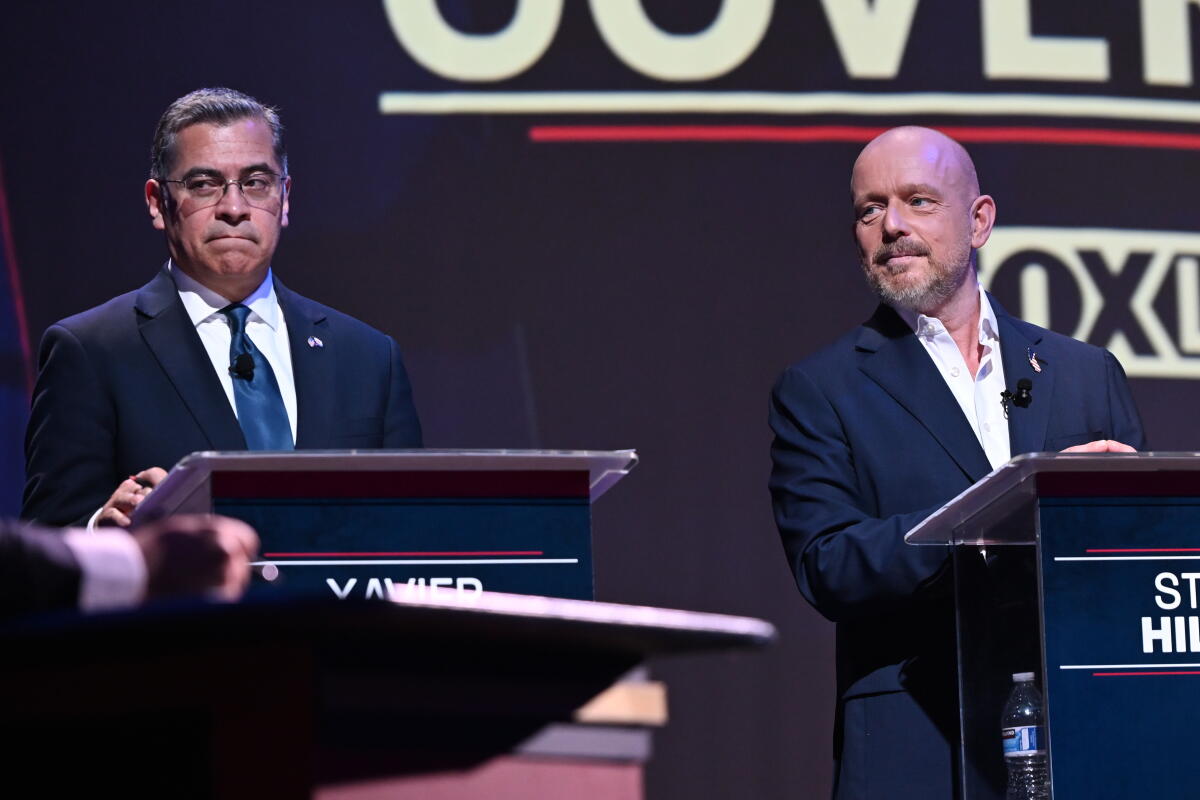
Spencer Pratt is shown on a television

Spencer Pratt is shown on a television while journalists work during the 2026 Los Angeles mayoral debate at Skirball Cultural Center on May 6.

(Jason Armond / Los Angeles Times)

Far from me to criticize someone’s faith. But I urge Pratt to reacquaint himself with the words of the messiah in whose path he professes to follow. Humility, frugality, turning the other cheek — it’s what Jesus taught and what Pratt has long rejected.

Nowhere does Pratt need more of refresher on Jesus’ lessons than when it comes to homeless people.

Instead of offering compassion or viable initiatives, Pratt consistently calls the unhoused “zombies,” “vagrants,” “drug addicts” and “bums,” with a particular fixation on the naked ones. He vowed to ABC 7 recently that he would push people off L.A.’s streets and onto federal land — like herding stray wildlife. The mayoral hopeful added that “scam homeless nonprofits” exacerbate homelessness, which must have been news to Scripture-based organizations such as the Los Angeles Catholic Worker, Union Rescue Mission and the Salvation Army, which have been trying to help homeless people since before Pratt was born.

Pratt also told ABC 7 reporter Josh Haskell that most of L.A.’s homeless are not locals.

“These people, when I unplug them … they’re all going to Seattle, where the mayor will welcome them,” Pratt proclaimed.

Jesus would not only roll out the welcome mat for homeless people — he would embrace them.

Spencer, what New Testament book says that your crude campaign against the most destitute among us is holy?

Christ never looked down on itinerants, famously saying, “The Son of man hath not where to lay his head.” In the Book of Mark, when Jesus sent his disciples out into the world, he told them to bring no food or money, because good people would take care of them.

“And if any place will not welcome you or listen to you, leave that place and shake the dust off your feet as a testimony against them,” Jesus said.

Christ did do some name calling, but his ire was directed at the powerful, the braggarts, the hypocrites — the Pratts of his time. The Nazarene saved his kindest words for the meek, the poor, the peacemakers — who are sorely lacking in Pratt’s caravan of disaffected liberals, Trumpers and the wealthy. Christ didn’t offer counsel to the comfortable but to outcasts — lepers, prostitutes, people possessed by demons or afflicted with disease — whose modern-day contemporaries live on our streets and whom Pratt World blames for all of L.A.’s ills.

Jesus especially embraced outsiders — the Canaanite woman he initially compared to a dog because she sought help for her daughter, the Samaritan lady at the well, the Roman centurion in the Book of Matthew of whom Jesus proclaimed, “I have not found so great faith” anywhere in Israel. Pratt would have rounded up all of them in donkey carts and dumped them in Babylon, if he had been around back then.

I understand how frustrating it is to see homeless encampments in neighborhoods and to deal with unhoused people who disrupt one’s day, as my wife does at her restaurant in Santa Ana. But whenever annoyance gets the better of me, I remember what Jesus told his followers: “Inasmuch as ye have done it unto one of the least of these my brethren, ye have done it unto me,” warning that he would keep this in mind on Judgment Day.

Those who didn’t take his advice? “Depart from me, ye cursed,” Christ thundered, “into everlasting fire, prepared for the devil and his angels.”

Christianity — and good society — calls for us to look to our better angels, not to demonize others, as Pratt regularly does. He knows this too.

“When the whole world hates you,” Pratt wrote, “it’s comforting to think at least the big guy upstairs has your back, so long as you repent.”

But repentance means admitting you’ve done wrong. Instead, Pratt is doubling down on his anti-homelessness nastiness as more and more people join his crusade.

Let’s see how many Angelenos embrace this false prophet on election day.


Source link

Bad optics? Israel jails soldiers who smashed Jesus statue in Lebanon | Israel attacks Lebanon News

Footage of an Israeli soldier attacking a Christian statue depicting the crucifixion of Jesus in southern Lebanon with a sledgehammer was difficult for Israel’s political establishment to ignore. The country has long tried to frame itself as a defender of Christians, and is allied with the powerful Christian Zionist movement in the United States.

But as Israel continues to lose support in the US and the West for its genocidal war in Gaza and attacks in Lebanon and Iran, support among Christians has also dipped – even before the video of the desecration of the Christian statue surfaced.

Recommended Stories

list of 3 itemsend of list

Responding to the footage on Monday, a day after it first went viral, Israeli Prime Minister Benjamin Netanyahu pushed his regularly repeated line that Israel respects all religions, even as critics point out that his government regularly does the opposite.

But, with even some of Israel’s supporters voicing anger at the soldier’s actions, Israel announced on Tuesday that he had been jailed for 30 days, along with another soldier who had been filming him. Six other soldiers have been summoned for questioning.

The decision to pursue action against the two soldiers stands out because it is in marked contrast to Israeli military investigations conducted into violations by soldiers, which overwhelmingly find them not to have been at fault. In fact, no Israeli soldier has been charged with killing a Palestinian this decade, despite the thousands killed even outside of the Gaza war context, including the 2022 killing of Al Jazeera’s correspondent in the occupied West Bank, Shireen Abu Akleh, who was herself a Christian.

Yossi Mekelberg, a senior consulting fellow with Chatham House, noted that it was important for the Israeli government to ensure that its response to the attack on the statue of Jesus was visible, particularly in light of the important role Christian supporters of Israel – including the US ambassador to Israel, Mike Huckabee – play in the administration of US President Donald Trump.

Those supporters frequently justify their support for Israel by relying on Christian Zionist interpretations of the Bible, and emphasising a “Judeo-Christian” value system and shared cultural heritage.

But official Israeli action in this case makes inaction in other cases more glaring.

“This [attack on the statue of Jesus], and the attacks upon mosques by settlers and the killing of Palestinians are all war crimes,” Mekelberg said. “The problem is that we don’t know how widespread it is. We only know about this one because they filmed it.”

History of violence

Through much of the conflicts in Gaza and Lebanon, observers and analysts have pointed to the stark difference in Israeli government responses to attacks on Christian symbols and places of worship and what has been the large-scale destruction of Islamic sites.

In March, Netanyahu found himself having to explain the decision to block the passage of Cardinal Pierbattista Pizzaballa, the Latin patriarch of Jerusalem, from entering the Church of the Holy Sepulchre to mark Palm Sunday, one of the holiest days of the Christian calendar. Before the end of the same day, Netanyahu had posted to social media, explaining that there had been “no malicious intent whatsoever, only concern for his safety”.

Last July, Netanyahu again found himself apologising for a strike on a third church in Gaza following pressure from the Trump administration, when three of the hundreds of people sheltering there were killed and several others injured, including the parish priest who regularly spoke to the late Pope Francis.

In a statement issued through his office, the Israeli prime minister claimed he deeply regretted the strike on the church, which he said was an accident.

“Every innocent life lost is a tragedy. We share the grief of the families and the faithful,” he said, without referencing the almost 60,000 men, women and Palestinian children his forces had killed by that point in the war.

Throughout the war, Israel’s defenders have emphasised the concept of Judeo-Christian values in an effort to justify Israel’s attacks and its repeated breaking of international law. But evidence of a shared civilisational bond is thrown into question by attacks on Christian symbolism, such as in Lebanon, and by Israel’s long-standing treatment of Palestinian Christians, who face the same dispossession and occupation as their Muslim neighbours.

“I think a lot of Israel’s defenders in the West like to portray it as being ‘us’, just over there, as if ‘over there’ is some form of dark jungle,” said HA Hellyer, a senior fellow at the Center for American Progress and senior associate fellow at the Royal United Service Institute.

“So, they can make excuses for Israelis killing Arabs in their thousands,” Hellyer said. “They can even make excuses for them killing Christians. But when you see Israeli soldiers destroying Christian symbols, it becomes much harder to defend those actions and to stem the growing trend of US supporters, both Democrat and Republican, moving away from Israel.”

What’s next for Israel’s relationship with Christians?

While the Israeli government has been keen to preserve evidence of the Judeo-Christian bond, complaints of harassment by Christian groups within Israel are growing, particularly with the increase in strength of the Israeli far right, including in government.

In 2025, the interreligious Rossing Center for Education and Dialogue recorded 155 incidents targeting Christians in Israel, a marked increase from the previous year. While physical assaults were the most common, comprising 39 percent of incidents, there were also accounts of spitting, hitting, and pepper-spraying.

Christian holidays, specifically those around the time of Easter, have become particular sources of tension, the report noted, with priests and nuns wearing visible Christian clothing in West Jerusalem and occupied East Jerusalem facing the risk of harassment every time they enter public spaces.

“We’ve entered a period of what [Australian genocide studies scholar] Dirk Moses called ‘permanent security’, where anything different, anything that might be a threat, or could even be a threat in the future, has to be destroyed,“ prominent Israeli sociologist Yehouda Shenhav-Shahrabani told Al Jazeera.

That difference is inherent to the Christian faith.

“It’s not about left or right,” Shenhav-Shahrabani explained. “It even goes to language. In everyday Hebrew, people refer to Jesus as Yeshu, which is a curse word, rather than Yeshua, which is correct.”

“That’s commonplace. That’s how it’s used in everyday media,” he continued. “If that’s where you begin, it doesn’t matter if it’s stupidity or ignorance, it all leads to the same place.”

Source link

Global fallout grows over Israeli soldier smashing Jesus statue in Lebanon | Israel attacks Lebanon

NewsFeed

Outrage continues to grow over the Israeli soldier who was photographed desecrating a statue of Jesus Christ in southern Lebanon, including among Trump’s former MAGA allies. From a Polish MP to a Palestinian theologian, observers say it reveals a wider pattern.

Source link

Outcry grows over Israeli soldier smashing Jesus statue in Lebanon | Israel attacks Lebanon News

A photo of an Israeli soldier smashing a statue of Jesus Christ in Lebanon has sparked outrage in the United States, adding to the anger Israel is facing, including from parts of US President Donald Trump’s base.

Although the incident is only one among a broad range of atrocities that Israel is accused of committing in the region in recent years, it garnered condemnations across the world and prompted a response from Israel’s Prime Minister Benjamin Netanyahu.

In the US, where support for Israel was once unchallenged – especially in right-wing circles that purport to espouse Christian values – the desecration of the Christian religious symbol added fuel to the criticism that the Israeli government is facing from some Republicans.

“You would never know it by consuming American corporate media, but this kind of incident is not rare,” said right-wing commentator Tucker Carlson, a former Trump ally.

“The Israeli government has permitted its soldiers to behave like barbarians for decades, all while sucking up generous funding from the United States. The only difference between now and the past is that social media has exposed Israel’s behavior for the world to see,” Carlson wrote in his newsletter on Monday.

‘Horrific’

Former Republican Congresswoman Marjorie Taylor Greene – who fell out with Trump over his hawkish foreign policy – highlighted that Israel receives billions of dollars in US military aid annually.

“‘Our greatest ally’ that takes billions of our tax dollars and weapons every year,” she wrote in a comment on X in response to the photo showing an Israeli soldier taking a sledgehammer to the head of the statue of Jesus.

Matt Gaetz, another former Republican congressman and Trump ally, said, “Horrific”.

For his part, independent journalist Glenn Greenwald mocked how Christian Zionists may defend Israel over smashing the statue.

“Christian Zionists: This Israeli soldier was absolutely justified in smashing the head of the Jesus Christ statue because Hezbollah and Hamas were hiding inside. We owe him our gratitude,” Greenwald wrote on X.

The anger echoed growing scepticism of the close alliance with Israel in Trump’s “Make America Great Again” (MAGA) constituency.

Trump is already facing pressure over joining Israel in starting a war against Iran, which sent oil prices soaring. Earlier on Monday, the US president addressed and denied claims that Netanyahu dragged the US into the conflict.

Support for Israel in the US is at a historic low, recent public opinion polls show.

While Israel still enjoys near-unanimous Republican support in Congress, that consensus is starting to fray, with dissent being expressed by the likes of Carlson, in part due to prolonged wars in the Middle East and attacks on Christians.

Israel says it will investigate

The desecration of the statue, which took place near the town of Debl in south Lebanon, according to local reports, prompted an unusually swift response from the highest level of the Israeli government.

“I condemn the act in the strongest terms. Military authorities are conducting a criminal probe of the matter and will take appropriately harsh disciplinary action against the offender,” Netanyahu said in a statement on Sunday.

Israel rarely holds its soldiers accountable for well-documented abuses in Gaza, the occupied West Bank and Lebanon, including sexual violence.

Netanyahu, who has been evading an arrest warrant by the International Criminal Court (ICC) over war crimes charges in Gaza since 2024, went on to argue that Israel treats Christians better than any other country in the region.

“While Christians are being slaughtered in Syria and Lebanon by Muslims, the Christian population in Israel thrives unlike elsewhere in the Middle East,” the Israeli prime minister claimed.

“Israel is the only country in the region that the Christian population and standard of living is growing.”

Lebanon has the largest per capita Christian population in the Middle East, and its president is a Maronite Catholic.

Israeli Foreign Minister Gideon Saar joined Netanyahu in denouncing the desecration of the statue, saying that it is “entirely contrary” to Israeli values.

But while Israel’s supporters tried to portray smashing the statue as an isolated mistake by one soldier, the incident reflects a pattern of Israeli attacks against houses of worship, including churches.

In 2024, Israeli troops filmed a mock wedding between two soldiers at a church in Deir Mimas in Lebanon and vandalised the building.

An Israeli tank demolished a statue of Saint George in the southern Lebanese village of Yaroun last year, as well.

Israel has bombed Palestinian churches several times in Gaza since the start of its genocidal war in the enclave, including an attack that killed at least 18 people in 2023.

Israel destroyed more than 1,000 mosques and three churches in Gaza during the war, according to local officials.

Catholic leaders respond

The Assembly of Catholic Ordinaries of the Holy Land denounced the attack on the statue on Monday.

“This act constitutes a grave affront to the Christian faith and adds to other reported incidents of desecration of Christian symbols by [Israeli] soldiers in southern Lebanon,” it said in a statement.

“It further reveals a disturbing failure in moral and human formation, wherein even the most elementary reverence for the sacred and for the dignity of others has been gravely compromised.”

The incident came as Israeli soldiers pushed to completely destroy homes and civilian infrastructure in dozens of Lebanese villages in order to prevent residents from returning to them.

“The outrage shouldn’t be about a destroyed statue of Jesus – abhorrent as that is,” Palestinian pastor Munther Isaac wrote in a social media post on Monday.

“The real outrage is the targeting of civilians, the assault on human dignity, the devastation in Gaza and Lebanon. War is evil. We need Accountability.”

The Council on American-Islamic Relations (CAIR) called on Trump and Congress to intervene and end Israeli violations after the destruction of the statue.

“For years, our government has ignored and enabled persistent Israeli attacks on churches and Christians in Lebanon, Gaza, and elsewhere,” CAIR said.

“Our message to American public officials is simple: If you continue sending more weapons and provide political cover for Israel’s rogue actions, you own what you see in this picture.”

Source link

Outrage after photo shows Israeli soldier smashing Jesus statue in Lebanon | Israel attacks Lebanon News

Social media users condemn Western silence on attacks on religious symbols and sites by Israeli soldiers and settlers.

A viral photograph showing an Israeli soldier hitting a statue of Jesus Christ in southern Lebanon with a sledgehammer has sparked outrage.

In a statement on Monday, the Israeli military confirmed the authenticity of the image that was widely shared online, garnering more than 5 million views on X.

It said that following an initial review, it was determined that the photograph showed an Israeli soldier “operating in southern Lebanon”, where Israel last month launched a ground invasion in conjunction with aerial bombardment amid its joint war with the United States on Iran.

The military added that an investigation had been opened and that “appropriate measures will be taken against those involved in accordance with the findings”.

Commenting on social media, Ayman Odeh, a Palestinian member of the Israeli parliament, wrote pointedly: “We’ll wait to hear the police spokesperson claim that ‘the soldier felt threatened by Jesus’.”

Ahmad Tibi, another Palestinian member of the Knesset, wrote on Facebook that those who blow up mosques and churches in Gaza and spit on Christian clergy in Jerusalem without punishment are not afraid to destroy a statue of Jesus Christ and publish it.

“Perhaps these racists have also learned from Donald Trump to insult Jesus Christ and insult Pope Leo?” he asked, referring to the US president’s recent controversies, including his now-deleted AI-generated image that portrayed him as a Jesus-like figure and his feud with the head of the Roman Catholic Church, who has criticised the war on Iran.

Several activists, academics and writers also criticised the desecration of the statue, which was located on the outskirts of the village of Debl in southern Lebanon, near the border with Israel.

Social media users also condemned the international silence following attacks by Israeli soldiers and settlers against religious sites and symbols.

“When the Western world remains silent, racists go further,” said Tibi.

Israeli forces repeatedly attacked religious sites, including mosques and churches, during Israel’s genocidal war on Gaza. In the occupied West Bank, meanwhile, settlers vandalised or attacked 45 mosques last year, according to the Palestinian Authority’s Ministry of Religious Affairs.

Separately, the Religious Freedom Data Center (RFDC) documented at least 201 incidents of violence against Christians, primarily committed by Orthodox Jews targeting international clergy or individuals displaying Christian symbols, between January 2024 and September 2025.

The majority of these incidents, which included multiple forms of harassment, including spitting, verbal abuse, vandalism and assaults, took place in Jerusalem’s Old City, located in occupied East Jerusalem.

Source link

Outrage after Israeli soldier desecrates statue of Jesus Christ in Lebanon | Israel attacks Lebanon

NewsFeed

A photo of an Israeli soldier smashing a statue of Jesus Christ with a sledgehammer in southern Lebanon has sparked widespread condemnation. Israeli officials confirmed the image is genuine and ‘promised to investigate’.

Source link

IDF says viral photo of Israeli soldier smashing Jesus statue is real

April 19 (UPI) — The Israel Defense Forces confirmed Sunday that a photo showing an Israeli solider smashing the head of a statue of Jesus in southern Lebanon is authentic.

The photo, originally posted on X by Palestinian journalist Younis Tirawi, quickly went viral across social media, drawing condemnation from Christians, Palestinians and others in the war-torn region.

After initially pledging an investigation into the photo, the IDF later announced they had found it to be real and not an artificial intelligence fabrication.

“Following the completion of an initial examination regarding a photograph published earlier today of an IDF soldier harming a Christian symbol, it was determined that the photograph depicts an IDF soldier operating in southern Lebanon,” the military announced.

“The IDF views the incident with great severity and emphasizes that the soldier’s conduct is wholly inconsistent with the values expected of its troops.

“The incident is being investigated by the Northern Command and is currently being addressed through the chain of command. Appropriate measures will be taken against those involved in accordance with the findings.”

The Israeli military added it is “working to assist the community in restoring the statue to its place” and vowed it has “no intention of harming civilian infrastructure, including religious buildings or religious symbols,” in its fight against Hezbollah militia forces in southern Lebanon.

The photo stirred up outrage among Christians, Palestinians and others in the Middle East.

Wadie Abunassar, coordinator of the Holy Land Christian Forum, a group of Christian laity advocating for the Christian presence in the region, called for action on the part of Israeli authorities.

“Israel has to inquire this crime, to apologize for it, to bring suspect to justice, & make sure it won’t be repeated!” he wrote in a social media post.

Meanwhile, Ayman Odeh, a Palestinian member of the Israeli parliament, added sarcastically, “We’ll wait to hear the police spokesperson claim that ‘the soldier felt threatened by Jesus.'”

An Israeli infantry soldier says his morning prayers near a bus loaded with combat gear inside northern Israel along the southern Lebanon border on February 18, 2025. Photo by Jim Hollander/UPI | License Photo


Source link

Pope Leo XIV holds mass with estimated 120,000 in Cameroon

1 of 2 | A handout picture provided by the Vatican Media shows Pope Leo XIV and Cameroonian President Paul Biya shaking hands during a meeting at the Presidential Palace in Yaounde, Cameroon, on Wednesday. Pope Leo XIV held a mass Friday in Douala, Cameroon in a stadium with an estimated 120,000 people. Handout Photo courtesy of Vatican Media/EPA

April 17 (UPI) — Pope Leo XIV held a mass on Friday in Douala, Cameroon, in a stadium with an estimated 120,000 people, marking Catholicism’s growth in Africa.

The pope discussed poverty, violence and corruption in his address to the people of Cameroon, where about 30% of the population is Catholic.

About 20% of the world’s Catholic population lives in Africa.

“Do not give in to distrust and discouragement,” the pope said. “Reject every form of abuse or violence, which deceives by promising easy gains but hardens the heart and makes it insensitive. Do not forget that your people are even richer than this land, for your treasure lies in your values: faith, family, hospitality and work.”

More than 37.7 million people live in poverty in Cameroon. The pope shared the story of Jesus multiplying loaves and fish, saying the “miracle” happened when they were shared.

“Yet this alone is not enough,” he said. “The food that sustains the body must be accompanied, with equal charity, by nourishment for the soul. A nourishment that sustains our conscience and steadies us in dark hours of fear and amid the shadows of suffering.”

The mass was held at Japoma Stadium on the third day of the pope’s 10-day tour of Africa. He will next visit Angola and later Equatorial Guinea during his trip.

Pope Leo spent Thursday in Bamenda, Cameroon, the epicenter of the Anglophone Crisis or Ambazonia War, an armed conflict between the government and separatist groups that has waged for nearly a decade.

Children race to push colored eggs across the grass during the annual Easter Egg Roll event on the South Lawn of the White House in Washington on April 21, 2025. Easter this year takes place on April 5. Photo by Samuel Corum/UPI | License Photo

Source link