javier aguirre

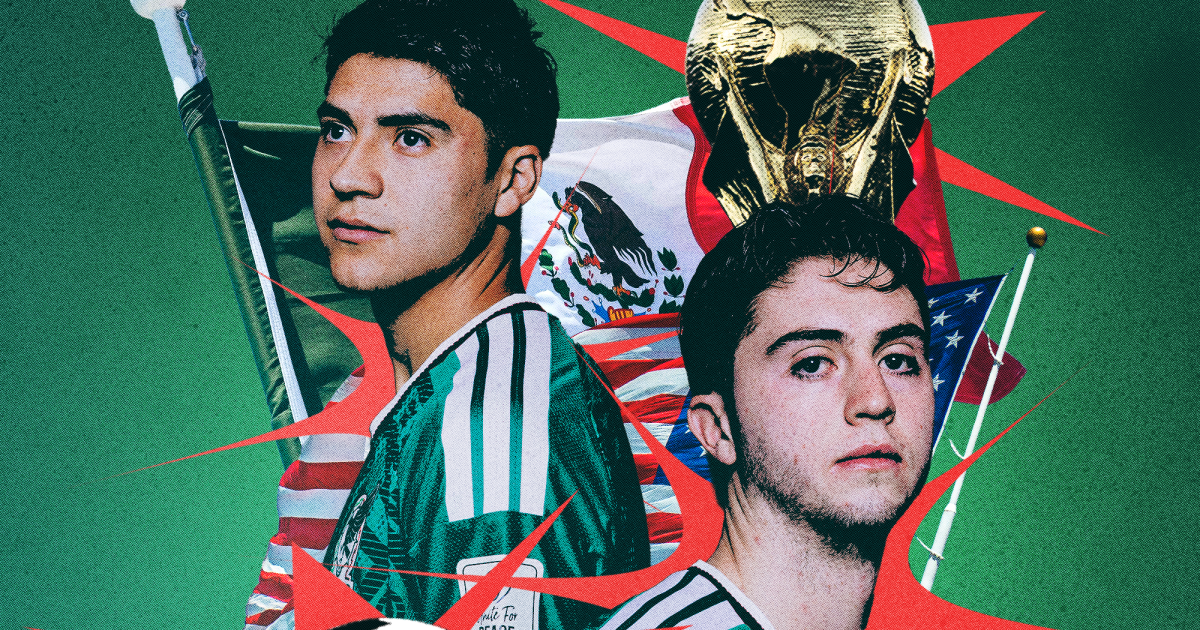
U.S.-born Brian Gutierrez and Obed Vargas signal a new era for Mexico

After the total failure that was Mexico’s participation in the Qatar 2022 World Cup, where they were eliminated in the group stage, the future looked very dire for “El Tri.” By 2024, the situation had worsened after another international failure at the Copa América. The 2026 World Cup co-hosts had even more pressure now. In a crisis-control move, the Mexico Football Federation opted to bring back its proven problem solver, head coach “El Vasco” Javier Aguirre, for a third stint.

In a short time, Aguirre was able to shape “El Tri” into a competitive squad by breaking from his usual approach. The man who shockingly demoted then-24-year-old goalkeeper Guillermo “Memo” Ochoa in favor of a more experienced player prior to the 2010 World Cup was now relying on upstarts.

Aguirre’s 26-man roster for the 2026 World Cup features 14 debutants on soccer’s grandest stage.The crown jewel of this nucleus is undoubtedly 17-year-old wonderkid Gilberto Mora, but there are also two American-born players who are also expected to become pillars of the team: Brian Gutiérrez, from Berwyn, Ill., and Obed Vargas, from Anchorage, Alaska.

Under Article 30, Section A, Part II of the Mexican Constitution, individuals born abroad are considered Mexican by birth if they are children of Mexican parents — a Mexican mother or a Mexican father. Gutiérrez’s parents are from San Juan de los Lagos, Jalisco, while Vargas’ father is a native of Morelia, Michoacán, and his mother was raised in Mexico City.

“Obviously, I’m taking it day by day and just trying to enjoy the experience,” said Gutiérrez about the opportunity to play for Mexico at the World Cup. “I talk about it a lot with my friends and family. Honestly, it’s amazing… I’m just living in the moment.”

Gutiérrez, 22, and Vargas, 20, are not the first players born in the United States to represent Mexico in a World Cup. That distinction belongs to Miguel Ponce and Isaac Brizuela, who were both born in California and part of the 2014 squad. But the comparisons largely end there.

Unlike Ponce and Brizuela, Gutiérrez and Vargas were fully raised in the United States and went through their entire soccer development on American fields. Ponce and Brizuela were also fringe contributors; they didn’t see any minutes in Brazil 2014.

Meanwhile, Gutiérrez and Vargas are already getting important playing time with the national team. Both were part of Mexico’s historic group stage where, for the first time in history, the team won all three of its games. Gutiérrez was a starter against South Africa and South Korea, while Vargas came off the bench to help preserve the 1-0 lead over South Korea.

Their protagonism in Aguirre’s squad could also signal another new era for the Mexican national team — one in which Mexican American players are just as vital as those born on Mexican soil.

“Brian and Obed are two young players of Mexican heritage. They are very talented players who have made great progress recently. We called them up, and they convinced us with their performances,” said Aguirre prior to the tournament. “I believe there are many Mexican American players who, in the future, will continue strengthening Mexico’s youth national teams, including the women’s side. That makes me happy because they were not born in Mexico, yet they have a deep love for the country and have shown it by choosing to represent us.”

Both Gutiérrez and Vargas are also products of MLS academies.

Gutiérrez, a skillful and dynamic attacking midfielder, rose through the ranks of Chicago Fire’s youth system and made his senior debut in 2020. In December, he moved to storied Liga MX club Chivas, his childhood team. It took time for Gutiérrez to establish himself as a starter for Gabriel Milito’s squad, but his game-changing talent was there — enough to catch the eye of “El Vasco.”

Vargas, a box-to-box midfielder, developed through the Seattle Sounders youth system and debuted with the senior team in 2021. A strong showing against Atlético de Madrid in the 2025 Club World Cup led to the Spanish club adding him to its roster this February. This move also put him in Aguirre’s World Cup plans.

“Playing for Mexico at the World Cup is a dream come true for all Mexican American kids,” said Vargas. “Obviously, with the World Cup being in both countries, it’s special to me. I have connections and ties to both countries.”

For so long, it was said Mexican American players just could not earn a place with Mexico at the international level. Players like Édgar Castillo and Alejandro Zendejas — born in Juárez but raised in El Paso — represented “El Tri” up to the U-23 level, then switched and played for the U.S. Jonathan González (Santa Rosa, Calif.) represented the U.S. at youth level and then chose Mexico, but after a few call-ups he fell out of the picture.

But in this World Cup cycle, Mexican American players have stood out more than ever.

Aguirre’s preliminary 55-man World Cup roster included six Mexican American players. Richard Ledezma (Phoenix), Efraín Álvarez (Los Angeles), Jorge Ruvalcaba (Rialto), and Julián Araujo (Lompoc, Calif.) ultimately missed the final cut. Of the four, Ledezma and Araujo came closest to making the team, but for different reasons fell short.

Vargas believes it was only a matter of time before the talent broke through.

“I think Mexican American players have always been there. The quality has always been there. Obviously, the growing passion for the sport in the United States has helped fuel the development of many of those players,” said Vargas. “I think it’s amazing to see so many Mexican Americans doing well with the national teams of both the United States and Mexico. Dreams come true for kids, and that continues to inspire the next generation of Mexican American players coming through in the U.S.”

Gutiérrez and Vargas, like many standout Mexican American players over the last 15 years, began their paths with “El Tri” amid a long-standing tug-of-war between their birth country and the country of their parents. The Mexico men’s national team and their U.S. counterparts have increasingly become rivals, both on the field and in recruiting dual-national players.

For Mexico, the United States now represents a prime area for scouting outside its territory. According to the Migration Policy Institute’s (MPI) tabulation of data from the U.S. Census Bureau’s 2022 American Community Survey, approximately 38.8 million U.S. residents were either born in Mexico or reported Mexican ancestry or origin.

Not only do Mexican American players expand the national team’s talent pool, but as some argue, they also bring a different element that can be a major advantage for the program.

Former Mexico youth coach and current Guatemala coach Luis Fernando Tena recently raised eyebrows in an interview with ESPN Deportes by stating that Mexican American players possess qualities that can set them apart from homegrown Mexican players.

“They have an American mindset. They grew up with that mentality and with good nutrition, and that makes them different,” said Tena, who led Mexico’s U-23 team to the gold medal at the 2012 London Olympics. “They are more disciplined, work harder, and are more focused — something that we sometimes don’t always find in many Mexican-born players.”

Gutiérrez and Vargas started their international careers representing Team USA at youth level, but FIFA’s one-time switch rule allowed them to change allegiances.

Vargas said he chose Mexico because he simply “followed his heart.” His love for his heritage and the Mexican national team outweighed everything else.

As for Gutiérrez, he was motivated to make the change because his time at Chivas convinced him. In Liga MX, the club has been at the forefront of tapping into the Mexican diaspora in the U.S. Their long-standing “Mexicans-only” policy limits the club’s talent pool when acquiring players. Because of this, Mexican American players are becoming a vital lifeline for Chivas.

“As soon as I arrived at Chivas, I knew my decision was to represent Mexico because we play with 100% Mexicans, that’s just how it is,” said Gutiérrez.

Opportunity may have also played a major role in Gutiérrez’s and Vargas’s “one-time switch” decisions. Both had no clear pathway into the U.S. senior squad, while Mexico offered a clearer route — and a chance at the 2026 World Cup.

In a 2023 interview, El Paso native Ricardo Pepi, who made the one-time switch from Mexico to the U.S., said on the Men in Blazers podcast that his decision was influenced by the fact that the U.S. had him in mind for the senior squad, while “El Tri” did not.

“It was just easy to decide. The U.S. wanted me to join them in World Cup qualifiers, which is a big deal,” said Pepi. “It’s a unique opportunity, being at a World Cup, and something I didn’t even have to think about because Mexico wanted me for the U-20s and eventually the first team. I was like, ‘I’m past that.’”

Although Gutiérrez and Vargas chose Mexico and embrace their parents’ culture, their duality is still present. They carry their communities with them.

A year ago, when aggressive ICE raids and mass deportations swept through many immigrant communities in the United States, particularly Mexican immigrant communities, a visibly frustrated Aguirre refused to comment on the situation, saying he was “apolitical” and not “a spokesperson” for the Mexican people.

This was not the case with Gutiérrez and Vargas, who both addressed questions about the ICE raids during Mexico’s World Cup media day in Pasadena, where they switched seamlessly between English and Spanish.

Gutiérrez answered without hesitation. His hometown of Berwyn is a suburb of Chicago, a city that in September was targeted by “Operation Midway Blitz,” a major federal immigration enforcement surge. According to the Chicago Tribune, between 3,800 and 4,500 individuals were detained or arrested during the operation.

Gutiérrez’s words reflected the strain felt throughout his community.

“It’s been a hard, hard year for us,” Gutiérrez said. “It’s affected a lot of families, and I take playing for Mexico with great pride and hope to show it on the field.”

It’s no secret that a large part of Mexico’s fanbase is composed of Mexican Americans. They are the ones who help fill massive NFL stadiums for “El Tri’s” annual MexTour, a slate of mostly inconsequential friendly matches that are often seen as a cash grab for the Mexican Football Federation. The presence of standout players like Gutiérrez and Vargas is a major development for this segment of the fanbase.

By featuring players with shared cultural experiences and struggles, the connection between the Mexican diaspora in the U.S. and “El Tri” can only strengthen. The ties now go beyond simply sharing the same roots; Mexican Americans can now gravitate toward a team with players who represent their dual identity. And this can bring a true sense of belonging.
Source link

In must-win match against Ecuador, Mexico looks to advance

Mexico advances to the second round of the World Cup backed by its strong record in the group stage and a formidable fortress — Azteca Stadium — where it will host Ecuador on Tuesday at 6 p.m. PDT in a knockout match airing on Fox and Telemundo.

El Tri became the first Mexican team to win all three of its group stage matches at a World Cup — a perfect finish accompanied by fan support rarely seen before, with more than 80,000 packing Azteca Stadium for two of its games and more than 800,000 surrounding El Ángel de la Independencia statue to celebrate wins.

Coach Javier Aguirre’s third stint leading the national team, which began in 2024 amid skepticism, has sparked World Cup fever in the streets of Mexico City, which have filled with fans wearing green jerseys, along with their dogs, cats and even ducks decked out in the national team colors.

“We’re motivated, but nothing is decided yet,” Mexico forward Armando González said. “Earning points is useless because now comes the important part — do-or-die matches. We’re focused on that.”

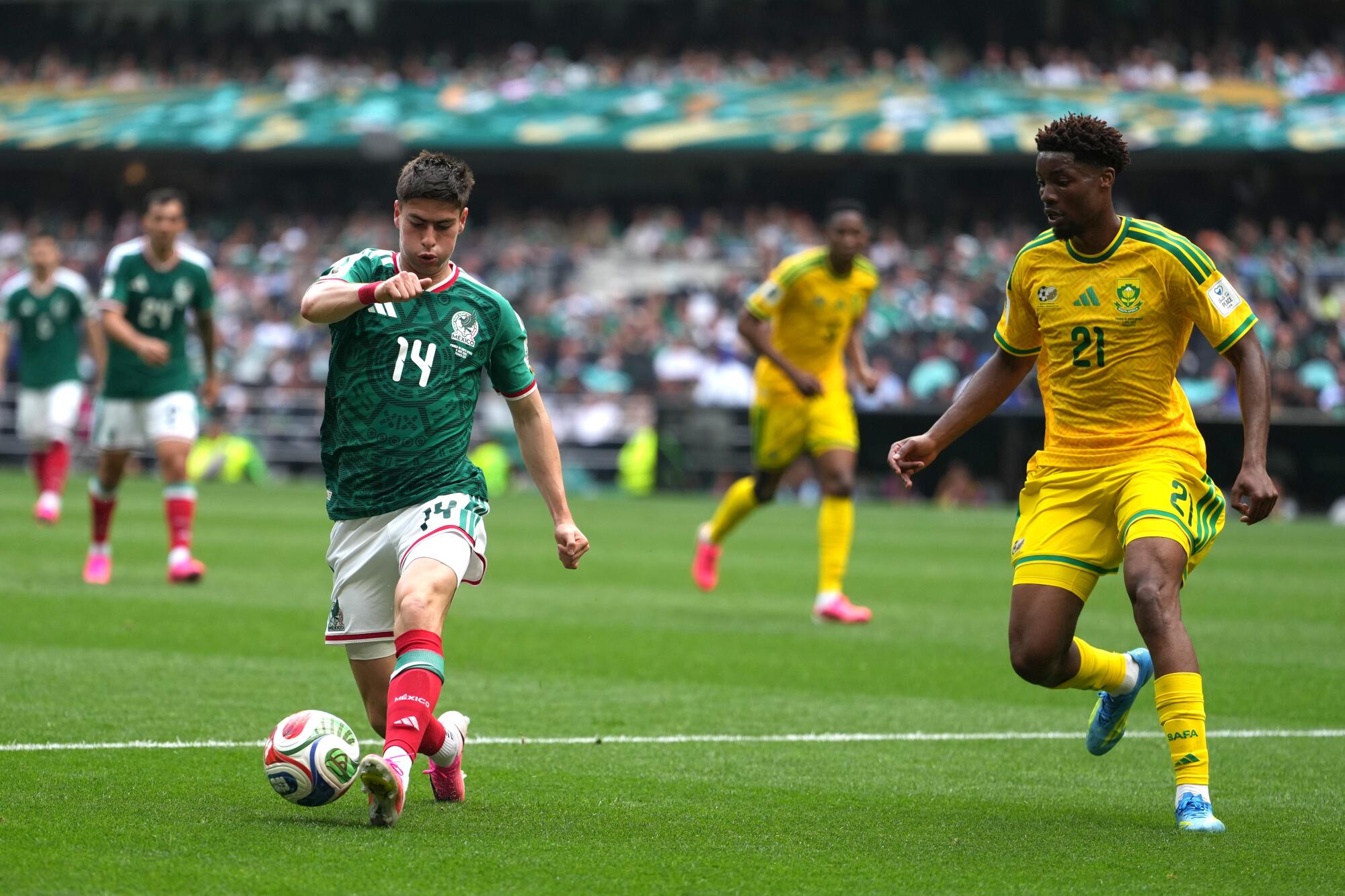
Mexico's Armando González controls the ball in front of South Africa's Ime Okon during on a World Cup match on June 11.

Mexico’s Armando González controls the ball in front of South Africa’s Ime Okon during on a World Cup match on June 11 at Azteca Stadium.

(Eduardo Verdugo / Ap Photo/eduardo Verdugo)

The winner of the match will face the winner of the contest between England and Congo on July 5 at Azteca Stadium.

Mexico has also been solid on defense, keeping three clean sheets while scoring six goals.

“We respect all our opponents,” said Mexico defender Jesús Gallardo, who sat out the last group stage match against Czechia. “We know this is the World Cup and every team is playing to win. We’ve won our three matches, and we’re proud of that. But we haven’t won anything yet. Ecuador has played well. We know they’re a very dynamic, very strong team.”

Erik Lira, Raúl Jiménez and Brian Gutiérrez will join Gallardo returning to the lineup after sitting out Mexico’s last match. Gutiérrez had a yellow card and was held out against Czechia to avoid a second yellow card and suspension. Gilberto Mora, 17, started in place of Gutiérrez and had a tremendous performance.

“We have to focus on what we do on the field; we want the fans to cheer us on,” Gallardo said. “We want to bring them a lot of joy.”

Following the convincing 3-0 victory over Czechia while resting some starters, the atmosphere on the Mexican team has been very relaxed, with several videos showing the players joking around with each other. Some of them have been training together for nearly two months because Aguirre arranged a monthlong training camp ahead of the World Cup.

“That’s why these past few months have gone by so quickly. Even though they’re always joking around, we know that we have a brother right beside us who would give his life for us,” González said.

On the other side, Ecuador arrives after advancing as one of the best third-place finishers, having closing Group E competition with four points — a stark contrast to its performance in the South American qualifiers, where Ecuador finished second only to world champion Argentina.

At the World Cup, Ecuador began the tournament with a tough last-minute loss to Ivory Coast and then failed to score against debutant Curacao. But when Ecuador had its back against the wall and needed to beat Germany in the final group-stage match, it pulled off a stunning upset, defeating the German team 2-1 to secure its spot in the next round.

That inconsistency makes Ecuador a wild card.

Mexico's Luis Romo celebrates with Jesus Gallardo, Erik Lira and Johan Vasquez after scoring against South Korea.

Mexico’s Luis Romo celebrates with Jesus Gallardo, Erik Lira and Johan Vasquez after scoring against South Korea during a World Cup match at Guadalajara Stadium on June 18.

(Silvia Izquierdo / Ap Photo/silvia Izquierdo)

“That’s what life is all about — having faith, having confidence. The team is very united,” said Sebastián Beccacece, Ecuador’s Argentine coach. “We’ve always remained calm and cautious in the face of adversity.

“The team is united, obviously full of enthusiasm and energy — like all national teams — but also tired, especially due to the schedule. Still, that’s no excuse. We’re driven by enthusiasm and the desire to make history; we’ll build our efforts on these foundations.”

Ecuador has also had to move quickly to plan for the match against Mexico. Following Thursday’s victory, Ecuador didn’t know it would be facing Mexico until Saturday morning. The team tried to travel to Mexico City on Sunday, but it ran into logistical problems and had to do so on Monday.

“Traveling to the Azteca Stadium is going to be a bit of a challenge,” Agustín Delgado, the all-time leading scorer for the Ecuadorian national team, said in an interview with Claro Sports. “That ultimately takes its toll in a match of this magnitude.

“This generation has what it takes for this World Cup and another one after that. They’re very young players. They haven’t reached their full potential yet; they have a lot to give.”

Unlike the game against Czechia, altitude won’t be as big a factor, since the Ecuadorian national team plays its home games in Quito, which sits at an elevation of 9,350 feet — making it the second-highest capital city in the world and more than 2,000 feet higher than Mexico City. It also has players who compete for clubs accustomed to playing at Mexican altitudes, such as Pedro Vite of Pumas and Enner Valencia of Pachuca.

Ecuador boasts proven talent such as Moisés Caicedo of Chelsea in England; William Pacho of Paris Saint-Germain in France; Piero Hincapié of Arsenal; and Joel Ordóñez of Club Brugge in Belgium.

“It’s a close match; there are star players on both teams,” said Álex Aguinaga, a former Ecuadorian player and Liga MX legend who is now a commentator for Fox Sports. “Ecuador’s defense is much more solid; it has players who handle the defensive zone very well.

Mexico fans cheer during a World Cup game against Czechia at Azteca Stadium on June 24.

Mexico fans cheer during a World Cup game against Czechia at Azteca Stadium on June 24.

(Alex Slitz / Getty Images)

“It’s so close, but I think it’s going to come down to a single goal.”

Ecuador will also try to capitalize on the pressure stemming from the fact that Mexico has won only one match in its entire history in knockout rounds — in 1986 when it played at home against Bulgaria and won 2-0. Between 1994 and 2018, Mexico was eliminated in the second round of the World Cup on each of the last seven occasions it reached that stage.

Mexico has never lost a match at Azteca Stadium in a World Cup, and its last defeat in an official match was against Honduras in a qualifying match in 2013.

“I think right now all the opponents are going to be tough; none of them will be easy,” said Obed Vargas, an Atlético Madrid player who has come off the bench for Mexico. “We’re taking it one game at a time, but for me, we have to make it to the final.”

Source link

Mexico coach Javier Aguirre answers critics by advancing

Before the World Cup, critics and fans of the Mexican national team debated whether Javier Aguirre’s third stint as head coach was the right decision. Two games later, the coach has led Mexico to the tournament’s knockout round.

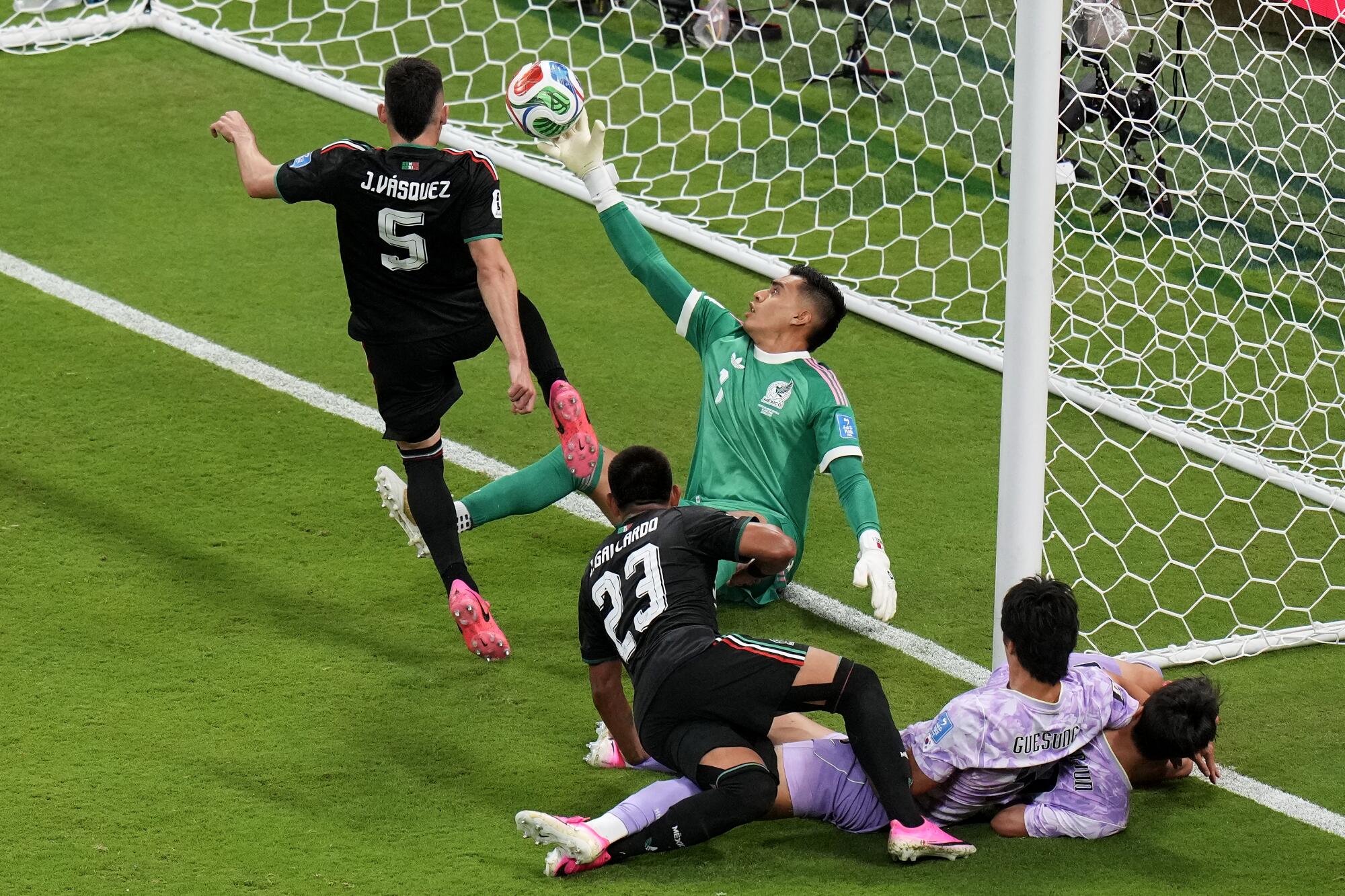
Thursday’s 1-0 victory over South Korea at Guadalajara Stadium made the World Cup co-host the first in the tournament to advance while also clinching the top spot in Group A with one group play game remaining. After South Korea’s goalkeeper fumbled a ball, Luis Romo scored the goal that gave the Mexicans six points and pushed them to the top of the standings.

El Tri will close out the first round against Czechia (6 p.m.) at Azteca Stadium on Wednesday.

During his post-match news conference, Aguirre spoke less about the result and more about the journey that led him to this moment. At 67 and having coached Mexico in three World Cups, he explained that his experience allowed him to approach a match he described as eminently tactical.

Mexico goalkeeper Raul Rangel reaches back to stop the ball from entering his goal during his team's 1-0 World Cup win.

Mexico goalkeeper Raul Rangel reaches back to stop the ball from entering his goal during his team’s 1-0 World Cup win over South Korea Thursday.

(Silvia Izquierdo / Associated Press)

“I’ve always tried to get my team to play well and to help the players and the national team develop,” Aguirre said.

For the coach, advancing to the knockout round represents the culmination of more than three decades of work on the sidelines and the support of a group of players who rose to the occasion under the most demanding circumstances.

The coach also acknowledged that advancing to the next round has eased the tension surrounding the team after the doubts that existed before the World Cup. Without mentioning personal vindication, he noted that soccer tends to judge solely based on the most recent result.

“If you win, you’re the best; if you lose, you’re the worst,” Aguirre said.

Aguirre said he remains calm because he believes his approach to coaching hasn’t changed and that the team was rewarded Thursday night against South Korea in a match marked by limited space and a high degree of tactical discipline.

With qualification secured, Aguirre said he will not alter his soccer philosophy during Mexico’s final group stage match even though it no longer faces the pressure of securing a spot in the next round.

He said Czechia will enter the game with a different competitive need and a drive to advance, while Mexico will work to maintain a high level of performance that allowed it to record two consecutive wins and keep two clean sheets at the start of the tournament.

On the South Korean side, coach Hong Myung-bo avoided making excuses and focused his analysis on the play that decided the match. Although he explained that he had not yet reviewed the goal sequence in detail, he knew the team made a series of small errors in an area of the field where he had previously warned that losing possession could prove decisive.

Mexico goalkeeper Raul Rangel blocks a shot by South Korea's Son Heung-min during the World Cup match on Thursday.

Mexico goalkeeper Raul Rangel blocks a shot by South Korea’s Son Heung-min during the World Cup match on Thursday.

(Natacha Pisarenko / Associated Press)

The coach said that one of the central focuses of their preparation had been avoiding turnovers near South Korea’s box in the face of Mexico’s high press.

Myung-bo said that during the pre-match talk, he emphasized that the first 20 minutes would be crucial and believed his players had executed that part of the plan. He said that as the minutes passed, South Korea managed to create chances and was gaining strength until its critical turnover.

“After the momentum of the match shifted in our favor … both in terms of overall pressure and the play itself, we were able to create many opportunities,” Myung-bo said. “Although it ended up being a very frustrating match and we’re left with a bitter taste in our mouths over the lost possession, there’s no time to dwell on it. We have one last match ahead of us, so we’ll prepare well.”

Source link

Mexico set to kick off 2026 World Cup against South Africa

The Mexican national team will kick off the 2026 World Cup against South Africa on Thursday with the weight of entertaining 83,000 at iconic Azteca Stadium and soccer fans around the globe.

The match at the venue known as Mexico City Stadium during the World Cup will kick off at noon PDT and air on Fox and Telemundo.

Once the ball starts rolling, the stadium’s altitude — 7,216 feet above sea level — will be one of the biggest assets for the Mexican lineup led by coach Javier Aguirre.

It will be Mexico’s eighth opening match in a World Cup, and El Tri carries a historical burden. It has never won a tournament opener, with a record of 0-5-2, including a 1-1 draw against South Africa in the opening match of the 2010 World Cup in Johannesburg.

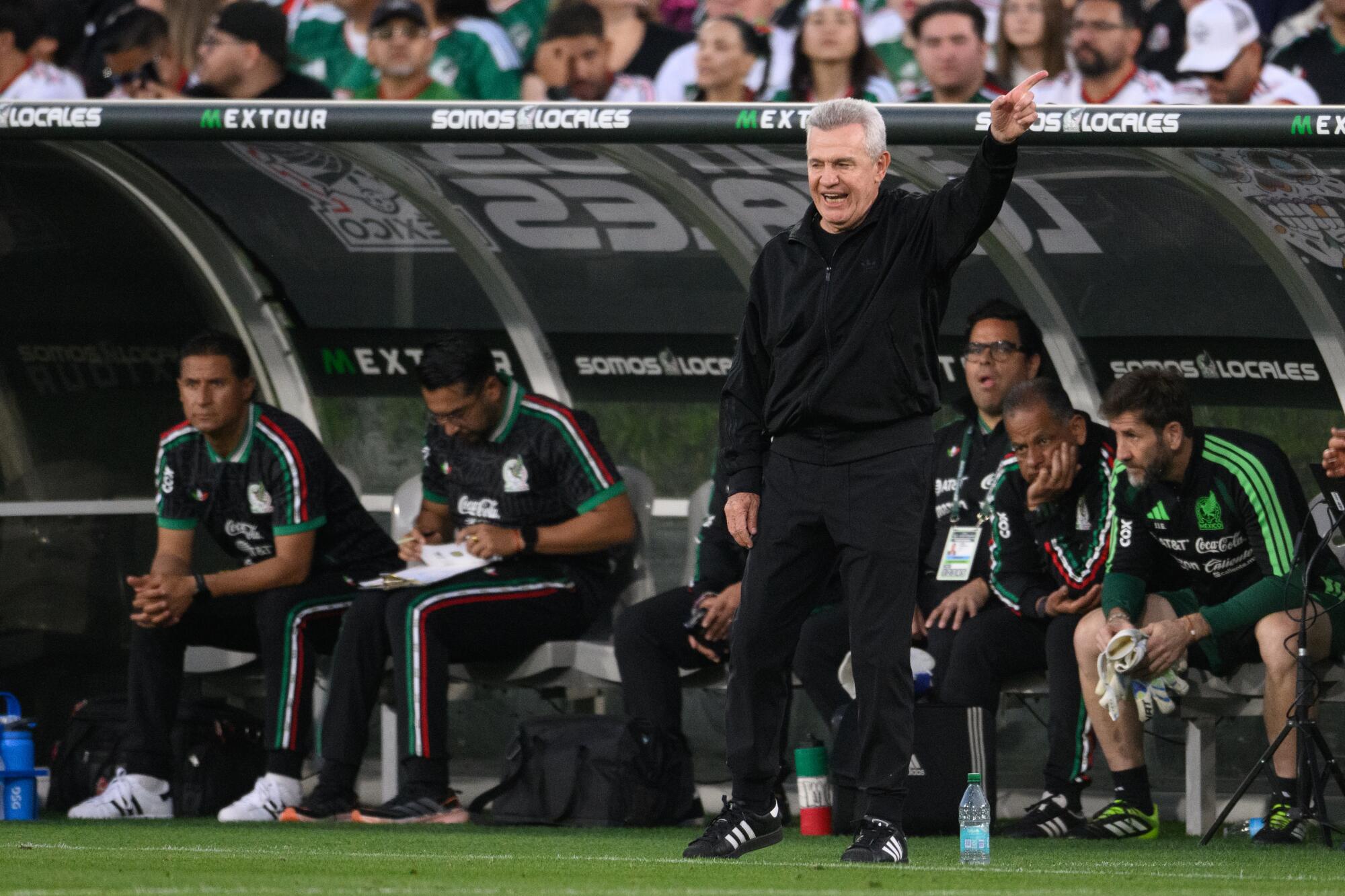
Mexico coach Javier Aguirre directs his players during a friendly against Australia on May 30 at the Rose Bowl.

Mexico coach Javier Aguirre directs his players during a friendly against Australia on May 30 at the Rose Bowl.

(Kyusung Gong / Ap Photo/kyusung Gong)

Aguirre will likely deploy the 4-3-3 formation he used during Mexico’s final warm-up match against Serbia.

“We’re ready; we’ve been working for 22 months,” said Aguirre, 67, who took the reins of the national team on Aug. 1, 2024, following Jaime Lozano’s failure at that year’s Copa América, when Mexico was knocked out in the group stage.

Since his arrival, Aguirre has led the team to its first Concacaf Nations League title and the Gold Cup. Mexico enters the tournament on an eight-game unbeaten streak, though several of those results came against lower tier opponents and at home. The two most encouraging highlights of that streak were the draws against Belgium and Portugal.

“If my teams are known for anything, it’s for their character,” Aguirre said. “My team is just like me.”

The starting goalkeeper position remains a topic of debate, but it appears Aguirre has already made his decision. Guillermo Ochoa, who will be playing in his sixth World Cup with Mexico, is considered by many to be the ideal experienced goalkeeper to use during the opener, when nerves are sure to be high. However, Raúl Rangel has been the starting goalkeeper during Mexico’s past three warm-up matches, playing the full 90 minutes each time.

Rangel, who was 10 years old when Mexico tied South Africa in the opening match of the 2010 World Cup and who fondly remembers El Tri’s victory over France that tournament, is confident between the posts.

Mexican goalkeeper Guillermo Ochoa shouts to his teammates during a friendly against Australia at the Rose Bowl.

Mexico could turn to veteran goalkeeper Guillermo Ochoa to calm nerves during the World Cup opener on Thursday.

(Ronaldo Bolanos/Los Angeles Times)

“We’re in great shape; we proved it against Portugal and Belgium, two teams that are among the world’s elite,” said Rangel, who noted that Ochoa has instilled a sense of calm in the team.

“I do believe we can be champions. We have to start keeping that in mind and believe that it’s possible. Not everyone can boast that they played in a World Cup on home soil.”

The Mexican team’s lack of elite club experience, however, is obvious and could be a problem. El Tri has few players in top-tier leagues and lacks game-changers on the wings, as Diego Lainez, Uriel Antuna and Hirving Lozano were left off the final roster. Offensive output is a cause for concern. In tight matches, goals have come mainly from defenders, with César Montes and Johan Vásquez being the primary threats on set pieces.

The commitment to youth appears to be a key factor in Aguirre’s approach to building the roster. Mexican American Brian Gutiérrez brings freshness and dynamism to the midfield, alongside Erik Lira’s energy. As an option off the bench, Aguirre could turn to 17-year-old Gilberto Mora, the youngest player in the tournament, who is sure to draw cheers from the crowd.

For his part, South Africa’s 74-year-old head coach, Hugo Broos, knows the Azteca Stadium well, having marked Maradona during the 1986 World Cup semifinals. To acclimate his players to the altitude, he held training camp in Pachuca, at an elevation of 7,979 feet.

“This game is special. I’ve played in European championships, but there’s nothing like a World Cup. And we’re going to play at the Azteca Stadium — it’s incredible that this is going to happen,” Broos said.

South Africa coach Hugo Broo talks with Nigeria's players during a World Cup qualifying match against Nigeria.

South Africa coach Hugo Broo talks with Nigeria’s players during a World Cup qualifying match against Nigeria in Bloemfontein, South Africa, on Sept. 9.

(Themba Hadebe / Associated Press)

He expects to be challenged by Mexico.

“They’re a very well-rounded team, with great mobility and teamwork,” Broos said of El Tri. “You can tell they want to be world champions.”

South Africa will pose a real threat with Mbekezeli Mokoena driving the midfield and the speed of Oswin Appollis and Relebohile Mofokeng on the wings. The team’s main weakness lies in finishing, as Lyle Foster is their only striker, and if he doesn’t perform well, the South African side will suffer.

“We can’t say we don’t have a chance against Mexico, because that’s not true,” said Broos about his team, which is ranked 60th in FIFA rankings and will tangle with a Mexican squad ranked No. 14.

Pregame entertainment will kick off at 10:30 a.m. PDT with performances by Shakira, Burna Boy, Maná, J Balvin, and Alejandro Fernández. As a new ceremonial feature, all 26 players from each team — starters and substitutes — will participate in the ceremony by lining up around the tournament’s central emblem on the field, rather than in the traditional pregame formation.

The match is expected to be played in the rain. Protests are expected around the stadium throughout the day, including demonstrations by the teachers’ union and groups representing the families of missing persons.

Source link