Weekly insights and analysis on the latest developments in military technology, strategy, and foreign policy.
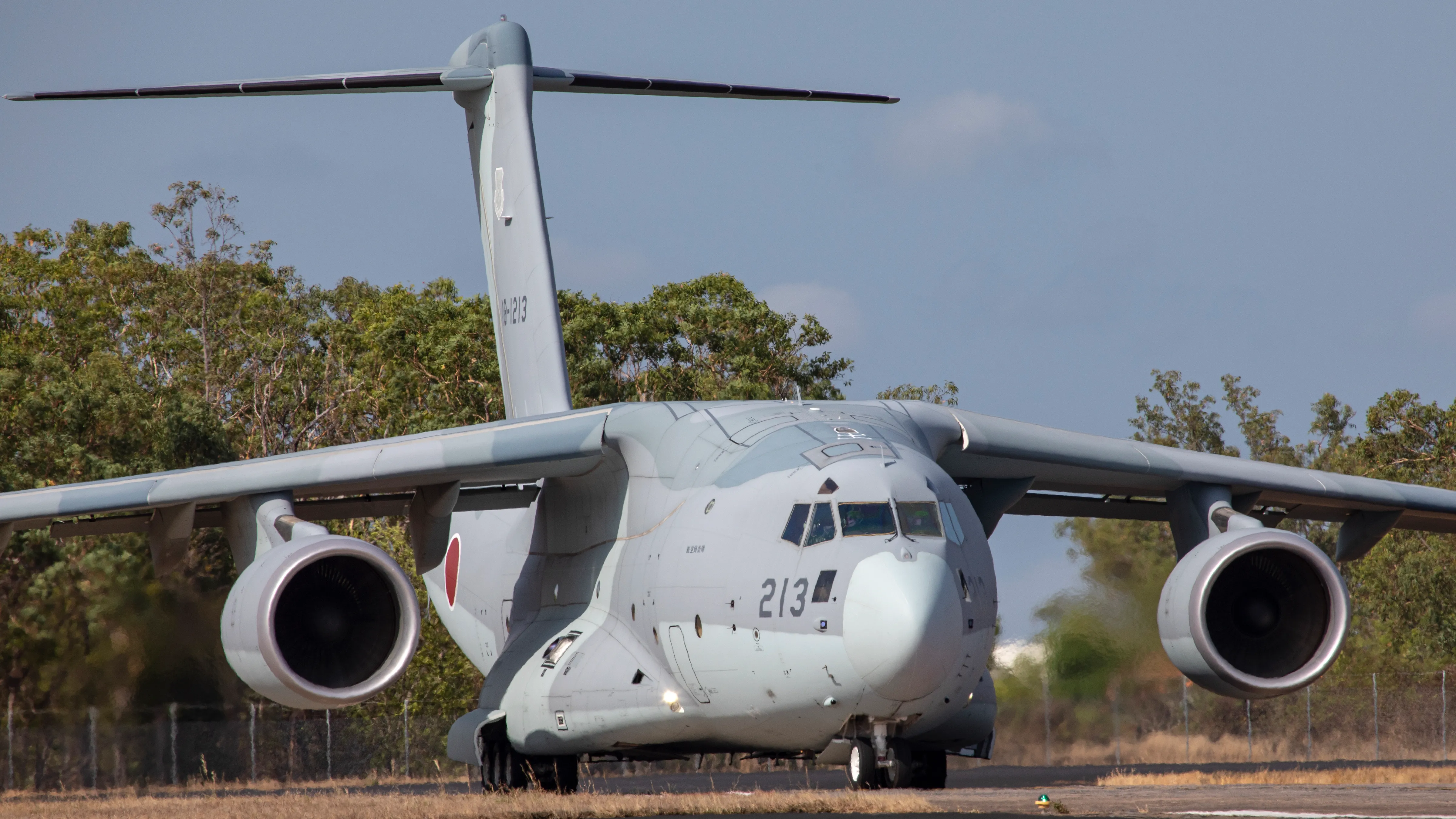
The latest addition to the Japan Air Self-Defense Force (JASDF) is, without question, one of the ugliest military aircraft to grace an apron today. With its enormous, bulged nose and other awkward protuberances, the Kawasaki EC-2 is, nevertheless, an important addition to the JASDF at a time when it faces increasing challenges from various sophisticated threats. The aircraft, which has generated much interest, took to the air for the first time today at Gifu Air Base, in the prefecture of the same name.
Derived from Japan’s indigenous C-2 twin-jet transport, the EC-2 is a standoff electronic warfare aircraft, the development of which began in 2021. Its primary role is to interfere with an opponent’s operations on the electromagnetic spectrum, from outside the range of air defense threats.
Specifically, the EC-2 is based on serial 68-1203, which was the third C-2 transport completed, before being modified for its specialist role.
As for the C-2, this military airlifter sits somewhere between a C-17 and a C-130 in terms of size and capabilities. In fact, it is probably closest in most regards to the four-turboprop Airbus A400M, but is powered by a pair of General Electric CF6 high-bypass turbofans — similar to those on many 747s and 767s, for instance.
A standard Japan Air Self-Defense Force C-2 transport aircraft. Australian Department of Defense SGT Pete Gammie
Returning to the EC-2, this aircraft is the successor to the JASDF’s one-off and now-retired Kawasaki EC-1, which was converted from an existing C-1 transport airframe and was for many years operated by the Electronic Warfare Operations Group (Denshi Sakusengun) at Iruma Air Base, in Japan’s Saitama prefecture.
A series of photos shows the now-retired Kawasaki EC-1:
Gifu is home to the JASDF’s Aviation Development and Testing Group, which will put the EC-2 through its paces before it is approved for operational service.
Before its first flight, the EC-2 became a peculiar object of interest for spotters and locals alike, with photographers taking numerous shots of the aircraft as it underwent taxi trials at Gifu.
Prior to that, the EC-2’s appearance had only been publicly known thanks to a rendering released by the Japan Ministry of Defense.
Schematic rendering of the EC-2. Japan Ministry of Defense
Back in 2022, a spokesperson from the Japan Ministry of Defense’s Acquisition, Technology & Logistics Agency (ATLA) told Janes that the C-2 was selected as the platform due to its ability to carry a significant amount of equipment to enable it to conduct “effective jamming” from outside of the opponent’s threat envelope.
“[The] C-2 transport aircraft has been selected as the base platform after considering such factors as its flight performance, maximum payload, and cost,” the ATLA spokesperson said at the time.
“By choosing the C-2 as the base platform, we make use of the existing infrastructure of the C-2 and thus effectively and efficiently operate the new C-2-based standoff EW aircraft,” the spokesperson added.
Compared to the C-1, the C-2 has a significantly higher payload capacity. The new transport can carry a payload of nearly 80,000 pounds for a maximum takeoff weight of 310,000 pounds, as opposed to a payload of around 26,000 pounds and a maximum takeoff weight of 100,000 pounds for the older C-1. You can look at a very direct visual comparison of the C-1 and the C-2 here.
A Japan Air Self-Defense Force C-1 transport aircraft in 2017. The last examples of these aircraft were retired in March 2025. KAZUHIRO NOGI/AFP via Getty Images AFP Contributor
Reportedly, however, at least some of the equipment previously used in the EC-1 — including the J/ALQ-5 electronic countermeasures system — has been ported over to the new EC-2.
Like its predecessor, the EC-2 has a huge bulbous nose, but it also adds two large, bulged fairings in tandem on the top of the fuselage. Meanwhile, there are two other prominent fairings mounted on either side of the rear fuselage.
Very few details of other specific equipment have been released, but imagery of the aircraft confirms that missile approach warning sensors (MAWS) are installed around the fuselage as part of its self-defense suite.
In an operational context, the EC-2 would use its powerful jamming systems to disrupt enemy sensors — especially those belonging to air defense systems and communications — on the ground and in the air, from a long distance.
The details that have been released relating to the EC-2 refer to program costs. Namely, the FY2025 Budget Request notes that around $260 million was allocated to the development of the aircraft. This is part of a total of around $3.2 billion that is being spent to upgrade intelligence collection and analysis capabilities.
Reflecting the increased emphasis on electromagnetic spectrum operations, Japan plans to buy four EC-2s, compared to having just one EC-1 in the past.
The EC-2 is the second specialized variant of the C-2, after the RC-2 signals intelligence (SIGINT) platform, first flown in 2018 and now active with the Electronic Warfare Operations Group. This aircraft was converted from the second C-2, serial 18-1202, and was officially handed over to the JASDF in 2020.
The RC-2 also has fairings on top and on the sides of the fuselage, and atop the tail. The nose radome is enlarged, and there is an extensive under-fuselage antenna ‘farm.’
According to statements from the Japan Ministry of Defense, it seems the EC-2 and RC-2 will likely work in concert. Specifically, the RC-2 is part of a wider effort to “improve capabilities to gather electromagnetic information necessary for electronic jamming and electronic protection.” This suggests that the RC-2 will conduct regular peacetime missions to gather data on locations and types of threat emitters, as part of generating an electronic order of battle, with this information then being used to ensure the EC-2 is able to target specific emitters.
As part of its fiscal 2023 budget, the Japan Ministry of Defense received a little over $25 million to explore the missile-toting C-2 concept, with a plan to continue technical research until fiscal 2024. If judged successful, full-scale development would then follow. The current status of that effort is unclear.
One factor that has stood in the way of additional procurement is the very high cost of the C-2, with around $2.3 billion plowed into the development effort and each airframe priced at approximately $176 million, as of 2017. This means Japan has been buying these aircraft at a slow rate, with the aim of fielding a frontline fleet of 16. The high cost has also contributed to a failure to win any export orders, which, if secured, would have helped to bring down the price.
The EC-2 seen on its first flight earlier today, accompanied by a Mitsubishi F-2B chase plane:
However, there is clearly a need for the EC-2, and it seems likely that the program will yield further examples of the standoff jammer.
In the past, Japanese defense officials have described the regional environment as “severe” and increasingly complex.
After all, Japan faces an increasingly challenging security environment, with the key threats provided by Chinese, North Korean, and Russian military activity. China has intensified its air and naval operations in the East China Sea and the wider Western Pacific, including deploying aircraft carriers and conducting frequent patrols near Japan’s southwestern islands. North Korea continues to test ballistic missiles capable of reaching Japan, while Russian aviation activity around Japanese airspace has also increased, including joint patrols with the Chinese military.
Outside of Japan, this type of platform is of growing interest, with a number of significant active procurement programs. In the past, we have looked in detail at the U.S. Air Force’s EA-37B Compass Call, as well as its derivative for Australia, the MC-55A Peregrine.
The second MC-55A Peregrine for the Royal Australian Air Force arrived at RAAF Base Edinburgh, South Australia, last week. Dsperandio dean sperandio
While its bizarre appearance might be the most obvious feature of Japan’s new EC-2, this ungainly machine will play an important role in the modernization of the Japan Air Self-Defense Force, as it increasingly looks at how to dominate the electromagnetic domain.
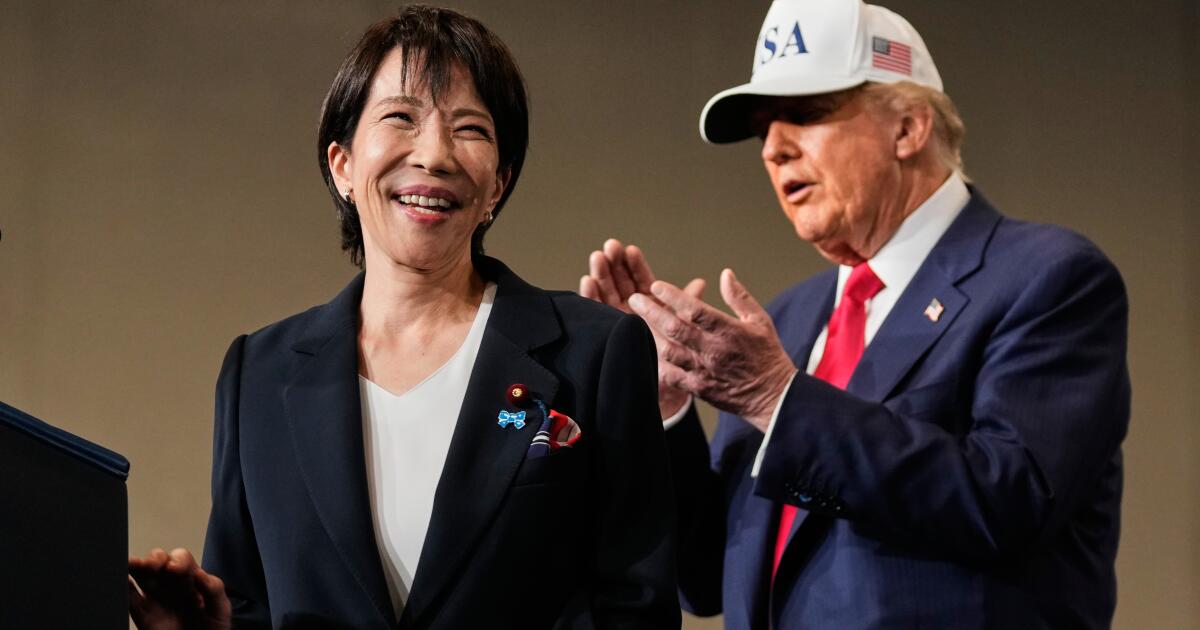
TOKYO — Japanese Prime Minister Sanae Takaichi is traveling Wednesday to the United States for what she expects to be a “very difficult” meeting with President Trump after he called on Japan and other allies to send warships to secure the Strait of Hormuz.
The three-day visit to Washington was originally expected to focus on trade and strengthening the U.S.-Japanese alliance as China’s influence grows in Asia. It is now expected to be overshadowed by the war the United States and Israel launched against Iran on Feb. 28.
”I think the U.S. visit will be a very difficult one, but I will do everything to maximize our national interest and to protect the daily lives of the people when the situation changes daily,” Takaichi told parliament on Wednesday, hours before her departure.
Takaichi held her first meeting with Trump in October in Tokyo, days after becoming Japan’s first female prime minister. A hard-line conservative, Takaichi is a protege of former leader Shinzo Abe, who developed a close friendship with Trump.
Her initial plan was to focus largely on China and strengthen the Japan-U.S. alliance ahead of Trump ‘s highly anticipated diplomatic trip to China that had been planned for months. The White House announced Tuesday that it is being delayed due to the war in the Middle East.
Takaichi will be in the hot seat figuring out what best to offer to Trump. Experts say showing commitment and progress in investment deals is key to a successful summit.
Japanese officials say the two sides will work to deepen cooperation in regional security, critical minerals, energy and dealing with China.
No plan to send warship to the Strait of Hormuz
A key U.S. ally in Asia, Japan has carefully avoided clear support for the U.S.-Israel strikes on Iran or a decision over a warship deployment. That’s mainly because of Japan’s constitutional constraints but also due to a legal question over the U.S. action and strong public opinion against it.
She told parliament that Japan hopes to see a de-escalation of the war, which has disrupted deliveries of oil and gas that Japan is highly dependent on.
“Without early de-escalation of the situation, our economy will be in trouble,” she said. “Early de-escalation is important for both the U.S. and global economy.”
Japan also hopes to secure its traditional ties with Iran, where most of Japanese oil imports come from.
Takaichi and her ministers have denied that Washington officially requested Japanese warships sent to the Strait of Hormuz. Trump on X asked a number of countries, including Japan, to volunteer. He then said he no longer needs them, complaining about a lack of enthusiasm.
That takes some pressure off Takaichi.
“We have no plans to send warships right now,” Takaichi told the parliamentary session Wednesday. A dispatch for survey and intelligence missions are possible but only after a ceasefire, she said. Some Japanese experts have commented that minesweeping would be a mission that the country could carry out when hostilities end.
“I will clearly explain what we can do and cannot do based on the Japanese law,” Takaichi said. “I’m sure (Trump) is fully aware of the Japanese law.”
China and security
Takaichi wants to discuss China’s security and economic coercion and ensure the U.S. commitment in the Indo-Pacific region, especially as some U.S. troops stationed in Japan are being shifted to the Middle East — a change seen by Japan as a potential risk for Asia as China’s clout grows.
Takaichi plans to reassure Trump of Japan’s military buildup, emphasizing the acceleration of long-range missile deployment to enhance offensive capabilities. This breaks from Japan’s postwar self-defense-only principle and reflects closer alignment with the U.S.
At the summit, Takaichi is expected to convey Japan’s interest in joining America’s “ Golden Dome “ multi-billion dollar, multi-layered missile defense system.
Japan considers China a growing security threat and has pushed a military buildup on southwestern islands near the East China Sea.
Takaichi has pledged to revise Japan’s security and defense policy by December and seeks to further bolster Japan’s military with unmanned combative weapons and long-range missiles.
Her government is to scrap a lethal arms exports ban in the coming weeks to promote Japan’s defense industry and cooperation with the United States and other friendly nations.
Oil in Alaska, rare earths in Japan
A resource-poor nation, Japan is seeking to diversify oil suppliers and is finalizing a Japanese investment for increased oil production in Alaska and stockpiles in Japan, according to media reports. A Japanese investment in small modular reactors and natural gas in the U.S. is also a possibility.
If agreed, the projects would be part of a $550 billion investment package that Japan pledged in October. In February, the two sides announced Japan’s commitment to the $36 billion first batch of projects — a natural gas plant in Ohio, a U.S. Gulf Coast crude oil export facility and a synthetic diamond manufacturing site — whose progress is also to be disccused with Trump.
Japan reportedly plans to propose a joint development of rare earths discovered in undersea soil around the remote Japanese island of Minamitorishima as part of the investment package.
Diplomatic and trade disputes have escalated further since Takaichi’s comment that any Chinese military action against Taiwan could be grounds for a Japanese military response.
Dodgers star Shohei Ohtani expressed regret Monday for his “shortcomings” following Japan’s early exit from the World Baseball Classic.
It is unclear what those shortcomings might have been. Over four games during this year’s tournament, Ohtani led Japan with a .462 batting average, three home runs and seven RBI in 13 at-bats.
Those stats are even better than the ones he posted as the MVP of the last WBC. Over seven games in 2023, Ohtani hit .435 with one home run and eight home runs in 23 at-bats to lead Japan to its third WBC championship.
Overall, however, Japan finished with a .284 batting average, down from a .299 average three years ago. Ohtani did account for his team’s final out of the 2026 tournament — an infield popup to seal an 8-5 quarterfinal loss to Venezuela on Saturday — and took to Instagram two days later.
“Thank you to all the fans for your support. Your cheers pushed us forward every day,” Ohtani wrote in Japanese. “We didn’t achieve the results we hoped for, and I deeply regret my own shortcomings.”
The two-way superstar did not pitch in this year’s WBC, after famously striking out then-Angels teammate Mike Trout of the United States for the final out of the 2023 championship game and going 2-0 with one save and a 1.86 ERA in that tournament.
Thousands of vehicles make the crossing every day.
Nicola Roy Spare Time writer
13:24, 28 Feb 2026
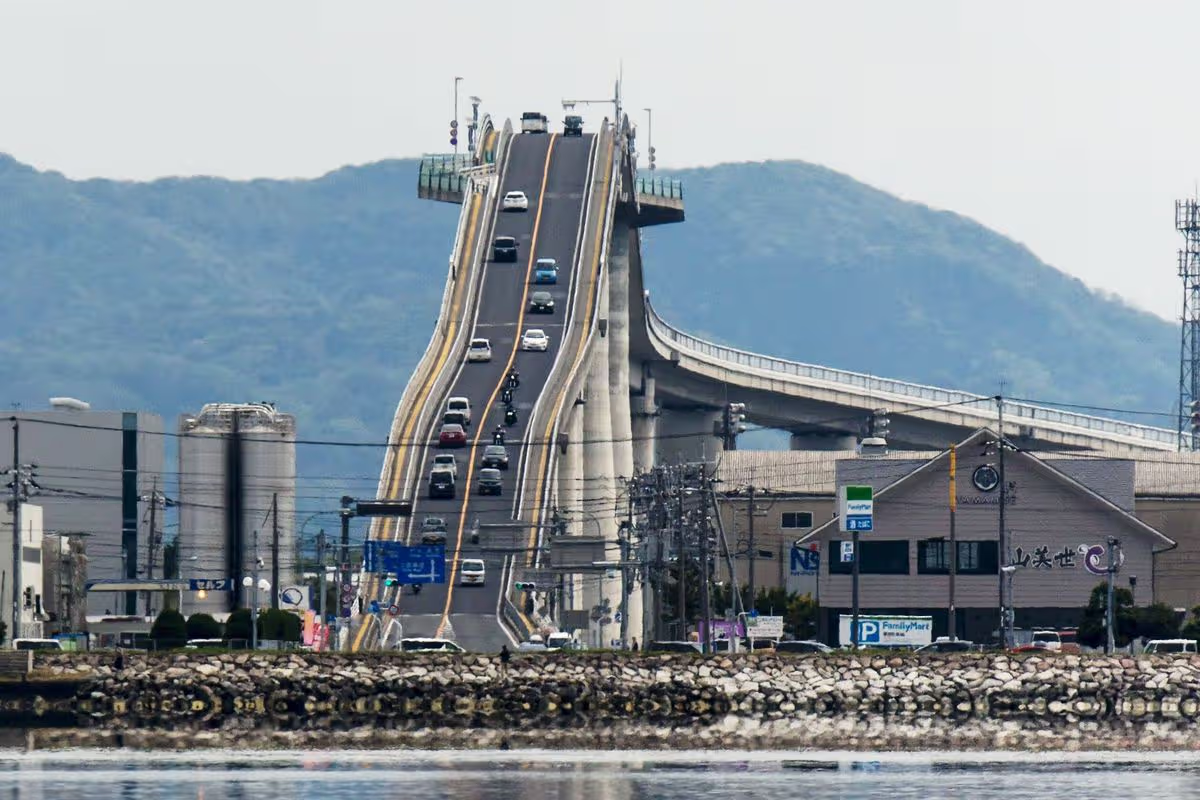
The bridge looks extremely steep from afar(Image: Getty)
A bridge so steep it’s been dubbed the ‘rollercoaster bridge’ is located in Japan and sees thousands of vehicles cross it daily. Often regarded as one of the steepest in the world, the Eshima Ohashi bridge links Matsue, in the Shimane Prefecture, with Sakaiminato in the Tottori Prefecture.
People say they have ‘nightmares’ after seeing photographs and footage of this bridge, which cost an eye-watering £119m to construct. In some images, it looks as though vehicles must climb at an extremely sharp angle.
It’s approximately 1.1 miles long, rising to 147 feet as it spans the Nakaumi Lake.
The bridge was constructed between 1997 and 2004, replacing a drawbridge that previously existed there. That structure, however, had some significant design flaws.
For instance, it could only handle 4,000 vehicles daily. Today, roughly 14,900 vehicles make the journey across in a 24-hour period, reports the Express.
It was also blocked by ships for approximately eight minutes at a time, and only vehicles weighing under 14 tons were permitted to use it.
In terms of its gradient, it measures approximately 6.1% on the Shimane side, which is where it’s often photographed from. On the opposite side, it’s marginally lower at 5.1%.
Ensure our latest lifestyle and travel headlines always appear at the top of your Google Search by making us a Preferred Source. Click here to activate or add us as Preferred Source in your Google search settings.
Images and clips of the bridge frequently cause a stir on social media, sparking discussion about its ‘terrifying’ appearance. One individual shared their thoughts on Reddit, saying: “One of my lifelong reoccurring nightmares involves bridges that look like this.”
Another wrote: “Oh. My. God. I get terrified shivers just looking at these pictures. Massive phobia of heights, I don’t think I’d do well on that bad boy.”
However, it’s important to bear in mind that photos of this bridge are often captured using a telephoto lens, which tends to make it appear far more dramatic than it truly is. It’s still quite steep, and extra caution is needed during the winter months to prevent it from becoming blanketed in ice and snow.
According to the Japan National Tourist Organisation, it’s frequently named one of the ‘craziest’ or ‘scariest’ bridges. Even if you’re without a car, you can walk or cycle across it, and it offers an excellent backdrop for photographs.
Additionally, telescopes and binoculars are available for tourists to gaze out across the lake when the weather permits.
Japan is one of those spots on the map of the planet Earth where infrastructure and digital innovation are closely connected.
The country considers technology as an instrument of national competitiveness. For the last few years, this approach has extended, bringing revolution to Japan digital infrastructure, and exceeding expectations not only of citizens but also of international travellers.
5G Expansion and Digital Urban Infrastructure
5G Japan tourism connectivity has accelerated, reflecting broader structural changes in the Japan telecom market. The nationwide 5G coverage of the major carriers has rapidly expanded.
Not so long time ago 5G in Japan was closely connected with industrial policy goals, special highlights among which are automation, smart manufacturing, and AI deployment. As for the sphere of tourism, the impact is no less significant.
Concerning major urban centers such as Tokyo, Osaka, and Fukuoka, high-speed connectivity for them became a significant part of the smart traffic systems, services for real-time navigation tracking and a platform for digital payment. As a result, foreign visitors get into an environment where stable data access is guaranteed.
Japan’s digital infrastructure is reliable, fast, and efficient. These qualities maintain the broad economic model of the country. However, this situation brings high expectations from visitors who are upset with limited data packages because they create a big contrast to the high-tech urban ecosystem.
Smart Tourism and Data Consumption Trends
Digital tourism Japan can be smooth and easy with AI-driven translation services, booking services, and transportation networks.
As a result, in your Japan data usage, you can easily carry out your daily tasks such as streaming, making video conferences, and having cloud-based document access. Even if you’re a short-term visitor, you will need a lot of data and a stable connection for simultaneous operation of your devices.
Such providers as Mobal have become part of the broader ecosystem within this environment. It guarantees international mobility for the maximum comfort of users. Japan supports the strategy of revitalizing inbound tourism, which is linked to regional economic development, especially when talking about areas outside Tokyo. High-speed connectivity is vitally needed.
Remote Work, International Mobility and Data Demands
The latest trend towards Japan is not only the attraction of tourists, but also the creation of comfortable conditions for those who choose remote work Asia opportunities. A lot of people nowadays are choosing hybrid or fully remote jobs, so they can do their daily work and travel at the same time. As a result, these people need good connections not only for their travel needs, but also for joining conferences, working with large files and secure company systems. Public Wi-Fi is not enough, and the need for fast, reliable, and high-speed internet only increases.
In this context, as demand grows, many international visitors search for Japan eSIM unlimited data solutions that match their usage patterns. One example is available at Mobal Japan eSIM unlimited data, which provides an unlimited eSIM designed specifically for short-term stays, typically ranging from 3 to about 31 days, with unrestricted data usage suited to tourists and business travelers.
eSIM technology supports Japan’s tendency for digital transformation. eSIMs are the easiest way for travelers to stay connected, which can be arranged beforehand.
Policy, Regulation and Mobile Accessibility for Foreign Visitors
Japan’s telecom system is a perfect balance of competition and strict oversight. The market is tightly controlled by the rules around SIM registration, protection of consumers, and network licensing. As a result, foreign visitors may face a problem while getting a local SIM card.
At the same time, it’s clear that easy mobile access is needed for the positive experience of Japan for both business and travel spheres. Mobal provides a stable connection within the regulated system. All the services are perfectly adapted to correspond to legal requirements and the needs of travellers. The focus is not on promotion but on smooth service and security compliance.
Japan expands 5G networks, developing smart city technologies. As a result, regulations are constantly changing, covering such aspects as cybersecurity and digital identity. Such updates are needed for easily foreign visitors access and reliable mobile networks.
The Future of Digital Access in Japan
To sum up all of the said above, the focus of Japan’s digital strategy is on the deep use of AI technology and faster network standards. Any city needs data and smart systems. Mobile internet became a need because it provides people with an opportunity to access transport, arrange shopping, and carry out their daily tasks.
Most of the international visitors Japan data usage visitors have expectations, quite similar to the expectations of local residents. Fast data is a must. The demand for Japan eSIM unlimited data plans is constantly growing, and it’s not about trends, but about the fact that travel and digital infrastructure have become closely connected. Companies which provide data for travelers work between regulation, technology, and global travel. Their role can’t be underestimated because connectivity is needed for the support of tourism, business, and the workforce. For Japan as a country, known for technological leadership in smart cities Japan, the accessibility of reliable digital systems for all categories of visitors is highly important to support its reputation.
Talking about the latest trends, the line between physical and digital infrastructure will slowly disappear due to the expansion of 5G networks. The main challenge at the current stage of development is to make sure that networks match changing travel patterns. As a result, seamless mobile access for short-term visitors is not a temporary trend, but the best reflection of long-term changes in the digital economy of Japan.