Janet

‘Michael Jackson: The Verdict’: 6 takeaways from the documentary

More than 20 years after Michael Jackson was acquitted on charges of child molestation — and two months since the global superstar’s record-breaking biopic skirted any mention of abuse allegations — a new Netflix docuseries brings his trial and the aftermath to the foreground.

“Michael Jackson: The Verdict,” a three-part documentary directed by Nick Green and released Wednesday, chronicles his 2005 trial in Santa Maria that began with a search raid of the pop star’s sprawling Neverland Ranch and ended with a jury finding him not guilty on 10 counts, including four counts of child molestation. At the center of the case was Gavin Arvizo, a then-15-year-old cancer survivor from Los Angeles.

Because recording was not allowed in the courtroom, the documentary relies heavily on archival footage from media surrounding the trial and firsthand accounts of key figures involved, including prosecutor Ron Zonen, Jackson family attorney Brian Oxman, journalist Diane Dimond, two trial jurors, and friends and supporters on both sides of the case.

The episodes also delve into the 2003 documentary “Living With Michael Jackson,” in which the pop star is interviewed by British journalist Martin Bashir, that sparked questions about his behavior, leading to the charges against Jackson. Jackson’s historically questionable relationships with children, the media circus surrounding the trial and the effect it had on fans, the family at its center and Jackson himself are explored, too.

Here are six key takeaways from “The Verdict.”

Jackson allegedly had his personal assistant order child pornography

One of the docuseries’ most revealing interviews came from Vincent Amen, a former Jackson associate who worked at Neverland Ranch from 2002 to 2003. He said he was put in charge of taking care of the Arvizo family during their stay at the property following media backlash from Gavin Arvizo’s appearance in “Living With Michael Jackson.”

At that time, Amen said, he “wholeheartedly” believed in Jackson’s innocence, especially because Jackson’s friend Frank Tyson, also known as Frank Cascio, a member of the family who filed a lawsuit against Jackson’s estate in April detailing alleged sexual abuse, vouched so strongly for him. Cascio, who met Jackson when he was 5 years old and later became his personal assistant, told Amen, “Michael would never do this with a child.”

Amen’s conviction shifted, however, after he discovered a disturbing magazine that apparently belonged to Jackson in Cascio’s possession.

“Frank cleaned out his house of anything that came from the Neverland Ranch. And he hands me a Nike bag,” Amen said in the docuseries. “I took the bag and I’m driving home, and I felt, ‘Something’s a little suspicious.’ And I said, ‘Let me take a look in this bag.’ I start taking videos to document this. I open the bag. I start looking, and I see a magazine.”

The series shows shaky footage of Vincent apparently finding a nudist magazine called “Naturally.” He flips to a video ordering section with titles circled in black marker, including videos called “Nudist Youth Weekend” and “Euro-Nudist Family.”

“I confronted Frank, I said, ‘Frank, what is this magazine? Because, you know, there’s circles around videos with naked children,’” Amen recounted. “He said, ‘That’s just a phase that Michael and I went through. He circled the videos that he wanted, I ordered them, and it was a phase that we went through.’ They watched them together.”

The Arvizo children called Jackson ‘daddy’ and had their own bizarre nicknames

Along with footage of the nudist magazine, Amen held on to other evidence of his time with Jackson and the Arvizo family, including a set of Polaroid pictures featuring Gavin’s mom, Janet, and younger brother, Star.

In one, Star points directly into the lens. It’s captioned, “You my daddy Michael.” Another photo of a smiling Janet and Star includes a handwritten caption from Janet that says, “Dearest loving Michael, we appreciate you being our family. What God brings together, no man can undo. We love you.”

Under a photo of Star with a cross-eyed expression, he wrote, “I love you, my daddy Michael. Your son, Blowhole.”

“These are the nicknames that Michael would give these young boys,” Amen said.

Bashir documentary marked a pivotal shift in the perception of Jackson

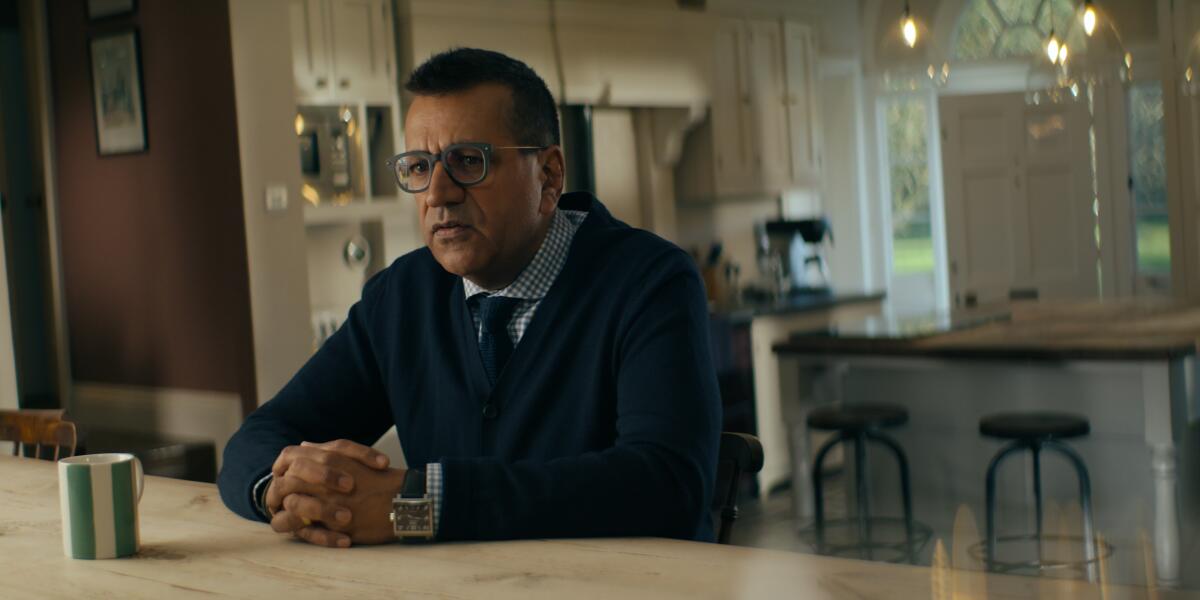
A man in glasses sits at a table counter with a coffee cup near him.

Martin Bashir in “Michael Jackson: The Verdict.”

(Netflix)

Though the first allegations of child molestation against Michael Jackson emerged in 1993, it was footage from Bashir’s “Living With Michael Jackson” that ignited public concern about Jackson’s relationship with Gavin.

In a pivotal scene from the 2003 documentary, Jackson brings Gavin in as an example of a child with cancer that he helped. Gavin, 13 at the time, leans his head on Jackson’s shoulder and holds his hand. Jackson tells Bashir that the two often share a bed at the Neverland Ranch, though in another scene he stresses that it’s not sexual.

“I realized that we had something that was hugely significant, but I didn’t realize the extent of the bombshell until the broadcast,” Bashir recalled in “The Verdict.”

“You can see it. You can look at that moment in the Martin Bashir documentary and you can actually pin the end of his life to that very moment,” J. Randy Taraborrelli, Jackson’s childhood friend and biographer, said in the docuseries.

Given Jackson’s stardom, news and tabloid media swarmed the scene of the trial along with droves of dedicated fans (and a much smaller contingent of detractors). And the archival footage from “The Verdict” shows the extent to which fandom and media frenzy influenced the proceedings.

Jackson’s fans stationed themselves throughout the route he’d take to the Santa Maria courthouse with signs showing their support, sometimes standing and shouting and other times driving alongside him and honking. Jackson had his director of security, Kerry Anderson, film these drives while he waved and engaged with supporters.

As many as 1,000 fans showed up on the first day of the trial, and many would line up starting at 5 a.m. for raffle tickets that would allow them to enter the courtroom. One fan interviewed for the docuseries, Sheree Wilkins, said she quit her job as a preschool teacher to move to Santa Maria for the trial. When the “not guilty” verdicts were announced, she fainted and had to receive medical attention.

TV news stations from around the world, including Taiwan, Japan and Mexico, sent crews to cover the trial.

Even inside the courtroom, where cameras were not allowed, enthusiasm for Jackson’s music could not be contained. Attendees recalled everybody, from the jury to the judge and even the prosecution, “swaying in their seats” when songs played as part of an evidence display.

“I remember me moving in time to his music,” prosecutor Ron Zonen said. “At one point Tom [Sneddon, the District Attorney leading the prosecution] jabbed me and said, ‘Would you stop moving your foot?’ ”

Jackson’s mental and physical health deteriorated

A man with a dark blazer sits with his hands clasped.

Mark Geragos briefly served as Jackson’s defense attorney.

(Netflix)

According to numerous interviews in “The Verdict,” Jackson’s substance use was problematic before and during the trial.

Jackson was not at Neverland during the raid that predated his charges. According to journalist Dimond, her sources said he was in Las Vegas “having wild parties.”

“There were cigarette burns in the leather couches and chairs. There were empty liquor bottles on every table. And this is where Michael Jackson had been for several days, entertaining young teenage boys, who all spoke German,” she said.

Later, Jackson’s well-publicized physical pain became the catalyst for controversy when he was hospitalized overnight, where he was allegedly given enough pain medication “to tranquilize an elephant,” and failed to show up on time for court the next day. The judge threatened to issue a warrant for his arrest if he didn’t make it to the courthouse within the hour, leading Jackson’s team to speed there at 90 mph.

Throughout the trial, stress took an enormous toll on Jackson, defense attorney Mark Geragos said in the docuseries.

“I watched him just disintegrate, literally disintegrate. The ingestion of substances was just astronomical. There was a time when I actually saw him in the fetal position on the floor, and I thought, ‘What do we do?’ I mean, you don’t want his death to be on your hands because you took some inaction,” he said. “We had genuine concerns whether he could even withstand a trial — physically, mentally.”

The prosecution’s case fell apart at the hands of key witnesses

“The Verdict” lays out, step by step, how the trial ended in Jackson’s full acquittal. One major contributor, the docuseries seems to argue, is the downfall of the prosecution at the hands of its own witnesses.

Defense attorney Tom Mesereau was an expert at discrediting witnesses, subjects told the filmmakers, but certain key witnesses, like Janet Arvizo, struggled to connect with the jury on their own.

“I called her Janet from another planet,” admitted juror Melissa Herard. “Sorry, but that’s just how she acted.”

Jackson’s ex-wife Debbie Rowe was meant to take the stand as a smoking gun for the prosecution but instead revealed no new information and came to Jackson’s defense.

The prosecution also partially hinged its case on past allegations of child sexual abuse against Jackson, but conflicting testimony caused these efforts to backfire. A former Neverland employee claimed to witness Jackson molest Wade Robson when he was a child, but Robson took the stand and denied anything happened.

“It’s hard to convince a jury when the subject of the act itself said it didn’t happen,” Zonen said.

In 2013, Robson reversed his stance and filed a lawsuit against the Jackson estate alleging sexual abuse. His allegations, along with those of James Safechuck, were the subject of the 2019 documentary “Leaving Neverland.”

Source link

A son makes his ailing mother proud on and off the field

Kaden Tennyson is a high school senior who works at an ice cream shop to make a few bucks to help pay for Uber drives and a veterinarian bill for his injured dog. He’s also a shotputter and discus thrower at Riverside Notre Dame.

He was suffering from a strained tendon in his right ankle resting at home when his ice cream manager called with a request for assistance.

“It was insanely busy,” said Tennyson, who is 6 feet 6 and 300 pounds. “I took an Advil and served birthday cake, brownie, chocolate fudge.”

There was no way Tennyson wouldn’t answer the call for duty.

“It’s my first job as a teenager,” he said. “It’s good for job experience.”

Tennyson never made it to the Southern Section track preliminaries after winning the league title.

“Every throw, it hurt badly,” he said. “I wanted to push through it.”

He made the decision to protect his future, so he passed on a chance to compete at Saturday’s Southern Section track championships.

He’s enjoyed much success in high school, on and off the playing field. He was back-to-back Skyline League champion. His best efforts were 51-10 in the shotput and 145-7 in the discus. He was admitted to 19 colleges. He was recognized by the Riverside Hall of Fame as a top scholar-athlete. He’s a two-time Principal’s Honor Roll recipient.

And yet, all that pales in comparison to what he has been forced to endure while his mother, Janet, twice battled cancer, affecting everyone emotionally and financially.

“As a mother, it’s been humbling to watch the kind of young man he has become through adversity,” Janet said in a letter she wrote honoring her son.

Fighting cancer is exhausting for everyone involved.

“We didn’t a spend a lot of time together, “ Kaden said. “She was mainly asleep. I wanted to be strong at home and not cry to make her sad. My friends helped a lot.”

Some of the senior activities Kaden hoped to participate in were lost for financial reasons, like going to the prom with his girlfriend.

He’s focused on the future.

“One of my dreams is to raise my own successful family,” he said. “In order to do that, you need to be successful yourself.”

He’ll take his 3.8 grade-point average and giant body to study buisness and compete in track and field at UC Irvine.

His mother is recovering. He intends to walk at graduation on June 5.

His mother says, “Kaden’s journey reflects resilience, family, perseverance and the reality that the effects of a serious illness don’t end when treatment does.”

Kaden’s smile continues. Maybe it’s because he works at an ice cream shop.

Asked he if he gets to sample the products, he said, “Sometimes.”

That’s a happy ending on any day.

Source link

Maine Gov. Janet Mills vetoes bill pausing AI data center development

Maine Gov. Janet Mills on Friday vetoed a bill that would have paused construction of artificial intelligence data centers in the state because lawmakers in the Maine legislature refused a carve-out to the pause for an already in progress project there. File Photo CJ Gunther/EPA

April 24 (UPI) — Maine Gov. Janet Mills on Friday vetoed a bill that would have paused artificial intelligence data center construction in the state for 18 months.

Mills said she decided to veto it because it would have potentially harmed a permitted and in progress data center expected to create hundreds of jobs, both for construction and once the center opens.

The project, a $550 million data center in Jay, Maine, is a multi-year effort to redevelop the former Androscoggin Mill, which was damaged in a 2020 boiler explosion and then closed in 2023, took with it hundreds of jobs and 22% of the town’s tax revenue.

The bill would have been the first in the country restricting or slowing the spread of large-scale data centers required for power-hungry AI systems, which have driven up the cost of both electricity and water for residents living near them, NBC News and Politico reported.

“A moratorium is appropriate given the impacts of massive data centers in other states on the environment and electricity rates,” Mills said in a press release.

“But the final version of this bill fails to allow for a specific project in the Town of Jay that enjoys strong local support from its host community and region,” she said.

There are more than 5,000 data centers in the United States — more than any country in the world — and that number has grown significantly in the last four years as artificial intelligence has become a focus the tech industry.

While many state and local leaders have started to respond to concerns among residents about the huge amounts of electricity needed to power AI data centers and the huge amounts of water needed to keep them cool, as have some members of Congress.

As states have contemplated increased regulation and scrutiny from tech and AI companies, President Donald Trump at the same time has worked to keep the cuffs of tech companies because they “must be free to innovate without cumbersome regulation,” he said in December.

“Excessive state regulation thwarts this imperative,” Trump said in an executive order meant to prevent states from creating new regulations.

Mills said she worked with Maine’s legislature to carve out an exemption for the data center in Jay but was unsuccessful, so she vetoed the law.

The development in Jay, she said, is under contract and permitted, and is expected to create 800 construction jobs, more than 100 high-paying permanent jobs and “substantial tax revenue” for the Town of Jay.

In a letter informing the legislature that she planned to veto the bill, Mills said she plans to issue an executive order to establish a council to study the impacts — real and potential — of data centers in Maine.

“I believe it necessary and important to examine and plan for the potential impacts of large-scale data centers in Maine, as the use of artificial intelligence becomes more widespread,” Mills said.

“Given the serious conversations about data centers here and around the country, I believe this work should commence without delay,” she told legislators.

President Donald Trump speaks during a Health Care Affordability event in the Oval Office at the White House on Thursday. Trump announced announced a new drug price deal with Regeneron. Photo by Will Oliver/UPI | License Photo

Source link

Janet and Paris Jackson skipped the ‘Michael’ premiere

Michael Jackson’s famous clan stepped out to celebrate the premiere of the new “Michael” biopic, but some of the Jacksons snubbed the event and have opposed the film.

On Monday at the Dolby Theatre in Hollywood, several members of the Jackson family gushed about the Antoine Fuqua-helmed film, which depicts the origin story of the King of Pop and follows the hitmaker from childhood through his upward trajectory to superstar status in the 1980s.

Michael Jackson’s nephew Jaafar Jackson, son of Jermaine Jackson, starred in the title role, and his aunts and uncles dropped accolades for his performance in red carpet interviews. Marlon Jackson said, “Watching the movie, sometimes we think we’re watching Michael up there, that’s how good he is.”

La Toya Jackson called his performance “absolutely excellent” and echoed Marlon, saying that she forgot she was watching Jaafar: “I thought I was watching my brother.”

But not all of the Jacksons were up for celebrating the film. Most notably absent were the “Beat It” singer’s pop star sister, Janet Jackson, and his daughter, Paris Jackson. The eldest of the siblings, Rebbie Jackson, also skipped the event. And although the film includes portrayals of many of the Jackson siblings, some also asked to be left out of the biopic, including Janet.

“I wish everybody was in the movie,” La Toya Jackson told Variety at the premiere. “She was asked and she kindly declined, so you have to respect her wishes.”

Last month, rumors began to swirl that the “All for You” singer attended a family screening of the film and wasn’t pleased. Page Six reported that Janet and Jermaine got into a spat, with Janet critiquing almost every scene.

At Monday’s premiere, “Entertainment Tonight” asked La Toya about the controversy, which she was quick to shut down. “There was absolutely no problem whatsoever, none whatsoever,” she said. “Please believe it.”

Although both of Michael Jackson’s sons, Prince and Bigi, have supported events for the film (Prince attended Monday’s premiere, and Bigi attended a Berlin premiere last week), and Prince served as an executive producer and was regularly on set, Paris Jackson has been vocal about her lack of involvement.

Last year, she posted on social media that she gave feedback on an early draft of the film, but her notes weren’t addressed. “I’ve left it alone,” she said. “It’s not my project, they’re going to make whatever they’re going to make.”

Paris Jackson, who works in the entertainment industry as a model, actor and musician, said she had stayed quiet about her feelings toward the “sugar-coated” project because she knew many people would be happy with it. “The film panders to a very specific section of my dad’s fandom that still lives in the fantasy,” she said.

“The thing about these biopics is, it’s Hollywood. It’s fantasy land. It’s not real, but it’s sold to you as real,” she continued. “The narrative is being controlled, and there’s a lot of inaccuracy, and there’s a lot of full blown lies, and at the end of the day, that doesn’t really fly with me.”

In earlier drafts of the “Michael” script, plot points included sexual abuse allegations brought by 13-year-old Jordan Chandler in 1993. Reportedly, the Michael Jackson estate became aware of a contract that legally barred the dramatization of the Chandler family and had to scrap parts of the script.

The film was originally set to premiere last year, but the production needed a new ending and weeks of reshoots to make the new iteration of the film work. In the version that hit theaters this week, “Michael” concludes in 1988, with a teaser for a potential Part 2.

Colman Domingo and Nia Long, who portray Michael Jackson’s parents, Joe and Katherine Jackson, appeared on “Today” this week and addressed the elephant in the movie theater.

“The film takes place from the ‘60s to 1988, so it does not go into the first allegations,” Domingo said. “Basically, we center it on the makings of Michael. So it’s an intimate portrait of who Michael is … through his eyes. So that’s what this film is.

“And there’s a possibility of there being a Part 2 that may deal with some other things that happen afterward,” he continued. “This is about the making of Michael, how he was raised, and then how he was trying to find his voice as an artist and be a solo artist.”

Long added that there might be a sequel, “if the price is right.”

Source link