Jair Bolsonaro

Brazilian ex-intelligence chief detained by US immigration authorities | Crime News

Brazilian media reports that Alexandre Ramagem fled the country after being convicted for involvement in a coup plot.

Brazilian media have reported that the country’s former intelligence chief, Alexandre Ramagem, has been detained by immigration authorities in the United States, where he had fled after being convicted in connection with a coup plot on behalf of former right-wing President Jair Bolsonaro.

CNN Brazil reported that Ramagem was arrested by US Immigration and Customs Enforcement (ICE) on Monday, citing Brazilian Federal Police and the Ministry of Justice and Public Security. The Brazilian outlet Globo reported that the arrest took place in Florida.

Recommended Stories

list of 3 itemsend of list

The Brazilian government has sought the extradition of Ramagem, who was sentenced to 16 years in prison for his involvement in efforts to keep Bolsonaro in power after he lost the country’s 2022 election to leftist challenger Luiz Inacio Lula da Silva.

Reports state that Ramagem fled Brazil in September, illegally crossing the border into Guyana before taking a plane to the US.

Globo reported that the Brazilian embassy in Washington, DC filed documentation with the US Department of State seeking his extradition on December 30, 2025.

Paulo Figueiredo, a political ally of Bolsonaro who lives in the US, said the detention was not related to Brazil’s extradition request.

“Ramagem was not arrested, but detained following a police approach in Orlando, initially for a minor traffic infraction and, subsequently, referred to ICE – a common procedure in Florida,” Figueiredo said in a social media post.

He added that Ramagem has a pending asylum application and is optimistic that he will be released “as soon as possible” rather than deported.

Al Jazeera is not able to verify the reason for Ramagem’s arrest by US authorities.

Bolsonaro himself is currently serving a 27-year prison sentence after being convicted in September.

His trial was depicted by Bolsonaro’s allies as a political witch hunt, and sparked the ire of US President Donald Trump, who placed large tariffs on Brazil and called for the trial to be thrown out. Trump later relaxed some of those tariffs following improved relations with President Lula.

Source link

Brazil, United States deepen cooperation to combat organized crime

An aerial photograph of cargo containers in the port of Santos in Sao Paulo, Brazil and the United States have reached an agreement to better track illegal shipments. File Photo by Isaac Fontana/EPA

April 10 (UPI) — The government of Brazil on Friday announced an agreement with the United States to combat transnational crime — a move that will integrate intelligence sharing and joint operations to target organized criminal networks.

The initiative was presented by Brazil’s finance ministry, where Minister Darío Durigan said the agreement between Brazil’s Federal Revenue Service and U.S. Customs and Border Protection will enable the exchange of cargo data, particularly on shipments leaving the United States for Brazil.

The focus will be on intercepting illegal goods, such as weapons and narcotics.

The announcement comes as Washington considers designating Brazil-based criminal groups Primeiro Comando da Capital and Comando Vermelho as terrorist organizations, according to outlet G1 O’Globo.

The effort gained traction after Eduardo Bolsonaro and Flávio Bolsonaro, sons of former President Jair Bolsonaro, urged members of the administration of Donald Trump to take action, The New York Times reported. U.S. officials have not publicly confirmed any such designation.

Brazilian authorities also highlighted the rollout of the DESARMA program, a system designed to allow real-time information sharing when customs officials identify shipments linked to firearms, ammunition, explosives and other sensitive materials.

Officials said the tool enables authorities to trace the origin of illicit goods and map criminal networks involved in the international arms trade.

Recent records show the system has expanded the ability to detect, connect and track illicit weapons flows, with early results already benefiting both countries.

U.S.-provided intelligence has helped uncover sophisticated smuggling methods, including rifle components hidden inside airsoft equipment and drugs concealed in packages labeled as common goods such as pet food sent through postal services.

Over the past 12 months, authorities identified 35 incidents involving the seizure of 1,168 items, weighing about 550 kilograms, primarily shipped from Florida using fraudulent declarations and concealment techniques.

Brazil’s tax revenue secretary, ​Robinson Barreirinhas, said ‌more than 1,100 weapons ​were seized ​over the past 12 ⁠months arriving from ​the United States, ​and that in the first quarter alone, authorities ​have seized more ​than 1.5 tons of ‌drugs.

Brazil’s finance ministry said consolidating this data into a structured database has improved identification of patterns, links between senders and recipients, and recurring trafficking routes. This, in turn, has strengthened information-sharing with U.S. authorities to support enforcement action at the source and dismantle criminal networks.

The ministry added that the cooperation is part of ongoing dialogue between President Luiz Inácio Lula da Silva and Trump, and forms part of a broader bilateral agenda focused on combating transnational organized crime.

Source link

Tight Brazil election raises concerns over U.S. influence, minerals

April 8 (UPI) — Brazil is heading toward a highly competitive presidential election, with a statistical tie between President Luiz Inácio Lula da Silva and Sen. Flávio Bolsonaro, amid concerns over possible U.S. influence and geopolitical tensions tied to critical minerals.

A poll by consulting firm IDEIA, conducted April 3-7 with 1,500 respondents, shows Lula with 45.5% support in a runoff scenario, compared with 45.8% for Bolsonaro, a difference within the 2.5 percentage point margin of error.

The survey points to an open race six months ahead of the October presidential vote.

IDEIA said the electorate remains unstable. About 51.4% of respondents said they could change their vote before the election and the survey introduced an unusual geopolitical dimension. Some 9.1% identified foreign influence as one of the main threats to Brazil’s democracy.

In addition, 52% said elections should be decided exclusively by Brazilians, while 28% said seeking international support is legitimate.

The scenario comes amid rising political tensions over the role of external actors in the campaign, particularly the United States, and Brazil’s strategic position in sectors such as critical minerals.

Tensions intensified after Bolsonaro took part in the Conservative Political Action Conference held in Texas on March 28.

During his speech, Bolsonaro said he expects to win the election but conditioned that outcome on institutional guarantees.

“I will win because it is the will of my people. But for that will to be preserved, we need free and fair elections,” he said in English before a conservative audience.

The senator said these conditions depend on greater transparency in vote counting and protections for free expression on social media.

“This is a major challenge. If our people can express themselves freely on social media and if votes are counted correctly, we will win,” he said.

Bolsonaro also called on the United States and the “free world” to closely monitor Brazil’s electoral process. He urged them to track freedom of expression and apply diplomatic pressure on institutions to ensure “elections based on values of liberty and transparency.”

At the same time, he rejected what he described as foreign interference in past elections, referring to the administration of Joe Biden, while maintaining the need for international oversight.

In that context, the senator presented himself as a political continuation of former President Jair Bolsonaro, describing himself as “Bolsonaro 2.0,” and positioned Brazil as a strategic U.S. ally in countering China.

“Brazil will be the battlefield where the future of the hemisphere will be decided,” he said.

He added that the country could play a key role in reducing U.S. dependence on China for critical minerals, particularly rare earth elements.

“The United States still depends on China for about 70% of its rare earth imports, while China controls about 70% of global mining and more than 90% of processing,” he said.

“Without these components, U.S. technological innovation becomes impossible and the production of advanced military systems falls into the hands of adversaries.”

The remarks drew reactions from the ruling coalition. Rep. Lindbergh Farias of the Workers’ Party said he had asked the Prosecutor General’s Office to assess possible liability by the senator.

Farias said Bolsonaro may have received a “confidential” report and shared it with U.S. authorities, an allegation not supported by public evidence.

“This has a name: betrayal of sovereignty,” he wrote on the social media platform X. “Those who act like this do not defend Brazil. They work against it. Brazilian sovereignty is not negotiable.”

The Prosecutor General’s Office has not said whether it will open an investigation.


Source link

Bolsonaro placed under temporary house arrest after hospital discharge

A supporter of former Brazilian President Jair Bolsonaro poses during a vigil outside DF Star Hospital in Brasilia, Brazil, on Friday. Bolsonaro was discharged after two weeks in the hospital with acute pneumonia and returned home under house arrest, as ordered by the Supreme Court. Photo by Andre Borges/EPA

March 27 (UPI) — Former Brazilian President Jair Bolsonaro was discharged from the hospital Friday and transferred to his residence in Brasilia, where he will serve a 90-day period of house arrest.

The house arrest follows a decision by the Supreme Federal Court that considered his health condition, his personal physician told local media.

Bolsonaro, 71, had been hospitalized March 13 with bronchopneumonia after presenting high fever, low oxygen saturation and chills while in prison.

His doctor, Brasil Caiado, confirmed that the former president “has just been discharged” and will continue his recovery at home under a “disciplined” treatment.

The ruling came from Justice Alexandre de Moraes, who authorized the former leader to temporarily serve his sentence under house arrest for an initial period of 90 days, starting from his discharge from the hospital, according to reports by Infobae. The provision may be extended and will be reassessed at the end of that period.

According to the medical team, the former president’s right lung “is normal,” while the left still shows some alterations that will be treated with physiotherapy.

Bolsonaro is serving a 27-year prison sentence for his involvement in an attempted coup after losing the 2022 election to current President Luiz Inácio Lula da Silva.

Bolsonaro had previously been serving his sentence under house arrest. However, the court ordered his imprisonment in November at the Federal Police Headquarters in Brasilia due to flight risk after he damaged his electronic ankle monitor with a welding tool.

Caiado said full recovery from severe bilateral pneumonia can take between six weeks and six months, and did not rule out possible complications such as pulmonary fibrosis.

Bolsonaro’s family made adjustments to his home to facilitate his recovery, including installing a special bed to treat reflux issues and episodes of hiccups.

The doctor described the judicial decision as a “sensible decision” and said the home environment offers better conditions to prevent relapses than a prison facility.

The Supreme Court had previously rejected similar requests from the defense, but in this case determined that the former president’s health condition “requires constant and careful attention,” in line with the recommendation of prosecutors.

House arrest imposes a series of restrictions on Bolsonaro, according to the digital outlet G1. The former president must wear an electronic ankle monitor at all times. He is prohibited from using smartphones, computers or any other means of communication, including through third parties.

He is also fully barred from publishing or recording videos or audio. This is particularly relevant, as polls show a technical tie in a potential runoff between his son Flavio Bolsonaro and President Luiz Inacio Lula da Silva in the October elections.

Source link

Brazil’s Bolsonaro hospitalized with bacterial pneumonia

The son of former Brazilian President Jair Bolsonaro, Sen. Flavio Bolsonaro, reacts outside the hospital where his father was taken in Brasilia, Brazil, on Friday. Jair Bolsonaro, has been imprisoned in a Brasilia penitentiary after being sentenced to 27 years in prison for his role in a coup attempt. Photo by Andre Borges/EPA

March 13 (UPI) — Former Brazilian President Jair Bolsonaro was hospitalized Friday in Brasilia after doctors diagnosed a bacterial lung infection, authorities said, marking the latest health episode for the 70-year-old who is currently serving a prison sentence.

Bolsonaro was admitted to the DF Star hospital with fever, vomiting and low oxygen levels. Doctors later confirmed a case of bacterial pneumonia and began treatment with intravenous antibiotics while keeping him under medical observation.

The former president was transferred to the hospital from detention. Since January, he has been held in the officers’ wing of the 19th Military Police Battalion, known as “Papudinha,” in Brasilia, where he is serving a sentence of 27 years, three months in prison for an attempted coup.

Health issues have been a recurring concern for Bolsonaro since a 2018 assassination attempt during a campaign rally in the southeastern city of Juiz de Fora, where he was stabbed in the abdomen.

The attack caused severe internal injuries and required emergency surgery, forcing him to spend weeks recovering in hospital while continuing his presidential campaign.

Since then, Bolsonaro has undergone several abdominal procedures and has been hospitalized numerous times for intestinal obstructions, infections, hernia repairs and other chronic health problems. Doctors said Friday his condition is stable and that doctors continue to monitor the infection.

Source link

Trump adviser banned by Lula from visiting Brazil

March 13 (UPI) — A State Department official was barred Friday from going to Brazil because of a proposed visit to jailed former Brazilian President Jair Bolsonaro, who is in prison for plotting a coup four years ago.

The official, Darren Beattie, was approved for a visa to attend a critical minerals summit next week, but his visa was pulled because the meeting with Bolsonaro was determined to be outside his diplomatic authorization, Brazil’s Supreme Court ruled Thursday, Bloomberg and The Guardian reported.

After the ruling, current Brazilian President Luiz Inacio Lula da Silva ordered his government to revoke Beattie’s visa entirely, at least partially because U.S. President Donald Trump denied Brazilian health minister Alexandre Padilha a visa and revoked visas held by his wife and daughter.

“That American guy who said he was coming here to visit Bolsonaro, he’s been barred from visiting and I have forbidden him from to Brazil so long as they don’t free up the visa of my health minister, which has been blocked,” Lula said Friday.

Bolsonaro is serving a 27-year prison sentence after he was convicted for plotting a coup after losing the 2022 election to Lula.

The charges were based on Bolsonaro’s supporters storming government buildings in January 2023 — a plan that had started in 2021, before the 2022 election — in an effort to prevent Lula from taking office.

Brazilian Foreign Minister Mauro Vieira said that although Beattie’s visa application included the minerals summit and meetings with other Brazilian officials, he only asked for the other meetings after asking for the Bolsonaro visit.

Trump and many within his administration, including Beattie, have been critical of the Brazilian Supreme Court and the country’s officials for jailing Bolsonaro on the coup charges.

“It should be noted that a visit by a foreign state official to a former president in an election year may constitute undue interference in the internal affairs of the Brazilian state, Vieira told the Supreme Court.

Lula and Flavio Bolsonaro, who is the son of the former president, are currently locked in a close race for Brazil’s presidency after a poll found them tied for the first time with 41% of participants, which would lead to a runoff election.

The Brazilian presidential election is scheduled for Oct. 4, and a runoff would be Oct. 25.

President Donald Trump speaks during an event celebrating Women’s History Month in the East Room of the White House on Thursday. Photo by Bonnie Cash/UPI | License Photo

Source link

Brazil pulls visa of Trump adviser who asked to visit Bolsonaro in prison | Politics News

Brazilian President Luiz Inacio Lula da Silva says Darren Beattie was ‘prohibited from visiting’ Bolsonaro in prison.

The government of Brazil has revoked the visa of Darren Beattie, a far-right adviser to United States President Donald Trump who had planned to visit ex-President Jair Bolsonaro in his prison cell in Brasilia.

Brazilian President Luiz Inacio Lula da Silva confirmed on Friday that Beattie’s visa has been pulled. He equated it to the US pulling visas from Brazilian officials in Washington, DC.

Recommended Stories

list of 3 itemsend of list

Among them was Brazilian Health Minister Alexandre Padilha, whose US visa was revoked last year.

“That American guy who said he was coming here to visit Jair Bolsonaro was prohibited from visiting, and I forbade him from coming to Brazil until they release the visa for my health minister,” Lula said during an event in Rio de Janeiro.

Separately, Brazilian officials told news services, including the AFP, that Beattie had lied about the purpose of the visit on his visa request.

Bolsonaro is a far-right ally of President Trump, and he is currently serving a 27-year sentence for his role in a coup plot after Brazil’s 2022 election.

Friday’s decision shows the continued tension between the Brazilian and US governments, even as Trump and Lula have enjoyed warming relations.

Last August, Trump placed Brazil under heavy tariffs — some of the highest in the world — in protest against Bolsonaro’s prosecution. He demanded that the country’s legal system drop the case against Bolsonaro and accused Brazil of persecuting right-wing voices.

After Trump met Lula at the United Nations General Assembly in September and again at a summit for the Association of Southeast Asian Nations (ASEAN) in October, relations between the two leaders improved.

Lula also reached out by telephone in October in a bid to ease the cumulative 50-percent tariffs on certain Brazilian products. On November 20, Trump responded by issuing an executive order “modifying the scope of tariffs” on Brazilian exports like beef and coffee.

But speculation has remained high that Trump could again intervene in the country’s domestic politics to boost the prospects of the Brazilian right.

Brazil is set to hold a new presidential election in October, where Lula is facing off against Bolsonaro’s eldest son, Flavio.

Lawyers for the imprisoned Bolsonaro had asked the Brazilian Supreme Court to approve a visitation request from Beattie this week, but the court rejected that request on Thursday.

Beattie, a strong critic of Lula’s government, was fired during Trump’s first term in office following reports that he had attended a white nationalist conference.

Bolsonaro, meanwhile, was placed in intensive care on Friday, with hospital officials saying the 70-year-old had a “high fever, a drop in oxygen saturation, sweating and chills” linked to pneumonia.

Source link

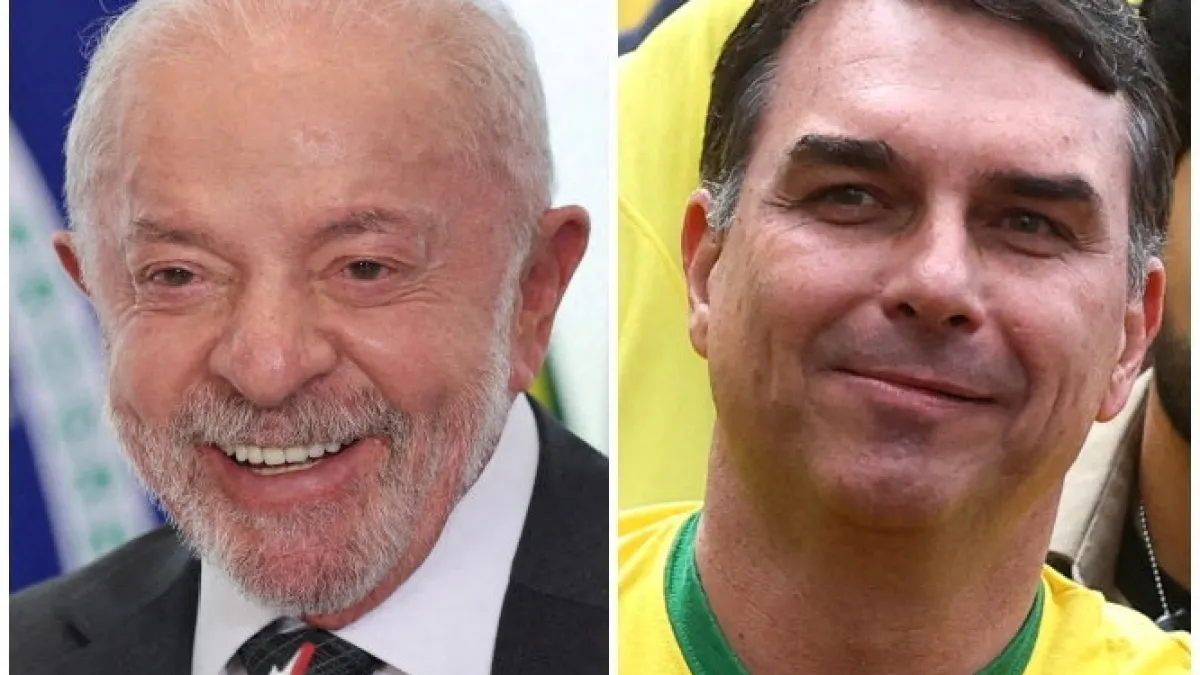
Lula, Flávio Bolsonaro tied in Brazil presidential runoff poll

Brazilian President Luiz Inácio Lula da Silva (pictured) and right-wing Sen. Flávio Bolsonaro are each polling 41% in a potential runoff election. Photo by Sebastiao Moreira/EPA

March 12 (UPI) — Brazilian President Luiz Inácio Lula da Silva and right-wing Sen. Flávio Bolsonaro are tied for the first time for a potential runoff after the Oct. 4 presidential election, according to a poll released Wednesday. A runoff would be Oct. 25.

The survey found each candidate with 41% support in a hypothetical second round.

Bolsonaro, a member of the Liberal Party and son of former President Jair Bolsonaro, leads among voters who identify as independent, a shift that could give him an edge.

Among independents, Bolsonaro gained 6 percentage points and would lead Lula 32% to 27% in a runoff scenario. Another 36% said they would not vote and 5% were undecided.

The gap between the two candidates has narrowed steadily, from 10 points in December to seven in January, five in February and zero in March, according to the survey conducted by polling firm Quaest and commissioned by Genial Investimentos.

Similar trends have appeared in other recent polls. A Datafolha survey published Saturday showed Lula with 46% support compared with 43% for Bolsonaro.

Quaest tested first- and second-round scenarios with eight potential candidates. In first-round simulations, Lula leads in two scenarios and is statistically tied with Bolsonaro in five others. Lula’s support ranges between 36% and 39%, while Bolsonaro’s support ranges between 30% and 35%.

Felipe Nunes, Quaest’s director, said Bolsonaro’s gradual rise began after his father publicly named him as a potential candidate in December.

“Flávio has managed to consolidate Bolsonaro’s electorate. He has grown among right-wing voters and improved his performance among independent voters,” Nunes said, according to news website O Globo.

The poll also showed worsening public assessments of the government and the economy.

Both Lula and Bolsonaro face high rejection rates, with 56% of respondents saying they would not vote for Lula and 55% saying the same about Bolsonaro.

“The shift over time is striking. In December, Lula had much greater potential and lower rejection. Now, both have similar levels,” Nunes said.

The survey found 48% of Brazilians believe the economy has worsened over the past 12 months, while 24% say it has improved. In February, negative perceptions stood at 43%.

Source link