jails

Bad optics? Israel jails soldiers who smashed Jesus statue in Lebanon | Israel attacks Lebanon News

Footage of an Israeli soldier attacking a Christian statue depicting the crucifixion of Jesus in southern Lebanon with a sledgehammer was difficult for Israel’s political establishment to ignore. The country has long tried to frame itself as a defender of Christians, and is allied with the powerful Christian Zionist movement in the United States.

But as Israel continues to lose support in the US and the West for its genocidal war in Gaza and attacks in Lebanon and Iran, support among Christians has also dipped – even before the video of the desecration of the Christian statue surfaced.

Recommended Stories

list of 3 itemsend of list

Responding to the footage on Monday, a day after it first went viral, Israeli Prime Minister Benjamin Netanyahu pushed his regularly repeated line that Israel respects all religions, even as critics point out that his government regularly does the opposite.

But, with even some of Israel’s supporters voicing anger at the soldier’s actions, Israel announced on Tuesday that he had been jailed for 30 days, along with another soldier who had been filming him. Six other soldiers have been summoned for questioning.

The decision to pursue action against the two soldiers stands out because it is in marked contrast to Israeli military investigations conducted into violations by soldiers, which overwhelmingly find them not to have been at fault. In fact, no Israeli soldier has been charged with killing a Palestinian this decade, despite the thousands killed even outside of the Gaza war context, including the 2022 killing of Al Jazeera’s correspondent in the occupied West Bank, Shireen Abu Akleh, who was herself a Christian.

Yossi Mekelberg, a senior consulting fellow with Chatham House, noted that it was important for the Israeli government to ensure that its response to the attack on the statue of Jesus was visible, particularly in light of the important role Christian supporters of Israel – including the US ambassador to Israel, Mike Huckabee – play in the administration of US President Donald Trump.

Those supporters frequently justify their support for Israel by relying on Christian Zionist interpretations of the Bible, and emphasising a “Judeo-Christian” value system and shared cultural heritage.

But official Israeli action in this case makes inaction in other cases more glaring.

“This [attack on the statue of Jesus], and the attacks upon mosques by settlers and the killing of Palestinians are all war crimes,” Mekelberg said. “The problem is that we don’t know how widespread it is. We only know about this one because they filmed it.”

History of violence

Through much of the conflicts in Gaza and Lebanon, observers and analysts have pointed to the stark difference in Israeli government responses to attacks on Christian symbols and places of worship and what has been the large-scale destruction of Islamic sites.

In March, Netanyahu found himself having to explain the decision to block the passage of Cardinal Pierbattista Pizzaballa, the Latin patriarch of Jerusalem, from entering the Church of the Holy Sepulchre to mark Palm Sunday, one of the holiest days of the Christian calendar. Before the end of the same day, Netanyahu had posted to social media, explaining that there had been “no malicious intent whatsoever, only concern for his safety”.

Last July, Netanyahu again found himself apologising for a strike on a third church in Gaza following pressure from the Trump administration, when three of the hundreds of people sheltering there were killed and several others injured, including the parish priest who regularly spoke to the late Pope Francis.

In a statement issued through his office, the Israeli prime minister claimed he deeply regretted the strike on the church, which he said was an accident.

“Every innocent life lost is a tragedy. We share the grief of the families and the faithful,” he said, without referencing the almost 60,000 men, women and Palestinian children his forces had killed by that point in the war.

Throughout the war, Israel’s defenders have emphasised the concept of Judeo-Christian values in an effort to justify Israel’s attacks and its repeated breaking of international law. But evidence of a shared civilisational bond is thrown into question by attacks on Christian symbolism, such as in Lebanon, and by Israel’s long-standing treatment of Palestinian Christians, who face the same dispossession and occupation as their Muslim neighbours.

“I think a lot of Israel’s defenders in the West like to portray it as being ‘us’, just over there, as if ‘over there’ is some form of dark jungle,” said HA Hellyer, a senior fellow at the Center for American Progress and senior associate fellow at the Royal United Service Institute.

“So, they can make excuses for Israelis killing Arabs in their thousands,” Hellyer said. “They can even make excuses for them killing Christians. But when you see Israeli soldiers destroying Christian symbols, it becomes much harder to defend those actions and to stem the growing trend of US supporters, both Democrat and Republican, moving away from Israel.”

What’s next for Israel’s relationship with Christians?

While the Israeli government has been keen to preserve evidence of the Judeo-Christian bond, complaints of harassment by Christian groups within Israel are growing, particularly with the increase in strength of the Israeli far right, including in government.

In 2025, the interreligious Rossing Center for Education and Dialogue recorded 155 incidents targeting Christians in Israel, a marked increase from the previous year. While physical assaults were the most common, comprising 39 percent of incidents, there were also accounts of spitting, hitting, and pepper-spraying.

Christian holidays, specifically those around the time of Easter, have become particular sources of tension, the report noted, with priests and nuns wearing visible Christian clothing in West Jerusalem and occupied East Jerusalem facing the risk of harassment every time they enter public spaces.

“We’ve entered a period of what [Australian genocide studies scholar] Dirk Moses called ‘permanent security’, where anything different, anything that might be a threat, or could even be a threat in the future, has to be destroyed,“ prominent Israeli sociologist Yehouda Shenhav-Shahrabani told Al Jazeera.

That difference is inherent to the Christian faith.

“It’s not about left or right,” Shenhav-Shahrabani explained. “It even goes to language. In everyday Hebrew, people refer to Jesus as Yeshu, which is a curse word, rather than Yeshua, which is correct.”

“That’s commonplace. That’s how it’s used in everyday media,” he continued. “If that’s where you begin, it doesn’t matter if it’s stupidity or ignorance, it all leads to the same place.”

Source link

Moroccan court jails rapper who has criticized ties with Israel

A Moroccan court sentenced a rapper known for his criticism of the country’s ties with Israel and accusations of government corruption to eight months in prison, the latest in a string of penalties against young musical artists.

Souhaib Qabli’s songs sharply criticize Morocco’s 2020 decision to normalize ties with Israel in an accord brokered by the first Trump administration. His lyrics also call out problems with public services and restrictions on freedom of speech, grievances also voiced by Morocco’s Gen Z protesters last year.

The judge ruled Thursday that Souhaib Qabli, a 23-year-old rapper, was guilty of insulting a constitutional body, his attorney Mohamed Taifi told the Associated Press. Qabli, who is a member of Al Adl Wal Ihsane, a banned but tolerated Islamist association, was also fined $106.

“The court did not clarify what it meant by a constitutional body. No specific party was identified in the case file, and there are many constitutional institutions,” Taifi said.

The attorney said that his client is appealing the verdict. He also said Qabli was cleared of other charges, including insulting public officials and disseminating false allegations.

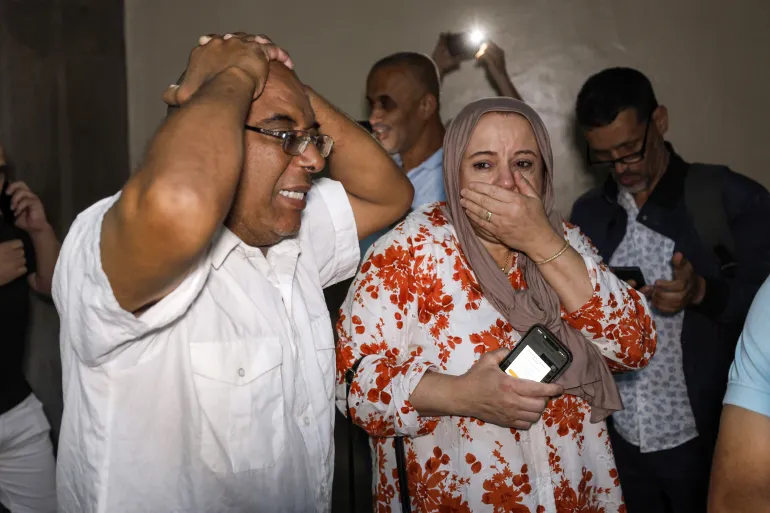
Before the public hearing, dozens of supporters gathered outside the court in Taza, a city in north-central Morocco about 160 miles from the capital, Rabat, holding banners calling for Qabli’s release. Rights groups in the North African kingdom have described the case as a political measure aimed at curbing freedoms.

Qabli, known by the stage name L7assal, was arrested earlier this month and remained in custody until the court delivered its verdict. He was studying refrigeration and air conditioning at a vocational training institute in addition to his music career.

His attorney said that Qabli was questioned in court about his songs and social media posts. Qabli said he had no intent to insult any constitutional body and was expressing his views through his music.

His songs include “No to the Normalization,” referring to Morocco’s decision to normalize ties with Israel in the U.S.-brokered Abraham Accords in 2020, in exchange for Washington’s recognition of Morocco’s claim to the disputed Western Sahara territory.

The move was criticized by Morocco’s pro-Palestinian supporters and sparked large protests in several cities. While authorities allowed the rallies, they have arrested activists who criticized the decision.

Morocco’s constitution generally guarantees freedom of expression, and the country is seen as relatively moderate compared with others in the Middle East. Yet certain types of speech can trigger criminal charges, and Morocco has seen tightening restrictions on dissent, including against journalists and activists.

Source link

Sheriff asks federal agency to review L.A. jails after inmate deaths

Sheriff Robert Luna has asked the National Institute of Corrections to examine conditions and practices at Los Angeles County jails, a request made after 10 inmates died in jail custody in less than three months.

The request comes amid growing concern over conditions inside county lockups. In September, California Atty. Gen. Rob Bonta sued the Sheriff’s Department over what he called “unsafe and unconstitutional conditions at county jails.”

Luna has also faced questions from the Sheriff Civilian Oversight Commission over health conditions, health access, drug use, and other factors that have led to in-custody deaths.

Now, the Sheriff’s Department is asking the National Institute of Corrections to conduct a comprehensive review of county jails in an effort to reduce the number of deaths, Luna told The Times.

“I want someone to come in and review from top to bottom,” Luna said.

Specifics on when the review would begin, and what it would entail, have not yet been set, but Luna said the aim is to get an outside, “unbiased view.”

Officials with the National Institute of Corrections referred questions to the federal Bureau of Prisons, its parent agency, which did not respond to a request for comment.

The National Institute of Corrections provides state, local and federal resources and guidance.

The agency, according to its site, provides “on site technical assistance” to jail administrators, and also helps to identify “gaps in policy and practice.”

The review, Luna said, would entail “everything we’re doing from policy, procedure, facilities, to make sure we’re not missing anything,” Luna said.

Inmate deaths have raised concerns among top sheriff officials and agencies charged with overseeing sheriff operations. The department saw 46 in-custody deaths in 2025, a steep increase from the 32 reported in 2024.

In-custody deaths are reviewed by the Office of Inspector General and the U.S. Department of Justice.

Bonta’s lawsuit against the Sheriff’s Department, filed in September 2025, alleged inmates were being “forced to live in filthy cells with broken and overflowing toilets, infestations of rats and roaches, and no clean water for drinking or bathing.”

In a statement, Bonta’s office alleged that a lack of access to healthcare in the jails, and conditions inside, contributed to a “shocking rate of preventable in-custody deaths, such as suicides.”

In a previous interview, Luna referred to the spate of death at the start of the year as a “kick in the groin.”

Efforts to reduce deaths are challenging partly because the inmate population inside the jails has been increasingly older, and ill, Luna said, with many of them suffering from drug addiction or long-term conditions.

About 82% of those in custody disclosed at least one medical or mental health issue when booked, officials said.

According to department data, half of the 46 inmate deaths recorded in 2025 were listed as natural. Autopsy results to determine the causes of death are still pending in this year’s cases.

Luna has pointed to changes that have already been made as efforts to improve conditions, including deploying body-worn cameras at the Inmate Reception Center, Men’s Central Jail and Twin Towers Correctional Facility.

The department has also opened a remodeled mental health assessment area at the Inmate Reception Center, the primary intake and release point for county inmates near Men’s Central Jail.

Source link