Nina Jacobson on ‘Hunger Games’ and the Hollywood ‘franchise machine’
This week, the newest installment of the dystopian “Hunger Games” franchise hits theaters, vaulting viewers back to the brutal world of Panem with a prequel focused on mentor Haymitch Abernathy.
“The Hunger Games: Sunrise on the Reaping” is the sixth film in the series, which has been helmed from the start by producer Nina Jacobson through her Color Force production company.
The former Walt Disney Co. studio executive launched Color Force in 2007 and, since then, has produced film adaptations of “Diary of a Wimpy Kid,” “The Goldfinch” and 2018’s “Crazy Rich Asians,” among other projects. Based in Los Angeles on the Fox lot, the nine-person company has had a big year so far, with the upcoming “Hunger Games,” as well as the FX limited series “Love Story: John F. Kennedy Jr. & Carolyn Bessette,” which was the most-watched FX limited series on Hulu and Disney+ and received six Emmy nominations.
Jacobson and her co-leader and producing partner Brad Simpson, who joined Color Force as partner in 2012, spoke with me ahead of “The Hunger Games: Sunrise on the Reaping” release about the appeal of the series nearly 15 years after the first film, the current landscape for independent producers and what Hollywood gets wrong about franchises.
This conversation has been edited for clarity and length.
What’s kept your interest in “The Hunger Games” franchise for more than a decade?
Jacobson: Suzanne [Collins] writes books that honestly, when I’m reading them, I can’t put them down, and when I put them down, I can’t stop thinking about them.
They’re rooted in unforgettable characters, and I think that there’s both a defiance that runs through these books, and anger, grief, and yet a deep hopefulness about our capacity to ultimately change corrupt and broken institutions and practices, but without ever glossing over the cost of resistance, the cost and consequences of violence, and how long it might take to actually see a change result from your acts of resistance.
After the original trilogy was done, [director] Francis [Lawrence] and I both thought we were done making the movies. We didn’t have any idea that “The Ballad of Songbirds & Snakes” was going to arrive until we got the phone call from Suzanne.
Franchises often have this inevitability to them, where they are scheduled before they’re actually conceived, let alone executed. We’re not making it on a schedule, not getting the books on a schedule, and just making [movies] if she writes a book, nor do we have any intention to make it if she doesn’t write a book.
Why has “The Hunger Games” resonated with audiences for so long?
Jacobson: Kids have grown up in a world very much reflected in the original trilogy. They’ve grown up in a world that has been at war for most of their lives.
In this one in particular, as Katniss was, these people with the least access and the least opportunity are the ones who don’t set out to be the heroes, but become ultimately activated, radicalized and ready to expand their circle of concern. And I think that the hopefulness and the power of seeing young people actually be agents of change in a very broken world, and this fundamental notion expressed in this movie that all machines can be broken, remains this hopeful and disruptive thematic current that I think speaks deeply to the times that we live in.
How has the industry’s thinking about franchises changed since “The Hunger Games” first came out in 2012?
Jacobson: As an executive at Disney from ’98 to 2006, we had to make somewhere between 20 to 22 movies a year, and of those, maybe two or three might be sequels. Mostly, we had to generate new material. And if something was a hit, we didn’t go out after “The Sixth Sense” and make “The Seventh Sense.” We went and made more M. Night Shyamalan.
I think that the pressure to crank out franchises as opposed to organically grown, audience-desired franchises, has changed in this last period. Especially when somehow, people got the idea that if everything were a franchise, that everybody would go [to the theaters] all the time, which I think is really faulty reasoning.
We just went through this with “Crazy Rich Asians.” If anything we worked on had been asked the most times, “When are you coming out with the sequel?” it was “Crazy Rich Asians.” We tried to work on a theatrical sequel, but we could not crack it, and we ultimately felt like better to make no movie than to make a movie that is not a satisfying sequel to the movie we made because the books are so big and rangy that you have to subtract a lot.
So in this case, television for us was actually very liberating because we have all these characters and all these crazy storylines that had to get boiled down for a theatrical romantic comedy for the first movie, and that’s part of why we were struggling to adapt the second book for film.
I think a lot of sequels get made because people think that they’re going to give you some kind of a guarantee of success. But there is no guarantee of success ever.
Do you see the trend toward franchises changing at all?
Jacobson: This year has been an amazing wake-up call that the issue is not that young people do not want to go to the theater to have communal experiences. The issue is that you need to give them something that they actually want to go see. Newer voices, more novel, innovative, original, fresh material.
But the franchise machine, I don’t know if it’s slowing down.
You had a big year with “Love Story.” What attracted you to that project?
Simpson: One of the things that people always love the most, we discovered, is a classic love story. When Ryan [Murphy] first pitched us doing JFK Jr. … we knew what most people knew, but it was really Elizabeth Beller’s book (“Once Upon a Time: The Captivating Life of Carolyn Bessette-Kennedy”) that cracked it open for us by telling the story of a commoner going into the kingdom and realizing that it fit a lot of classic tropes of love stories, but also we hadn’t seen a love story told that way on television.
What has all the consolidation in Hollywood meant for independent production companies?
Simpson: Consolidation is never good for anybody. It’s better to have more distributors, it’s better to have more buyers.
A lot of times what happens when things become too consolidated, new startup companies come in and find a way into the marketplace. Certainly, A24 has shown and Neon and some of these companies that they could be more nimble and more quick.
I actually think we’re in a very similar point to one of those pivot points, like the 1960s when the studio machines had become sort of lumbering and big, and you needed a lot of revolutionary filmmakers coming in to reset stuff. And I think that’s what’s happening right now, especially in film. You have a lot of movies that would have never made it through the studio system coming out in different ways, and audiences are embracing them.
What are the biggest challenges for independent producers today?
Simpson: There used to be a really robust and flush system where there were lots of studios, and they had producing deals with independent producers. And that’s where young producers went and got trained.
You hear about producers who are young and really want to make it. They’re the people who are going to discover the young voices and believe in things and push them through the system. And they just literally cannot earn a basic living.
Trump still backs the federal incentive
Last week, President Trump took to his social media website to say he was still working with Republican and Democrat co-sponsors of the federal film and TV tax credit proposal, despite the wide losses Republicans took in the midterm elections.
Calling the effort a “very bipartisan undertaking,” Trump said meetings were routinely being set up by leaders of both parties to get the proposal across the finish line during Congress’s lame duck session.
Rep. Laura Friedman (D-Glendale), who is one of the House leaders for this proposal, also urged lawmakers to get the incentive across the finish line.
“When the White House and this many members of both parties agree, there’s no excuse to wait,” she said in a statement Friday after Trump’s social media post. “A national film and TV incentive means jobs in California, Georgia, New York, New Jersey and every state across the country. Let’s get it done.”
A new Bond for a new generation
The internet lighted up Monday morning, as Amazon MGM Studios announced that “The Batman” and “The Odyssey” star Robert Pattinson would be the new James Bond.
Unlike past 007s, who were largely less known before they stepped into the superspy’s shoes, Pattinson comes with a lengthy film resume that includes several franchises (“Harry Potter,” “Dune” and “The Twilight Saga,” to name a few), as well as a popularity with younger moviegoers.
In addition to his blockbuster fare, Pattinson also starred in A24’s “The Drama” and “Primetime” this year, two films that resonated with Gen Z.
“By going for him in particular, I think they’re trying to create a bond that caters to fans that maybe first experienced Bond with Daniel Craig and maybe aren’t necessarily the 50-plus crowd that have grown up with Bond closer to its origins,” Brandon Katz, director of insights and content strategy at Greenlight Analytics, told me.
Stuff We Wrote
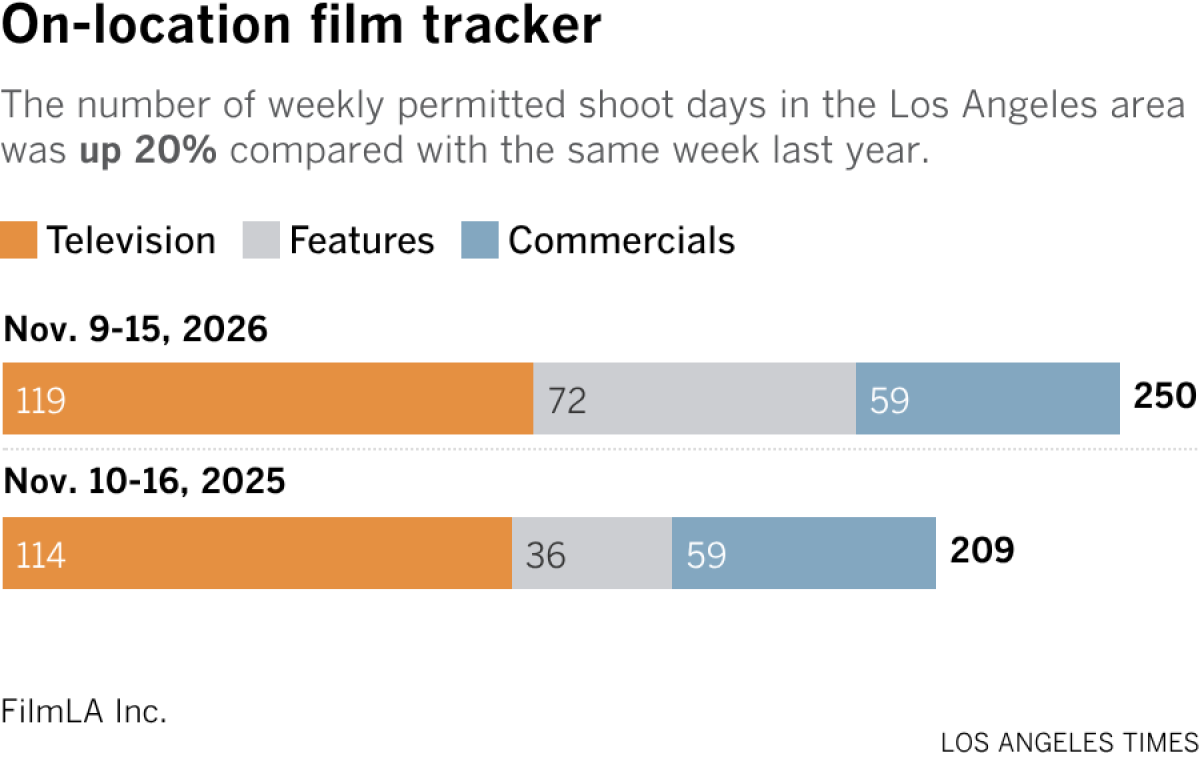
Film shoots

Number of the week

The domestic box office now stands at $8.76 billion as of Sunday, according to Rentrak data.
That’s a nearly 21% jump compared with the same time period last year, when the box office in the U.S. and Canada was about $7.26 billion. And with several big titles still to come, including Disney and Marvel Studios’ “Avengers: Doomsday” and Skydance-owned Warner Bros. Pictures and Legendary Entertainment’s “Dune: Part Three,” analysts expect that total could rise to $10 billion by year-end.
What I’m watching
This week, I watched the first episode of the new season of Amazon MGM’s “The Rings of Power.” It’s a show I haven’t always kept up with, but I love the dwarfs’ storyline so far.