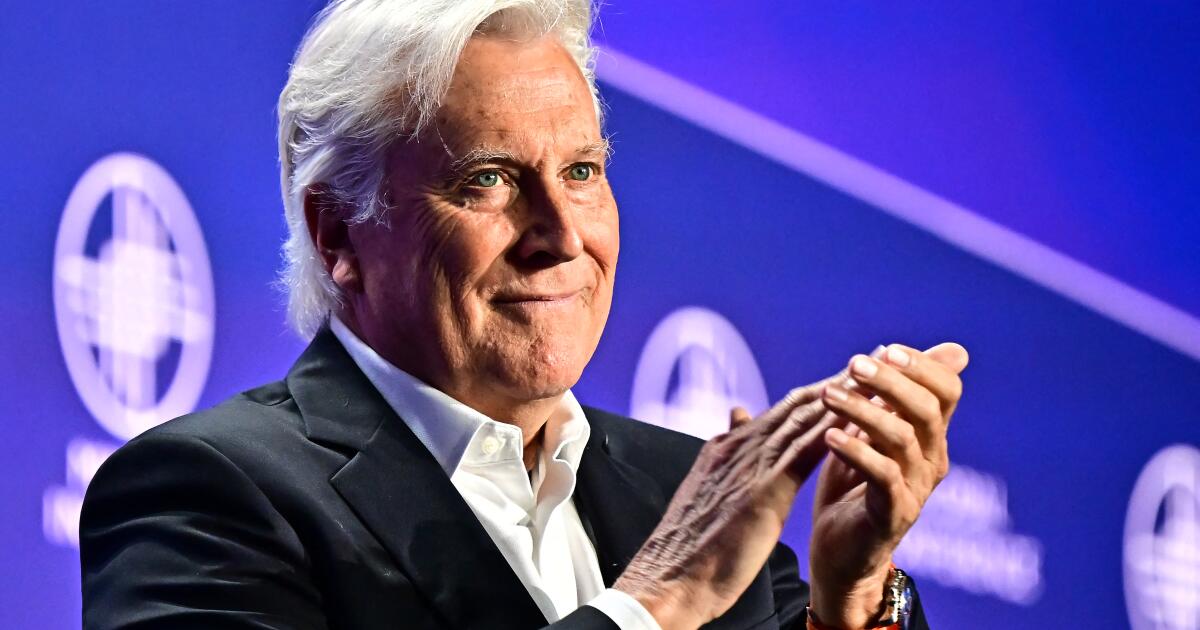
What’s at stake for Dodgers’ owner Mark Walter as authorities probe his businesses
When Mark Walter, the Lakers controlling owner, flipped the storied team last week for $12.5 billion amid a federal probe of his businesses, it stunned the sports world but seemed to make financial and legal sense.
The Dodgers majority owner, who had bought his stake in the basketball team last year at a $10-billion valuation, likely netted a big payday from the sale to former Disney Chief Executive Bob Iger and venture capitalist Joshua Kushner.
And that’s money the billionaire can apply to pay down the debts of two troubled Delaware life insurers he owns that are under federal scrutiny.
It’s not at all clear whether the sale of the Lakers will have any effect on the ongoing investigations. Neither Walter nor his companies have been charged with any crimes.
TWG Global, Walter’s holding company, did not respond to a request for comment Friday, but a spokesperson for the company has previously stated that they are cooperating with authorities and expect the matter to be resolved “favorably.”
“Mark Walter and TWG have always acted in good faith, and those who have done business with Mark know him as honest and straightforward,” the statement said.
After receiving federal grand jury subpoenas in February, Delaware Life and Clear Spring Life and Annuity conducted internal investigations. They found that $21 billion in loans they made should have been recorded as extended to “related parties.”
Related parties have business or personal ties and transactions between them can have legitimate reasons, but they also pose potential conflicts of interest and require disclosure and typically extra regulatory scrutiny.
In the case of insurers, which hold premium dollars from policyholders for future claims payouts, regulators want to ensure the money is there when it’s needed. Related-party transactions can threaten that.
Walter, 66, chief executive of Chicago investment firm Guggenheim Partners, led a group that included another Guggenheim executive and Magic Johnson in acquiring the Dodgers for $2.15 billion in 2012. The Times has reported he tapped the insurers he owned for financing, a deal that was later vetted by state insurance regulators.
However, the amount of related-party loans made by the two affiliated life insurers now under federal scrutiny is vastly more, amounting to 40% of the invested assets of Delaware Life as of Dec. 31, according to Fitch Ratings. The credit rating outfit said that is the most of any North American life insurers it reviews.
It’s unclear exactly where all the money went, but the Wall Street Journal reported billions were passed through a third party before being received by entities tied to Walter or his TWG Global holding company.
Company executives also told Fitch that they were unaware they were making related-party loans. Bloomberg reported that investigators are looking at some loans made to multiple companies affiliated with one Chicago firm to see if they were passed along to Walter’s ventures.
In June regulatory filings that disclosed the $21 billion in restatements, each insurer labeled them as “corrections of errors,” which would imply that they were inadvertent.
Jacob Frenkel, a former U.S. attorney, said it appears clear a focus of the investigation into Walter’s businesses is to determine whether the restatements were just errors.
“If there is intentional concealment of related-party transactions or the creation of intermediaries to help with that concealment, that certainly [could] invite criminal and civil enforcement scrutiny,” said Frenkel, who prosecuted financial crimes and also worked for the Securities and Exchange Commission.
Authorities have seized Walter’s cellphone and laptop, according to Bloomberg. Still, investigations by prosecutors and securities regulators can result in no action.
Frenkel said that if criminality is found in complex investigations such as this one, federal prosecutors will typically file mail or wire fraud charges that carry up to 20 years in prison.
It would not matter whether a company that was the victim of fraudulent conduct closed or is able to continue conducting business after being rescued financially.
“The entity’s failure is not a prerequisite for there to be a crime in intentionally misleading conduct,” he said.
The Securities and Exchange Commission is conducting a parallel investigation into both companies, according to their regulatory filings.
Frenkel said its interest could revolve around how Guggenheim Investments, Walter’s asset management firm, booked revenue from its dealings with the insurers and the disclosures of the transactions.
The SEC can seek civil monetary penalties and the return of illegal profits, and bar or suspend an individual from serving as a corporate officer or director, among other remedies.
Delaware Life and Clear Spring are part of TWG’s Group 1001 Life & Annuity.
Delaware Life has started a remediation plan to restructure some of the loans, review others and address its “control deficiencies,” including through TWG purchasing some of the loans, according to ratings outfit S&P Global. It hopes to complete the plan by the end of the year.
However, Fitch in its downgrade of Delaware Life said the plan may prove “insufficient to fully address governance, reporting, and investment oversight issues.”
The Delaware Department of Insurance did not respond to emails for comment.
Rex Frazier, a former deputy commissioner at the California Department of Insurance, said that in the situation that the insurers find themselves, the state regulator will be looking at a company’s capital sufficiency.
“The change from unaffiliated to affiliated transactions can affect the regulator’s view of whether the insurers have adequate capital and, if the regulator thinks not, then the regulator can impose additional capital requirements,” said Frazier, now president of the Personal Insurance Federation of California, a property and casualty industry trade group.
“If the regulator determines that there is inadequate capital to pay for their obligations … there are many serious remedies they can take to protect vulnerable people depending on those income streams,” he said, including seizing a company or forcing its sale.
There is no indication that either insurer is in such dire straits. Since the disclosures, rating agencies Fitch, AM Best and S&P Global have downgraded the companies’ outlook to negative, but they also have said the insurers maintain a high level of financial strength.
Walter is not the only owner of a life insurer to rely on related-party loans to fund its business dealings.
AM Best, in a December report, said affiliated investments among life insurers and annuity companies grew more than 17% annually in 2024 to more than $373 billion, driven by those owned by private equity and asset managers.
It said the growth of such investments — a type of related-party transactions — presents “regulatory risks” that may suggest “a company’s operations are more intertwined with its parent and affiliated investment management with possible negative consequences.”
“Should the parent/affiliate company experience financial stress, negative impacts to the insurer are heightened due to the higher exposure,” it said.
Frenkel said it’s good to keep in mind that at the end of their investigations, neither the Justice Department nor the SEC may take any action.
However, due to the complexity of the case, it may be a while before that point is even reached.
“This is clearly the type of investigation that the ‘where is this going?’ conversation could easily still be continuing in January of 2028,” he said.