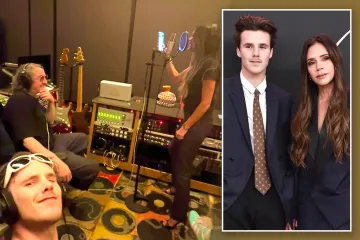
CRUZ Beckham has put on a loved-up display with his girlfriend Jackie Apostel in Florida after his cryptic post amid the family feud with his brother Brooklyn.
The singer, 21, put his recent family dramas to the back of his mind to enjoy some quality time with Jackie, 29.
Sign up for the Showbiz newsletter
Thank you!
Cruz Beckham has put his family dramas aside to enjoy a Florida getaway with girlfriend JackieCredit: InstagramShe took to Instagram to share a sneak peek into their tripCredit: Instagram
She took to Instagram to share a sneak peek into their holiday with two sweet snaps.
In the first photo, she stood in front of a stunning backdrop of palm trees, blue skies and the stunning sea.
Jackie wore a backless black dress as she looked towards the camera for the sexy picture.
In the second photo, Cruz wrapped his arm around his other half as he planted a kiss on her cheek while closing his eyes.
Posting to his Instagram stories, Cruz shared a screenshot from his phone of himself attempting to FaceTime someone, cropping out the contact name.
He cryptically said in the caption of the post: “I never get an answer…”
Cruz then added: “Anyway, new tour vlog is out @itsthebreakers check it, link in story’s“.
The aspiring musician didn’t divulge who never answers his calls, but it could have been a nod to his older brother Brooklyn, who has blocked him on social media.
Cruz is amongst the several family members who have been cut off by Brooklyn and his wife Nicola Peltz.
Until now, the Beckham arm of the family have remained fairly silent on the row, choosing not to respond to Brooklyn’s lengthy statement.
But speaking for the first time on the row, Victoria was asked directly about her eldest son during a new interview with the Wall Street Journal.
It comes after he shared a cryptic post which could have been aimed at his estranged brother BrooklynCredit: Getty
The Spice Girls star said: “I think that we’ve always—we love our children so much.
“We’ve always tried to be the best parents that we can be. And you know, we’ve been in the public eye for more than 30 years right now, and all we’ve ever tried to do is protect our children and love our children.
“And you know, that’s all I really want to say about it.”
Victoria did not refer to Brooklyn by name when asked about the rift but discussed how she had only ever tried to “protect and love our children”.
Brooklyn had previously suggested public image and Brand Beckham was the biggest priority to his mum and dad.
Victoria and David are understood to have been left devastated over the fall out and have even recently offered to meet with Brooklyn and his wife Nicola in the presence of lawyers and therapists in an attempt to rebuild the rift.
But with Brooklyn seemingly standing strong on his statement, the family are still yet to make any movements towards a reconciliation.
Victoria Beckham recently broke her silence on the family feudCredit: GettyBrooklyn and his wife Nicola Peltz have completely cut off his familyCredit: Getty
It seems like a simple ask that male politicians don’t sexually harass or even rape women, but also, it seems like an open secret in Congress that sexual misconduct is too common.
Take Eric Swalwell, whose epic political immolation has captivated this week’s national political news, including a TMZ-obtained video of the then-congressman bleary-eyed in a bathrobe on a yacht that was literally the least-worst revelation.
For years “there were swirling rumors about Eric,” former Rep. Jackie Speier told me. Speier in 2018 thought she’d put in place tough new rules to stop sexual misconduct among her former colleagues, and the type of backroom shrugs that allowed men to prowl unchecked.
But despite her efforts, Speier, who represented a part of the Bay Area near Swalwell’s district until 2023, said the problem remains Congress itself, and the “crippling” power that elected officials have over their staffs. Don’t get her started on how that power imbalance is even worse for young lobbyists.
“I’ve always said that Congress is Hollywood for ugly people,” she said. “It’s a whole environment that becomes, I think, toxic.”
But also one that, she added, isn’t inevitable.
The 2018 change
In 2017, the #MeToo movement had swept into the public consciousness and ignited calls for change.
Armed with that outrage and the roiling fire of public opinion, Speier set out to change archaic rules that governed how sexual misconduct was handled in Congress.
“I’ll just run through what it was like,” she told me. “If you wanted to file a complaint, you had to be prepared to go through some period of counseling; to have a cooling off period; to participate in mandatory mediation; and sign an NDA, and then the taxpayers picked up the tab if there was a settlement. It was kind of jaw dropping to think that that was the policy.”
It wasn’t just policy, it was culture. Speier herself had been the victim of an assault when she was a young staffer — a senior staffer pushing her against a wall and forcibly kissing her. And like so many women, she put the episode aside and went on with her career because speaking out would have likely brought her more grief than justice.
But by 2017, she realized the public was at a “tipping point,” and, as she said then, “Congress has been a breeding ground for a hostile work environment for far too long.”
It did away with the weird and coercive requirement for counseling and a cooling off period and most significantly, forced sexual harassers to pay for their own settlements instead of pinning the cost on taxpayers.
But even with the new rules, some colleagues didn’t seem to get it. Speier recalled one man who, informed of possibility he would have to pay sexual harassment settlements out of his own pocket, asked if he could purchase insurance to cover those costs.
“How about you keep your zipper up?” Speier wondered.
The bigger problem
Still, Speier said she thought the law made a difference not just in how claims of misconduct were handled, but in the culture of Capitol Hill.
But, “over time it just was relaxed,” she said.
When Speier left office in 2023, Rep. George Santos (R-N.Y.) was under investigation for sexual harassment — a claim Congress deemed unfounded, but bounced Santos from its ranks for a bunch of other misconduct.
Let’s be real — Congress has never been without scandal.
But Speier said that doesn’t mean sexual abuse can’t be stopped. She just thinks the rules she put in place need to be even tougher: A zero-tolerance approach similar to what corporate America often enforces.
“I’m thinking now that the way to fix this may be something more direct and straightforward and simple, much like they do in the private sector,” she said.
“When the CEO is having an affair with a subordinate and it becomes known, he’s history. He’s relieved of his duties, and if we made it clear that if you sexually harass a staff member, or you have an affair with a staff member, you will be expelled, or you will be subject to expulsion of Congress, that will change their behavior.”
I love her enthusiasm and I support tossing out miscreant members, but I’m not sure even that will keep the zippers up. But there is always hope.
And something has to be done.
“These cases underscore the fact that these women do not feel comfortable coming forward,” she pointed out. “So we’ve got to figure out why and close that hole.
“Is it because they’re fearful that they’ll be retaliated against or that they’ll be ostracized or blackballed? I don’t know the answer, but I’m really urging my colleagues on both sides of the aisle to fix this, and part of fixing it is talking to these women who were, in fact, sexually harassed and assaulted and find out why they didn’t feel comfortable coming forward.”
That’s the real issue, and the real demand we should be making. From the Oval Office to district offices, too many elected leaders have proven they’ll use their power to obtain sex — by coercion or even force.
And too many women remain afraid to speak out because they still suffer both career and social consequences — a realistic fear that coming forward could end their own ambitions, or at least leave them battling to not be defined by the abuse.
Yes, Swalwell and others have been shamed into resigning.
But it’s past time to make sexual abuse a one-strike-you’re-out offense — for the perpetrator, not the survivor.
You’re reading the L.A. Times Politics newsletter
George Skelton and Michael Wilner cover the insights, legislation, players and politics you need to know. In your inbox Monday and Thursday mornings.
By continuing, you agree to our Terms of Service, which include arbitration and a class action waiver. You agree that we and our third-party vendors may collect and use your information, including through cookies, pixels and similar technologies, for the purposes set forth in our Privacy Policy such as personalizing your experience and ads.
Hi, and welcome to another edition of Dodgers Dugout. My name is Houston Mitchell, and today is a very special day, so it’s time for the annual Jackie Robinson newsletter.
Are you a true-blue fan?
Get our Dodgers Dugout newsletter for insights, news and much more.
By continuing, you agree to our Terms of Service, which include arbitration and a class action waiver. You agree that we and our third-party vendors may collect and use your information, including through cookies, pixels and similar technologies, for the purposes set forth in our Privacy Policy such as personalizing your experience and ads.
On April 15, 1947, Robinson made his major league debut at Brooklyn’s Ebbets Field in front of crowd of 26,623. He walked and scored a run in the Dodgers’ 5–3 victory. Thus began one of the most amazing careers in sports history. Robinson broke the color barrier and faced challenges few major leaguers ever had to endure.
Some players on his team didn’t want to play alongside him, starting a petition saying they would rather not be his teammate. Manager Leo Durocher’s response: “I don’t care if the guy is yellow or Black, or if he has stripes like a … zebra. I’m the manager of this team, and I say he plays. What’s more, I say he can make all of us rich. And if any of you can’t use the money, I will see that you are traded.”
Players on other teams called him every racial insult. Some opposing managers were worse. Fans, some of them little kids parroting what their parents were saying, called him vile names. And Robinson had, and could have, only one response: No response. Give in and lose his temper, then the racists would say “See, his kind aren’t strong enough to play in the majors.” It would be used as leverage to kick him out and keep the majors “pure.” For a good example of what Robinson endured, watch “42” starring the late, great Chadwick Boseman.
So, Robinson took it. But he not only had to take it, he also had to play at a high level to prove Black people could play in the majors. He ran the bases with abandon. He excelled as a fielder no matter where they put him. He led the Dodgers to victory after victory, including their first World Series title in 1955.
And let’s not forget his wife, Rachel, who will turn 104 in July. She was a source of strength for Jackie and underwent verbal abuse and threats herself. She is an amazing woman and deserves full credit for her role in all of this. I think it’s safe to say that Jackie wouldn’t have been the same without her.
Robinson was a standout player at whichever position the Dodgers played him. On the bases, he was a terror. He stole home 19 times in his career, tied with Bobby Bragan for the most since 1920.
Robinson was drafted into the Army in 1942. Stationed at Fort Riley, Kan., he was not allowed to play on the segregated camp baseball team. He was appointed morale officer for the Black troops at Fort Riley and later was re-assigned to Ford Hood, Texas. On July 6, 1944 he refused when a white bus driver told him to move to the back of the bus. The base provost marshal and military police supported the driver, and Robinson was subject to court-martial. He won the hearing and the Army decided to kick him out with an honorable discharge.
In 1945, Robinson joined the Kansas City Monarchs of the Negro American League, which is where Branch Rickey found him and signed him. The rest is history.
After he retired from baseball, Robinson became a leader in the Civil Rights movement. He was hired to serve as a vice president for Chock Full O’Nuts, the first Black man to be named a vice president of a major American company. In 1964, he co-founded Freedom National Bank of Harlem, created to financially help Black communities. In 1970, he founded the Jackie Robinson Construction Company, which built housing for low-income people.
In perhaps the most famous steal of home in history, Jackie Robinson steals home in Game 1 of the 1955 World Series. For the rest of his life, Yankees catcher Yogi Berra said Robinson was out.
(John Rooney / Associated Press)
But let’s go back to his baseball career.
Imagine trying to do your job every day with thousands of people surrounding you, hurling racist taunts. Imagine going on the road and not being able to stay in the same place as your co-workers, but being forced to room with someone across town. Imagine having a wife and child who have to go through the same thing. Imagine a policeman coming into your workplace and threatening to arrest you and shut down your business unless you left, because they don’t appreciate “your kind” in their city. Imagine getting death threats every day in the mail.
Most people would not be able to do what Robinson did. He set the example that players such as Larry Doby of Cleveland, who broke the color barrier in the American League, were able to follow.
It’s sad that sometimes I will hear fans of other teams complain that Robinson’s No. 42 is retired and listed alongside the numbers of the legends from their team, because “he didn’t play for their team.”
Even now, some people try to find flaws that Robinson had to cut him down. What they don’t realize is that pointing out whatever flaws he had doesn’t make him seem less impressive — but even more impressive. It shows he was an imperfect man who performed one of the most perfect human achievements of all time.
But words don’t adequately describe what Jackie Robinson did or what he went through. They can’t. It’s embarrassing to even try.
What’s a good way to celebrate Jackie Robinson Day? Find anyone you know under the age of 18 and make sure they know who Jackie Robinson was and what he did. Don’t let his memory be forgotten. Show them the movie “42.” Give them a book on Robinson. Or sit down and talk to them about him. It’s the best gift you can give them.
In his own words
Some of the best quotes from Jackie Robinson:
“Plenty of times I wanted to haul off when somebody insulted me for the color of my skin, but I had to hold to myself. I knew I was kind of an experiment. The whole thing was bigger than me.”
“A life is not important except in the impact it has on other lives.”
“I’m not concerned with your liking or disliking me. All I ask is that you respect me as a human being.”
“Life is not a spectator sport. If you’re going to spend your whole life in the grandstand just watching what goes on, in my opinion you’re wasting your life.”
“There’s not an American in this country free until every one of us is free.”
“During my life, I have had a few nightmares which happened to me while I was wide awake.”
“I’m grateful for all the breaks and honors and opportunities I’ve had, but I always believe I won’t have it made until the humblest Black kid in the most remote backwoods of America has it made.”
“Many people resented my impatience and honesty, but I never cared about acceptance as much as I cared about respect.”
“Negroes aren’t seeking anything which is not good for the nation as well as ourselves. In order for America to be 100% strong — economically, defensively and morally — we cannot afford the waste of having second- and third-class citizens.”
“Blacks have had to learn to protect themselves by being cynical but not cynical enough to slam the door on potential opportunities. We go through life walking a tightrope to prevent too much disillusionment.”
“It kills me to lose. If I’m a troublemaker, and I don’t think that my temper makes me one, then it’s because I can’t stand losing. That’s the way I am about winning, all I ever wanted to do was finish first.”
Jackie Robinson joins a picket line in Cleveland in 1960 to protest discrimination against Black people at southern lunch counters.
(Associated Press)
“When I am playing baseball, I give it all that I have on the ball field. When the ballgame is over, I certainly don’t take it home. My little girl who is sitting out there wouldn’t know the difference between a third strike and a foul ball.”
“Pop flies, in a sense, are just a diversion for a second baseman. Grounders are his stock trade.”
“I guess you’d call me an independent, since I’ve never identified myself with one party or another in politics. I always decide my vote by taking as careful a look as I can at the actual candidates and issues themselves, no matter what the party label.”
“How you played in yesterday’s game is all that counts.”
“I think if we go back and check our record, the Negro has proven beyond a doubt that we have been more than patient in seeking our rights as American citizens.”
“Baseball is like a poker game. Nobody wants to quit when he’s losing; nobody wants you to quit when you’re ahead.”
“The most luxurious possession, the richest treasure anybody has, is his personal dignity.”
In the words of others
”A credit to baseball and to America.” —Branch Rickey, general manager of the Brooklyn Dodgers
“To do what he did has got to be the most tremendous thing I’ve ever seen in sports.” —Pee Wee Reese, teammate of Jackie Robinson
“The greatest moment in the history of baseball.” —MLB Commissioner Rob Manfred
“He gave the Black community a sense of hope, a sense of pride.” —John Lewis, civil rights leader
”I didn’t know baseball from pingpong. But the point was that he had broken in. I grew inches that day. I puffed out my chest. A Black person had made it against the most tremendous odds.” —Archbishop Desmond Tutu
“Jackie’s character was much more important than his batting average.” —Hank Aaron
”Jackie Robinson made his country and you and me and all of us a shade more free.” —Roger Kahn, author of “The Boys of Summer”
“There’s a direct line between Jackie Robinson and me.” —former President Barack Obama
“He knew he had to do well. He knew that the future of Blacks in baseball depended on it. The pressure was enormous, overwhelming, and unbearable at times. I don’t know how he held up. I know I never could have. He was the greatest competitor I have ever seen.” —Duke Snider, teammate
”There was never a man in the game who could put mind and muscle together quicker than Jackie Robinson.” —Rickey
“After the game, Jackie Robinson came into our clubhouse and shook my hand. He said, ‘You’re a helluva ballplayer and you’ve got a great future.’ I thought that was a classy gesture, one I wasn’t then capable of making. I was a bad loser. What meant even more was what Jackie told the press, ‘Mantle beat us. He was the difference between the two teams. They didn’t miss DiMaggio.’ I have to admit, I became a Jackie Robinson fan on the spot. And when I think of that World Series, his gesture is what comes to mind. Here was a player who had without doubt suffered more abuse and more taunts and more hatred than any player in the history of the game. And he had made a special effort to compliment and encourage a young white kid from Oklahoma.” —Mickey Mantle, on the 1952 World Series
”Jackie, we’ve got no army. There’s virtually nobody on our side. No owner, no umpires, very few newspapermen. And I’m afraid that many fans may be hostile. We’ll be in a tough position. We can win only if we can convince the world that I am doing this because you’re a great ballplayer, and a fine gentleman.” —Rickey
“Every time I look at my pocketbook, I see Jackie Robinson .” —Willie Mays
“Give me five players like Robinson and a pitcher and I’ll beat any nine-man team in baseball.” —former Dodgers manager Chuck Dressen
“He led America by example. He reminded our people of what was right and he reminded them of what was wrong. I think it can be safely said today that Jackie Robinson made the United States a better nation.” —American League president Gene Budig
”Jackie Robinson is the best I’ve seen. Robinson is the perfect blend of ballplayer. He has creativeness and imagination. Every move he makes from the minute he steps onto the field is designed to beat the other club. He’s constantly asking himself, at bat or on the bases, ‘what can I do to beat the other guy?’ That’s the kind of ballplayer that wins pennants.” —Fresco Thompson, assistant farm director for the Dodgers when Robinson played his first game
“If I were in Jackie Robinson’s shoes, I probably never would have made it.” —Hall of Fame pitcher Bob Gibson
”Today we must balance the tears of sorrow with the tears of joy. Mix the bitter with the sweet in death and life. Jackie as a figure in history was a rock in the water, creating concentric circles and ripples of new possibility. He was medicine. He was immunized by God from catching the diseases that he fought. The Lord’s arms of protection enabled him to go through dangers seen and unseen, and he had the capacity to wear glory with grace. Jackie’s body was a temple of God. An instrument of peace. We would watch him disappear into nothingness and stand back as spectators, and watch the suffering from afar. The mercy of God intercepted this process Tuesday and permitted him to steal away home, where referees are out of place, and only the supreme judge of the universe speaks.” —Jesse Jackson, delivering a eulogy for Robinson
Have a comment or something you’d like to see in a future Dodgers newsletter? Email me at houston.mitchell@latimes.com. To get this newsletter in your inbox, click here.
The avian power couple follows her home, keeping her company as she cooks dinner.
“We live in such a busy world, and things are always being thrown at our face, so sometimes it’s nice to just have a gentle reminder of nature and what else is out there in the world,” Wagner told me last week.
You’re reading Boiling Point
The L.A. Times climate team gets you up to speed on climate change, energy and the environment. Sign up to get it in your inbox every week.
She is just one of many devoted fans; the eagles had the highest view count of any year-round nature livestream active on YouTube between last fall and this spring, said Rebecca Mauldin, an assistant professor at the University of Texas at Arlington who studies social connectedness.
While the eagles’ following is singular, it’s part of a broader trend: surging interest in webcams that broadcast nature, unadulterated, minute by minute, in all its messy glory.
The number of 24/7 livestreams created per year swelled by about 3,000% between 2019 and 2025, Mauldin’s data show.
Jackie and Shadow’s livestream exemplifies “Slow TV,” a genre that began with a 2009 Norwegian broadcast of a seven-hour train trip. It took off, with other marathon programs featuring chopping firewood and knitting.
The appeal makes intuitive sense. In a world of quick camera cuts, sound bites and troubling headlines, Mother Nature’s rhythms can be a salve. And with many of us wound up in concrete urbanity, the livestreams offer instant transportation to the wild.
Following Jackie and Shadow takes patience. If they’re not hanging out at the nest, it’s a waiting game until they come back. Even when they’re there, there may not be much going on.
Entertainment “can be very artificial, it can be very packaged, and it can be very short,” said Jenny Voisard, media manager for Friends of Big Bear Valley, the nonprofit that operates the cameras broadcasting the eagles. “This is long and slow and calm.”
Yet nature is unpredictable, another draw for viewers. This nesting season alone has brought plenty of drama, from the lovebirds losing their eggs to ravens to laying more not long after. Last week, I wrote about the couple’s shocking origin — it involves a love triangle! — and their rise to reality stardom.
Last year, Jackie and Shadow raised two chicks that went on to fledge: Sunny and Gizmo
(Friends of Big Bear Valley)
Research backs the vibes. Those who watch nature livestreams — from platypi to osprey — report a host of benefits, from uplifted mood to relaxation, said Mauldin, citing a literature review she-coauthored.
Others get jazzed about learning about a particular species, she said.
There may be limitations, though.
In terms of connecting to nature, “I lean toward the effect is stronger if you’re actually outdoors, or, you know, you’ve got a little ant crawling on your finger and watching it,” Mauldin said.
She highlighted another dimension I didn’t think of: Many “talk about how they’re developing strong online relationships, and you can see it in the chats or in the comments.”
Someone might comment that they had a bad day and are glad to be watching their favorite birds again, and another viewer will rally to support them. Then there are people who watch on their own, but gab about it later with a friend.
Friends of Big Bear Valley, with 1.2 million followers on Facebook, offers more than just updates on the eagles. It’s a buzzing community center where fans can share their thoughts and engage with one another.
Animals may also get something out of being watched: protection.
The eagle cam, for example, “sort of stokes the public’s imagination and interest in conservation,” said Thomas Leeman, deputy chief of the U.S. Fish and Wildlife Service’s migratory bird program in the Pacific Southwest. “They start to really care about whichever particular birds that they’re watching.”
Wagner, of Chicago, said her husband and 14-year-old son sometimes give her a hard time about how invested she is in Jackie and Shadow.
But her cat, Oscar, shares her fascination.
She recently posted a photo of the feline on Jackie and Shadow’s Facebook — looking intently at a TV where an eagle hunkered down on the nest.
“My new cat is just as obsessed as all of us,” she wrote.
More recent wildlife news
Big Bear’s celeb eagles continue to keep us on our toes. Jackie recently vanished from the nest for nearly 24 hours, sending fans into a panic — but eventually reunited with her eggs and mate, reports USA Today’s Michelle Del Rey.
While we’re on the subject of avian kind: Last week, I wrote about a pair of condors that appear to be nesting in Northern California, something not seen for a century. The Yurok Tribe is leading the effort to bring the large, endangered vultures back to their historic homeland in Humboldt and Del Norte counties.
As conservationists celebrate that win, the story for birds nationwide is not so rosy. A recent study found that North America is rapidly losing birds, and the loss is accelerating, largely due to intensive agriculture and warming temperatures, writes the Associated Press’ Seth Borenstein.
A few last things in climate news
Trump’s war on Iran has disrupted global oil and gas supplies. The conflict has kept ships that carry millions of barrels of oil a day stranded in the Persian Gulf, and key Middle East facilities have sustained damage, reports the Associated Press.
Oil prices have spiked, and Californians are paying the highest price at the pump in the nation. As my colleague Iris Kwok explains, that’s due to the state’s higher taxes and stricter requirements for cleaner, more expensive gas that pollutes.
This is the latest edition of Boiling Point, a newsletter about climate change and the environment in the American West. Sign up here to get it in your inbox. And listen to our Boiling Point podcast here.