Italys

Exploring Italy’s ‘forgotten’ Dolomites: ‘The same massive mountains without the crowds’ | Dolomites holidays

The “forgotten” Dolomites lie to the east, far from the crowds of the Tre Cime di Lavaredo and Val Gardena. Belluno is the main gateway, two hours north of Venice by train or a drive up the A27. From here, the upper Piave valley leads into the quieter Friulian mountains. The land rises gently, opening into pasture, then stone lifting into spires above the meadows.

Traditional local councils, the Regole di Comunità, still manage the land and forests collectively here, sustaining artisans and alpine farmers in scattered hamlets shaped by shared work and resilience. Pastìn (a minced, seasoned blend of pork and beef), malga cheeses and polenta, once staples for long days in the mountains, are still shared over grappa at the end of the day. Beyond the hamlets, paths lead towards Monte Pelmo or drift into the beech woods of Cansiglio, where deer call at dusk. It’s a fine place to experience mountain culture, and these are some of my favourite places.

Alpine lakes and pools

Lago di Calaita is beneath the Pale di San Martino peaks. Photograph: Denis Perilli

The Val del Mis lies west of Belluno, where the narrow SP2 road follows the shore of Lago del Mis. The lake is worth half a day on its own – paddle north by canoe or kayak towards the Cascata della Soffia waterfall, or explore the side gorge of Falcina, where you can swim in still, deep pools of crystalline water under the Passerella del Peron suspension bridge, just off the SR203 past Ponte Mas. Alternatively, from the car park at the northern end of the lake, it’s a 10-minute walk to the Cadini del Brenton – a series of turquoise pools carved into white rock cascading from one basin to the next, some more than four metres deep. A wooden bridge trail leads between them, but bathing here is forbidden.

From the Val del Mis, head north-west towards San Martino di Castrozza, then south through Fiera di Primiero, following signs for the Val Vanoi on the SP79, then climb the road to the spectacular Lago di Calaita, at an altitude of 1,621 metres beneath the ramparts of the Pale di San Martino. At dawn, the rock above is grey; by sunset, the whole massif turns gold. Open meadows line the shore, and Rifugio Miralago serves canederli (bread dumplings) and polenta with tosèla di primiero, the local cheese. In winter, the lake freezes, and the meadows are used for snowshoeing. A two-hour uphill walk leads to the darker Lago Pisorno, said to be haunted.

Mountain viewpoints

From Monte Penna there are spectacular views of Monte Pelmo. Photograph: Denis Perilli

Head for Agordino – the group of valleys along the Cordevole river, south of Cortina d’Ampezzo – for the highest viewpoints. You’ll experience the same massive Dolomite walls but without the crowds. Park near Rifugio Staulanza and take CAI trail 472. In a couple of hours, climbing gently through sparse larch and open grass, you’ll reach the slopes of Monte Penna and look straight at Monte Pelmo’s immense north-west wall – sheer pale rock rising from the valley floor. You’re standing on gentle grass; across the valley, the mountain is vertical stone. The central basin – the Trono di Dio (Throne of God) – is visible in full. To the west is the jagged profile of Monte Civetta.

For a closer look at Civetta, take the old mule track from the hamlet of Piaia, through woods dotted with tabià, the traditional wooden barns used for storing hay at altitude. After a two-hour climb, the trail opens on to the broad pasture of Sasso Bianco, looking directly at Civetta’s sheer face. Note that the road to Piaia is very narrow; parking at the end is limited.

To the south-east, the Alpago basin opens out. From the small Malga Pian Grant farm, the Costa Schienon ridge leads to the rocky peak of Cima delle Vacche at 2,058 metres. It makes for a fine full day’s hike, with the view widening at every step – Lago di Santa Croce shimmers below, and the Dolomites tower beyond.

Farther north, the Campanile di Val Montanaia rises some 300 metres from the floor of its glacial valley. The walk from Rifugio Pordenone takes about three hours over scree and is suited to experienced hikers. The Perugini bivouac beneath the spire offers overnight accommodation – when climbers reach the summit during the day, they ring a small bell, which peals across the valley below.

Restaurants

Outdoor dining at Agriturismo Bon Tajer near Lentia. Photograph: Alberto Bogo

The isolation that once made these valleys hard to reach has also kept their culinary customs intact. Near Lentia in the Valbelluna, Agriturismo Bon Tajer has hundreds of hand-painted wooden plates and chopping boards hanging from the ceilings and walls. Four generations of farmers have run the kitchen where the dishes are made with local herbs and valley produce – egg custards arrive cooked in their own shells, starters come on beds of moss with foraged flowers. Finish with the farm’s own idromele, a fermented honey drink. The mountains glow purple at sunset from the terrace. It’s a 30-minute drive up from Belluno.

Higher up, above Feltre, Malga Campon sits on the summit plateau of Monte Avena. It’s a stone-and-wood hut surrounded by cattle, horses and donkeys grazing freely, with views across the Vette Feltrine peaks, the Lagorai chain and the Monte Grappa massif. In early spring, the meadows fill with white and purple crocuses. The food is homemade – thick slices of bread with pastìn and malga cheese, best eaten under a tree with the animals grazing nearby. Malga Campon is also a starting point for hikes across the plateau. It’s a 30-minute drive from Feltre.

Rifugios and farm stays

The cosy, remote Bivacco dei Loff. Photograph: Denis Perilli

In the north of the region, above Domegge di Cadore, the road ends at Rifugio Padova. But hike on up through the woods and meadows surrounding the Casera Vedorcia dairy under the jagged limestone peaks of Spalti di Toro, to Rifugio Tita Barba di Pieve (open June-Sept but book ahead, €50-80 a night including dinner), a gorgeous alpine log cabin. The hike takes about two and a half hours on the CAI 342 and 352 trails, but the rifugio serves delicious meals and has comfy beds. From the nearby viewpoint on Monte Vedorcia, the panorama stretches over the Centro Cadore lake to the Antelao and Marmarole peaks.

For something even wilder, Bivacco dei Loff, which perches beneath the cliff of Crodón del Gevero, is a cosy stone bothy with a fireplace, a loft for sleeping and a table at the window overlooking the Valle del Rujo – on clear days, the view reaches the Venetian lagoon. Below, the Via dell’Acqua follows the stream past ruined mills and washhouses down to Cison di Valmarino. It’s about a 90-minute hike from Passo San Boldo on trail 991. You can’t book and it’s free to stay, so bring a tent in the event it’s full.

In the far eastern edges of the region, the Cansiglio plateau rises into a forested tableland. Agriturismo Filippon is just a 30-minute drive from the A27, hidden in an alpine meadow ringed by fir and beech. Mountain cattle graze the clearing and wild deer also visit. Meals are prepared with farm-fresh goods and there is a barrel sauna and open-air bathtub. The old Gran Bosco de Reme di San Marco, where Venice once sourced timber for boats’ oars, beckons above, and you could walk for days here, lost in mountain air.

Wild Guide Northern Italy: Hidden Places and Great Adventures from the Dolomites to Tuscany is published on 1 May by Wild Things (£19.99). To order a copy for £17.99 go to guardianbookshop.com. Delivery charges may apply.

Source link

Why has Italy’s Giorgia Meloni suspended a defence pact with Israel? | US-Israel war on Iran News

Italy’s decision to suspend a defence agreement with Israel has more symbolic value than concrete consequences, but it is an unprecedented move by the Italian government and reflects deep unease over its longtime ally’s actions in the Middle East, analysts say.

On Monday, Prime Minister Giorgia Meloni said Italy would not renew a memorandum of understanding – signed in 2003 and ratified in 2005 – between the two countries’ ministries of defence. The accord provided a framework for cooperation in “defence industry and procurement policy” and “import, export and transit of defence and military equipment”, among other things.

Recommended Stories

list of 3 itemsend of list

The memorandum was set to automatically renew every five years “unless a written notice of intention to denounce is given” by one of the two countries to the other.

That notice arrived on Monday in a letter written by Italian Defence Minister Guido Crosetto to his Israeli counterpart, Israel Katz.

The Israeli government has downplayed the move. Foreign Minister Gideon Saar said it was a deal that “never materialised” and did not have “substantial content”. “Israel’s security will not be harmed,” he wrote on X.

It is true that the Italy-Israel agreement constituted more of a political framework than a series of operational commitments between the two countries. Furthermore, the Italian government’s decision does not cancel it outright, as opposition parties and human rights advocates have long demanded, but merely suspends it.

Still, the move is a sharp reversal for a right-wing government that has been one of Europe’s staunchest allies of Israel.

Along with Germany, Italy has been one of the strongest opponents of calls to suspend a trade agreement between Israel and the European Union. Italy has largely supported Israel’s war on Gaza, which a United Nations inquiry says amounts to genocide, and it has refused to recognise Palestinian statehood. 

But relations between Israel and Italy have soured recently.

On Monday, the Italian ambassador to Tel Aviv, Luca Ferrari, was summoned after Italy’s Foreign Minister Antonio Tajani condemned Israel for its “unacceptable attacks against the civilian population” in Lebanon during a visit there. And last week, the Italian government accused Israeli forces of firing warning shots at a convoy of Italian peacekeepers in southern Lebanon, prompting Tajani to summon the Israeli ambassador.

Israel also launched a massive attack across Lebanon last week, bombing 100 targets in 10 minutes on Wednesday, shortly after a two-week truce between Iran and the US was called. That series of strikes killed hundreds of people in one of the country’s worst mass slaughters since the end of the country’s civil war in 1990. Observers say the attack on Lebanon was an unwelcome disruptor to efforts to de-escalate tensions in the region.

De-escalating Middle East tensions

The Italian government’s decision to suspend its defence agreement with Israel “must be seen within a broader effort to progressively stabilise the region, including by reducing tensions in Lebanon”, said Michele Valensise, president of the Institute for International Affairs and former secretary-general of Italy’s Ministry of Foreign Affairs.

“Israel’s military operation there objectively constitutes an irritant, complicating negotiations with the Iranians,” said Valensise. “If the Lebanese front can be part of a deal with Iran, then everyone has an interest in de-escalation there.”

European governments, including Italy, have been watching nervously as the United States-Israeli war on Iran has unfolded. Following initial joint Israel-US strikes on Tehran on February 28, Iranian forces brought shipping traffic in the Strait of Hormuz to a near-total halt, causing the paralysis of the one-fifth of global oil and liquefied natural gas (LNG) exports that pass through the narrow waterway in peacetime.

Following a first failed round of high-stakes Iran-US talks in Islamabad last weekend – amid a fragile two-week truce – Washington imposed a naval blockade on Iranian ports, further aggravating fears of a protracted energy crisis. Italy heavily relies on gas imports.

‘Stop the genocide’

Possibly more importantly, Italy’s government and prime minister are preparing for elections next year.

“There is a general discontent over the war in Iran and the crisis in the Strait of Hormuz – a crisis that’s impacting Italian growth and, if it continues, could have a significant impact on citizens, something Meloni worries about in a pre-election year,” said Arturo Varvelli, a political scientist and senior policy fellow at the European Council on Foreign Relations.

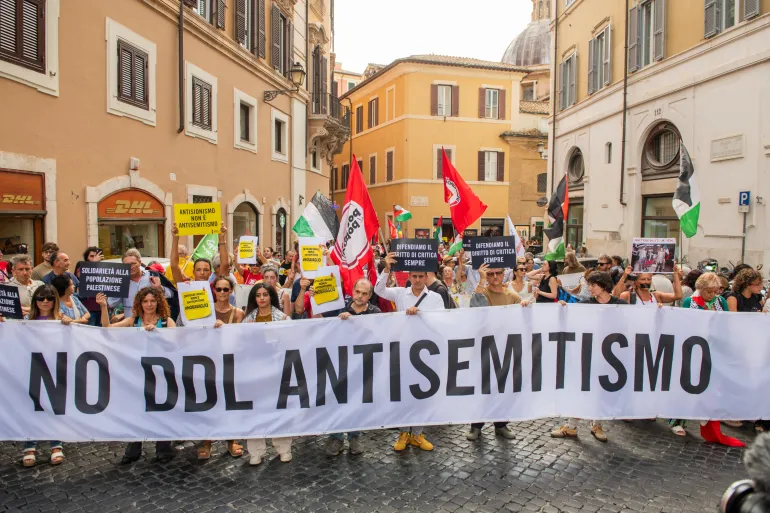
Italian public opinion also has a strong pro-Palestinian component. Last October, more than two million Italians took to the streets as part of a general strike in solidarity with the Global Sumud Flotilla, which was intercepted by Israel while trying to bring aid to Palestinians in Gaza. The flotilla had been carrying 40 Italians among its passengers, calling on Israel to “stop the genocide”.

“There’s a concern that this will be a long agony, between an increasingly unmanageable Trump and the economic problems he and Netanyahu have caused with the war in the Middle East,” Varvelli said.

After years of efforts to emerge as US President Donald Trump’s “whisperer” in Europe, Meloni has been pushed by the war in Iran to put some distance between herself and Trump. Rome refused the US president’s request to join a naval coalition to force the opening of the Strait of Hormuz and to allow US bombers to refuel at a military base in southern Italy.

Trump had not commented on those decisions until yesterday, when, in an interview with Italian newspaper Corriere della Sera, he took aim at Meloni. The Italian PM had leapt to defend Pope Leo XIV after he became embroiled in a feud with Trump. Pope Leo had condemned the US president’s threat that Iran’s “civilisation will die” if it didn’t re-open the Strait of Hormuz. In response to that, Trump unleashed a storm of criticism at Leo, calling him “weak on crime” and “terrible for foreign policy”. He said he does not “want a Pope who criticises the President of the United States”.

Trump also posted a bizarre image of himself as a Christ-like figure healing the sick on social media. He has since claimed it was meant to depict him as a doctor, following widespread criticism.

Of Meloni, who he once affectionately called “a real live wire”, Trump said, “I’m shocked at her” during an interview with Corriere della Sera on Tuesday.

“Do people like her? I can’t believe it,” he said in the interview, adding, “I thought she had courage. I was wrong.”

Source link